• Skip to main content
  • Architecture
    • Overview
      Learn about VergeOS’ unique unfied architecture that integrates virtualization, storage, networking, AI, backup and DR into a single data center operating system
    • Infrastructure Wide Deduplication
      VergeOS transforms deduplication from a storage-only commodity into a native, infrastructure-wide capability that spans storage, virtualization, and networking, eliminating hidden resource taxes
    • VergeFS
      VergeFS is a distributed, high-performance global file system integrated into VergeOS, unifying storage across nodes, tiers, and workloads while eliminating the need for external SANs
    • VergeFabric
      VergeFabric is VergeOS’s integrated virtual networking layer, delivering high-speed, low-latency communication across nodes while eliminating the complexity of traditional network configurations.
    • Infrastructure Automation
      VergeOS integrates Packer, Terraform, and Ansible to deliver an end-to-end automation pipeline that eliminates infrastructure drift and enables predictable, scalable deployments.
    • VergeIQ
      Unlock secure, on-premises generative AI—natively integrated into VergeOS. With VergeIQ, your enterprise gains private AI capabilities without the complexity, cloud dependency, or token-based pricing.
  • Features
    • Virtual Data Centers
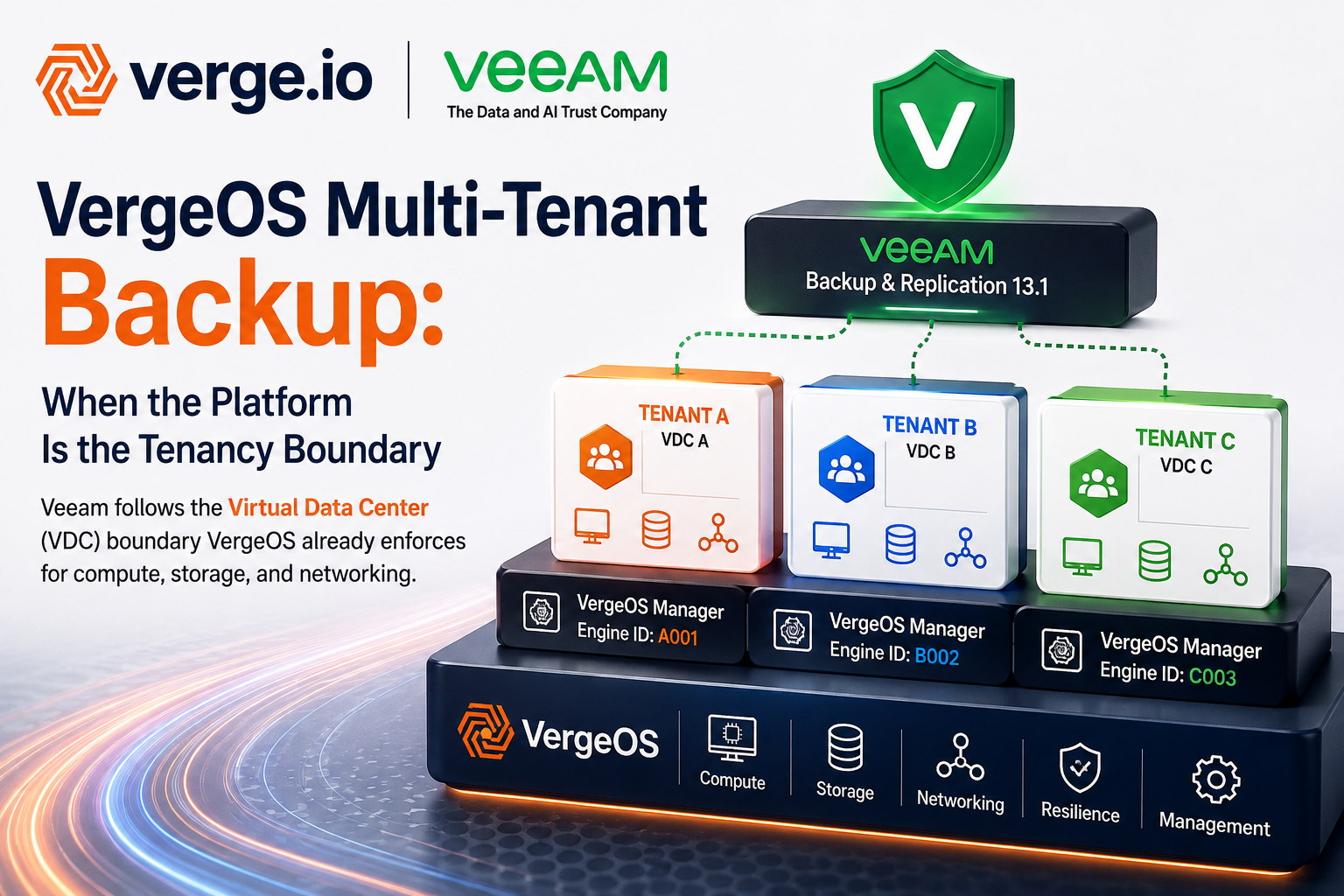
      A VergeOS Virtual Data Center (VDC) is a fully isolated, self-contained environment within a single VergeOS instance that includes its own compute, storage, networking, and management controls
    • High Availability
      VergeOS provides a unified, easy-to-manage infrastructure that ensures continuous high availability through automated failover, storage efficiency, clone-like snapshots, and simplified disaster recovery
    • ioClone
      ioClone utilizes global inline deduplication and a blockchain-inspired file system within VergeFS to create instant, independent, space-efficient, and immutable snapshots of individual VMs, volumes, or entire virtual data centers.
    • ioReplicate
      ioReplicate is a unified disaster-recovery solution that enables simple, cost-efficient DR testing and failover via three‑click recovery of entire Virtual Data Centers—including VMs, networking, and storage.
    • ioFortify
      ioFortify creates immutable, restorable VDC checkpoints and provides proactive ransomware detection with instant alerts for rapid recovery and response.
    • ioMigrate
      ioMigrate enables large-scale VMware migrations, automating the rehosting of hundreds of VMs (including networking settings) in seconds with minimal downtime by seamlessly transitioning entire VMware environments onto existing hardware stacks.
    • ioProtect
      ioProtect offers near-real-time replication of VMware VMs—including data, network, and compute configurations—to a remote disaster‑recovery site on existing hardware, slashing DR costs by over 60% while supporting seamless failover and testing in an efficient, turnkey VergeOS Infrastructure.
    • ioOptimize
      ioOptimize leverages AI and machine learning to seamlessly integrate new and old hardware and automatically migrate workloads from aging or failing servers.
    • ioGuardian
      ioGuardian is VergeIO’s built-in data protection and recovery capability, providing near-continuous backup and rapid VM recovery during multiple simultaneous drive or server failures.
  • IT Initiatives
    • VMware Alternative
      VergeOS offers seamless migration from VMware, enhancing performance and scalability by consolidating virtualization, storage, and networking into a single, efficient platform.
    • Hyperconverged Alternative
      VergeIO’s page introduces ultraconverged infrastructure (UCI) via VergeOS, which overcomes HCI limitations by supporting external storage, scaling compute and storage independently, using existing hardware, simplifying provisioning, boosting resiliency, and cutting licensing costs.
    • SAN Replacement / Storage Refresh
      VergeIO’s storage by replacing aging SAN/NAS systems within its ultraconverged infrastructure, enhancing security, scalability, and affordability.
    • Infrastructure Modernization
      Legacy infrastructure is fragmented, complex, and costly, built from disconnected components. VergeOS unifies virtualization, storage, networking, data protection, and AI into one platform, simplifying operations and reducing expenses.
    • Virtual Desktop Infrastructure (VDI)
      VergeOS for VDI delivers a faster, more affordable, and easier-to-manage alternative to traditional VDI setups—offering organizations the ability to scale securely with reduced overhead
    • Secure Research Computing
      VergeIO's Secure Research Computing solution combines speed, isolation, compliance, scalability, and resilience in a cohesive platform. It’s ideal for institutions needing segmented, compliant compute environments that are easy to deploy, manage, and recover.
    • Venues, Remote Offices, and Edge
      VergeOS delivers resiliency and centralized management across Edge, ROBO, and Venue environments. With one platform, IT can keep remote sites independent while managing them all from a single pane of glass.
  • Blog
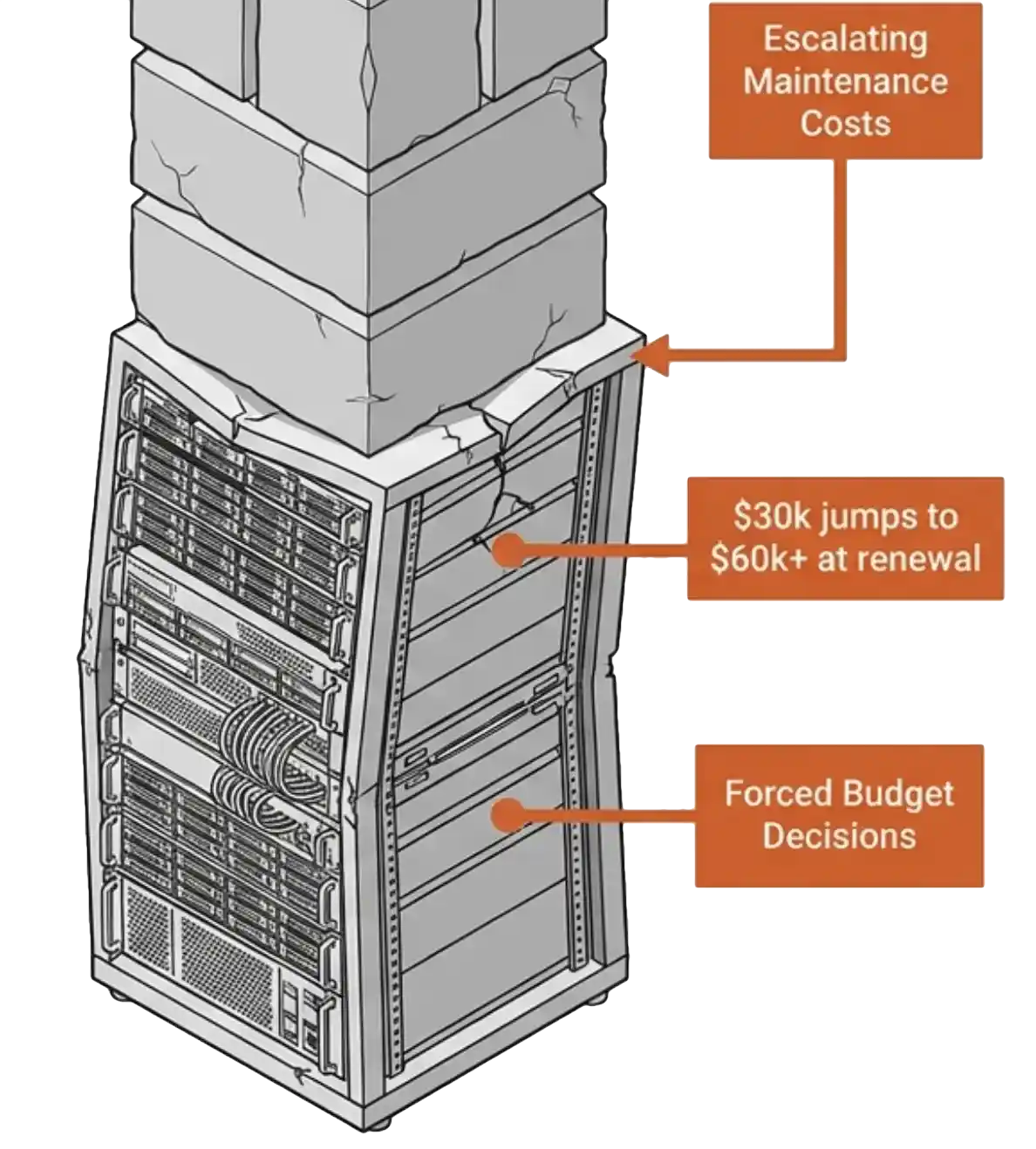
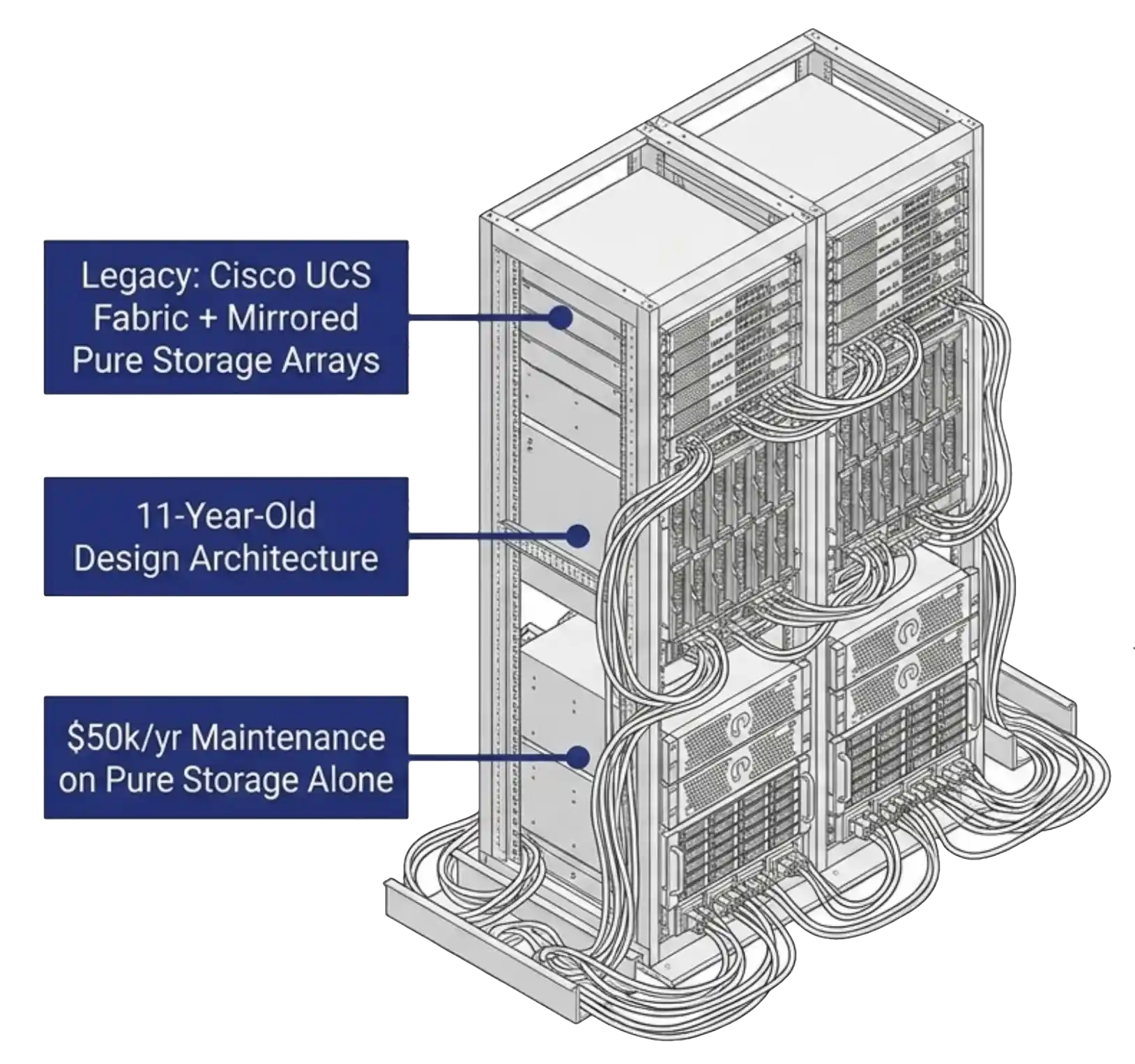
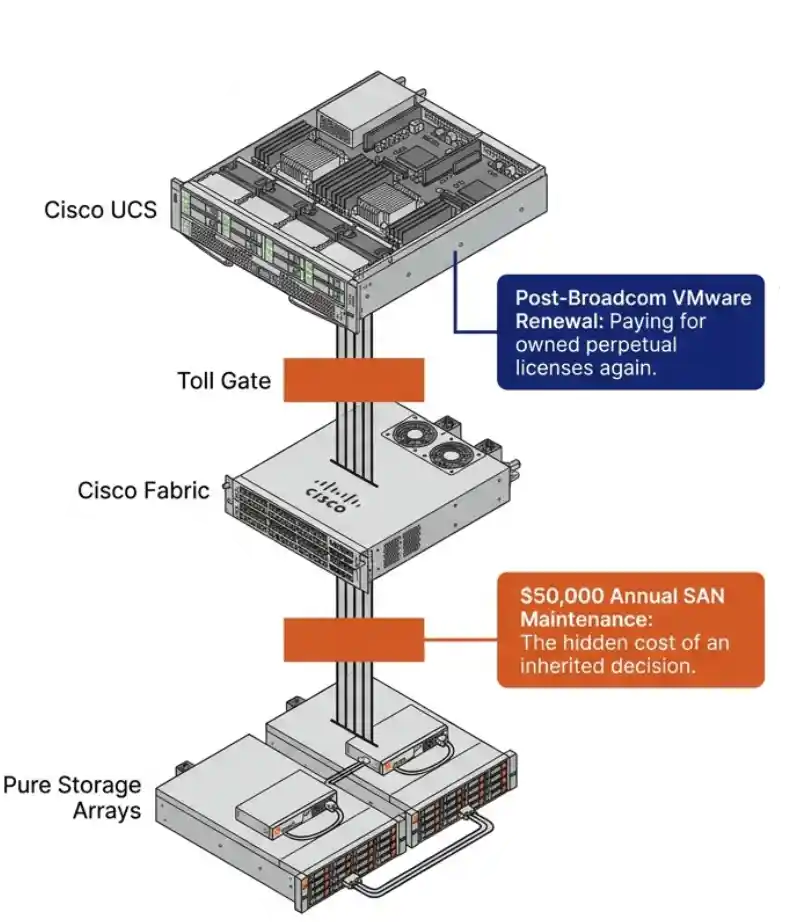
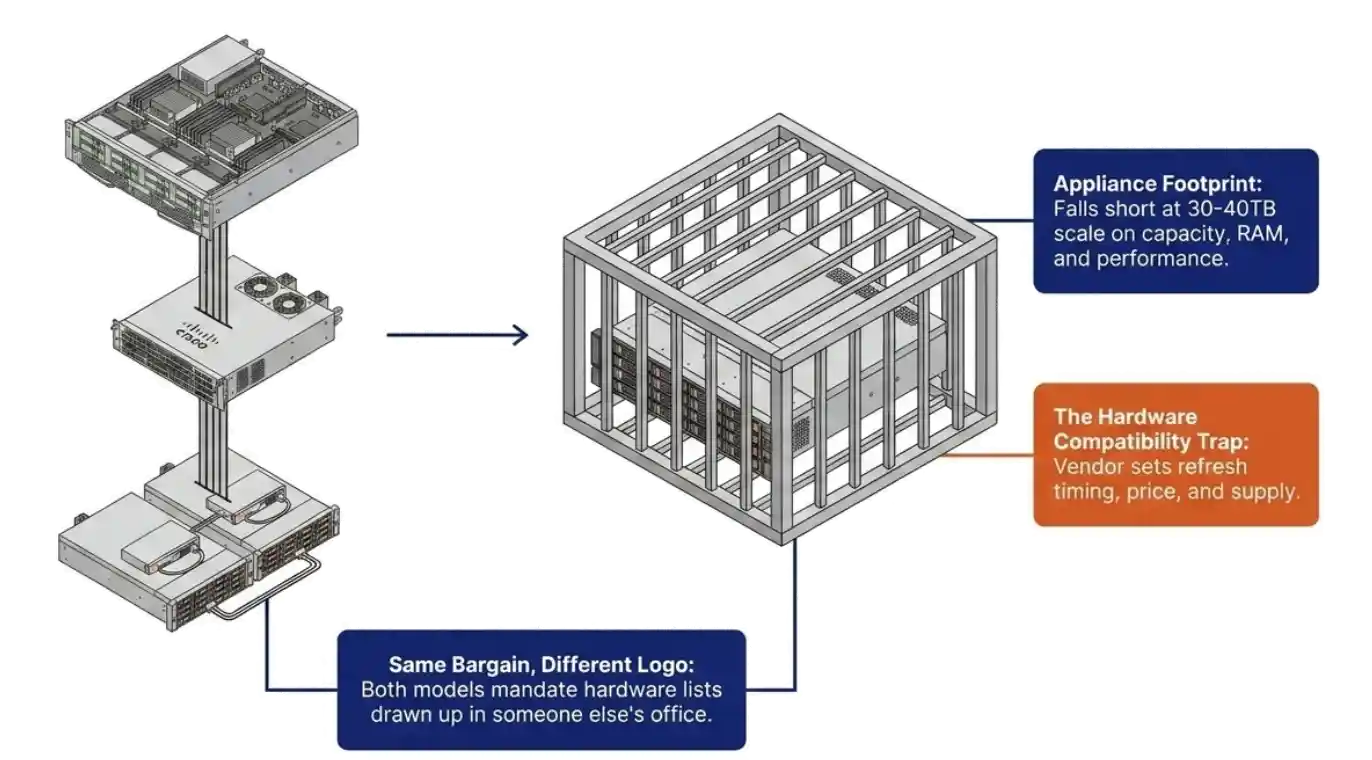
      • A Pure Storage AlternativeA Pure Storage alternative rarely starts as a storage project. Saratoga Casino Holdings inherited mirrored Pure Storage arrays, Cisco UCS blades, and VMware from a partnership that wound down. Scott Bartgis took the decision back, chose his own nodes through CXTEC equal2new, and removed roughly $50,000 a year in array maintenance.
      • Legacy HCI Took Control of Your Data CenterLegacy HCI promised to simplify the data center, then set three clocks IT no longer controls: the renewal date, the hardware refresh, and the servers you are allowed to buy. This post breaks down how each clock got set, and how a single-codebase Private Cloud Operating System hands all three back.
      • Why Are VMware Executives Joining VergeIO?Zia Yusuf, VMware's former ecosystem chief, invested in VergeIO and joined its board, the second VMware leader in weeks after CTO Kit Colbert. One built the partner engine, the other set the technology. Both reached the same verdict: leaving VMware means moving to a private cloud operating system.
    • View All Posts
  • Resources
    • Become a Partner
      Get repeatable sales and a platform built to simplify your customers’ infrastructure.
    • Technology Partners
      Learn about our technology and service partners who deliver VergeOS-powered solutions for cloud, VDI, and modern IT workloads.
    • White Papers
      Explore VergeIO’s white papers for practical insights on modernizing infrastructure. Each paper is written for IT pros who value clarity, performance, and ROI.
    • In The News
      See how VergeIO is making headlines as the leading VMware alternative. Industry analysts, press, and partners highlight our impact on modern infrastructure.
    • Press Releases
      Get the latest VergeOS press releases for news on product updates, customer wins, and strategic partnerships.
    • Case Studies
      See how organizations like yours replaced VMware, cut costs, and simplified IT with VergeOS. Real results, real environments—no fluff.
    • Webinars
      Explore VergeIO’s on-demand webinars to get straight-to-the-point demos and real-world infrastructure insights.
    • Documents
      Get quick, no-nonsense overviews of VergeOS capabilities with our datasheets—covering features, benefits, and technical specs in one place.
    • Videos
      Watch VergeIO videos for fast, focused walkthroughs of VergeOS features, customer success, and VMware migration strategies.
    • Technical Documentation
      Access in-depth VergeOS technical guides, configuration details, and step-by-step instructions for IT pros.
  • How to Buy
    • Schedule a Demo
      Seeing is believing, set up a call with one of our technical architects and see VergeOS in action.
    • Versions
      Discover VergeOS’s streamlined pricing and flexible deployment options—whether you bring your own hardware, choose a certified appliance, or run it on bare metal in the cloud.
    • Test Drive – No Hardware Required
      Explore VergeOS with VergeIO’s hands-on labs and gain real-world experience in VMware migration and data center resiliency—no hardware required
  • Company
    • About VergeIO
      Learn who we are, what drives us, and why IT leaders trust VergeIO to modernize and simplify infrastructure.
    • Support
      Get fast, expert help from VergeIO’s support team—focused on keeping your infrastructure running smoothly.
    • Careers
      Join VergeIO and help reshape the future of IT infrastructure. Explore open roles and growth opportunities.
  • 855-855-8300
  • Contact
  • Search
  • 855-855-8300
  • Contact
  • Search
  • Architecture
    • Overview
    • VergeFS
    • VergeFabric
    • Infrastructure Automation
    • VergeIQ
  • Features
    • Virtual Data Centers
    • High Availability
    • ioClone
    • ioReplicate
    • ioFortify
    • ioMigrate
    • ioProtect
    • ioOptimize
    • ioGuardian
  • IT Initiatives
    • VMware Alternative
    • Hyperconverged Alternative
    • SAN Replacement / Storage Refresh
    • Infrastructure Modernization
    • Virtual Desktop Infrastructure (VDI)
    • Secure Research Computing
    • Venues, Remote Offices, and Edge
  • Blog
  • Resources
    • Become a Partner
    • Technology Partners
    • White Papers
    • In The News
    • Press Releases
    • Case Studies
    • Webinars
    • Documents
    • Videos
    • Technical Documentation
  • How to Buy
    • Schedule a Demo
    • Versions
    • Test Drive – No Hardware Required
  • Company
    • About VergeIO
    • Support
    • Careers
×
  • Architecture
    • Overview
    • VergeFS
    • VergeFabric
    • Infrastructure Automation
    • VergeIQ
  • Features
    • Virtual Data Centers
    • High Availability
    • ioClone
    • ioReplicate
    • ioFortify
    • ioMigrate
    • ioProtect
    • ioOptimize
    • ioGuardian
  • IT Initiatives
    • VMware Alternative
    • Hyperconverged Alternative
    • SAN Replacement / Storage Refresh
    • Infrastructure Modernization
    • Virtual Desktop Infrastructure (VDI)
    • Secure Research Computing
    • Venues, Remote Offices, and Edge
  • Blog
  • Resources
    • Become a Partner
    • Technology Partners
    • White Papers
    • In The News
    • Press Releases
    • Case Studies
    • Webinars
    • Documents
    • Videos
    • Technical Documentation
  • How to Buy
    • Schedule a Demo
    • Versions
    • Test Drive – No Hardware Required
  • Company
    • About VergeIO
    • Support
    • Careers

George Crump

June 24, 2026 by George Crump

Preparing your infrastructure for ransomware is an architecture decision you make before the attack, not a scramble you survive during it.

Using infrastructure to prepare for ransomware is a different posture than the one most data centers run today. The common model assumes the team will perform perfectly under pressure, at 3 a.m., with executives on the phone and a ransom clock running. The future asks for something steadier. It asks for ransomware-ready infrastructure, built in advance to both defend against an attack and recover from one, rather than the familiar scramble that starts only after the damage is done.

10–15 minFrom encryption to alert, inside the storage layer
~6 daysTypical attacker dwell time you cut short
MinutesBack to a clean data center, not days
100%DR test success rate with the VDC model
Key Takeaways
  • Preparation beats reaction. Infrastructure built to contain and recover from ransomware turns the attack into a drill you have already run.
  • VDC isolation, immutable snapshots, ioGuardian, and off site replication stack protection on the platform instead of outside it.
  • ioFortify detects the attack inside the storage layer in 10 to 15 minutes, well within the roughly six day attacker dwell window.

Today, most data centers depend almost entirely on their backup infrastructure to recover from ransomware. That dependence is the weak point. Three years ago I made the case that ransomware is an infrastructure problem, not a data problem, and recovery is where that point becomes hardest to ignore. Ransomware-ready infrastructure works the other way. It is proactive. It uses virtual data centers, or VDCs, to isolate the blast radius of an attack. It provides protection on the platform instead of outsourcing recovery to a separate backup application. It stacks multiple layers of data availability and recoverability under the workloads it runs.

Key Terms
Virtual Data Center (VDC)
A self contained environment with its own compute, networking, storage, and access controls. Isolation holds an attack to the VDC it enters.
ioClone
Read only snapshots at the instance, VDC, or VM level, taken as often as every 10 to 15 minutes. Set the snapshots that anchor recovery to immutable and give them a retention window.
ioFortify
Storage layer detection that flags the deduplication anomaly created by encryption, alerting within 10 to 15 minutes.
ioGuardian
Near continuous protection that keeps VMs running through multiple simultaneous drive or server failures.
ioReplicate
Three click, WAN aware, deduplicated replication of an entire VDC to a remote VergeOS instance.
Defense in Depth, Built In
Five layers of a ransomware-ready infrastructure, each one already in place before an attack.
1
Isolation. Each VDC contains the blast radius by default.
2
Rehearsal. Clone the full data center and drill recovery with no risk to production.
3
Immutable snapshots. Read only by default, immutable with retention for the copies that anchor recovery.
4
ioGuardian. Keeps VMs running through failures, and stands behind the snapshot layer itself.
5
Off-site DR. ioReplicate recovers an entire VDC to a remote VergeOS instance.

The Real Cost of Reacting to Ransomware Instead of Preparing Your Infrastructure

The reactive backup-first recovery model that using infrastructure to prepare for ransomware replaces

The trouble with the backup-first model is location. Most backup systems do not live inside the production infrastructure. They live outside it. The most recent backup is already hours, sometimes days, old, and by definition it has to travel back from the backup system to production before anything runs again. The cost is time.

A data loss window opens between the last good backup and the moment recovery completes. Part of that window is nothing more than the time it takes to move backup data across to the production side. Ransomware rarely takes just a few files. It takes thousands of files across multiple servers, which stretches every one of those minutes into hours. Preparation closes the gap by keeping protection and recovery on the same platform as the workloads.

Prepare Your Infrastructure to Contain Ransomware

Preparation begins with containment. In most environments the blast radius of an attack depends on firewall rules and segmentation that someone maintains by hand. That work is rarely complete, and it is almost never tested at the moment it matters.

Using infrastructure to prepare for ransomware by isolating an attack inside a single virtual data center

VergeOS takes a different path. Each virtual data center is a self contained environment with its own compute, networking, storage, and access controls. Ransomware that enters one VDC stays in that VDC. The containment is the default behavior of the platform, in force today, before any alert fires. You do not assemble it during the incident. It is already there.

Two patterns show how this works in practice. A cloud service provider can build a virtual data center for each customer. One tenant hit with ransomware stays sealed inside that tenant, with no path into the others sharing the platform. The same model works inside the enterprise. A team can separate mission critical data, business critical data, and user applications into their own virtual data centers. An infection in the user application VDC finds no route into the systems that run the business.

Rehearse Ransomware Recovery Before You Need It

A plan you have never run is a guess. The teams that recover fastest are the ones that have practiced, and most infrastructure makes practice expensive or risky. Standing up a copy of production usually means new hardware, long copy windows, and a real chance of disrupting the systems you depend on.

Rehearsing recovery on a cloned data center, part of using infrastructure to prepare for ransomware

VergeOS removes that friction. A single clone command stands up an isolated, space efficient copy of an entire VDC. The copy runs independent from production, so teams test patches, validate recovery steps, and walk the full response without touching live workloads. Honeypots and decoy targets add another rehearsal tool. They confirm that defenses fire and that recovery works before a real attacker tests them for you. Run the drill on a schedule. The first time you execute the recovery workflow should not be the day you are under attack.

The scope of that copy is what makes the drill honest. You are not testing recovery against a single VM pulled out of context. You are testing it against a faithful, isolated clone of the entire data center, with every workload, network, and dependency in place. That fidelity gives the team a true feel for how an attack moves and how recovery plays out, before either one happens for real.

Set the Right Snapshots to Immutable

Recovery depends on a clean copy the attacker cannot reach. VergeOS captures that copy with ioClone, which pairs a blockchain inspired file system inside VergeFS with global inline deduplication. The result is an instant, independent, space efficient snapshot, taken at the level the situation calls for. VergeOS snapshots the entire instance, a single virtual data center, or an individual VM. A coarser snapshot drills into its contents, so an instance level snapshot can extract one VDC or one VM when recovery needs a single piece.

Read-only and immutable snapshots, a core layer of using infrastructure to prepare for ransomware

Every snapshot is read only by default, so nothing in the running environment alters it. From there you set the snapshots that matter for recovery to immutable. Ransomware cannot encrypt or delete an immutable snapshot. VergeOS takes snapshots as often as every 10 to 15 minutes, retains them as long as you need, and places effectively no limit on their count. That cadence compresses the recovery point from hours down to minutes.

The discipline that matters is retention. Set retention times on your immutable snapshots so a portion of them survives an attacker who gains system access and starts deleting snapshots. An immutable snapshot under retention holds until its window expires, even against someone with administrative control. That guarantee is the difference between a snapshot you hope is there and one you know is there.

Add Layers Below the Snapshot

Snapshots defend against encryption. Hardware fails for its own reasons, often at the worst time, and a ransomware event can strike during a drive or node failure. ioGuardian covers that ground. It provides near continuous data protection that keeps VMs running through multiple simultaneous drive or server failures, with a recovery point measured in minutes rather than hours.

ioGuardian also stands behind the snapshots themselves. If an attacker compromises snapshot retention, it gives you a separate recovery path that does not depend on those snapshots. It is the layer that keeps the environment available when more than one thing breaks at once.

Extend Protection Off Site

A site wide event calls for a copy somewhere else. ioReplicate delivers three click recovery of an entire VDC, including its VMs, networking, and storage, to a remote VergeOS instance. Replication runs asynchronously, adapts to WAN conditions, and moves only deduplicated data, so it stays practical across real network links. The proof is in the testing. Customers report a 100 percent DR test success rate with the VDC model, and the tests run in under an hour. Off site protection you can actually test is the layer that survives the loss of a whole location.

Reactive Versus Prepared

The difference between the two postures is not effort during the attack. It is the work the infrastructure did to prepare for ransomware before it. The table below sets the common reactive defaults against what VergeOS has standing by the time an attacker shows up.

DimensionReactive defaultPrepared with VergeOS
Blast radiusHand maintained firewall rules, rarely testedVDC isolation, on by default
Recovery practiceRare, needs spare hardwareClone a full VDC, rehearse with no risk
Recovery pointHours between protection eventsRead only snapshots every 10 to 15 minutes
DetectionEndpoint or log tooling, hours to flagStorage layer signature in 10 to 15 minutes
Recovery methodRestore from backup, rebuild per VMPromote a clean snapshot, no data movement

What to Do When Ransomware Hits

Detecting Ransomware in the Storage Layer

Preparation changes the character of the response. The work runs calm and rehearsed instead of frantic and improvised. ioFortify starts the clock in your favor. The same deduplication engine that makes snapshots efficient also serves as a sensor. Encryption produces unique blocks, which defeats deduplication, and ioFortify catches that signature inside the storage layer within 10 to 15 minutes. That window sits well inside the roughly six day average dwell time attackers count on.

The detection insight

Encryption produces unique blocks, which breaks deduplication. That broken signature is the alarm, and it surfaces in the storage layer in minutes rather than days.

The Response Path

From the alert, the response follows a short, practiced path.

  1. Mount a clean snapshot that is 10 to 15 minutes old in a quarantined state.
  2. Scan the snapshot, then remove the payload if it is present.
  3. Promote the clean snapshot to primary, which mounts with no data movement, and tear down the infected copy, keeping a forensic image.

There is no restore from backup, no wait for capacity, and no per VM rebuild loop. A clean data center comes back in minutes, and the forensic copy preserves how the attack unfolded.

Using Infrastructure to Prepare for Ransomware Is a Decision You Make Now

The platform decides how an attack ends long before it starts. Isolation contains it. Drills make the response familiar. Immutable snapshots, ioGuardian, and replication hand you clean copies at every level. ioFortify shortens the gap between compromise and detection from days to minutes. Using infrastructure to prepare for ransomware is not a product you buy in a panic. You build it in, and then you rehearse it.

Two actions move you forward today. Set immutability and a retention window on the snapshots that anchor recovery. Then schedule a recovery drill this quarter and run the full workflow end to end. The goal is a day when the ransom note arrives and your data center is already back.

Schedule a Ransomware Readiness Assessment

Walk through your current recovery posture with a VergeOS expert and find where preparation closes the gap.

Frequently Asked Questions
Should I make every snapshot immutable?
No. Every snapshot is read only by default, which covers routine recovery. Set immutability on the snapshots that anchor your ransomware recovery, and give them a retention window. A retained immutable snapshot holds until that window expires, even against an attacker who gains administrative access and tries to delete it.
Does VDC isolation replace my firewalls?
No. VDC isolation contains the blast radius by architecture, so an attack inside one virtual data center has no path into the others. Firewalls still govern traffic, and the containment holds without manual rules written in the middle of an incident.
How does ioFortify detect ransomware?
Encryption produces unique blocks that defeat deduplication. ioFortify watches for that drop in efficiency inside the storage layer and alerts within 10 to 15 minutes, well inside the roughly six day window attackers count on.
How is ioFortify different from my EDR or SIEM?
ioFortify watches the storage layer rather than endpoints or logs. It detects the deduplication drop that encryption causes, and it fires faster than most SIEM queries. It complements existing security tooling rather than replacing it.
Can I recover a single VM instead of the entire data center?
Yes. Snapshots exist at the instance, VDC, and VM level, and a coarser snapshot drills into its contents. You can extract one VDC or one VM when recovery needs a single piece rather than the whole environment.
What recovery point can I expect?
VergeOS takes snapshots as often as every 10 to 15 minutes, so the recovery point sits in that range. That cadence replaces the hours, sometimes days, that separate protection events in a backup-first model.
What makes a recovery drill different on VergeOS?
A clone stands up a full, isolated copy of a VDC with no data movement and no new hardware. Teams rehearse the real workflow against a faithful copy of production without risk to live systems.

Filed Under: Ransomware

June 17, 2026 by George Crump

An AI-powered VMware alternative now runs in production, and the mechanics matter more than the headline. VergeIO built Verge CLI as three working parts that let an AI assistant operate a VergeOS environment in plain language, with the administrator setting the limits. This post walks through how the pieces fit, what happens when you issue a request, and why a single code base changes the result.

Key Takeaways
  • Verge CLI ships as three components that work together: a command-line interface, an MCP server, and a set of agent skills.
  • One code base and one API let the assistant act across compute, storage, networking, and data protection in a single coherent operation.
  • You choose the model. Cloud assistants such as Claude Code and OpenAI Codex, or local open-weight models such as Llama, Qwen, and DeepSeek, all connect through the same open standard.

Inside the AI-Powered VMware Alternative: The Brains, the Hands, and the Know-How

Verge CLI is three parts, not one tool. Each part has a job, and together they turn a plain-language request into a real change on the platform. Think of them as the hands, the brains, and the know-how.

The Brains, the Hands, and the Know-How: the three components of the AI-powered VMware alternative Verge CLI

The Hands: The Command Line of the AI-Powered VMware Alternative

The Verge CLI maps to the full VergeOS API. One command set covers compute, storage, networking, and data protection. These commands are the actions the assistant takes on the platform. VergeOS has always been API-first, so the command line was a natural extension of its design. It runs commands the platform already understands rather than clicking through a graphical console.

The Brains: The MCP Server

The MCP server builds on the open Model Context Protocol. It connects an AI platform to the environment and gives the assistant a secure, scoped view of the environment and its documentation. The assistant reasons against VergeOS documentation through this server, so its conclusions track how the platform behaves rather than what a model guesses. The server also marks the boundary of what the assistant can see and touch, which keeps the AI inside the limits that an administrator sets.

The Know-How: Agent Skills in an AI-Driven VMware Alternative

The agent skills encode how VergeOS experts design networks, build environments, and run diagnostics. The assistant works like a seasoned operator instead of a generic chatbot. A request to build a secured three-tier environment carries the firewall rules between tiers that an experienced engineer would apply. The know-how is the difference between a tool that answers documentation questions and an operator that builds it correctly the first time.

One Code Base, One API: How the AI-Driven VMware Alternative Works

One code base and one API across compute, storage, networking, and data protection in the AI-powered VMware alternative

Here is what the architecture buys you. A request to build a virtual machine, place it on a network, carve storage, and set replication runs as one coherent action against one API. The assistant issues the work, the platform executes it, and the state stays consistent.

A layered stack works differently. The same request crosses vSphere, vSAN, NSX, and a separate backup product. Each part can half succeed, and the agent then reconciles partial state across four control planes. The single code base removes that class of error. One request, one API, one result.

MCP-based infrastructure management now spans several vendors. Nutanix, Red Hat, and Microsoft offer solutions, and community servers are available for VMware and Proxmox. VergeOS gives an AI assistant control of compute, storage, networking, and data protection through a single code base and a single API. Some vendors simulate this with a unified control plane in a management GUI. Those platforms still draw on layered and acquired components, with networking and data protection as separate licensed layers. VergeOS runs as one code base from the start, so the assistant meets one API rather than a federation of them. The architecture beneath a VMware alternative decides the result, a point made in the analysis that architecture is what separates one VMware alternative from another.

Root-Cause Diagnosis in an AI-Driven VMware Alternative

One data model spans all four domains, so the assistant traces a symptom from virtual machine to storage to network and finds the real source. A system-wide diagnostic reads real log lines, follows the dependency from the surface fault to the underlying cause, and reports where the real problem lives. The reasoning comes from VergeOS documentation through the MCP server, so the diagnosis matches how the platform runs.

“The agent reasons against VergeOS documentation through the MCP server, so its diagnoses come from how the platform actually works, not a model’s guess. Because one API spans compute, storage, and networking, it traces a fault across the whole stack that tooling stitched across separate products would miss.” Larry Ludlow, Chief Architect of Verge CLI, VergeIO

Choosing the Model for Your AI-Powered VMware Alternative: Cloud or Local

Running local models or private AI?

If you plan to run local open-weight models, or build a full private AI deployment, the GPU choices decide the cost and the result. Schedule a meeting to take part in our GPU analysis and size the hardware before you commit.

Get Your GPU Analysis

The integration stays the same. Only the location of the model and the data changes. Most organizations run a cloud frontier assistant such as Anthropic Claude Code or OpenAI Codex, and that path fits the majority of accounts. Teams under strict security or compliance rules run a local open-weight model, such as Llama, Qwen, or DeepSeek, through a runtime like Ollama and keep all operations and environment data on their own infrastructure. A customer can start with a cloud assistant and later move to a local model on the same platform. The open standard makes any MCP-compatible client a valid front end, so you are not locked to a single vendor’s assistant.

The Administrator Stays in Control of the AI-Driven VMware Alternative

The assistant proposes the work and runs it step by step once an administrator approves each change. The administrator decides what the assistant sees, what it runs on its own, and what waits for sign-off. The buyer and the operator remain the same person who runs the platform today. The assistant shortens the learning curve on a new platform and guides the team through advanced features they would otherwise postpone. An AI-powered VMware alternative changes the daily work and leaves ownership where it belongs. It does not replace the people who own the environment.

“Customers leaving VMware want lower cost and infrastructure ready for AI. Verge CLI gives them both. Claude Code, Codex, or a local model they run themselves can all operate the platform directly, and the administrator stays in control of what it’s allowed to do.” Jason Yaeger, SVP of Product and Engineering, VergeIO

What an AI-Powered VMware Alternative Means for You

For IT Administrators

An AI-powered VMware alternative pays off most for the person who runs the environment. Verge CLI removes the busywork and shortens the learning curve, and it keeps you in control the whole time.

Skip the Learning Curve

The assistant guides you through VergeOS in plain language, so you are productive on day one rather than month three.

Operate the Whole Stack

Create VMs, build networks, carve storage, and set data protection in one conversation, without mastering four separate tools.

Stay in Control

You decide what the assistant runs on its own and what waits for your approval. It runs only inside the limits you set.

Find Root Cause Faster

The assistant reasons against VergeOS documentation and traces a fault across compute, storage, and networking, so you fix the real problem rather than the symptom.

Reclaim Your Time

Hand off routine work like VM creation, workload moves, and network changes, and spend your hours on the projects that matter.

Grow Your Value

You become the operator of an AI-assisted platform, with deeper reach and more impact.

Getting Started with the AI-Powered VMware Alternative

Four steps put the capability to work. Install Verge CLI on the VergeOS environment. Connect an MCP client, whether a cloud assistant or a local model. Verify the connection and set the limits on what the assistant may run on its own. Then operate in plain language, from building networks to deploying workloads to diagnosing faults. The same flow holds for a VMware refugee mid-migration and for an existing customer adopting deeper features. Either way, an AI-powered VMware alternative reaches production sooner.

Key Terms

Model Context Protocol (MCP). An open standard that connects an AI assistant to a system and its documentation. Verge CLI uses MCP so any compatible client works.
Agent skills. Encoded expert procedures for designing networks, building environments, and running diagnostics, which let the assistant act like a trained operator.
Open-weight model. A model a customer can run on its own hardware, such as Llama, Qwen, or DeepSeek, which keeps all operations and data in house.

The AI-Powered VMware Alternative vs. a Layered Stack

CapabilityVergeOS with Verge CLILayered stack (vSphere, vSAN, NSX, backup)
Control surfaceOne API across the full stackA separate API per product
Cross-domain requestOne coherent actionCrosses four control planes, can half succeed
Root-cause diagnosisOne data model traces the fault end to endStitched across separate tools
AI integrationSupported part of the productUnsupported community add-ons for VMware and Proxmox
Model choiceCloud or local through MCPTied to the vendor’s assistant
Live Webinar · June 23, 2026
See It Run Live: Chat With Your Infrastructure

Reading about a plain-language operation is one thing. Watching it build a network and trace a fault is another. VergeIO and Truth in IT run an AI agent against a live VergeOS environment on June 23, 2026, at 1:00 PM ET. The 45-minute session is a live demo and Q&A with the team that built Verge CLI.

Register for the June 23 Webinar Schedule a Technical Deep Dive

Frequently Asked Questions

What is Verge CLI?
Verge CLI is a three-part release for VergeOS: a command-line interface that maps to the full API, an MCP server, and a set of agent skills. Together they let an AI assistant operate the platform in plain language, with the administrator deciding what runs on its own and what needs approval.
Which AI assistants work with it?
Any MCP-compatible client. That includes Anthropic Claude Code, OpenAI Codex, and local open-weight models such as Llama, Qwen, and DeepSeek run through Ollama.
Does the AI run my infrastructure on its own?
Only within the limits you set. The assistant proposes the work and runs it step by step once an administrator approves each change.
How is this different from AI on VMware or Proxmox?
Community projects deliver AI access to VMware and Proxmox as unsupported add-ons. Verge CLI ships and is supported as part of VergeOS, and it controls compute, storage, networking, and data protection through one code base and one API.

Filed Under: AI

June 16, 2026 by George Crump

For Immediate Release

VergeIO Launches Verge CLI, Enabling an AI-Powered VMware Alternative

Verge CLI gives an AI platform commands to act, an MCP server connects it over the open Model Context Protocol, and agent skills supply the know-how. Claude Code, OpenAI’s Codex, or a local model can operate a customer’s VergeOS environment in plain language, with the administrator in control of what it can do.

Ann Arbor, Mich.June 16, 2026VergeIO · VergeOS
For More Details

Verge CLI Datasheet

Get the full technical breakdown of Verge CLI, the MCP server, and the agent skills.

View the Datasheet

ANN ARBOR, Mich., June 16, 2026. VergeIO, the Private Cloud Operating System company, today announced Verge CLI, a complete command-line interface for VergeOS that turns a leading VMware alternative into an AI-powered platform. Alongside the CLI, VergeIO is releasing an MCP server built on the open Model Context Protocol and a set of agent skills. Together they let agentic AI platforms, including Anthropic’s Claude Code and OpenAI’s Codex, work with a customer’s VergeOS environment directly, building networks, deploying workloads, and diagnosing faults in plain language, with the administrator deciding what the assistant runs on its own and what needs their approval.

Key Takeaways
  • Verge CLI is a complete command-line interface that maps to the full VergeOS API, covering compute, storage, networking, and data protection from one command set.
  • An MCP server on the open Model Context Protocol and a set of agent skills let Claude Code, OpenAI’s Codex, or any compatible platform operate a VergeOS environment in plain language.
  • The administrator decides what the assistant runs on its own and what needs approval, so conversational operation runs inside the limits a person sets.
  • Privacy or security sensitive teams run a local open-weight model, keeping every operation and all environment data on their own infrastructure.

API-First by Design

VergeOS has always been API-first, so Verge CLI was a natural extension of the company’s development philosophy. The interface maps to the full VergeOS API, so one command set covers compute, storage, networking, and data protection. That command set is the hands an AI platform uses to act, and a set of agent skills supplies the know-how to drive it. Claude Code or Codex reads the environment, proposes the work, and runs it within the limits the administrator sets. Infrastructure that used to mean per-core VMware licensing now takes direction in plain language.

“Customers leaving VMware want lower cost and infrastructure ready for AI. Verge CLI gives them both. Claude Code, Codex, or a local model they run themselves can all operate the platform directly, and the administrator stays in control of what it’s allowed to do.”

— Jason Yaeger, SVP of Product and Engineering, VergeIO

Open by Standard, Including Local AI

The MCP server is built on the Model Context Protocol, an open standard, so any compatible client works rather than a single vendor’s assistant. Teams with privacy or security requirements run a local open-weight model, such as Llama, Qwen, or DeepSeek through a runtime like Ollama, and keep every operation and all environment data on their own infrastructure.

Key Terms
Verge CLI
A complete command-line interface for VergeOS. It maps to the full platform API, so one command set drives compute, storage, networking, and data protection.
MCP Server
A server that gives an AI platform a secure, scoped window into a VergeOS environment and its documentation, built on the open Model Context Protocol.
Model Context Protocol (MCP)
An open standard supported by today’s major AI platforms. It lets any compatible client connect to the VergeOS environment rather than a single vendor’s assistant.
Agent Skills
A library that encodes how VergeOS engineers design networks, deploy workloads, and run diagnostics, giving an AI platform the know-how to drive the command set.
Local Open-Weight Model
A model such as Llama, Qwen, or DeepSeek run inside the customer’s own environment through a runtime like Ollama, so no environment data leaves their infrastructure.

One API, Diagnoses Grounded in How the Platform Works

Live Webinar

See Verge CLI in action

Watch Claude Code and Codex operate a live VergeOS environment in plain language. Register for the live session.

Save Your Seat

Because one API spans the whole platform, an AI agent traces a fault end to end rather than guessing from a single layer. The agent reasons against VergeOS documentation through the MCP server, so its conclusions come from how the platform actually behaves.

“The agent reasons against VergeOS documentation through the MCP server, so its diagnoses come from how the platform actually works, not a model’s guess. Because one API spans compute, storage, and networking, it traces a fault across the whole stack that tooling stitched across separate products would miss.”

— Larry Ludlow, Chief Architect of Verge CLI, VergeIO

How Verge CLI Compares

 Traditional VMware StackVergeOS with Verge CLI
Management surfaceSeparate consoles for hypervisor, storage, and networkOne command set across compute, storage, networking, and data protection
AI operationChatbots that answer documentation questionsClaude Code, Codex, or a local model that acts on the environment
Control modelScripts and manual change windowsAdministrator sets what the assistant runs on its own and what needs approval
Data privacyCloud-bound AI servicesLocal model option keeps all environment data on-premises
Frequently Asked Questions
What is Verge CLI?
Verge CLI is a complete command-line interface for VergeOS. It maps to the full platform API, so one command set covers compute, storage, networking, and data protection, whether an administrator types the commands or an AI platform proposes them.
How do Claude Code and OpenAI’s Codex work with VergeOS?
An MCP server built on the open Model Context Protocol connects the AI platform to the environment, and a set of agent skills supplies the know-how. Claude Code or Codex reads the environment, proposes the work, and runs it within the limits the administrator sets.
Does the AI act on its own?
The administrator decides what the assistant runs on its own and what needs their approval. Conversational operation runs inside the limits a person sets, not outside them.
Can we use a local AI model for privacy or security?
Yes. Teams with privacy or security requirements run a local open-weight model, such as Llama, Qwen, or DeepSeek through a runtime like Ollama. Every operation and all environment data stay on their own infrastructure.
When is Verge CLI available?
Verge CLI is available on June 23rd to VergeOS customers, along with the MCP server and agent skills.
VergeIO Launches AI-Powered VMware Alternative

About VergeIO

VergeIO is the Private Cloud Operating System company, headquartered in Ann Arbor, Michigan. Its platform, VergeOS, collapses virtualization, storage, networking, and data protection into a single integrated software stack running on commodity hardware. VergeOS is a leading VMware alternative, recognized by DCIG as a Top 5 VMware Alternative across both the SME and SLED categories. Verge CLI is available on June 23rd to VergeOS customers.

Schedule a Technical Deep Dive
###

Filed Under: Press Release

June 15, 2026 by George Crump

Refurbished SSD telemetry determines whether a used enterprise drive is suitable for production. The Refurbished SSD Framework webinar aired on May 7, and six weeks of follow-up calls have surfaced one question more than any other. Buyers accept the 40 to 60 percent discount against new pricing. The objection that survives is narrower and sharper. How does a team know the supplier’s stated wear number is honest? The answer never rests on trust. It rests on measurement.

Audio Overview AI-generated
VergeIO · Exposing The Refurbished SSD Odometer Rollback

Most refurbished data center hardware suppliers are reputable. They serialize inventory, document the chain of custody, and stand behind their wear representations. The risk sits with the exception, not the rule, and the platform’s job is to catch that exception before it matters.

A supplier can reset SMART counters and present a drive as having 20 percent wear when the actual figure is near 90. The buyer who accepts that number on faith inherits the risk. The buyer who measures the drive with platform-level telemetry manages it. That single distinction separates a procurement decision from a gamble.

The control that does the work is not a single reading at intake. It is a continuous measurement against the platform’s thresholds throughout the drive’s entire production life. A label can be reset. A trajectory under real writes cannot. That trajectory is what VergeOS watches.

Key Takeaways
  • Refurbished SSD telemetry does not depend on catching a reset counter at the door. Continuous monitoring plus redundancy keeps a mislabeled drive from costing you data.
  • VergeOS raises a drive warning when wear level or reallocated sectors cross a threshold, then a proactive replacement procedure swaps the drive with the cluster online and redundant.
  • A reset counter hides a drive’s starting point, not its trajectory. Real production writes push a worn drive across the thresholds far sooner than its label predicts.

A Reset Counter Hides the Starting Point, Not the Trajectory

The wear-leveling indicator falls in a straight line as data is written. The slope per terabyte stays about the same across the drive’s life. A counter reset to 20 percent counts down from that false floor at the normal rate, and a single day of synthetic writes barely moves it. The label, on its own, resists a quick catch at intake.

The trajectory tells the truth the label hides. Worn NAND retires cells under real writes. Reallocated sectors grow, and read and write errors climb. Wear crosses its threshold sooner than a true 20 percent drive ever would. VergeOS reads those signals per drive and raises a status the moment a limit is passed.

The documented warning statuses are exact:

  • Wear level exceeded its maximum threshold.
  • Reallocated sectors exceeded their maximum threshold.
  • Read or write error threshold reached.

Each one bubbles up to the System Dashboard as a Warning or an Error. The drive that lied about its starting point announces its real condition the first time production pressure finds it.

Key Terms
SMART
Self-Monitoring, Analysis and Reporting Technology. The industry standard that exposes a drive’s internal health counters to the host. Enterprise SSDs publish roughly twenty attributes.
Drive status
VergeOS assigns each vSAN drive a health status. Warning and Error states flag wear-level, reallocated sectors, and read or write errors that exceed a defined threshold, and they appear on the System Dashboard.
Subscription
A VergeOS alert or report. On-Demand subscriptions email the moment a threshold, warning, or error fires. Scheduled subscriptions email periodic dashboards so a team can track trends over time.
TBW
Terabytes Written. The rated write endurance of an SSD. Refurbished enterprise drives typically retain 80 to 95 percent of their rated TBW, a figure that the wear leveling count directly exposes.

The Seven Refurbished SSD Telemetry Attributes to Watch

Enterprise SSDs publish around twenty SMART attributes. Seven of them account for the bulk of the predictive value, and reading them together matters more than reading any one alone.

  • Total writes track progress toward the rated TBW.
  • Reallocated sectors indicate physical media degradation, as failed cells are added to a remap list.
  • Wear leveling count reports how much fresh NAND the drive has left to redirect writes onto.
  • The ECC error rate indicates that the drive silently corrects more errors per read, a leading indicator that the firmware tries to hide.
  • End-to-end error rate flags controller-level corruption that should sit at zero.
  • Power-on hours and temperature round out the picture: the first as context, the second as an accelerant for every other failure mode.
Refurbished SSD telemetry in VergeOS: SMART measurement of wear level and reallocated sectors

VergeOS turns three of these into operational triggers. Wear level, reallocated sectors, and read or write errors each have a maximum threshold, and crossing one of them moves the drive into a Warning or Error state.

The metric that tells the truth about a used drive is wear leveling, not power-on hours. A drive rotated out of a hyperscaler on a three-year calendar can show high power-on hours and low wear. A drive run hard in a write-heavy role shows the reverse. A team that reads wear leveling against the supplier’s claim reads the drive correctly.

Using Refurbished SSD Telemetry to Lower the Odds

Intake testing is the first filter, not the whole answer.

  1. Install the refurbished drives behind VergeOS.
  2. Run a stress workload. Watch for reallocated sectors and read or write errors that a healthy drive of the stated wear would not produce.
  3. Cross-check the reported wear against host writes and power-on hours. A drive that contradicts itself, or that sheds sectors under load, goes back before it ever holds production data.
On-Demand Webinar
The Refurbished SSD Framework
Walk through the intake protocol and the architecture that backs it, start to finish.
Register to Watch

The limit deserves a plain statement. A clean counter reset can pass a short bench test, and the wear percentage moves too little in a day to expose a falsified baseline on its own. Intake testing reduces the likelihood of introducing a bad drive into production. Catching the rest is the job of continuous monitoring.

The protocol still earns its place. It turns the supplier’s wear number into a claim that the platform inspects rather than accepts, and it returns the obviously bad units on the first batch. The passing drives enter an environment that keeps watching them.

Continuous Monitoring Is Where the Protection Lives

The drive that slips through the intake meets the part that matters. Refurbished SSD telemetry does its real work in production, where VergeOS watches every drive and alerts on the conditions that precede failure. An On-Demand subscription emails the moment a drive crosses its wear-level or reallocated-sector threshold or changes status. A scheduled subscription delivers the drive and tier dashboards at a daily or weekly interval, so a team can track trends between alerts. VergeOS recommends running both against the System Dashboard for timely awareness of drive issues.

VergeOS proactive drive replacement with the node in maintenance mode and the cluster online

A mislabeled drive reveals itself here. Its real wear crosses the threshold weeks ahead of the schedule its fake label implied. The Warning status fires on the dashboard. The team replaces the drive before it fails, using the proactive replacement procedure, with the node in maintenance mode and the rest of the cluster online and redundant. The mislabel costs a drive swap, not a data loss.

This is the answer to the original objection. A team does not need to prove the wear number honest at the door. It needs to detect a drive drifting toward failure and act before the failure occurs. Continuous monitoring paired with proactive replacement does exactly that.

Refurbished SSD Telemetry Needs a Platform Behind It

VergeOS continuous drive monitoring dashboard with threshold-based alerts

Monitoring buys you a warning, and the architecture prevents data loss. The two work as a pair, and refurbished SSD telemetry earns its value only on a platform built to act on what it finds. VergeOS pairs monitoring with synchronous replication at RF2 or RF3, so the loss of one or two drives results in no rebuild storm and no service interruption.

The failures that a team does not predict are still handled without interrupting the application. Same-batch refurbished drives age together, and a cohort can move toward the edge in parallel. When a loss exceeds replication tolerance, ioGuardian streams missing blocks to running VMs as they request them, and live migration moves workloads off the degraded nodes. Recovery becomes the data path during the failure, not a restore job after it.

Provenance stops deciding the final outcome. A worn drive and a fresh drive present the platform with the same event, a drive crossing a threshold or dropping out, and the response does not change with the drive’s history. The case has been made that storage recovery architectures matter more than drive reliability, and that principle is what lets refurbished media stand on equal footing with new.

Label-Based Trust vs VergeOS Monitored Operation

 Label-Based TrustVergeOS Monitored Operation
Supplier wear claimAccepted as stated on the invoiceTreated as a claim the platform inspects under load and across production life
Worn drive in productionDiscovered when it failsCrosses a wear or reallocated-sector threshold and raises a Warning first
Response to the signalReactive replacement after an outageProactive replacement with the cluster online and redundant
Failure beyond toleranceBackup restore and downtimeioGuardian inline streaming, no service interruption

Refurbished SSD Telemetry is a Math Problem.

The webinar closed on a single line. Refurbished enterprise flash is a procurement decision, not a courage test. Six weeks of conversations have moved the proof from the loading dock to the running cluster. The discount lives on the invoice. That discount runs deep enough to pay for a VMware exit with refurbished hardware. The protection lives in refurbished SSD telemetry that watches every drive and an architecture that absorbs the failures it sees coming.

The fear that kept refurbished drives out of the data center was the fear of a number no one could check. VergeOS does not ask a team to check that number once. It checks the drive every day it runs.

Two steps put the framework to work. Watch The Refurbished SSD Framework on demand to see the architecture in full. Then run the Refresh Cost Diagnostic against your own environment and put a number on what a refurbished refresh saves.

Frequently Asked Questions
Can VergeOS catch a supplier who resets the SMART counters?
Not always at intake. A clean reset can pass a short bench test, and the wear percentage moves too little in a day to expose a falsified baseline. VergeOS catches the drive in production instead. Real writes push a worn drive across its wear and reallocated-sector thresholds far sooner than its label predicted, and the platform raises a Warning the moment that happens.
What does VergeOS do when a drive crosses a threshold?
It assigns the drive a Warning or Error status that bubbles up to the System Dashboard, and any On-Demand subscription you configured sends an email. From there the proactive replacement procedure swaps the drive with the node in maintenance mode and the rest of the cluster online and redundant.
Why read wear leveling instead of power-on hours?
Power-on hours measure time, and wear leveling measures use. A drive rotated out of a hyperscaler on a fixed calendar can show high hours and low wear. A write-heavy drive shows the reverse. Wear leveling against the supplier’s stated figure is the comparison that reveals the drive’s real condition.
Does refurbished media put data at more risk than new media?
The failure rate runs higher on used media. The failure consequence does not. VergeOS responds to a drive crossing a threshold or dropping out the same way regardless of the drive’s history, and RF2 or RF3 plus ioGuardian carry the data through. Continuous monitoring paired with redundancy turns the higher failure rate into a maintenance task rather than a data-loss event.

Filed Under: Storage Tagged With: Enterprise SSD, Proactive Drive Replacement, refurbished SSDs, SMART telemetry, Storage architecture, VergeOS

June 10, 2026 by George Crump

Before we look at the value of an integrated VMware alternative, IT needs to realize that what vendors claim as integration isn’t always integration. The pseudo-integrated solutions don’t deliver the same return on investment (ROI) nor do they reduce total cost of ownership (TCO) in the way a true integrated solution does.

Key Takeaways
  • Three architectures hide behind the word integrated, and each carries different cost, performance, and operational consequences.
  • A hypervisor swap lowers the license bill and leaves three-tier complexity and cost in place.
  • HCI removes the storage array but keeps separate software stacks, and almost none ship in-house network software.
  • UltraConverged infrastructure builds every service into one code base, which reclaims hardware, simplifies operations, and lowers TCO.

Nearly every VMware alternative on the market claims to be integrated. Look closer, and three very different architectures hide behind that single word. Each one carries its own consequences for cost, performance, resiliency, scalability, and day-to-day operational load. Choosing among them is the real decision an IT team makes when it exits VMware, even when the conversation never names it directly.

The stakes are higher now than during earlier platform shifts. Memory prices remain high, flash costs keep climbing under AI-driven demand, and no budget can absorb an architecture that burns resources to keep layers of software talking to one another. When hardware is expensive, efficiency stops being a talking point and becomes the deciding factor.

Key Terms
Hypervisor Swap
Replacing ESXi with another hypervisor while keeping the existing three-tier architecture of separate servers, storage, networking, and management.
Hyperconverged Infrastructure (HCI)
An architecture that runs storage as software on each compute node, unifying the operator view while keeping the hypervisor, storage, and networking as separate code bases.
UltraConverged Infrastructure (UCI)
A design that builds virtualization, storage, networking, availability, security, automation, and management into a single code base.
Single Code Base
One software foundation that every infrastructure service shares, removing duplicate overhead and letting services communicate inside the platform.
Total Cost of Ownership (TCO)
The full cost of an environment across hardware, licensing, support, power, and staff time over its life.

The value of an integrated VMware alternative compared across three types: hypervisor swap, HCI, and UltraConverged infrastructure
Every vendor calls its platform integrated. Few build it that way.

Three roads lead out of VMware. Only one removes the complexity instead of moving it.

The Hypervisor Swap

Live Webinar · June 11
Beyond the Hypervisor Swap

Greg Campbell and former VMware CTO Kit Colbert walk through the VergeOS 2026 architecture and how one platform handles VMs, containers, GPUs, and AI services.

Register Now

The simplest path away from VMware is to replace ESXi with another hypervisor while leaving the surrounding three-tier architecture untouched. Servers stay separate from storage. Networking remains a collection of independent systems, and backup, disaster recovery, security, and management each continue to run as their own products. The appeal is obvious. Migration disruption stays low, and existing operational habits carry forward with little retraining.

The problem is that everything else carries forward, too. The complexity, the cost, and the operational burden that defined the environment before the migration all survive the swap intact. In many cases the economics get worse. Rising server prices and persistent pressure on memory and flash make a portfolio of separate silos more expensive to maintain each quarter, and each component still has to be bought, upgraded, licensed, protected, and managed on its own schedule. For an organization that wanted real simplification, a hypervisor swap never delivers the value of an integrated VMware alternative, offering little beyond a smaller licensing bill.

Hyperconverged Infrastructure

Hyperconverged infrastructure earned its reputation for a reason. HCI collapsed the external storage array into the server layer, so storage services run as software on each node next to the virtualization layer. Compute, storage, and networking start to look like one system from the operator’s chair, and for many teams that was a genuine step forward.

Hyperconverged infrastructure, a partial VMware alternative, masking separate hypervisor, storage, and networking software silos

Look under the management console and the picture changes. Most hyperconverged platforms are a set of separate software modules wired together. The hypervisor is one code base, storage is another, and management becomes a third layer that presents them through a shared interface. The integration is administrative rather than architectural. Administrators see one dashboard, and several independent software stacks keep running underneath it.

Networking exposes the seams most clearly. Almost no HCI vendor ships network software it developed in house. Most still lean on proprietary networking hardware, an irony for an architecture that set out to move infrastructure into software, and the rest bolt on a third-party software-defined networking product. VMware NSX is the exception. It is genuine in-house network software, yet it arrives as a separate module that carries a steep additional price.

The HCI tax: why a non-integrated VMware alternative reserves CPU and memory on every node before workloads run

That structure creates real costs. Each service claims its own CPU and memory, data often has to cross software boundaries before it reaches an application, and feature releases have to be coordinated across multiple code bases. Troubleshooting turns into tracing a request through several components built by different teams. When performance demands climb, capacity grows fast, or a workload like AI lands on the cluster, HCI’s insistence that storage and compute scale together starts to waste money. Teams respond by bolting on dedicated silos again, which quietly rebuilds a modern version of the three-tier design they were trying to escape.

The lasting presence of three-tier infrastructure is not proof that HCI failed. It is a sign that most organizations were never shown the value of an integrated VMware alternative, only a better-looking dashboard.

UltraConverged Infrastructure

UltraConverged infrastructure is where the value of an integrated VMware alternative shows up, and it starts from a different premise. Rather than gather multiple products under a shared management framework, UCI builds the infrastructure services into one code base. Virtualization, storage, networking, availability, security, automation and management ship as components of a single software architecture instead of separate products stitched together after the fact. VergeOS is built this way, and that one design choice drives everything that follows.

The distinction sounds academic until you trace its effects. Services share one code foundation, so no independent stacks fight each other for resources. Communication between services happens inside the platform rather than across external modules and network hops. Engineering refines features across the whole architecture instead of negotiating handoffs between product teams. The platform runs with less overhead, consumes fewer resources, and behaves predictably, the result of being designed as one system rather than assembled from several.

The deduplication multiplier shows the value of an integrated VMware alternative: one deduplication map shared across storage, network, and RAM cache

The deeper payoff is system-wide design. Storage services understand virtualization requirements. Networking services understand storage requirements, and availability services act with direct knowledge of both. The infrastructure operates as a single system rather than a federation of integrated products, and that difference shows up in every performance and resiliency decision the platform makes.

Deduplication shows how that single design ripples past storage. In a multi-product stack, deduplication is a storage feature, and its benefit stops at the array. In a single code base, that same deduplication map is visible to every service. The network transports only unique data, so replication and migration traffic shrink to the blocks that have changed. The RAM cache holds only unique data, so a fixed amount of memory caches far more of the working set. One feature, written once, makes storage, networking, and memory all do more with the same hardware.

Why a Single Code Base Delivers the Value of an Integrated VMware Alternative

The advantages of one code base grow more valuable as infrastructure demands keep rising. They land in four areas that senior IT buyers feel directly.

Resource consumption comes first. Multi-layered architectures force every software stack to carry its own memory footprint, processing load, and operational overhead. A single-code-base design strips out most of that duplication and frees a larger share of system resources to run applications instead of plumbing.

Operations comes next. When infrastructure services share one architecture, administrators spend less time refereeing interactions between products and more time managing outcomes. Fewer software boundaries mean faster troubleshooting and fewer finger-pointing exercises between vendors.

Innovation follows. New capabilities reach the entire platform at once, without waiting on multiple teams to align their roadmaps. Features arrive as platform improvements rather than integration projects that a customer has to validate.

Economics ties the first three together. Memory and flash stay constrained by what has been characterized as a Memory and Flash Supercycle, so every gigabyte an infrastructure layer wastes is a gigabyte an application cannot use. Every storage resource spent propping up software is capacity a workload never sees. An architecture that minimizes its own overhead turns that discipline into a direct and measurable cost advantage.

The Value and ROI of an Integrated VMware Alternative

The value of an integrated VMware alternative starts with hardware that does more with less. Every hyperconverged node runs a storage controller in software, and that controller reserves memory and CPU on each node before a single application starts. Reservations of 24 to 64 GB of RAM per node are common, so a 16-node cluster can surrender 384 GB to more than 1 TB of memory to storage overhead alone. A single-code-base platform folds storage into the same kernel that runs the virtual machines, and that reclaimed memory goes back to workloads. At current DRAM prices, recovering a terabyte of RAM across a cluster is real money returned to the budget.

UltraConverged infrastructure shows the value of an integrated VMware alternative, built on a single code base integrating compute, storage, networking, and management

Node (host) count tells the same story. When the architecture stops spending capacity on duplicate software stacks, the same workloads fit on fewer servers. Customers consolidating from three-tier or HCI environments routinely land their workloads on 20 to 40 percent fewer nodes. Fewer nodes mean lower hardware spend, lower power and cooling draw, less rack space, and fewer hypervisor and storage licenses to renew every year.

Total cost of ownership is where the three approaches separate most clearly. The hypervisor swap trims one line on the invoice and leaves the rest of the cost structure standing. HCI removes the array and keeps paying for layered software. UltraConverged infrastructure collapses the stack into one license and one support contract, and the savings compound across the life of the environment.

Cost DriverHypervisor SwapHyperconverged (HCI)UltraConverged (UCI)
Hardware efficiencyThree-tier waste unchangedController VMs reserve RAM and CPU on every nodeStorage runs in-kernel, overhead reclaimed for workloads
Software licensingNew hypervisor plus the existing stackHypervisor, storage, network, and management licensed separatelyOne license covers every service
Support contractsOne per siloSeveral, often split by moduleOne contract, one vendor
Scaling modelAdd silos independentlyCompute and storage scale together, often wastefullyCompute and storage scale independently inside one system
Operational loadFull pre-migration burden remainsHardware silos gone, software silos persistCoordination work largely removed

Operational cost follows the same pattern. A team running separate storage, networking, backup, and disaster recovery products carries separate upgrade cycles, separate support contracts, and separate troubleshooting paths. Each of those is staff time that never touches a business outcome. Folding the services into one platform removes whole categories of coordination work, and the recovered hours land where they belong, on projects that move the business forward. One platform also means one vendor to call, which ends the cross-vendor finger-pointing that stretches a simple outage into a multi-day investigation.

The math behind these returns is not complicated. It comes from refusing to pay for the same function three times. A hypervisor swap relocates complexity and bills you for the privilege. Real integration removes it. The most important number behind the value of an integrated VMware alternative is not the per-core license. It is the share of the hardware you bought that actually runs your applications, and that number is set by the code itself.

See how a single code base changes the math in your environment.

Schedule a Technical Deep Dive today

Frequently Asked Questions
What does integrated really mean in a VMware alternative?
True integration means infrastructure services share one code base, not separate products presented behind a common dashboard. The first is architectural, the second is administrative.
Does a hypervisor swap save money?
It trims the license line and leaves the rest of the cost structure standing. Separate silos for storage, networking, backup, and disaster recovery still have to be bought, upgraded, and managed on their own schedules.
Why does a single code base lower TCO?
One code base reclaims the RAM and CPU that controller VMs reserve, fits workloads on fewer nodes, and collapses licensing and support into one contract. Those savings compound across the life of the environment.
How does VergeOS fit these categories?
VergeOS is UltraConverged infrastructure. It builds virtualization, storage, networking, availability, security, automation, and management into one code base, so it competes on operational cost rather than feature count.

Filed Under: VMwareExit

June 3, 2026 by George Crump

To be more than a hypervisor swap, IT professionals need to look for an AI-ready VMware alternative. The Broadcom acquisition has rewritten the economics of virtualization, and many IT teams are still trying to escape renewal costs that no longer justify the value received.

Treating the VMware exit as a single-platform replacement project is a mistake, especially since the next infrastructure decision is already taking shape around AI. That decision arrives faster than most teams expect, and the platform selected during the VMware exit determines whether private AI becomes practical or prohibitively expensive.

An AI-ready VMware alternative now has to pass two tests. The platform has to replace VMware without forcing an application redesign, and it has to support the AI workloads that will land in the data center next.

Key Takeaways
  • An AI-ready VMware alternative has to pass two tests: replace the platform today and run AI workloads tomorrow.
  • A platform that solves virtualization but not AI forces a second infrastructure decision a year or two later.
  • Test AI readiness on existing hardware before committing to a replacement.

Why an AI-Ready VMware Alternative Matters Now

Many organizations begin their AI journey with public services. That approach removes the need to purchase infrastructure, hire specialists, or learn new operational models. The problem is that most successful AI projects eventually encounter limits that are difficult to solve from outside the organization.

Why an AI-ready VMware alternative matters: cost, data gravity, and strategic control

Cost

Public AI platforms charge for every interaction (Token Costs). A handful of occasional questions costs little, and an assistant used by hundreds of employees, a document analysis platform processing millions of records, or a customer-facing application serving thousands of daily requests creates a very different economic picture. Recurring inference costs grow faster than expected, and at some point, owning the infrastructure costs less than renting for every transaction.

Data Gravity

The most valuable AI systems depend on internal documents, customer records, operational procedures, financial data, and institutional knowledge. Moving that data into external AI environments introduces governance, compliance, security, and operational concerns. The more valuable the data, the stronger the incentive to keep the AI system close to the source.

Strategic Control

AI is rapidly becoming part of an organization’s competitive advantage. When customer service workflows, software development assistance, and decision support systems depend entirely on external providers, pricing changes, model updates, and availability decisions remain outside the organization’s control.

Not every AI workload belongs in the data center, and public AI services continue to play an important role. Most organizations will identify a set of AI workloads that cost less, are governed more cleanly, and operate more strategically on their own infrastructure. The platform selected during the VMware exit is also the foundation for those workloads. An AI-ready VMware alternative pulls both jobs together from day one.

Key Terms
Private Cloud Operating System (PCOS)
A single integrated codebase for compute, storage, networking, protection, and AI. Different from hyperconverged platforms that wrap separate products behind one management GUI.
NVIDIA vGPU 20
NVIDIA’s virtual GPU release for the 2026 generation of accelerators. Lets a single physical GPU host multiple virtual machine workloads.
Multi-Instance GPU (MIG)
A partitioning technology that splits a physical GPU into independent slices, each with its own memory and compute. Different workloads share one accelerator without contending for resources.
VergeIQ
VergeIO’s integrated AI runtime. Runs private language models, retrieval-augmented generation applications, document analysis systems, and AI assistants on the same cluster that hosts virtual machines and containers.
Retrieval-Augmented Generation (RAG)
An AI pattern that pulls relevant content from a private document store at query time and feeds it to a language model. Keeps proprietary data inside the organization and improves answer accuracy.

What to Look For in an AI-Ready VMware Alternative

Most organizations begin their VMware evaluation with a familiar checklist. Those requirements remain important. The first job of any VMware alternative is replacing the platform that already runs the business.

Virtualization baseline: the five requirements of an AI-ready VMware alternative

Migration Simplicity

Existing VMware workloads should move without application redesign, operating system changes, or lengthy conversion projects. The migration process should preserve virtual machines, networking, and storage configurations and minimize downtime. Less time rebuilding workloads means faster realization of savings.

Feature Parity

High availability, live migration, snapshots, distributed resource management, virtual networking, and integrated storage services need to operate as mature production capabilities, not features that require workarounds to reach the same outcome.

Stronger Protection

A VMware migration is the opportunity to improve recovery capabilities, not duplicate them. Native replication, immutable snapshots, ransomware detection, rapid recovery workflows, and integrated disaster recovery all belong in the evaluation.

Live Webinar · June 11
Beyond the Hypervisor Swap

Greg Campbell and former VMware CTO Kit Colbert walk through the VergeOS 2026 architecture and how one platform handles VMs, containers, GPUs, and AI services.

Register Now

Operational Simplicity

Many organizations left VMware over more than licensing. They also became frustrated with a virtualization stack that had evolved into multiple products, each with its own management, upgrade, troubleshooting, and expertise. Storage, networking, virtualization, security, automation, monitoring, and recovery became independent layers, often behind a unified interface that hid the seams.

The platform should reduce operational complexity, not recreate it. A unified architecture should run virtualization, storage, networking, protection, and automation as part of a single system. The default decision of swapping hypervisors, replacing VMware with another loosely integrated stack, exchanges one form of complexity for another. The goal is simplification, not substitution.

Licensing Simplicity

Licensing costs were the catalyst for leaving VMware in the first place. Replacing one complicated licensing structure with another postpones the problem. The alternative should deliver predictable economics that hold steady as the environment grows and not penalize the organization for increasing density, which is the consequence of a “per-core” licensing model.

These five requirements form the foundation of an AI-ready VMware alternative, and they are where most evaluations stop. None of them answers the next infrastructure question. They determine whether a platform replaces VMware, not whether that same platform supports the AI workloads many organizations will bring into their own data centers. A platform can satisfy every item on this checklist and still force a second infrastructure decision a year or two later. The missing consideration is AI readiness.

The Missing Criterion of an AI-Ready VMware Alternative

The search for an AI-ready VMware alternative begins where most evaluations end. Many platforms start to fall short on feature parity with VMware. Most also lack a clear path to AI. Some require separate platforms or additional licensing to support containers. Others support GPUs through disconnected infrastructure. Many force organizations to build, operate, and support an entirely separate AI environment.

Virtual machines and AI workloads on a single platform: the AI-ready VMware alternative

The result is a platform that solves today’s virtualization challenge and creates tomorrow’s infrastructure challenge.

As AI workloads move into the private data center, requirements change. Containers become as important as virtual machines. GPU resources become shared infrastructure. AI services need the same data, protection, networking, and recovery framework as the rest of the business.

A platform that cannot meet those requirements forces a second infrastructure decision. New hardware gets purchased, a separate AI environment goes online, and a second team starts supporting it. The organization that set out to simplify operations ends up adding complexity.

The better approach is to select an AI-ready VMware alternative that handles both traditional virtualization and private AI from day one.

Kubernetes as a First-Class Workload

Most modern AI applications deploy as containers. Kubernetes should operate on the same infrastructure as virtual machines and share the same networking, protection, and disaster recovery framework. Containers should not require a separate infrastructure stack.

GPU Sharing and Virtualization

GPUs are among the most expensive resources in the data center, and few organizations justify dedicating an entire accelerator to a single workload. The platform should support NVIDIA vGPU 20 and universal Multi-Instance GPU (MIG) so AI inference, VDI, engineering, and analytics workloads share one physical GPU.

Integrated AI Runtime

Running private AI should not require building a separate AI platform. Solutions such as VergeIQ deploy private language models, retrieval-augmented generation applications, document analysis systems, and AI assistants directly on the cluster that already hosts virtual machines and containers.

Storage Performance

Inference workloads depend on rapid access to models, embeddings, and vector databases. Infrastructure delivering millions of IOPS with sub-millisecond latency on standard NVMe eliminates the bottlenecks that traditionally justified dedicated AI infrastructure.

Architectural and Operational Simplicity

AI should not introduce another set of servers, storage systems, and management tools, nor require a dedicated infrastructure team. The goal is one platform that supports virtual machines, containers, GPUs, and AI services within a single operational framework managed by the same infrastructure team.

That is where many VMware alternatives fall short. They solve the virtualization problem and leave the AI problem for next year. Organizations that avoid a second platform decision choose a platform that handles both from day one.

VMware Exit: Today’s Checklist vs. Tomorrow’s Workload

CapabilityVirtualization-First ChecklistAI-Ready VMware Alternative
ContainersSeparate cluster, separate licenseKubernetes as a first-class workload
GPU supportOptional add-on, often per-hostvGPU and MIG sharing across workloads
AI runtimeBuild it yourselfIntegrated runtime (VergeIQ)
StorageTuned for VM I/ONVMe-native, sub-millisecond latency
Operational modelSeparate team for AIOne team, one operational framework

Prove an AI-Ready VMware Alternative on Hardware You Already Own

Evaluating an AI-ready VMware alternative does not require new hardware. The best proof of concept runs on the cluster already sitting in the data center, whether VxRail, ReadyNode, or commodity servers. On that hardware, migrate a virtual machine, deploy a Kubernetes workload, and run a private AI inference workload.

Measure the migration effort. Measure the infrastructure needed to support containers. Measure how GPUs get shared and managed across workloads. The most telling question is whether one team can manage it all through a common operational framework.

The real test is not whether a platform runs virtual machines. Nearly every alternative does that. The test is whether the platform becomes the foundation for the next decade of infrastructure. If virtual machines, containers, GPUs, and AI services each require different platforms, tools, and teams, then the evaluation has already produced its answer.

Organizations evaluating an AI-ready VMware alternative have one opportunity to make a single platform decision. The harder requirement is picking the platform that eliminates the need for another infrastructure decision eighteen months from now.

Take a VergeOS Test Drive and see how virtual machines, Kubernetes, GPU virtualization, and VergeIQ operate on a single platform. Greg Campbell and former VMware CTO Kit Colbert walk through the architecture live on June 11. Registration is open.

Frequently Asked Questions
What is an AI-ready VMware alternative?
An AI-ready VMware alternative is a platform that replaces VMware for traditional virtualization and also runs the containers, GPU workloads, and private AI services that follow. It treats Kubernetes, GPU sharing, integrated AI runtime, and high-performance NVMe storage as first-class capabilities, not bolt-ons.
Why does AI readiness factor into a VMware replacement?
AI workloads are arriving in production faster than most infrastructure cycles. Cost, data governance, and strategic control will push most successful AI projects into the private data center within the same window as the typical VMware exit. A VMware alternative chosen for virtualization alone will struggle to handle the containers, GPUs, and AI runtime that follow.
What is a Private Cloud Operating System?
A Private Cloud Operating System integrates compute, storage, networking, protection, and AI in a single codebase. The integration happens in the code, not in a management GUI that ties separate products together. The result is one platform, one operational model, and one team.
Does an AI-ready VMware alternative need NVIDIA vGPU and MIG support?
Yes. VergeOS supports NVIDIA vGPU 20 and universal MIG, allowing a single physical GPU to host multiple isolated virtual machine or container workloads. AI inference, VDI, engineering applications, and analytics workloads share the same accelerator infrastructure.
How does VergeIQ fit into an AI-ready VMware alternative?
VergeIQ runs on the same VergeOS cluster that hosts virtual machines and containers. Organizations deploy private language models, retrieval-augmented generation applications, document analysis systems, and AI assistants directly on the platform that already runs the rest of the business. No separate AI infrastructure required.
Can an AI-ready VMware alternative run on the same hardware that hosted VMware?
Yes. VergeOS runs on existing VxRail, ReadyNode, and commodity server hardware. Most VMware replacement evaluations begin on hardware already in production, which removes the need for a separate hardware purchase to validate the platform.

Filed Under: AI Tagged With: AI, Alternative, Container Platform, IT infrastructure, VMware

  • « Go to Previous Page
  • Page 1
  • Page 2
  • Page 3
  • Page 4
  • Interim pages omitted …
  • Page 37
  • Go to Next Page »

855-855-8300

Get Started

  • Versions
  • Request Tour

VergeIO For

  • VMware Alternative
  • SAN Replacement
  • Solving Infrastructure Modernization Challenges
  • Artificial Intelligence
  • Hyperconverged
  • Server Room
  • Secure Research Computing

Product

  • Benefits
  • Documents
  • Architecture Overview
  • Use Cases
  • Videos

Company

  • About VergeIO
  • Blog
  • Technical Documentation
  • Legal

© 2026 VergeIO. All Rights Reserved.