• Skip to main content
  • Architecture
    • Overview
      Learn about VergeOS’ unique unfied architecture that integrates virtualization, storage, networking, AI, backup and DR into a single data center operating system
    • Infrastructure Wide Deduplication
      VergeOS transforms deduplication from a storage-only commodity into a native, infrastructure-wide capability that spans storage, virtualization, and networking, eliminating hidden resource taxes
    • VergeFS
      VergeFS is a distributed, high-performance global file system integrated into VergeOS, unifying storage across nodes, tiers, and workloads while eliminating the need for external SANs
    • VergeFabric
      VergeFabric is VergeOS’s integrated virtual networking layer, delivering high-speed, low-latency communication across nodes while eliminating the complexity of traditional network configurations.
    • Infrastructure Automation
      VergeOS integrates Packer, Terraform, and Ansible to deliver an end-to-end automation pipeline that eliminates infrastructure drift and enables predictable, scalable deployments.
    • VergeIQ
      Unlock secure, on-premises generative AI—natively integrated into VergeOS. With VergeIQ, your enterprise gains private AI capabilities without the complexity, cloud dependency, or token-based pricing.
  • Features
    • Virtual Data Centers
      A VergeOS Virtual Data Center (VDC) is a fully isolated, self-contained environment within a single VergeOS instance that includes its own compute, storage, networking, and management controls
    • High Availability
      VergeOS provides a unified, easy-to-manage infrastructure that ensures continuous high availability through automated failover, storage efficiency, clone-like snapshots, and simplified disaster recovery
    • ioClone
      ioClone utilizes global inline deduplication and a blockchain-inspired file system within VergeFS to create instant, independent, space-efficient, and immutable snapshots of individual VMs, volumes, or entire virtual data centers.
    • ioReplicate
      ioReplicate is a unified disaster-recovery solution that enables simple, cost-efficient DR testing and failover via three‑click recovery of entire Virtual Data Centers—including VMs, networking, and storage.
    • ioFortify
      ioFortify creates immutable, restorable VDC checkpoints and provides proactive ransomware detection with instant alerts for rapid recovery and response.
    • ioMigrate
      ioMigrate enables large-scale VMware migrations, automating the rehosting of hundreds of VMs (including networking settings) in seconds with minimal downtime by seamlessly transitioning entire VMware environments onto existing hardware stacks.
    • ioProtect
      ioProtect offers near-real-time replication of VMware VMs—including data, network, and compute configurations—to a remote disaster‑recovery site on existing hardware, slashing DR costs by over 60% while supporting seamless failover and testing in an efficient, turnkey VergeOS Infrastructure.
    • ioOptimize
      ioOptimize leverages AI and machine learning to seamlessly integrate new and old hardware and automatically migrate workloads from aging or failing servers.
    • ioGuardian
      ioGuardian is VergeIO’s built-in data protection and recovery capability, providing near-continuous backup and rapid VM recovery during multiple simultaneous drive or server failures.
  • IT Initiatives
    • VMware Alternative
      VergeOS offers seamless migration from VMware, enhancing performance and scalability by consolidating virtualization, storage, and networking into a single, efficient platform.
    • Hyperconverged Alternative
      VergeIO’s page introduces ultraconverged infrastructure (UCI) via VergeOS, which overcomes HCI limitations by supporting external storage, scaling compute and storage independently, using existing hardware, simplifying provisioning, boosting resiliency, and cutting licensing costs.
    • SAN Replacement / Storage Refresh
      VergeIO’s storage by replacing aging SAN/NAS systems within its ultraconverged infrastructure, enhancing security, scalability, and affordability.
    • Infrastructure Modernization
      Legacy infrastructure is fragmented, complex, and costly, built from disconnected components. VergeOS unifies virtualization, storage, networking, data protection, and AI into one platform, simplifying operations and reducing expenses.
    • Virtual Desktop Infrastructure (VDI)
      VergeOS for VDI delivers a faster, more affordable, and easier-to-manage alternative to traditional VDI setups—offering organizations the ability to scale securely with reduced overhead
    • Secure Research Computing
      VergeIO's Secure Research Computing solution combines speed, isolation, compliance, scalability, and resilience in a cohesive platform. It’s ideal for institutions needing segmented, compliant compute environments that are easy to deploy, manage, and recover.
    • Venues, Remote Offices, and Edge
      VergeOS delivers resiliency and centralized management across Edge, ROBO, and Venue environments. With one platform, IT can keep remote sites independent while managing them all from a single pane of glass.
  • Blog
      • VMware Alternatives Must Be AI-ReadyAn AI-ready VMware alternative has to do more than replace virtualization. It has to handle the containers, GPUs, and private AI workloads that arrive next. Here are the five things to look for and how to test them on hardware you already own.
      • Surviving Cascading Drive FailureCascading drive failure is the scenario every operator dreads. One drive fails, rebuilds spin up, then a second and third drive give out as the surviving drives wear faster. VergeOS keeps VMs running through synchronous replication, ioGuardian inline recovery, and live migration, even when the cascade exceeds RF2 and RF3.
      • Evaluating Kubernetes? Pick Your Foundation First.On May 20, half the live audience said they're still evaluating Kubernetes. The harder question is whether a team can evaluate Kubernetes and exit VMware at the same time. The platform underneath the cluster decides more of the five-year operations math than the distribution does. Pick the foundation first.
    • View All Posts
  • Resources
    • Become a Partner
      Get repeatable sales and a platform built to simplify your customers’ infrastructure.
    • Technology Partners
      Learn about our technology and service partners who deliver VergeOS-powered solutions for cloud, VDI, and modern IT workloads.
    • White Papers
      Explore VergeIO’s white papers for practical insights on modernizing infrastructure. Each paper is written for IT pros who value clarity, performance, and ROI.
    • In The News
      See how VergeIO is making headlines as the leading VMware alternative. Industry analysts, press, and partners highlight our impact on modern infrastructure.
    • Press Releases
      Get the latest VergeOS press releases for news on product updates, customer wins, and strategic partnerships.
    • Case Studies
      See how organizations like yours replaced VMware, cut costs, and simplified IT with VergeOS. Real results, real environments—no fluff.
    • Webinars
      Explore VergeIO’s on-demand webinars to get straight-to-the-point demos and real-world infrastructure insights.
    • Documents
      Get quick, no-nonsense overviews of VergeOS capabilities with our datasheets—covering features, benefits, and technical specs in one place.
    • Videos
      Watch VergeIO videos for fast, focused walkthroughs of VergeOS features, customer success, and VMware migration strategies.
    • Technical Documentation
      Access in-depth VergeOS technical guides, configuration details, and step-by-step instructions for IT pros.
  • How to Buy
    • Schedule a Demo
      Seeing is believing, set up a call with one of our technical architects and see VergeOS in action.
    • Versions
      Discover VergeOS’s streamlined pricing and flexible deployment options—whether you bring your own hardware, choose a certified appliance, or run it on bare metal in the cloud.
    • Test Drive – No Hardware Required
      Explore VergeOS with VergeIO’s hands-on labs and gain real-world experience in VMware migration and data center resiliency—no hardware required
  • Company
    • About VergeIO
      Learn who we are, what drives us, and why IT leaders trust VergeIO to modernize and simplify infrastructure.
    • Support
      Get fast, expert help from VergeIO’s support team—focused on keeping your infrastructure running smoothly.
    • Careers
      Join VergeIO and help reshape the future of IT infrastructure. Explore open roles and growth opportunities.
  • 855-855-8300
  • Contact
  • Search
  • 855-855-8300
  • Contact
  • Search
  • Architecture
    • Overview
    • VergeFS
    • VergeFabric
    • Infrastructure Automation
    • VergeIQ
  • Features
    • Virtual Data Centers
    • High Availability
    • ioClone
    • ioReplicate
    • ioFortify
    • ioMigrate
    • ioProtect
    • ioOptimize
    • ioGuardian
  • IT Initiatives
    • VMware Alternative
    • Hyperconverged Alternative
    • SAN Replacement / Storage Refresh
    • Infrastructure Modernization
    • Virtual Desktop Infrastructure (VDI)
    • Secure Research Computing
    • Venues, Remote Offices, and Edge
  • Blog
  • Resources
    • Become a Partner
    • Technology Partners
    • White Papers
    • In The News
    • Press Releases
    • Case Studies
    • Webinars
    • Documents
    • Videos
    • Technical Documentation
  • How to Buy
    • Schedule a Demo
    • Versions
    • Test Drive – No Hardware Required
  • Company
    • About VergeIO
    • Support
    • Careers
×
  • Architecture
    • Overview
    • VergeFS
    • VergeFabric
    • Infrastructure Automation
    • VergeIQ
  • Features
    • Virtual Data Centers
    • High Availability
    • ioClone
    • ioReplicate
    • ioFortify
    • ioMigrate
    • ioProtect
    • ioOptimize
    • ioGuardian
  • IT Initiatives
    • VMware Alternative
    • Hyperconverged Alternative
    • SAN Replacement / Storage Refresh
    • Infrastructure Modernization
    • Virtual Desktop Infrastructure (VDI)
    • Secure Research Computing
    • Venues, Remote Offices, and Edge
  • Blog
  • Resources
    • Become a Partner
    • Technology Partners
    • White Papers
    • In The News
    • Press Releases
    • Case Studies
    • Webinars
    • Documents
    • Videos
    • Technical Documentation
  • How to Buy
    • Schedule a Demo
    • Versions
    • Test Drive – No Hardware Required
  • Company
    • About VergeIO
    • Support
    • Careers

VergeOS

May 27, 2026 by George Crump

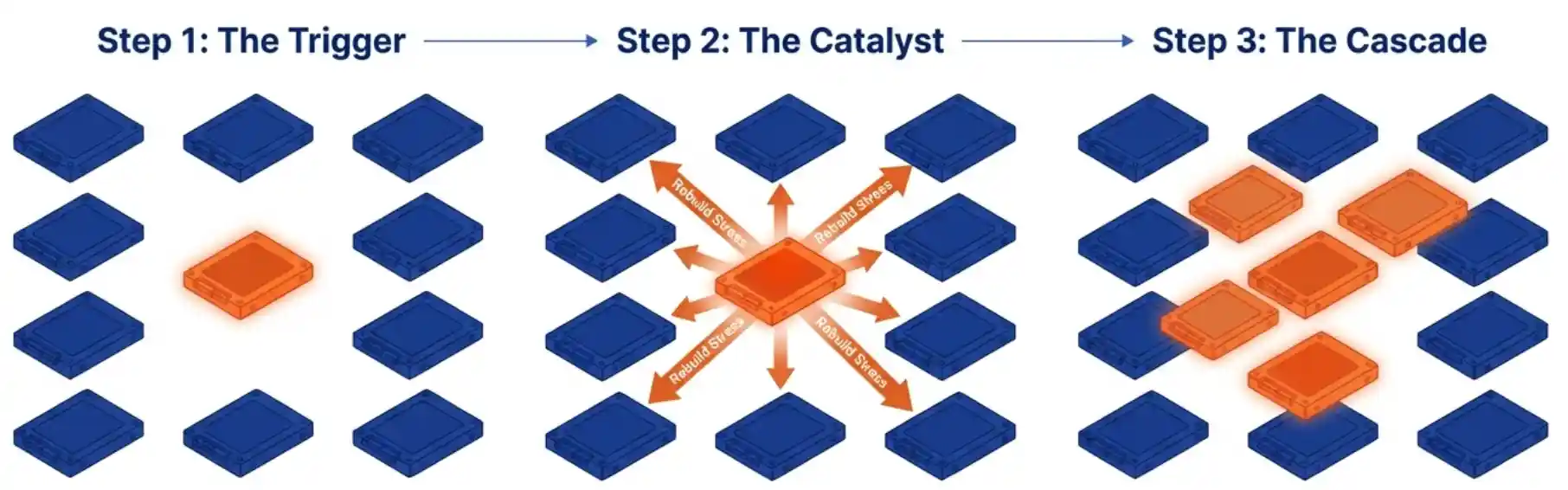
Cascading drive failure is the storage scenario every IT operator wants to never live through. Picture this. A six-node hyperconverged environment running production workloads. A drive fails on one of the nodes. The rebuild starts. Mid-rebuild, a second drive fails. More rebuilds spin up. A third drive fails. Then a fourth. The cluster has now exceeded the tolerance of RF2, the standard two-copy synchronous replication model in VergeOS. It has also exceeded RF3 if you happened to be running it. On most platforms, this cascading drive failure has just ended the cluster, the VMs are stopped, and recovery is a tape-restore conversation.

Key Takeaways
  • Cascading drive failure is the dominant concurrent-failure pattern, not the exception. One drive fails, rebuilds kick off, surviving drives wear faster under the rebuild load, and the next failure arrives before the cluster has recovered from the first.
  • Hyperconverged and ultraconverged architectures raise the stakes on cascading drive failure. Compute and storage share nodes, so a node loss takes both layers down at once.
  • RF2 and RF3 absorb the first one or two losses. ioGuardian streams missing blocks inline beyond that. Live VM migration moves workloads off degraded nodes in parallel. Users see no interruption.

VergeOS handles a cascading drive failure differently. As each drive fails and the failure surface widens, ioGuardian streams the missing blocks inline to the running VMs as the VMs request them. The platform also live-migrates the affected VMs off the most degraded nodes to surviving ones. By the time three or four servers have effectively crashed, the users are still accessing their applications and data. They never see the cascade happen.

The scenario above is a thought experiment built from common failure patterns. Same-batch drives age together. Rebuild storms stress surviving drives and accelerate the next failure. Correlated wear pushes the cascade forward. The pattern is not exotic, it is statistically expected on used media and possible on new media. The architecture that makes the outcome survivable is shipping today. Once you understand how it works, the case for using refurbished media on the right platform becomes a procurement decision rather than a courage test.

4 of 6Servers effectively crashed in the cascading drive failure scenario
0User-noticed service interruptions during the cascade
40–60%Refurbished enterprise SSD discount versus new pricing

Why Cascading Drive Failure Happens

Cascading drive failure is not exotic. Every hyperscaler operating at scale has documented this pattern in their published field data on flash drives. When one SSD fails inside a same-batch group, the probability that two or three more in that group fail within days is materially elevated. The drives shipped together, ran the same workload, and reached the same point on their wear curves at the same time. Rebuilds make it worse, not better, since the surviving drives carry the rebuild load and accelerate their own wear. This is true of new media. It is more true of refurbished media, where the wear distribution is tighter than a fresh procurement order.

Cascading drive failure from correlated wear curves accelerated by rebuild storms

The architectural answer is the same regardless of failure cause. Consider three causes: a same-batch firmware bug, correlated end-of-life on a single procurement order, and rebuild stress that propagates the next failure. All three look identical to the storage layer. The platform either absorbs the cascading drive failure without service interruption or it does not. Refurbished drives raise the prior probability of a cascade. They do not change the response model.

Converged architectures raise the stakes further. Hyperconverged and ultraconverged platforms run compute and storage on the same physical nodes, so the loss of a node takes both layers down at once. A cluster experiencing cascading drive failure across the same week is also watching three VM hosts wobble. The architectural answer has to absorb both halves of that failure surface, not just the storage half. Refurbished media on a converged platform without inline recovery compounds the problem in two dimensions at once. The protection model has to cover storage and compute simultaneously or it does not cover anything that matters.

How VergeOS Absorbs Cascading Drive Failure

VergeOS uses synchronous replication rather than erasure coding. RF2 maintains two copies of every block on different drives across different nodes. RF3 maintains three. A write only completes once the second or third copy acknowledges. The platform survives the loss of any drive, and at RF3 the loss of any two, with no parity calculation, no rebuild storm, and no degraded-mode performance penalty. The choice between RF2 and RF3 is a capacity question, not an architecture question. The replication model is the same.

VergeOS architecture for cascading drive failure: RF2 and RF3 synchronous replication, ioGuardian inline recovery, and live VM migration

ioGuardian extends the protection model beyond the replication tolerance. It is a separate node holding a complete asynchronous copy of the cluster, updated on every system snapshot. When a failure exceeds the configured RF level, ioGuardian does not attempt to rebuild the failed drives. It steps inline and delivers the missing blocks to the running VMs as the VMs request them. Recovery is not a process that runs in the background. Recovery is the data path itself.

The compute layer responds in parallel. As nodes degrade past the threshold where they can serve workloads reliably, VergeOS live-migrates the affected VMs to surviving nodes. The VMs themselves see no interruption. The combination of inline storage recovery plus continuous VM migration is what lets the cluster absorb the loss of multiple servers without service impact, even when the cascading drive failure exceeds both RF2 and RF3 tolerances.

The Ultra Converged Infrastructure model adds another dimension to cascade resilience. VergeOS supports heterogeneous node types in the same cluster: storage-heavy nodes packed with drives, compute-heavy nodes loaded with CPU and RAM, and classic hyperconverged nodes that balance both. A cluster running this mix spreads the cascade surface across different physical roles. When a same-batch cascade hits the storage-heavy nodes, the compute-heavy nodes keep running VMs uninterrupted. When a compute node fails, the storage nodes keep serving data. The same UCI flexibility that lets you scale compute and storage independently during normal operations also makes it structurally harder to lose a cluster to a single concentrated failure.

Two design consequences follow. The first is performance: the surviving drives never carry a rebuild storm, writes incur no parity recalculation tax, and the failed state holds production-level latency when the ioGuardian target runs on flash. The second is hardware flexibility. The ioGuardian server runs on its own license and its own hardware, and it does not need to match the production cluster in CPU family, generation, or media type. Customers run AMD ioGuardian targets behind Intel production environments, repurpose retired servers as ioGuardian capacity, and place a second ioGuardian instance at a cloud service provider for site-level resilience.

Key Terms
Cascading Drive Failure
A drive failure pattern in which one failure triggers conditions (rebuild stress, correlated wear) that make subsequent failures more likely. Common on same-batch media, more pronounced on refurbished media.
RF2 / RF3
VergeOS’s two-copy and three-copy synchronous replication models. Every write completes only after the additional copies acknowledge. Survives loss of one or two drives with no rebuild storm and no degraded-state performance penalty.
ioGuardian
A separate node holding a complete asynchronous copy of the cluster, updated on every system snapshot. Streams missing blocks inline to running VMs when failures exceed the configured RF level. Eliminates the rebuild process as a recovery mechanism.
Live VM Migration
VergeOS’s mechanism for moving running VMs off degraded nodes to surviving ones without service interruption. Works in parallel with ioGuardian during a cascade so the compute layer keeps serving even as storage absorbs the failure.
UCI Node Types
VergeOS supports storage-heavy, compute-heavy, and balanced hyperconverged nodes in the same cluster. Spreading workloads across heterogeneous node types makes the cluster structurally more resilient to a single concentrated failure pattern.

Telemetry Prevents Failure Before It Starts

The cascading drive failure scenario makes the architecture vivid. It also makes the point in the wrong direction. The goal is not to absorb the failure event. The goal is to never reach it. VergeOS does both. The replication model, ioGuardian, and live migration handle the moment of failure. The telemetry layer makes sure the moment rarely arrives.

VergeOS SMART telemetry catching the early signature of cascading drive failure before the second drive fails

The platform tracks seven SMART attributes on every drive in real time: total writes, power-on hours, reallocated sectors, wear leveling, ECC errors, end-to-end errors, and temperature. The data flows through a subscription model. A subscription is a rule that fires an alert on a defined condition.

The obvious subscription watches a wear-level threshold, and most customers set the first alert at seventy percent. The more useful subscription watches rate of change. An alert that fires when a drive’s wear level jumps ten points within ten days catches drives at risk of failure days or weeks ahead of any fixed threshold. The same rate-of-change subscription catches the early signature of a cascading drive failure before the second drive in a batch fails.

This capability turns refurbished procurement into a verifiable transaction. A reputable supplier delivers drives with a stated wear level and chain-of-custody record. The buyer installs them, runs a stress workload for twenty-four hours, and lets the platform watch. A drive that arrives at ninety percent wear when the supplier represented twenty percent gets flagged before any production data lands on it. The drive goes back, the supplier gets the call, and the framework has been validated by the platform itself. Refurbished media stops being a faith-based purchase and becomes a quantifiable one.

VergeIO On-Demand Webinar
The Refurbished SSD Framework

George Crump and Aaron Richman walk through the secondary-market case, the procurement framework, and the architectural model that makes refurbished enterprise drives a procurement decision rather than a courage test.

Watch the Recording →

This is the two-sided coverage VergeOS delivers. The telemetry layer gives you everything you need to try to prevent the cascading drive failure from happening in the first place, through real-time SMART exposure, rate-of-change subscriptions, and verifiable supplier representations. If the cascade still arrives despite the early-warning systems, the architecture has the resiliency to withstand it, through synchronous replication, inline recovery, live migration, and heterogeneous UCI node distribution that keeps user workloads running through the failure. Both halves of the coverage matter. Most platforms leave the second half to you.

What This Means for Refurbished Procurement

The conventional argument against refurbished enterprise SSDs is elevated failure risk. The argument is correct. The platform decision is what changes the consequence of that risk. New media on a naive architecture faces a different set of stakes than refurbished media on a platform built to absorb cascading drive failure. Erasure coding controls protection at the cost of double-digit-hour rebuilds and a real chance that the next drive failure during rebuild ends the cluster. Synchronous replication, inline recovery, and live migration hold the cluster up regardless of failure cause or media age.

Stack the cost math on top of that architectural reality and the picture changes. Refurbished enterprise SSDs run forty to sixty percent below new pricing in the current market, a market whose underlying dynamics have been characterized as memory and flash prices that are not coming down. The reputable supply chain runs through R2v3-certified vendors who serialize inventory, perform NIST 800-88 sanitization, and stand behind their representations. Drives typically carry eighty to ninety-five percent of rated write life remaining. A buyer who runs SMART verification on intake, sets the rate-of-change subscription, and deploys behind RF2 with ioGuardian has answered the failure-risk question in three independent ways before any customer data lands.

Naive Architecture vs VergeOS for Cascading Drive Failure

 Naive ArchitectureVergeOS
Protection modelErasure coding with parity calculation overheadSynchronous replication with no parity overhead
Recovery on failure within toleranceMulti-hour rebuild storm on surviving drivesContinuous serving with no rebuild
Recovery on failure beyond toleranceRecover from backup, days of downtimeioGuardian inline streaming, no service interruption
Compute response during cascadeVMs stop on affected nodes, manual restart requiredLive migration moves VMs to surviving nodes automatically
Failure surface across node typesSymmetric nodes concentrate the cascadeUCI heterogeneous nodes spread the cascade across roles
Refurbished SSD verificationManual intake test, no continuous monitoringSeven SMART attributes monitored real-time, rate-of-change alerts

The cascade is what makes the scenario memorable. The architecture absorbs cascading drive failure for the same reason it absorbs a same-batch firmware bug, a bad refurbished batch, or a single drive that happened to fail on a busy day. The failure cause is not the variable. The platform is. A companion post, How VergeOS Makes Refurbished SSDs Safe to Run, catalogs the platform’s response to each of the four supplier-side refurb risks.

Frequently Asked Questions
What is ioGuardian and how is it different from a backup system?
ioGuardian is a VergeOS data-protection node that holds a complete asynchronous copy of the production cluster, updated on every system snapshot. When a failure exceeds the configured RF protection level, ioGuardian streams the missing blocks inline to running VMs as the VMs request them. The VMs never stop serving. ioGuardian replaces rebuild as the recovery mechanism for failures beyond replication tolerance. It does not replace backup. It eliminates rebuild as the primary recovery path.
Can VergeOS handle a cascading drive failure that exceeds RF2 and RF3?
Yes. RF2 absorbs the first drive loss, RF3 absorbs the first two. When a cascading drive failure exceeds the configured RF level, ioGuardian streams missing blocks inline to running VMs while live migration moves workloads off the most degraded nodes to surviving ones. The UCI node-type flexibility spreads the failure surface across compute-heavy, storage-heavy, and balanced nodes, so the cascade rarely takes the whole cluster. The cluster keeps serving even when concurrent failures take out a majority of nodes.
Why is cascading drive failure protection more critical on HCI and UCI than on split architectures?
Hyperconverged and ultraconverged platforms run compute and storage on the same physical nodes. The loss of a node takes both layers down at once. A cluster experiencing cascading drive failure is also watching three or four VM hosts wobble. The architectural answer has to absorb both halves of that failure surface, not just the storage half. ioGuardian and live migration were designed for that combined blast radius.
How does VergeOS verify that a refurbished drive’s stated wear level is accurate?
VergeOS exposes seven SMART attributes per drive in real time and lets administrators define subscription rules. A wear-level threshold subscription alerts when any drive crosses a defined value. A rate-of-change subscription alerts when wear increases faster than expected, catching drives that arrived in worse condition than the supplier represented. Both subscriptions fire before production data is at risk.
Does ioGuardian require the same hardware as the production cluster?
No. The ioGuardian server runs on its own license and its own hardware. It does not need to match the production cluster in CPU family, generation, or storage media. Customers run AMD ioGuardian targets behind Intel production environments, repurpose retired servers as ioGuardian capacity, and place a second ioGuardian instance at a cloud service provider for site-level resilience.
What happens if a same-batch firmware bug takes out multiple drives at once?
The architectural response is the same as cascading drive failure from any other cause. RF2 or RF3 absorbs the first one to two failures within tolerance. ioGuardian absorbs the rest by streaming inline, and live migration moves VMs off the affected nodes. The cluster keeps serving. The corrective action with the manufacturer or supplier happens on a normal-business-hours schedule rather than a 3 AM emergency.

Filed Under: Storage Tagged With: cascading drive failure, ioGuardian, live migration, refurbished SSDs, RF2, RF3, UCI, VergeOS

May 26, 2026 by George Crump

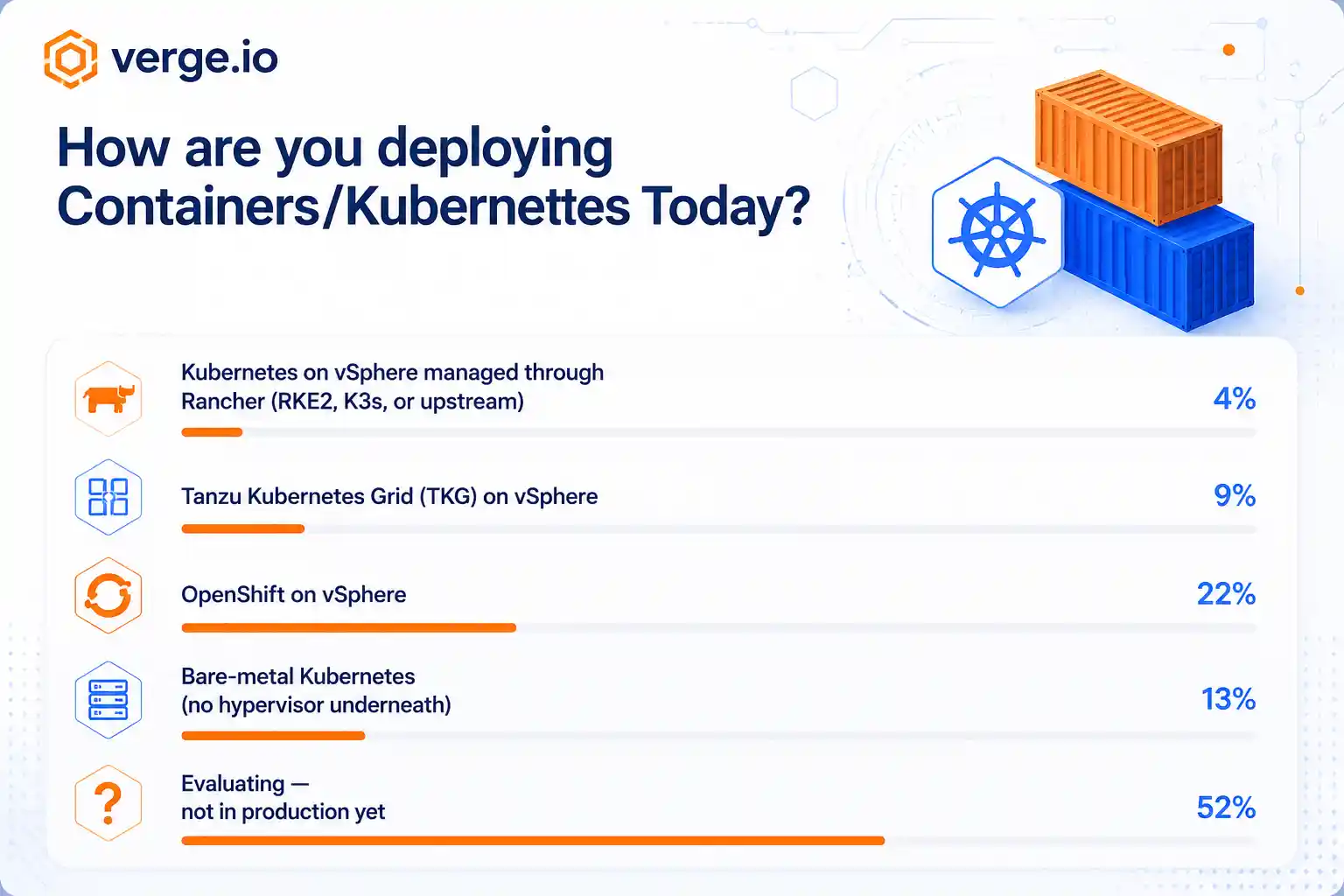
Live webinars produce one piece of data no white paper captures cleanly. That data is the audience poll. On May 20, the first poll on Kubernetes Without the VMware Tax asked attendees how their team runs Kubernetes in production today. Roughly half answered the same way. Kubernetes is still in the evaluation column, not yet running in production.

May 20 webinar poll results showing roughly half of attendees still evaluating Kubernetes

The trade press paints a picture of every enterprise running Kubernetes for years, and the poll told a different story. For a team in that evaluating column, the exit from VMware has become the new priority. The real question is whether the team can evaluate Kubernetes and exit VMware at the same time.

The argument is straightforward. The platform underneath the Kubernetes layer decides more of the long-run operations math than the distribution does. The full architectural case lives in Collapsing the Kubernetes Stack, the long-form companion paper to this post, and the dollar math gets walked separately in The Kubernetes VMware Exit Math, Explained. Pick the platform last, and the distribution choice locks in the storage layer, the snapshot policy, and the vendor count. Pick it first, and the distribution choice becomes a distribution choice.

Key Takeaways
  • Pick the platform first. Exiting VMware to a platform that understands containers answers the foundation question and the distribution question inside the same project.
  • Running Kubernetes on a hypervisor not designed for container workloads adds a translation tax in storage, networking, and lifecycle, and that tax compounds at every renewal.
  • VergeOS publishes three Helm charts from a single Cluster Repository on GitHub, ships persistent volumes natively from the same storage that runs the VMs, and presents both workload types through Rancher. One platform, one support contract, two workload types.

Does the environment need Kubernetes?

The hardest question for a team evaluating Kubernetes is not which distribution to pick. The hardest question is whether the environment needs Kubernetes at all. Plenty of environments need Kubernetes for the right reasons. Plenty of others do not, and the honest answer matters more than the marketing.

The honest answer in the room on May 20 came from David Zarzycki, the engineer who did most of the work on the VergeOS Kubernetes integration. His phrasing was the right one. Is your environment complex enough to warrant the complexity of running Kubernetes at all?

Kubernetes earns its keep when applications change frequently, when teams ship daily, when multi-tenancy is real, when GPU scheduling matters, and when developer self-service is a stated requirement. A two-tier ERP application with a six-month release cycle does not need Kubernetes. A microservices platform with twenty deploy events per day does. Most production environments have both kinds of workloads sitting side by side, and that mix is exactly why the foundation question matters more than the distribution question.

A clean example of a Kubernetes-shaped workload looks like a retail analytics platform that ingests several million transaction events per hour, runs a dozen microservices scaling independently against the event stream, and ships code multiple times a day with feature flags and blue-green rollouts. Storage demand spikes during peak hours. Compute demand spikes around marketing campaigns. The engineering team treats every service as independently deployable. That workload pattern is what Kubernetes was built for, and the platform underneath has to keep up with it. The two-tier ERP application sitting next to that platform does not need any of that machinery, and asking Kubernetes to run it is the wrong tool for the wrong job.

Key Terms
Foundational Platform
The compute, storage, and networking substrate underneath the Kubernetes cluster. A true foundational platform combines hypervisor, storage system, network fabric, and container orchestration on a single code base, with one management plane and one support contract for both VM and container workloads. The foundational platform sets the operational ceiling for everything running on top of it.
Kubernetes distribution
A packaged version of upstream Kubernetes with vendor support, lifecycle tools, and sometimes additional CRDs. Examples include Tanzu Kubernetes Grid, Red Hat OpenShift, SUSE Rancher Prime, and upstream RKE2 or K3s.
Cluster Repository
A registered Helm chart source that Rancher can pull from. VergeOS publishes a single Cluster Repository on the verge-io GitHub. One Rancher registration brings the node driver and pins the three platform charts (CSI, Cloud Controller, Cluster Autoscaler) to verified upstream versions.
Overlay storage
A separate storage system layered on top of the hypervisor storage to give Kubernetes pods persistent volumes. Longhorn, Portworx, OpenEBS, and Rook/Ceph are common examples. The deeper case for treating Kubernetes persistent storage as an architectural coordination problem sits in the analyst piece on StorageSwiss. Overlay storage is the classic indicator the underlying platform does not natively support container workloads.
Translation tax
The operational and architectural cost of bridging between a Kubernetes layer and a hypervisor layer not built together. Shows up as duplicate snapshot policies, separate networking control planes, two backup systems, and three support contracts.

The foundation question, not the distribution question

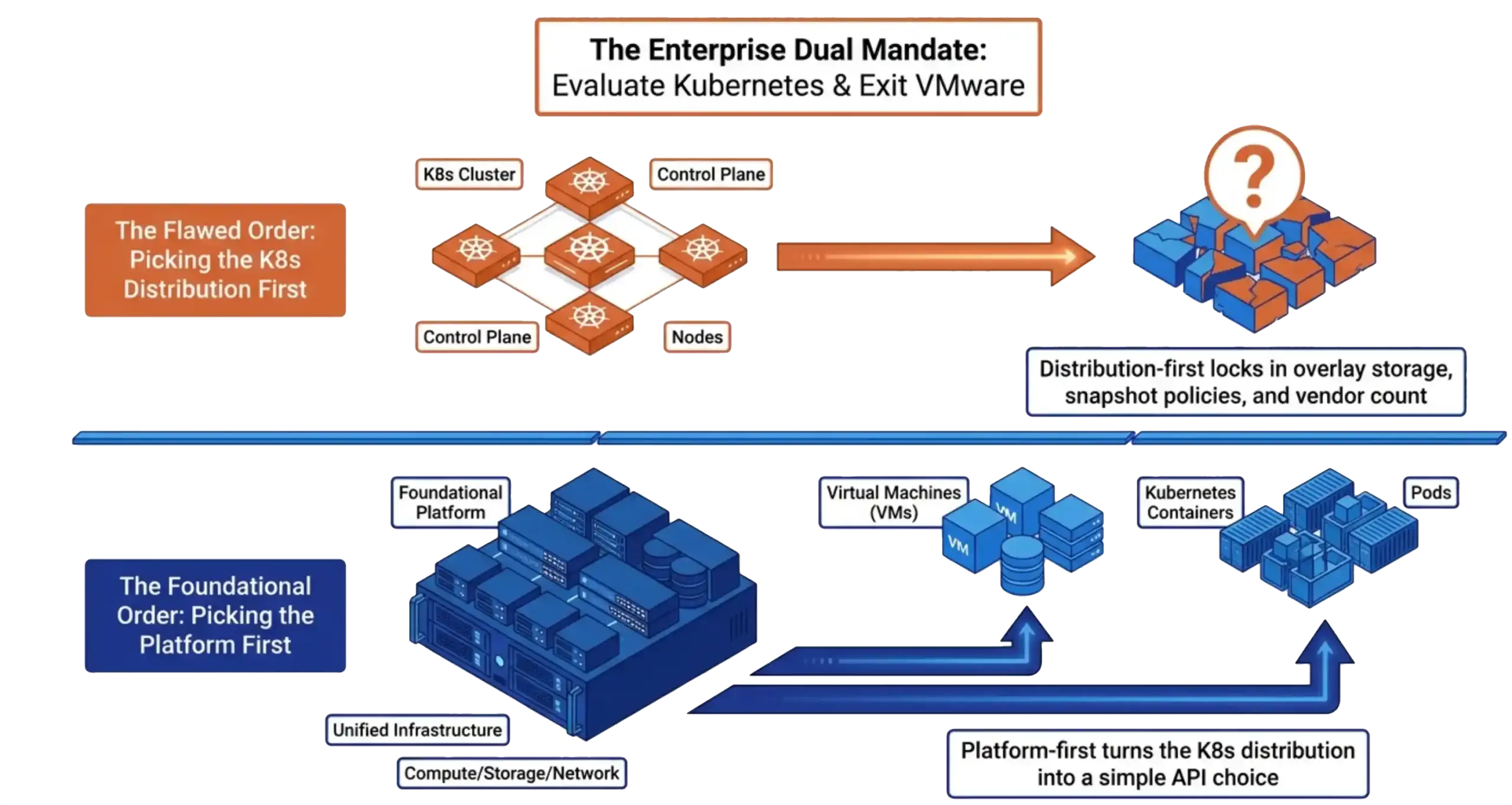
Kubernetes evaluations almost always start with the distribution shortlist. The standard candidates are Tanzu, OpenShift, Rancher Prime with RKE2 or K3s, and upstream Kubernetes on bare metal. Tanzu’s long goodbye makes that grading harder for any team still committed to vSphere. Each shortlist gets graded against developer experience, ecosystem depth, support contracts, and price. The platform underneath the cluster nodes is a separate conversation. The hypervisor, the storage layer, and the network fabric get graded last, if at all.

The dual mandate of running VMs and Kubernetes containers on a single integrated platform

That order is backward. The platform underneath decides how persistent volumes get carved, how cluster nodes scale, how snapshot and replication policies coordinate across VMs and pods, and how many vendor support contracts the operations team carries forever. The Kubernetes distribution determines which API the developer interacts with. Both matter, and the platform decides more.

The reason the order keeps getting reversed is that the distribution choice is louder. There are conferences for Tanzu and conferences for OpenShift. There is no conference for “the platform underneath.” Teams evaluating Kubernetes hear the loudest voices first and rank the platform later. The five-year math punishes that order.

The platform question reduces to a simple test. Count the support contracts the operations team will carry once the evaluation is over. Count the snapshot engines. Count the storage systems. Count the network control planes. Every number greater than one in that list is a translation tax line item. Every one of those line items comes from picking the distribution first and letting the distribution dictate the platform.

What changes when the platform underneath is integrated

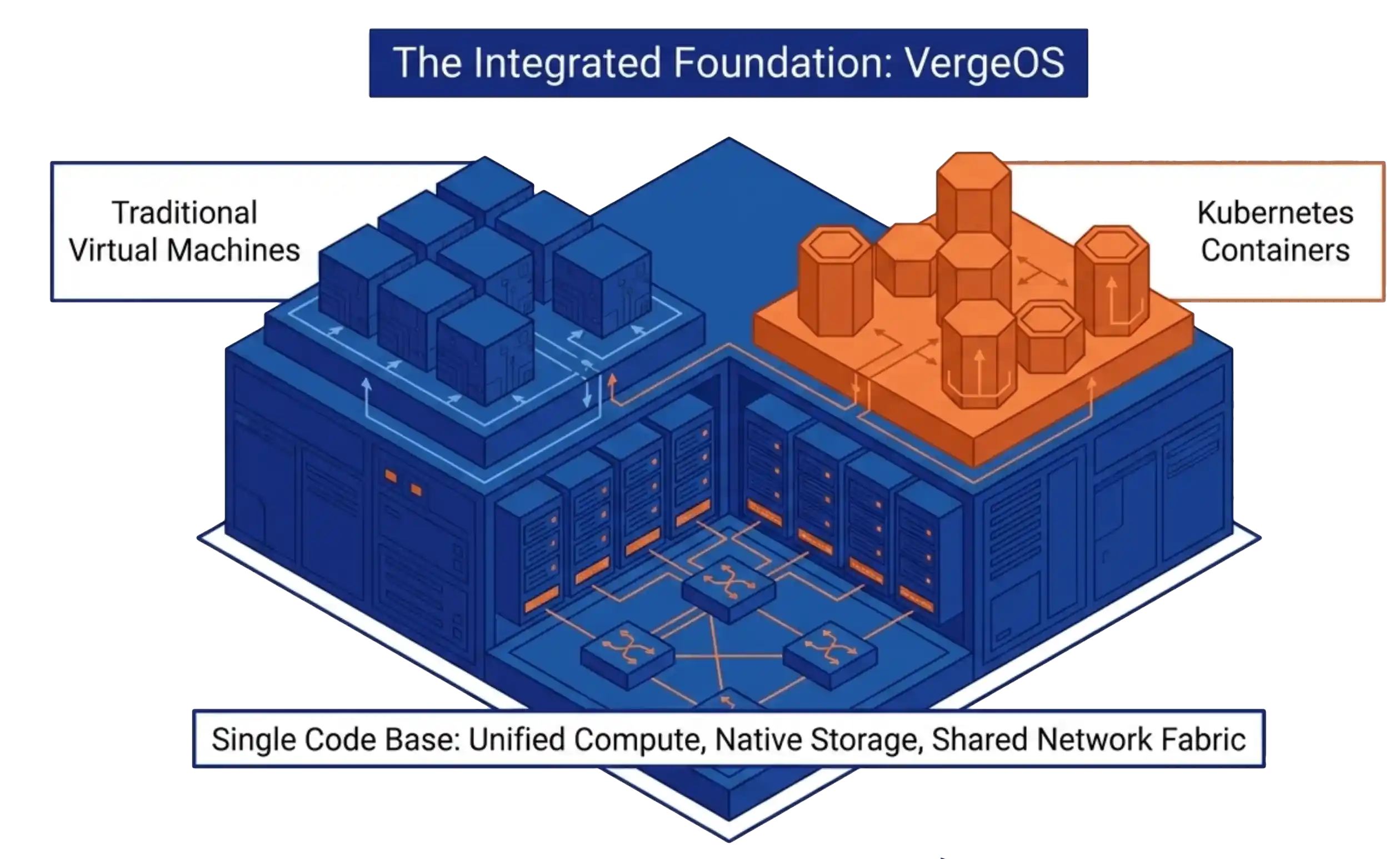
VergeOS as a unified foundation for both VMs and Kubernetes containers

VergeOS treats VMs and Kubernetes containers as workloads on the same code base. The hypervisor, the storage layer, the network fabric, and the Kubernetes integration share one platform. Three Helm charts pulled from one Cluster Repository on the verge-io GitHub. A CSI driver provisions persistent volumes from VergeFS directly, with no overlay storage layer between the pod and the disk. A Cloud Controller Manager handles networking and node lifecycle events through the standard Kubernetes interface. A Cluster Autoscaler handles node-count management through the same upstream project every other distribution uses.

What that means in practice. Rancher remains the management plane the operations team already knows. The cluster object stays standard. The persistent volume comes off the same storage fabric the VMs use, with no Longhorn to license and no Portworx contract to manage. The Kubernetes distribution is whichever flavor Rancher provisions, usually RKE2 or K3s, both upstream. The platform underneath handles the rest, on the same code base it uses to run the VM side of the house. The Kubernetes Without the VMware Tax datasheet lays the architecture diagram and the deployment flow side by side for teams that want the one-page reference.

The typical vSphere Kubernetes stack vs an integrated platform

Capability Typical vSphere Kubernetes Stack VergeOS
Hypervisor licensing VCF subscription, per-core pricing Included in the platform
Kubernetes distribution Tanzu, OpenShift, or Rancher Prime, separate contract RKE2 or K3s via Rancher, no separate licensing
Persistent volumes (CSI) Vendor CSI driver, overlay storage often required (Longhorn, Portworx) Native VergeOS CSI driver, no overlay storage
Networking and load balancing Vendor CNI plus separate load-balancer contract Cloud Controller Manager via standard Kubernetes interface
Snapshot and replication Two policy engines, one for VMs, one for K8s One snapshot and replication engine, both workload types
Vendor support contracts Three or more One
Cluster create time (May 20 live demo) Variable, often 15 to 20 minutes Six minutes, on a lightweight lab system

Why Rancher?

VergeOS works with any Kubernetes distribution that runs on standard upstream nodes. The integration is upstream by design, three Helm charts and a node driver, no fork and no proprietary kernel extension. A team already running OpenShift or Tanzu can keep that distribution and put VergeOS underneath it.

A team that has not committed to a distribution yet should start with Rancher. The reasoning is practical. Rancher carries the lightest commercial weight of the major management planes, with no separate licensing layer attached to RKE2 or K3s. The node driver integration is the cleanest path to a working cluster on VergeOS. The cluster lifecycle, upgrade, and visibility story all sit in one console the operations team learns quickly. Standing up a first cluster on Rancher takes minutes, and the resulting cluster is upstream Kubernetes. No fork, no proprietary distribution to retrain against, and no vendor exit story to plan for later.

Production proof, named on the live call

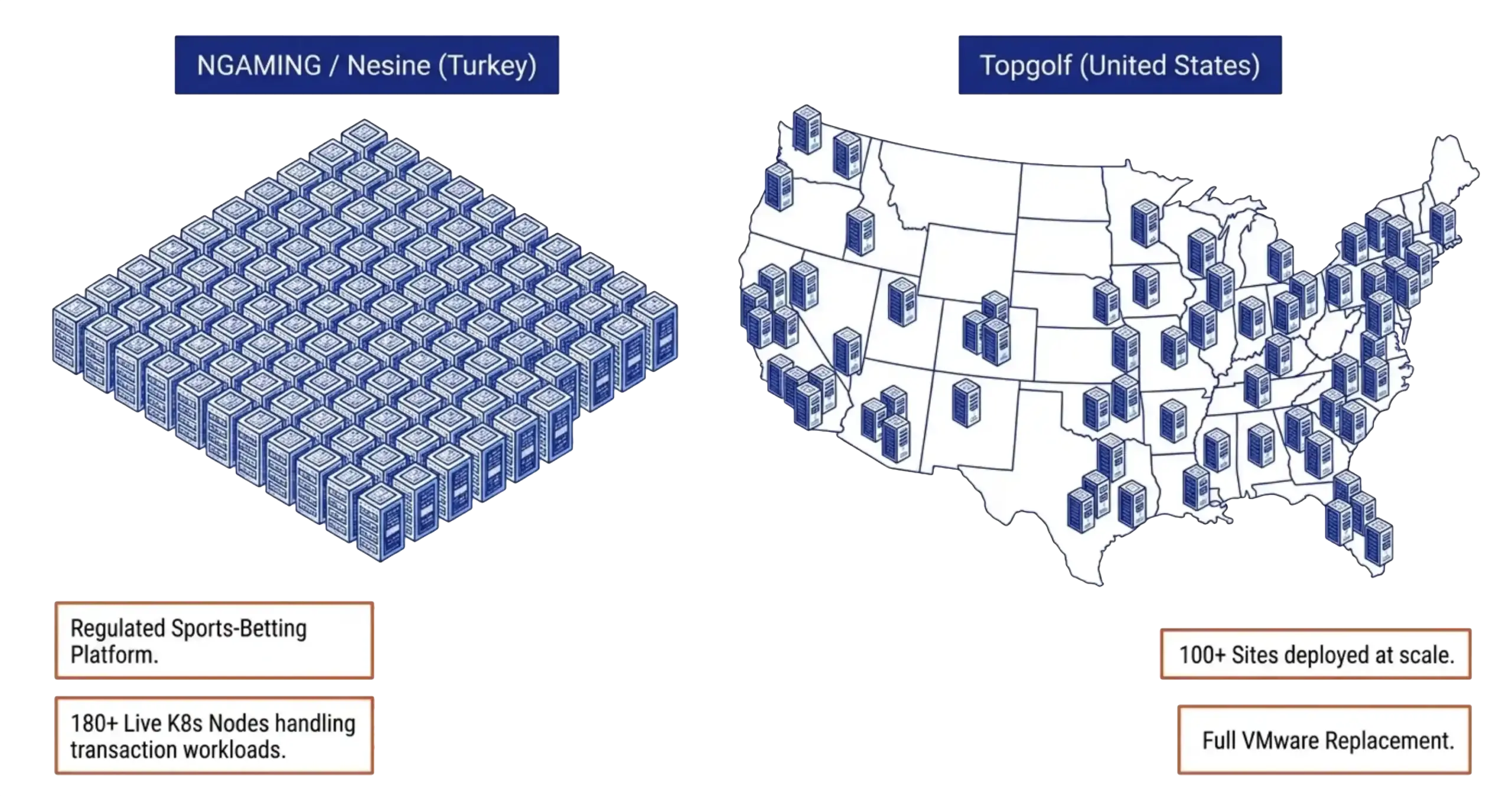
Two customers got named on the May 20 webinar, and both are cleared for public use. NGAMING / Nesine in Turkey runs a regulated sports-betting platform on VergeOS, with over 180 Kubernetes nodes carrying live transaction workload. The same production validation appears in the VergeIO Kubernetes general availability announcement.

Production VergeOS Kubernetes deployments at NGAMING / Nesine and Topgolf

Their feedback in the rollout was that the engineering response cycle felt like having a software development shop on call, even across time zones. That kind of feedback is rare, and it came up for one reason. The engineers who wrote the VergeOS SDKs are the same engineers who wrote the Kubernetes integration. Same team, same code base, same release cadence.

Topgolf is the second name. Over a hundred VergeOS sites across the United States, replacing VMware. The reason Topgolf gave for choosing VergeOS was not the platform alone. It was the platform plus the partnership, agile enough to respond at scale and capable enough to run the full environment. Both customers are evidence that the integrated-platform argument scales from a 180-node Kubernetes cluster in Turkey to a hundred-site VMware replacement in the United States, on the same code base.

How to start evaluating Kubernetes the right way

The clean path for a team evaluating Kubernetes from a standing start looks like this. Stand up VergeOS as the platform. Register the verge-io Cluster Repository in Rancher. Provision a test cluster through the Rancher UI. Run workloads on it. Cluster creation took six minutes on the live demo, on a lightweight home-lab system with two cores and four gigabytes of RAM per node. Production environments run faster. The three Helm charts come from the same repository. The persistent volumes come from VergeOS storage. The Rancher cluster object behaves exactly the way it would on any other Rancher node driver.

Keep going on Kubernetes Without the VMware Tax

The webinar walks the live demo on real hardware. The white paper walks the full architectural argument.

Watch the on-demand webinar
Read the white paper

From there the distribution question becomes which flavor of upstream Kubernetes Rancher provisions for the team, with RKE2, K3s, or upstream Kubernetes as the practical options. The platform decision is already made. The vendor count is one. The migration question other teams are still working through does not show up at all. There is nothing to migrate from. The team that picks the platform first gets to keep the evaluation focused on the part that matters, which is whether Kubernetes fits the workload, not whether the storage layer fits the Kubernetes distribution.

The fastest way to validate the foundation argument against a specific environment is a 30-minute architecture overview with one of the engineers who built the integration. Aaron Richman, Field Evangelist at VergeIO and one of the presenters on the May 20 webinar, runs these sessions directly. The agenda is the team’s environment, the workloads under consideration, and the path from the current VMware footprint to a VergeOS deployment that handles VMs and Kubernetes on one platform. No slide deck. The session works against a real environment. Book a session and the conversation starts where the webinar left off.

Why this matters to a team still evaluating Kubernetes

The CloudBolt CII study and the most recent CNCF surveys both show the same pattern. Teams deploying Kubernetes on top of a hypervisor not designed for container workloads spend more on storage, more on vendor support, and more on operations than teams picking an integrated platform from the start.

The gap widens at every renewal. Most evaluations get the order wrong, and the reason is consistent. The distribution choice is louder, and the platform choice shapes the next five years.

The teams in the evaluating column during the May 20 webinar still have a chance to get this order right. The teams that have already moved are working through the migration version of the same question. The order matters more than the urgency.

Frequently Asked Questions
We are not running Kubernetes yet. Do we still need to think about a platform like VergeOS now?
Yes. The platform underneath the cluster decides storage, networking, snapshot policy, and vendor count. Picking the platform after the distribution locks in choices harder to reverse than the distribution decision itself.
Can VergeOS run alongside our existing VMware environment during evaluation?
Yes. VergeOS runs on standard x86 hardware and supports parallel deployment. Most evaluations stand up a VergeOS cluster on dedicated hardware, run the Kubernetes workload on it, and migrate VMs over on the team’s timeline.
Which Kubernetes distribution does VergeOS provision?
Rancher provisions the distribution. The default Rancher choices are RKE2 and K3s, both upstream Kubernetes. VergeOS does not fork or modify the distribution. The three platform Helm charts (CSI, Cloud Controller, Cluster Autoscaler) work with the upstream cluster.
Do we have to commit to Rancher to use VergeOS Kubernetes support?
Rancher is the supported management plane today. The Helm charts themselves are upstream and run on any Kubernetes cluster the operations team chooses to manage with kubectl. Rancher is the recommended path for three reasons. UI continuity for operations, node driver integration, and the full cluster lifecycle story in one place.
What happens to our existing VMs when we add Kubernetes workloads?
VMs and Kubernetes containers run on the same VergeOS code base. The same storage. The same networking. The same snapshot and replication policies. The operations team manages one platform, one console, one support contract.
How long does a real production cluster take to provision?
On the May 20 live demo, a three-node RKE2 cluster came up in six minutes on a lightweight home-lab system. Production environments with proper resource allocation typically come up faster. The time is dominated by Rancher provisioning the cluster runtime on the VMs, not by VergeOS provisioning the VMs themselves.

Next steps

The Collapsing the Kubernetes Stack white paper, the Kubernetes Without the VMware Tax datasheet, and the on-demand recording of the May 20 webinar all live in the Kubernetes Without the VMware Tax research center. The fastest way to validate the foundation argument is on your own hardware, with your own workloads. Take a Test Drive Today and provision a Kubernetes cluster through Rancher on VergeOS the same way David showed live.

Filed Under: Private Cloud Tagged With: Container Platform, Kubernetes, Kubernetes Evaluation, Rancher, RKE2, VergeOS, VMware alternative

May 5, 2026 by George Crump

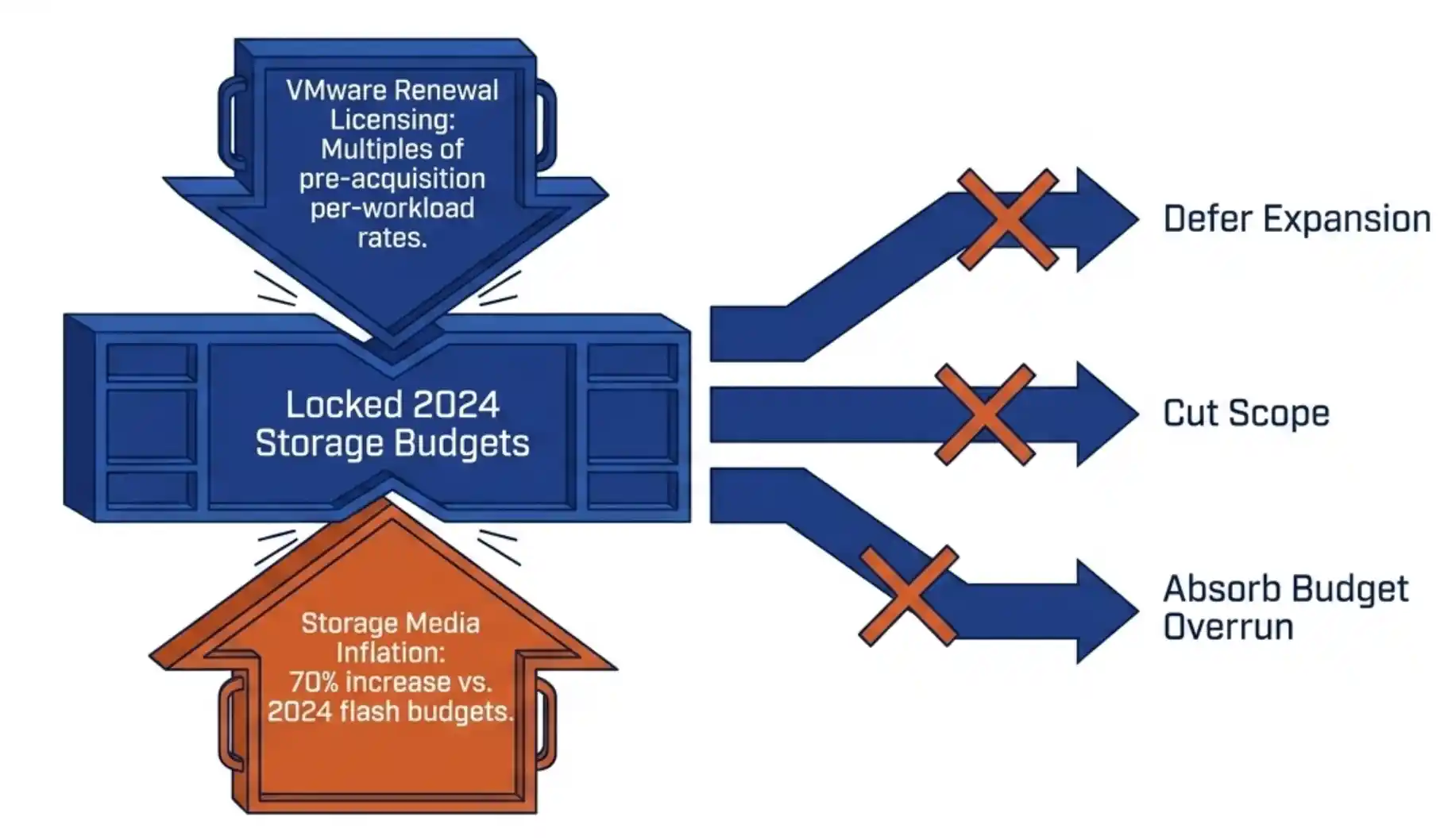
SAN refresh in trouble: 2026 flash inflation under-funds 2024 budgetsYour 2026 SAN refresh is in trouble. Flash inflation has pushed enterprise SSD prices up 70 percent. Refresh budgets locked in 2024 are now under-funded against current list pricing. The standard responses are to defer expansion, cut scope, or absorb the cost as a budget overrun. None of those options preserve the operational plan you set last year.
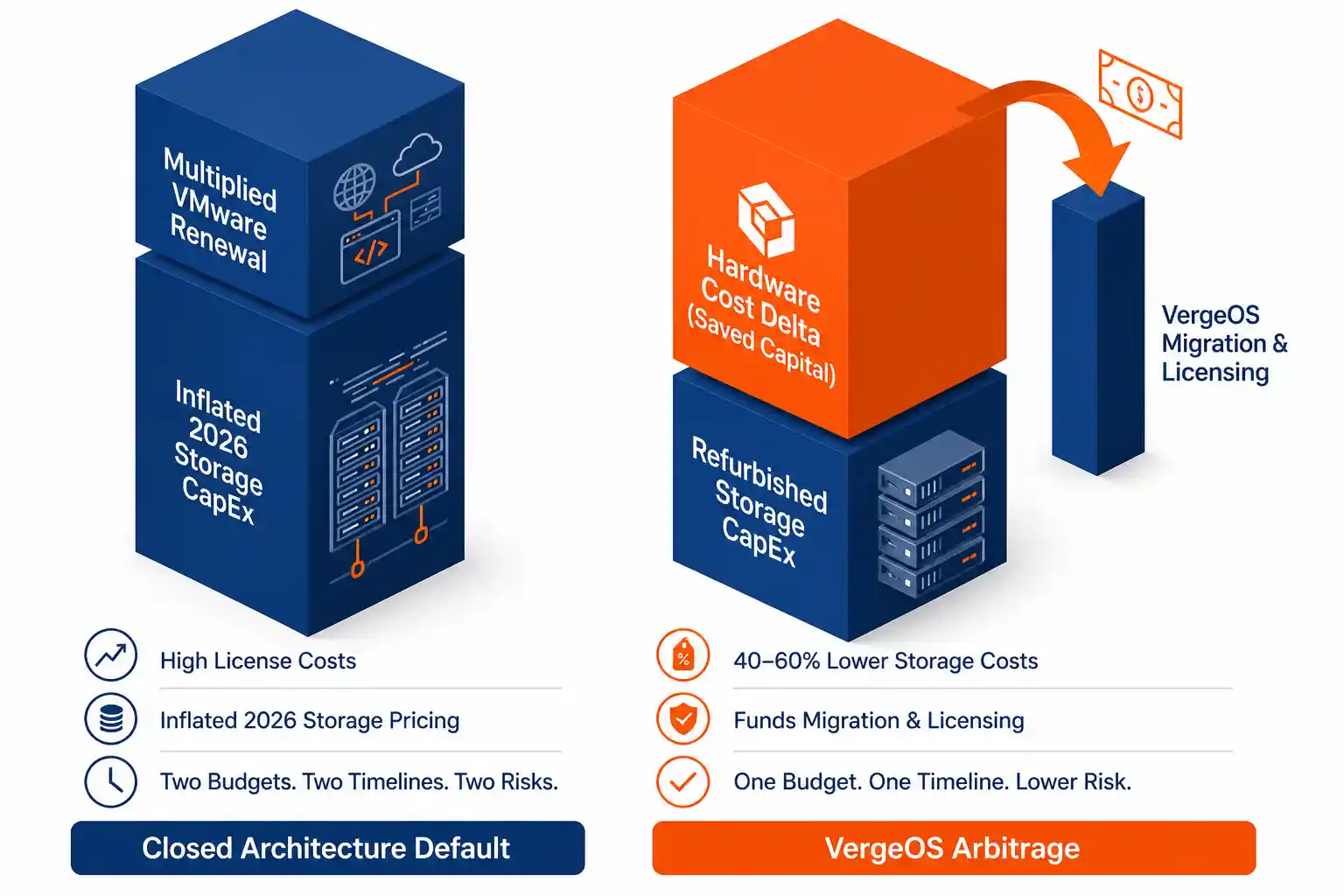
A fourth option exists. Capture the original capacity expansion at 40 to 60 percent of new flash list pricing using the secondary enterprise SSD market. Run that capacity on VergeOS instead of VMware. The hardware savings fund the platform exit. The SAN refresh costs less than it would have last year. The VMware exit pays for itself.

This is not two decisions. It is one decision executed once, with the savings stacking across both line items in the budget. The procurement framework and the architecture ship together, and the financial mechanism only works when both are deployed at the same time. This dynamic has been characterized as Broadcom’s best retention tool, since the same memory and flash supercycle that pushes refresh budgets underwater also makes the migration hardware harder to fund.

Key Takeaways
Refurbished enterprise SSDs sell at 40 to 60 percent below 2026 new flash list pricing, with 80 to 95 percent rated write life remaining at market entry.
The hardware cost delta on a SAN refresh covers the software and licensing line items of a VMware migration, converting a painful CapEx event into a near-neutral financial maneuver.
VergeOS synchronous replication with RF3 plus ioGuardian absorbs the failure rate of refurbished media without service interruption, validated by a documented customer event in which four of six hosts went down simultaneously with zero downtime and zero data loss.

Why the SAN Refresh and the VMware Exit Belong in the Same Decision

VergeOS arbitrage refresh stacks SAN and VMware exit savingsMost infrastructure teams treat their SAN refresh and their hypervisor strategy as separate problems. The SAN refresh is a procurement decision, owned by storage architects. The VMware exit is a platform decision, owned by virtualization leads and the CIO. The two budgets land in different fiscal lines, the two evaluation cycles run on different clocks, and the two vendor conversations rarely overlap.
That separation worked when storage and compute came from different vendors with different procurement paths. It does not work in 2026. VergeOS integrates storage, compute, networking, and virtualization into a single operating system. The SAN refresh and the platform exit run on the same code base, the same hardware substrate, and the same budget cycle. Treating them separately means buying two solutions where one will do.

The financial argument follows directly. A SAN refresh on VergeOS uses commodity x86 servers with refurbished enterprise SSDs at 40 to 60 percent below new flash list pricing. The capacity arrives at a fraction of the cost of a closed-architecture refresh. The hardware delta funds the VMware migration that the same cluster will host. The procurement decision and the platform decision compound into one financial outcome.

The Math: SAN Refresh Below 2025 Prices

The secondary enterprise SSD market is not a salvage market. Hyperscalers, MSPs, and Fortune 500 operators replace drives on rolling multi-year lease schedules, long before wear thresholds are met. Drives enter the secondary market with 80 to 95 percent of their rated write life remaining and 7,000 or more terabytes written endurance ratings intact. The supply is large, growing, and dominated by enterprise-grade media, not consumer drives.

The pricing math is direct. A 3.84TB enterprise SAS SSD sells new at $560 or more in current 2026 list pricing. The same drive, refurbished from a hyperscaler refresh cycle and qualified through a six-part procurement framework, sells at roughly $170. The delta is not 40 to 60 percent below 2026 list pricing. It is 40 to 60 percent below the inflated 2026 number, which means it lands competitively against what the same capacity would have cost new in 2024 or 2025.

40–60%
Cost reduction below 2026 new flash list pricing
80–95%
Rated write life remaining at secondary market entry
7,000+
Terabytes written endurance rating on enterprise refurbished

The procurement framework is the work. R2v3 supplier qualification confirms the drives came from a certified refurbisher with serialized inventory. NIST 800-88 sanitization certificates document compliant data destruction. Fraud detection verifies retail firmware against rebadged OEM drives. SMART diagnostics baseline the seven attributes that matter. Firmware validation confirms the drive runs vendor-released code. Stress testing proves the drive holds up under sustained workload. The framework is not optional. It is the difference between a SAN refresh strategy and a coin flip.

The Math: The Migration Pays for Itself

VMware renewal pricing has made the status quo untenable for a substantial portion of the installed base. Per-workload license pricing has climbed to multiples of pre-acquisition rates. The renewal conversation is no longer about a routine increase. It is about whether the platform is worth the new contract value at all.

The standard response is to evaluate alternatives, plan a migration, and request CapEx for the destination platform. The CapEx request is the problem. New compute, new storage, and new licensing all hit the budget in the same fiscal cycle, often in the same quarter. The financial picture looks like a one-time capital event piled on top of the existing operational baseline, and procurement defers the decision rather than absorb the impact.

The arbitrage play changes the picture. The VergeOS cluster pools existing flash with newly procured refurbished enterprise drives, creating a unified storage tier that runs at a fraction of standard hardware costs. The hardware cost delta on the SAN refresh creates the budget headroom that the VMware exit needs. The migration funds itself out of the savings on the storage line item. The CapEx request becomes a near-neutral request, or in many cases a net-positive one.

The financial mechanism only works when the SAN refresh and the VMware exit run on the same platform. Two separate vendors mean two separate budgets and two separate procurement cycles. One unified operating system collapses both decisions into one budget event with stacked savings.
Key Terms
Synchronous Replication

Storage architecture in which every block is written to multiple servers simultaneously. The write acknowledges only after all replicas land, eliminating the rebuild storms and parity-calculation windows that plague closed RAID architectures.

RF2 / RF3

VergeOS replication factors. RF2 keeps two synchronous copies and tolerates the loss of any one drive or host (N+1). RF3 keeps three synchronous copies and tolerates the simultaneous loss of any two drives or hosts (N+2). RF3 is the baseline for production workloads on refurbished media.

ioGuardian (N+X)

VergeOS active-service capability that absorbs concurrent failures beyond the base replication factor’s mathematical tolerance. Surviving replicas serve data at full performance during background re-replication, eliminating the secondary-failure window that turns a single hardware event into a service outage.

R2v3 Certification

The Responsible Recycling Standard, version 3, governs certified refurbishment and remarketing of electronic equipment. R2v3-certified suppliers maintain serialized inventory, documented sanitization processes, and verifiable provenance, which is the procurement floor for refurbished enterprise SSDs.

The Architectural Defense: Refurbished Media Becomes a Non-Event

The financial case is strong. The architectural objection is the question that stops most CFOs from approving the play. Refurbished drives carry a statistically higher failure probability than new drives, and the last thing any infrastructure team wants is a procurement decision that turns into a 2 a.m. outage. The right response to elevated drive failure probability is not avoidance. It is architecture that absorbs the elevated failure rate without service impact.

Live Webinar · May 7, 2026
Solve the Storage Crisis with Refurbished Enterprise Drives

George Crump and Aaron Richman walk the procurement framework, the architecture, and the migration sequencing in 45 minutes. Live Q&A included.

Register Now →

VergeOS protects data with synchronous replication, not RAID. Every block writes to multiple servers simultaneously. The write acknowledges only after all replicas land. There is no parity calculation, no rebuild process running across surviving spindles, no extended window where a single additional failure causes data loss. RF3 on VergeOS keeps three synchronous copies of every block across separate hosts, and the architecture mathematically tolerates the simultaneous loss of any two drives or hosts.

ioGuardian extends that tolerance further. The active-service capability keeps surviving replicas running at full performance during the re-replication window, eliminating the secondary-failure exposure that turns a single hardware event into a service outage on legacy systems. One VergeOS customer ran an RF2 cluster with ioGuardian protection across six servers. During a single incident, four of the six servers went down simultaneously. RF2 mathematically tolerates exactly one host failure. The math says the cluster should have suffered catastrophic data loss. The cluster experienced zero downtime and zero data loss. ioGuardian absorbed three concurrent failures beyond the base replication factor’s tolerance.

That magnitude of architectural over-engineering renders refurbished media failure rates irrelevant. A correlated batch failure across drives from the same lease cycle is the kind of event that would destroy a parity-based RAID set. On VergeOS with RF3 and ioGuardian, the same event is absorbed without service impact. The refurbished SSD strategy is not gambling on drive quality. It is deploying capacity in an architecture that does not depend on individual drive reliability.

SAN Refresh Comparison: Closed Architecture vs. VergeOS Arbitrage

 Closed Architecture RefreshVergeOS Arbitrage Refresh
Storage mediaNew flash, vendor-locked modulesRefurbished enterprise SSDs, commodity hardware
Pricing vs. 2025 list70 percent above 2025 listBelow 2025 list, competitive with 2024 pricing
Capacity expansion targetReduced to fit 2024 budgetOriginal target maintained
Failure protection modelParity-based RAID with rebuild stormsSynchronous replication with N+X ioGuardian
Hypervisor licensingVMware renewal at multi-fold increaseVergeOS integrated, no separate hypervisor cost
Migration fundingSeparate CapEx request, deferredFunded by hardware cost delta on the refresh

The Procurement Floor: How to Qualify Suppliers Without Gambling

The architectural defense answers the technical objection. The procurement objection is the practical one. How does a storage architect actually qualify suppliers without taking a position on every drive that arrives at the loading dock? The answer is the six-part intake framework, which converts refurbished SSD purchasing from a coin flip into a repeatable process.

The framework runs in sequence. R2v3 certification verifies the supplier’s chain of custody and serialized inventory. NIST 800-88 sanitization certificates confirm compliant data destruction on the drives entering the data center. Fraud detection verifies matching serials and retail firmware against rebadged OEM drives. SMART diagnostics baseline the seven attributes that matter for endurance and reliability. Firmware validation confirms the drives run vendor-released code, not modified or counterfeit firmware. Stress testing proves sustained-workload performance under realistic conditions.

The framework is the work. The savings are the reward. A SAN refresh built on this procurement floor delivers the cost advantage of the secondary market without importing the failure modes of the lower-tier suppliers, and it does so on a repeatable schedule that scales with the rest of the operational plan.

One Budget Cycle, Two Wins

Digital White Paper
Solve the Storage Crisis with Refurbished Enterprise Drives

The full framework. Fifteen sections covering the secondary market, the four risk categories, the six-part procurement funnel, and the VergeOS architecture that absorbs the residual risk.

Get the Paper →

The 2026 storage cost crisis is real. The VMware renewal pressure is real. The combination is what makes most infrastructure teams flinch and defer. The SAN refresh that pays for the VMware exit changes the financial calculation by stacking the savings rather than running them as separate decisions.

The procurement framework qualifies the drives. The architecture absorbs the risk. The cost delta funds the migration. The refresh costs less than it would have last year. The exit pays for itself. None of the three components work in isolation. All three deployed together produce a budget outcome that no other combination of vendors can match in the current supply environment.

The May 7 webinar walks through this play with real numbers. Register for the webinar.

Frequently Asked Questions
How much does a SAN refresh on VergeOS with refurbished enterprise SSDs cost compared to a new flash refresh in 2026?
Refurbished enterprise SSDs sell at 40 to 60 percent below 2026 new flash list pricing. A VergeOS refresh on commodity x86 servers with qualified refurbished SSDs runs at a fraction of the cost of a closed-architecture refresh. The exact savings depend on cluster size and capacity targets, but the math typically produces a hardware line item that lands below 2025 list pricing for the same capacity. The May 7 webinar walks through three cluster sizes with real numbers.
Are refurbished enterprise SSDs reliable enough for production workloads?
Refurbished enterprise SSDs from R2v3-certified suppliers carry 80 to 95 percent of their rated write life and ship with 7,000 or more terabytes written endurance ratings intact. They include power-loss protection, premium NAND binning, and the architectural features that consumer drives lack. The reliability case rests on two pillars: a six-part procurement framework that filters out fraud and OEM firmware lock, and an architecture that absorbs the residual failure rate without service interruption.
Can VergeOS pool existing legacy storage with newly procured refurbished SSDs?
Yes. VergeOS pools heterogeneous storage media seamlessly. Existing legacy flash continues serving production capacity alongside newly procured refurbished enterprise drives in the same cluster. The architecture treats hardware as commodity substrate, not as a procurement constraint. The flexibility is a critical part of the financial case for the VMware exit, since it eliminates the requirement to purchase 100 percent new storage as part of the migration.
Does the architectural strategy work with RF2, or does it require RF3?
RF3 is the baseline recommendation for production workloads on refurbished media. It tolerates the simultaneous loss of any two drives or hosts, and combined with ioGuardian it absorbs additional concurrent failures beyond the mathematical N+2 tolerance. RF2 with ioGuardian works for capacity-sensitive deployments and has a documented customer record of surviving four-of-six host failures with zero data loss. The choice depends on workload criticality and capacity targets.
What does the VMware migration look like operationally?
The VergeOS cluster runs alongside the VMware estate during the migration window. Workloads move in waves on a schedule the customer controls. The new platform absorbs production traffic as the old platform is decommissioned. The hardware cost delta from the SAN refresh provides the budget headroom for the licensing and migration services line items, which removes the financial barrier that defers most VMware exit decisions in the first place.

Filed Under: Storage Tagged With: flash inflation, ioGuardian, refurbished SSDs, RF3, SAN Refresh, secondary market, VergeOS, VMware exit

March 16, 2026 by George Crump

Planning a storage refresh in 2026 means confronting a cost structure that looks nothing like it did two years ago. The cost of dedicated storage was already hard to justify before the flash and memory supercycle hit. The licensing, the proprietary flash, the maintenance contracts, the dedicated controllers that require their own teams to manage — the math never added up the way vendors claimed it did. We covered the baseline problem in The High Cost of Dedicated Storage. In 2026, that baseline problem has a multiplier on it.

Key Takeaways
  • DRAM prices are up 171% year-over-year through 2027 — storage array controller memory has followed, and vendors are passing every dollar of that increase forward.
  • Enterprise storage controllers require hundreds of gigabytes of RAM per controller just to run storage functions like deduplication, compression, tiering, and caching. None of that memory serves workloads.
  • Proprietary enterprise flash is increasingly unavailable at expected prices and lead times. Supply chain constraints hit certified media harder than commodity SSDs because production runs are smaller and certification cycles are longer.
  • Reducing protection levels to save on flash costs is the wrong move. The value of your data has not gone down because storage prices went up.
  • VMware licensing changes compound the problem by landing in the same budget cycle as a storage refresh, creating a combined infrastructure bill many organizations were not prepared for.
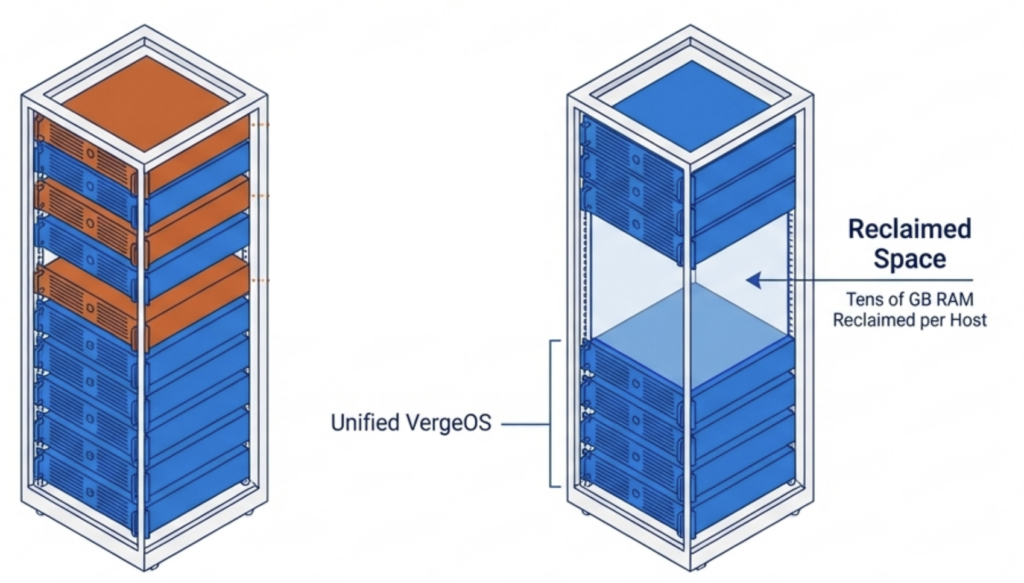
  • VergeOS runs the full stack — hypervisor, storage, and networking — at 2–3% memory overhead per node with no dedicated storage controllers and no proprietary flash requirements.

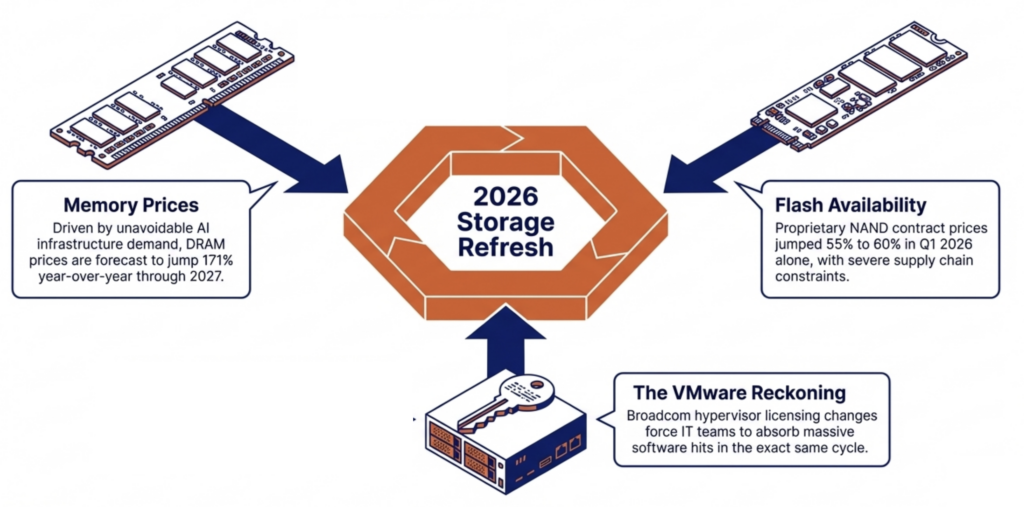
Three forces that did not exist at the same intensity two years ago are now hitting storage refresh decisions simultaneously: memory prices, flash availability, and the VMware licensing reckoning. Any one of them would force a difficult conversation. All three at once make a traditional storage refresh one of the most expensive infrastructure decisions for IT teams this year.

Key Terms
  • Storage Refresh — The process of replacing aging storage hardware — arrays, controllers, and media — with new equipment. In 2026, this process is significantly more expensive due to DRAM and NAND flash price increases.
  • DRAM (Dynamic Random Access Memory) — The primary system memory used by servers and storage controllers. Enterprise array controllers require hundreds of gigabytes of DRAM to run storage functions like deduplication, compression, and caching.
  • NAND Flash — The semiconductor storage technology used in SSDs. Contract prices jumped 55–60% in Q1 2026, driven by AI infrastructure demand that has constrained global supply.
  • Proprietary Flash — Certified storage media required by enterprise array vendors. Manufactured in smaller production runs than commodity SSDs, making supply chain disruptions more severe and price increases steeper.
  • N+2 Protection — A data availability level that sustains two simultaneous device failures without data loss. Stepping down to N+1 to save on flash capacity trades long-term resilience for short-term budget relief.
  • Flash and Memory Supercycle — The current period of elevated and constrained DRAM and NAND flash pricing driven by AI infrastructure demand. Analysts forecast supply constraints extending through 2027 and beyond.
  • Private Cloud Operating System — A software platform that unifies hypervisor, storage, and networking into a single stack running on commodity x86 hardware. VergeOS runs the full stack at 2–3% memory overhead per node with no dedicated storage controllers required.

Storage Arrays Are Memory Hogs

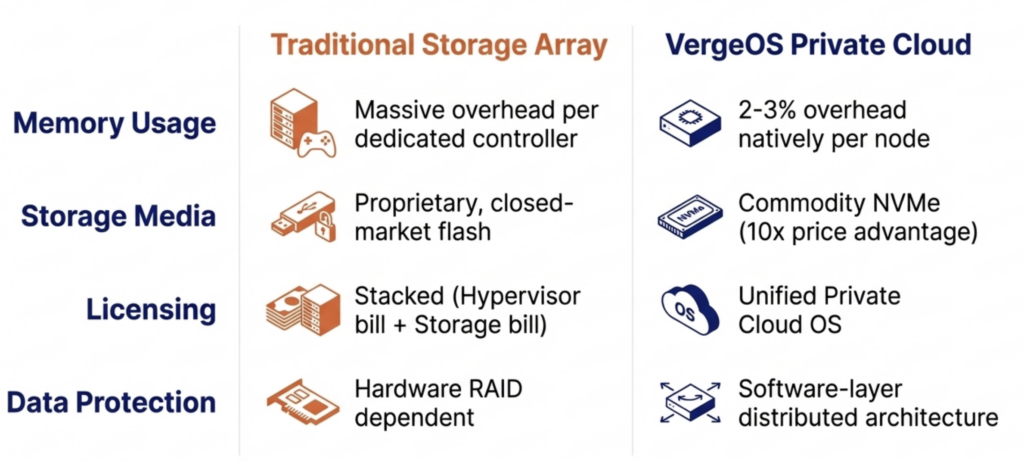
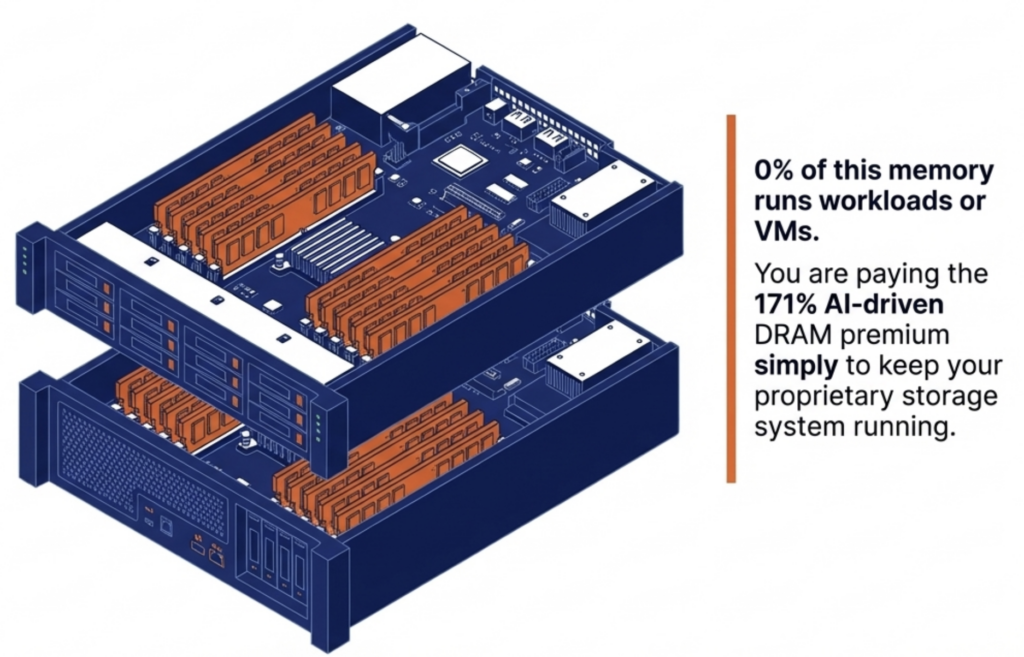
Enterprise storage controllers do not run on air. Deduplication, compression, tiering, caching, and RAID management all execute in RAM. High-end array controllers routinely require hundreds of gigabytes of memory per controller to handle these functions at production scale. That memory exists entirely to serve the storage system itself — none of it runs workloads, VMs, or appears in any application performance metric.

storage refresh cost 2026

When DRAM prices were stable, this was a footnote in a procurement spreadsheet. DRAM prices are not stable. They are up 171% year-over-year through 2027, according to current market forecasts, driven by AI infrastructure demand that enterprise IT cannot negotiate away. Storage vendors face the same supply constraints as everyone else. They are paying more for controller memory and passing that cost forward. The list price for a storage refresh today reflects a DRAM market that looks nothing like the one your last refresh was based on.

Proprietary Flash: Why Storage Refresh Costs Keep Climbing

Enterprise storage arrays require certified, proprietary flash media. The certification process exists for legitimate reasons — compatibility testing, firmware validation, performance guarantees. It also creates a closed market where vendors set prices independent of commodity flash trends.

storage refresh cost 2026

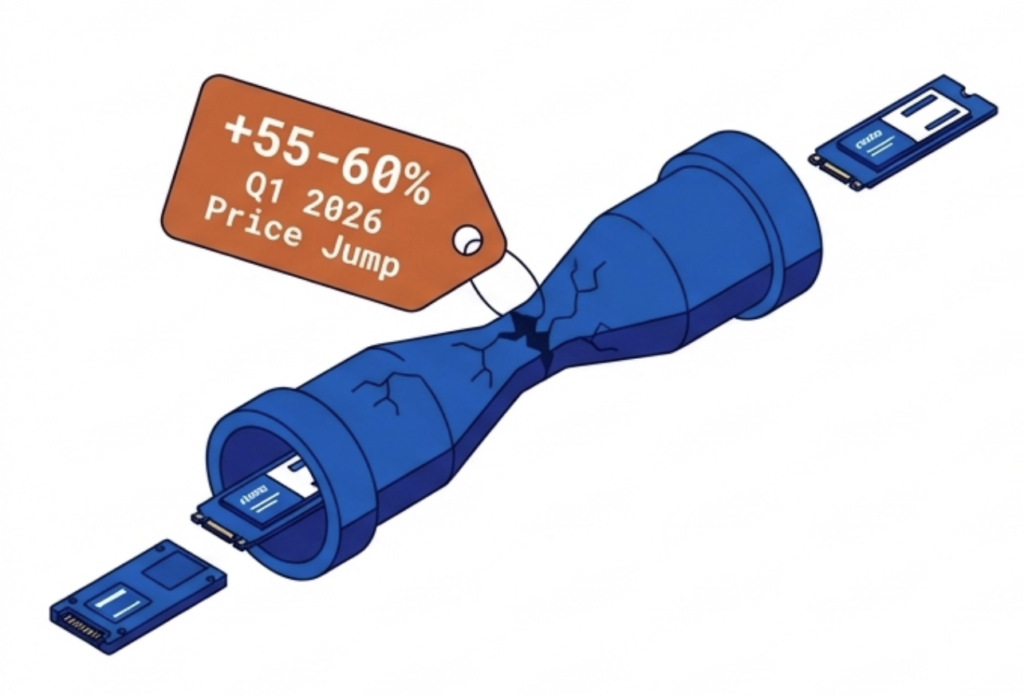
NAND flash contract prices jumped 55 to 60% in Q1 2026. Consumer and data center SSDs have both seen significant price increases. Enterprise array flash has increased further, and in many configurations, it has simply become unavailable at the quantities and timelines IT teams expected. Supply chain constraints might hit commodity flash, but they hit proprietary enterprise flash harder because production runs are smaller and certification cycles are longer. Organizations planning a storage refresh in Q1 2026 are discovering that the hardware they specified six months ago no longer ships on the same timeline or at the same price.

Under this pressure, the instinct for some IT teams is to reduce protection levels — stepping down from N+2 to N+1 to cut capacity costs. That instinct is wrong, and the reasons why are worth understanding before making a decision that trades long-term resilience for short-term budget relief. The value of your data has not gone down because flash prices went up.

VMware Licensing Changes the Total Cost Equation

Organizations evaluating a storage refresh are often doing so within the same budget cycle as they consider absorbing Broadcom’s VMware licensing changes. The two costs used to be separate line items evaluated in separate cycles. In 2026, many IT teams are considering a combined infrastructure bill that includes a storage refresh, a VMware licensing increase, and ongoing hardware cost inflation from the supercycle. The math on continuing the status quo has broken down for a significant portion of the installed base.

A Different Architecture, A Different Storage Refresh Cost

A Private Cloud Operating System like VergeOS approaches this problem from a fundamentally different position. The entire VergeOS stack — hypervisor, storage, and networking — runs at 2 to 3% memory overhead per node. There are no dedicated storage controllers, no separate storage network, and no proprietary flash requirements.

VergeOS safely leverages commodity SSDs, including consumer-grade and even refurbished drives, through its distributed architecture. The platform handles data protection and availability at the software layer, not through hardware RAID controllers that require proprietary media to function. For a detailed look at the architecture and the economics behind it, Architecting for the Flash and Memory Supercycle is available on demand.

The result is a cost structure that does not track with the supercycle the same way a dedicated storage array does. No controller memory markup. No proprietary flash sourcing problem. No separate storage licensing on top of hypervisor licensing. The same servers running the same workloads carry the storage function natively, without the dedicated hardware that is currently the most expensive and hardest-to-source component in a traditional refresh cycle.

The cost of a storage refresh in 2026 is not just higher. For many organizations, it is the wrong question entirely.

Frequently Asked Questions
  • Why are storage array costs rising faster than commodity hardware in 2026? Enterprise arrays rely on certified proprietary flash media and controller DRAM, both sourced in smaller volumes than commodity components. That makes them more vulnerable to supply chain disruptions and more expensive when constraints hit. DRAM prices are up 171% year-over-year, and those costs flow directly into array pricing.
  • Can I use commodity SSDs instead of certified enterprise flash? Not in a traditional enterprise array — those systems require certified media and will reject uncertified drives. Platforms like VergeOS are built differently. The distributed software layer handles data protection and availability, allowing commodity and even refurbished SSDs to be used safely in production.
  • Should I reduce data protection levels to lower my storage refresh cost? No. The value of your data has not declined because flash prices increased. Stepping from N+2 to N+1 extends the rebuild window during a drive failure, increasing both the risk of data loss and the performance impact on production workloads. The right response to rising storage costs is a more efficient architecture, not less protection.
  • How does VergeOS avoid dedicated storage controller costs? VergeOS integrates storage natively into the same nodes running the hypervisor and networking stack, with only 2–3% total memory overhead for the entire platform. There are no separate storage controllers, no separate storage network, and no proprietary flash requirements. The distributed architecture provides N+2 data availability using commodity SSDs on standard x86 hardware.
  • What is the Flash and Memory Supercycle? The Flash and Memory Supercycle is the current period of elevated and constrained DRAM and NAND flash pricing driven primarily by AI infrastructure demand. DRAM prices are projected to rise 171% year-over-year through 2027. NAND flash contract prices jumped 55–60% in Q1 2026 alone. Analysts forecast supply constraints extending through 2027 and potentially beyond.
  • Does this apply to hyperconverged infrastructure as well as dedicated arrays? Yes. HCI platforms that fold storage software into compute nodes carry their own memory overhead for storage services — often 20–30% of total host memory before any VM runs. That overhead has a real dollar cost at supercycle DRAM prices, whether storage lives in a dedicated array or in HCI storage software running on every node.

Filed Under: Storage Tagged With: DRAM prices, enterprise storage, FlashAndMemorySupercycle, NAND flash, private cloud, storage refresh, VergeOS, VMware alternative

March 9, 2026 by George Crump

The ability to reduce RAM consumption may be the most important factor in choosing a VMware alternative in 2026. What started as a licensing decision after Broadcom’s acquisition has become an infrastructure economics decision. Organizations began evaluating replacements to escape licensing uncertainty. Then the Flash and Memory Supercycle hit.

Key Takeaways
The Memory and Flash Supercycle is driving DRAM prices up 171% YoY through 2027, NAND flash up 55–60% in a single quarter, and server deliveries delayed by months. VMware licensing changes from Broadcom compound the pressure.
Memory ballooning, transparent page sharing, and hypervisor swapping are reactive workarounds that manage scarcity after it occurs. None of them reduce total physical RAM requirements.
VergeOS integrates virtualization, storage, networking, and data protection into a single code base that runs at 2–3% memory overhead, compared to the double-digit percentages consumed by multi-product stacks.
Topgolf reduced server count by 50% per venue across 100+ locations. Alinsco Insurance migrated a mission-critical VxRail environment during business hours with zero downtime and gained memory headroom on the same hardware.
VergeOS runs safely on commodity NVMe drives, uses global inline deduplication to reduce flash capacity requirements, and delivers snapshot-driven local replication through ioGuardian that protects against multiple simultaneous drive failures without hardware RAID.
The platform’s global deduplicated cache operates across all VMs across all nodes, caching only unique data blocks from the already-deduplicated storage pool. This drives higher cache hit rates and fewer flash reads without wasting RAM on redundant cached data.

How a Hypervisor Can Reduce RAM ConsumptionDRAM prices are expected to increase 171% year-over-year through 2027. NAND flash contract prices jumped 55–60% in Q1 2026 alone. Server orders that once shipped in weeks now face multi-month delivery delays. The platform you choose now determines how much RAM, flash, and hardware you need for the next three to five years.

171%
Projected YoY DRAM price increase through 2027
55–60%
NAND flash contract price increase in Q1 2026
Months
Server delivery delays in categories that shipped in weeks

Finding a VMware alternative is still the primary mission. But the supercycle raises the bar. It is no longer enough to swap one hypervisor for another just because it costs less to license. The replacement must also reduce RAM consumption per workload, require fewer servers, and reduce flash storage costs. Any platform that relies on memory ballooning, transparent page sharing, or hypervisor swapping to manage RAM is using the same software tricks the industry has relied on for years. Those techniques react to memory pressure after it occurs. None of them reduce the total physical RAM your infrastructure actually requires.

Key Terms
Memory and Flash Supercycle

A sustained period of rising DRAM and NAND flash prices driven by AI infrastructure demand, DDR4 end-of-life, and constrained fabrication capacity. Industry analysts project tight supply through at least 2027.

Memory Ballooning

A hypervisor technique that uses a guest driver to reclaim unused RAM from idle VMs. Reactive by design, it fails under tight VM sizing and causes cascading performance degradation when multiple VMs spike simultaneously.

Transparent Page Sharing (TPS)

A memory deduplication technique that merges identical OS pages across VMs. Limited to identical pages, disabled by default in VMware since 2014 due to security concerns, and ineffective for application data.

Global Inline Deduplication

VergeOS technology that identifies and eliminates duplicate data blocks at the storage layer before they are written to flash. Reduces total flash capacity requirements, lowers write amplification to extend drive life, and feeds only unique blocks into the RAM cache.

Global Deduplicated Cache

A VergeOS RAM cache that operates across all VMs across all nodes and draws from the already-deduplicated storage pool. Holds only unique data blocks, increasing effective cache capacity and hit rates without the CPU overhead of a separate cache-level deduplication algorithm.

ioGuardian

VergeOS data availability technology that uses snapshot-driven local replication to protect against multiple simultaneous drive failures. Eliminates the need for hardware RAID controllers and delivers consistent performance during failures and rebuilds.

Commodity NVMe

Standard NVMe solid-state drives that cost significantly less than enterprise or server-class SSDs. VergeOS makes commodity drives production-safe through software-managed wear leveling, global deduplication to reduce writes, and ioGuardian replication to handle failures gracefully.

Our on-demand webinar goes deeper into each of these points. Watch Architecting for the Flash and Memory Supercycle to see how the platform decisions you make today determine your infrastructure costs for the next three to five years.

Start with an Efficient Code Base That Reduces RAM Consumption

The first question to ask any VMware alternative is how much RAM the platform itself consumes before a single VM even starts. VMware environments running vSphere, vSAN, vCenter, and NSX stack four separate products on every host. Each product reserves memory for its own management processes. Add external replication software and hardware RAID controllers, and the cumulative overhead climbs even further.

VergeOS takes a different architectural approach. It delivers a complete private cloud operating system that integrates virtualization, storage, networking, and data protection as services within a single code base. There is no separate storage product. There is no separate networking product. The platform is built with global deduplication, enabling synchronous replication without the typical capacity impact and delivering better, more consistent performance in production and during failures.

Memory usage comparison across virtualization platformsIt eliminates the need for hardware RAID controllers, which are also increasing in price because they consume RAM. VergeOS includes built-in data replication for disaster recovery, and its global inline deduplication reduces capacity costs at the disaster recovery site as well. The entire platform runs at 2–3% memory overhead. Compare that to the double-digit percentages consumed by multi-product virtualization stacks and HCI platforms that reserve tens of gigabytes per node before workloads even start.

A lower baseline means more RAM available for production workloads on the same hardware. During a supercycle, that difference translates directly into fewer servers needing to be purchased at inflated prices.

Use Existing Hardware and Reduce How Much You Need

Server reduction through VergeOS consolidationVergeOS installs on any x86 server from any manufacturer. Organizations migrating from VMware continue to run on the same physical servers they already own. There is no hardware forklift upgrade. No waiting six months for new server deliveries that keep getting pushed back as memory and flash shortages worsen. The servers, RAM, and SSDs already purchased and deployed remain in production.

Getting there does not require the purchase of a parallel environment or even a maintenance window. VergeOS supports node-by-node migration from VMware. Evacuate workloads from one host, install VergeOS on that host, migrate VMs onto the new platform, and repeat across the remaining hosts. Production continues running throughout the process. Alinsco Insurance completed this on a five-node VxRail cluster running a mission-critical insurance application that cannot tolerate downtime. The team migrated node by node during business hours with zero downtime. Critical web servers were moved at night out of an abundance of caution, but even those migrations produced no service interruption. During a supercycle, this approach eliminates the capital expense of purchasing a second set of servers to stand up alongside the existing environment.

On-Demand Webinar
Architecting for the Flash and Memory Supercycle

How the platform decisions you make today determine your infrastructure costs for the next three to five years.

Watch On-Demand →

Because VergeOS consumes less RAM per host, organizations can increase VM density and consolidate to fewer servers. Topgolf, operating more than 100 venues globally, reduced each site from six-node VxRail clusters to three-node VergeOS clusters. That is a 50% server reduction per venue. Alinsco Insurance continued to run on the same VxRail hardware and internal SSDs after migration, and servers that felt constrained under VMware gained additional headroom under VergeOS.

The freed servers create immediate value. One becomes a dedicated ioGuardian server, delivering N+2 or greater (N+X) data protection without purchasing new hardware or hardware RAID. The remaining servers become part donors. Pull the DRAM and NVMe drives and redistribute them across the active production nodes. VergeOS supports mixed node types and mixed node roles in the same cluster, so the redistribution does not require matching hardware specifications.

Freed servers from VergeOS consolidation become parts donors or ioGuardian nodesThe consolidation math works across an entire fleet. An organization running 100 six-node VMware clusters that consolidates to 100 three-node VergeOS clusters frees 300 servers for repurposing, retirement, or spare parts — during a supercycle where replacement hardware is both expensive and slow to ship.

Reduce Flash Costs with Commodity SSDs

The supercycle affects flash storage as well as memory. Enterprise and server-class SSDs carry steep price premiums that continue to climb alongside NAND contract prices. Commodity NVMe drives are rising in price, too. But the price gap between enterprise and commodity is widening, not narrowing, and commodity drives do seem to be more readily available. Organizations that can safely run on commodity flash pay less per terabyte today relative to enterprise alternatives than they did a year ago.

VergeOS runs safely on commodity SSDs. The platform’s storage engine manages I/O scheduling and wear management at the software layer, reducing dependence on the drive’s internal controller. Global inline deduplication reduces total writes to each drive, directly extending drive life. ioGuardian’s snapshot-driven local replication protects against multiple simultaneous drive failures without data loss or downtime, so that a commodity drive that wears out faster than an enterprise drive is replaced gracefully. No hardware RAID controller is required. The combination makes commodity flash a production-safe choice at a fraction of the cost of enterprise SSDs.

A Cache That Benefits from Deduplication

Unified RAM cache across VergeOS nodes drawing from deduplicated storage poolMost virtualization platforms cache storage data independently on each node. If ten nodes access the same data block, ten separate copies sit in ten separate caches. That wastes RAM on redundant data across the cluster.

VergeOS approaches caching differently. The platform performs global inline deduplication at the storage layer, so the storage pool contains only unique blocks. The RAM cache operates across all VMs across all nodes and draws from that already-deduplicated pool. The cache holds only unique data without running a separate deduplication algorithm inside the cache itself. More unique blocks fit in the same physical RAM, driving higher cache hit rates and fewer reads from flash.

An important factor in making this work across nodes is VergeOS’s optimized internode communication protocol, purpose-built for this use case and free from the overhead of chatty iSCSI or NFS protocols. We will explore the technical details of this architecture in an upcoming post. The takeaway for now: VergeOS does not waste RAM caching duplicate data.

The VMware Alternative Decision Just Got Bigger

The search for a VMware alternative is no longer just about licensing. The supercycle means the platform you choose determines your RAM consumption, your flash costs, your server count, and how long your existing hardware stays in production. Choose a platform that relies on the same memory tricks the industry has used for decades, and you inherit the same overhead during the most expensive hardware market in years. Choose a platform built to reduce RAM consumption from a single efficient code base with built-in data availability, and you start with less overhead, run on the servers you already own, and reduce how many you need going forward.

Frequently Asked Questions
What is the Memory and Flash Supercycle?
A sustained period of rising DRAM and NAND flash prices driven by AI infrastructure demand, DDR4 end-of-life, and constrained fabrication capacity. DRAM prices are expected to increase 171% year-over-year through 2027, and NAND flash contract prices jumped 55–60% in Q1 2026 alone. Server delivery times have extended to multi-month delays.
Why don’t memory ballooning and transparent page sharing solve the problem?
These are reactive techniques that manage memory pressure after it occurs. Memory ballooning reclaims unused RAM from idle VMs but fails under tight sizing. Transparent page sharing merges identical OS pages but has been disabled by default in VMware since 2014 due to security concerns. Neither technique reduces the total physical RAM your infrastructure requires.
How much RAM overhead does VergeOS consume?
The entire VergeOS platform — including virtualization, storage, networking, and data protection — runs at 2–3% memory overhead. Compare that to multi-product VMware stacks that consume double-digit percentages, or HCI platforms like Nutanix that reserve 24–32 GB per node for controller VMs before workloads start.
Can I migrate from VMware without buying new servers?
Yes. VergeOS installs on any x86 server from any manufacturer and supports node-by-node migration from VMware. Evacuate workloads from one host, install VergeOS, migrate VMs onto the new platform, and repeat. The servers, RAM, and SSDs you already own stay in production. Alinsco Insurance completed this on a five-node VxRail cluster during business hours with zero downtime.
How does VergeOS reduce the number of servers needed?
Lower platform overhead means more RAM is available for production workloads on each host, increasing VM density. Topgolf reduced each venue from six-node VxRail clusters to three-node VergeOS clusters — a 50% reduction in servers across more than 100 locations. Freed servers become parts donors or dedicated ioGuardian data protection nodes.
Is it safe to run commodity NVMe drives in production?
With VergeOS, yes. The storage engine manages I/O scheduling and wear management at the software layer. Global inline deduplication reduces total writes to each drive, extending drive life. ioGuardian’s snapshot-driven local replication protects against multiple simultaneous drive failures without hardware RAID, so a commodity drive that wears faster is replaced gracefully with no data loss or downtime.
How does VergeOS cache data differently from VMware or Nutanix?
Most platforms cache storage data independently on each node, meaning duplicate blocks are cached separately on every host. VergeOS performs global inline deduplication at the storage layer first, then the RAM cache draws from the already-deduplicated pool. The cache holds only unique blocks across all VMs across all nodes, using an optimized internode protocol instead of iSCSI or NFS. More unique data fits in the same physical RAM, driving higher cache hit rates.
What happens to servers freed up after consolidation?
One freed server becomes a dedicated ioGuardian node, delivering N+2 or greater data protection without a new hardware purchase and without hardware RAID. The remaining servers become parts donors — pull the DRAM and NVMe drives and redistribute them across active production nodes. VergeOS supports mixed node types and mixed node roles, so no matching hardware specifications are required.

Filed Under: Private Cloud Tagged With: Cache, data protection, Deduplication, FlashAndMemorySupercycle, Migration, Performance, servers, Storage, VergeOS, VMware, VMware alternative

April 20, 2023 by George Crump

VergeOS can provide complete layer 2 and layer 3 functionality! This video shows you how to tap into the full potential of VergeOS’ networking capabilities. Our latest LightBoard video features CEO Yan Ness and Director of Product Development Paul Hodges, taking you through VergeOS Networking Fundamentals.

Filed Under: Videos Tagged With: networking, VergeOS

855-855-8300

Get Started

  • Versions
  • Request Tour

VergeIO For

  • VMware Alternative
  • SAN Replacement
  • Solving Infrastructure Modernization Challenges
  • Artificial Intelligence
  • Hyperconverged
  • Server Room
  • Secure Research Computing

Product

  • Benefits
  • Documents
  • Architecture Overview
  • Use Cases
  • Videos

Company

  • About VergeIO
  • Blog
  • Technical Documentation
  • Legal

© 2026 VergeIO. All Rights Reserved.