• Skip to main content
  • Architecture
    • Overview
      Learn about VergeOS’ unique unfied architecture that integrates virtualization, storage, networking, AI, backup and DR into a single data center operating system
    • Infrastructure Wide Deduplication
      VergeOS transforms deduplication from a storage-only commodity into a native, infrastructure-wide capability that spans storage, virtualization, and networking, eliminating hidden resource taxes
    • VergeFS
      VergeFS is a distributed, high-performance global file system integrated into VergeOS, unifying storage across nodes, tiers, and workloads while eliminating the need for external SANs
    • VergeFabric
      VergeFabric is VergeOS’s integrated virtual networking layer, delivering high-speed, low-latency communication across nodes while eliminating the complexity of traditional network configurations.
    • Infrastructure Automation
      VergeOS integrates Packer, Terraform, and Ansible to deliver an end-to-end automation pipeline that eliminates infrastructure drift and enables predictable, scalable deployments.
    • VergeIQ
      Unlock secure, on-premises generative AI—natively integrated into VergeOS. With VergeIQ, your enterprise gains private AI capabilities without the complexity, cloud dependency, or token-based pricing.
  • Features
    • Virtual Data Centers
      A VergeOS Virtual Data Center (VDC) is a fully isolated, self-contained environment within a single VergeOS instance that includes its own compute, storage, networking, and management controls
    • High Availability
      VergeOS provides a unified, easy-to-manage infrastructure that ensures continuous high availability through automated failover, storage efficiency, clone-like snapshots, and simplified disaster recovery
    • ioClone
      ioClone utilizes global inline deduplication and a blockchain-inspired file system within VergeFS to create instant, independent, space-efficient, and immutable snapshots of individual VMs, volumes, or entire virtual data centers.
    • ioReplicate
      ioReplicate is a unified disaster-recovery solution that enables simple, cost-efficient DR testing and failover via three‑click recovery of entire Virtual Data Centers—including VMs, networking, and storage.
    • ioFortify
      ioFortify creates immutable, restorable VDC checkpoints and provides proactive ransomware detection with instant alerts for rapid recovery and response.
    • ioMigrate
      ioMigrate enables large-scale VMware migrations, automating the rehosting of hundreds of VMs (including networking settings) in seconds with minimal downtime by seamlessly transitioning entire VMware environments onto existing hardware stacks.
    • ioProtect
      ioProtect offers near-real-time replication of VMware VMs—including data, network, and compute configurations—to a remote disaster‑recovery site on existing hardware, slashing DR costs by over 60% while supporting seamless failover and testing in an efficient, turnkey VergeOS Infrastructure.
    • ioOptimize
      ioOptimize leverages AI and machine learning to seamlessly integrate new and old hardware and automatically migrate workloads from aging or failing servers.
    • ioGuardian
      ioGuardian is VergeIO’s built-in data protection and recovery capability, providing near-continuous backup and rapid VM recovery during multiple simultaneous drive or server failures.
  • IT Initiatives
    • VMware Alternative
      VergeOS offers seamless migration from VMware, enhancing performance and scalability by consolidating virtualization, storage, and networking into a single, efficient platform.
    • Hyperconverged Alternative
      VergeIO’s page introduces ultraconverged infrastructure (UCI) via VergeOS, which overcomes HCI limitations by supporting external storage, scaling compute and storage independently, using existing hardware, simplifying provisioning, boosting resiliency, and cutting licensing costs.
    • SAN Replacement / Storage Refresh
      VergeIO’s storage by replacing aging SAN/NAS systems within its ultraconverged infrastructure, enhancing security, scalability, and affordability.
    • Infrastructure Modernization
      Legacy infrastructure is fragmented, complex, and costly, built from disconnected components. VergeOS unifies virtualization, storage, networking, data protection, and AI into one platform, simplifying operations and reducing expenses.
    • Virtual Desktop Infrastructure (VDI)
      VergeOS for VDI delivers a faster, more affordable, and easier-to-manage alternative to traditional VDI setups—offering organizations the ability to scale securely with reduced overhead
    • Secure Research Computing
      VergeIO's Secure Research Computing solution combines speed, isolation, compliance, scalability, and resilience in a cohesive platform. It’s ideal for institutions needing segmented, compliant compute environments that are easy to deploy, manage, and recover.
    • Venues, Remote Offices, and Edge
      VergeOS delivers resiliency and centralized management across Edge, ROBO, and Venue environments. With one platform, IT can keep remote sites independent while managing them all from a single pane of glass.
  • Blog
      • VMware Alternatives Must Be AI-ReadyAn AI-ready VMware alternative has to do more than replace virtualization. It has to handle the containers, GPUs, and private AI workloads that arrive next. Here are the five things to look for and how to test them on hardware you already own.
      • Surviving Cascading Drive FailureCascading drive failure is the scenario every operator dreads. One drive fails, rebuilds spin up, then a second and third drive give out as the surviving drives wear faster. VergeOS keeps VMs running through synchronous replication, ioGuardian inline recovery, and live migration, even when the cascade exceeds RF2 and RF3.
      • Evaluating Kubernetes? Pick Your Foundation First.On May 20, half the live audience said they're still evaluating Kubernetes. The harder question is whether a team can evaluate Kubernetes and exit VMware at the same time. The platform underneath the cluster decides more of the five-year operations math than the distribution does. Pick the foundation first.
    • View All Posts
  • Resources
    • Become a Partner
      Get repeatable sales and a platform built to simplify your customers’ infrastructure.
    • Technology Partners
      Learn about our technology and service partners who deliver VergeOS-powered solutions for cloud, VDI, and modern IT workloads.
    • White Papers
      Explore VergeIO’s white papers for practical insights on modernizing infrastructure. Each paper is written for IT pros who value clarity, performance, and ROI.
    • In The News
      See how VergeIO is making headlines as the leading VMware alternative. Industry analysts, press, and partners highlight our impact on modern infrastructure.
    • Press Releases
      Get the latest VergeOS press releases for news on product updates, customer wins, and strategic partnerships.
    • Case Studies
      See how organizations like yours replaced VMware, cut costs, and simplified IT with VergeOS. Real results, real environments—no fluff.
    • Webinars
      Explore VergeIO’s on-demand webinars to get straight-to-the-point demos and real-world infrastructure insights.
    • Documents
      Get quick, no-nonsense overviews of VergeOS capabilities with our datasheets—covering features, benefits, and technical specs in one place.
    • Videos
      Watch VergeIO videos for fast, focused walkthroughs of VergeOS features, customer success, and VMware migration strategies.
    • Technical Documentation
      Access in-depth VergeOS technical guides, configuration details, and step-by-step instructions for IT pros.
  • How to Buy
    • Schedule a Demo
      Seeing is believing, set up a call with one of our technical architects and see VergeOS in action.
    • Versions
      Discover VergeOS’s streamlined pricing and flexible deployment options—whether you bring your own hardware, choose a certified appliance, or run it on bare metal in the cloud.
    • Test Drive – No Hardware Required
      Explore VergeOS with VergeIO’s hands-on labs and gain real-world experience in VMware migration and data center resiliency—no hardware required
  • Company
    • About VergeIO
      Learn who we are, what drives us, and why IT leaders trust VergeIO to modernize and simplify infrastructure.
    • Support
      Get fast, expert help from VergeIO’s support team—focused on keeping your infrastructure running smoothly.
    • Careers
      Join VergeIO and help reshape the future of IT infrastructure. Explore open roles and growth opportunities.
  • 855-855-8300
  • Contact
  • Search
  • 855-855-8300
  • Contact
  • Search
  • Architecture
    • Overview
    • VergeFS
    • VergeFabric
    • Infrastructure Automation
    • VergeIQ
  • Features
    • Virtual Data Centers
    • High Availability
    • ioClone
    • ioReplicate
    • ioFortify
    • ioMigrate
    • ioProtect
    • ioOptimize
    • ioGuardian
  • IT Initiatives
    • VMware Alternative
    • Hyperconverged Alternative
    • SAN Replacement / Storage Refresh
    • Infrastructure Modernization
    • Virtual Desktop Infrastructure (VDI)
    • Secure Research Computing
    • Venues, Remote Offices, and Edge
  • Blog
  • Resources
    • Become a Partner
    • Technology Partners
    • White Papers
    • In The News
    • Press Releases
    • Case Studies
    • Webinars
    • Documents
    • Videos
    • Technical Documentation
  • How to Buy
    • Schedule a Demo
    • Versions
    • Test Drive – No Hardware Required
  • Company
    • About VergeIO
    • Support
    • Careers
×
  • Architecture
    • Overview
    • VergeFS
    • VergeFabric
    • Infrastructure Automation
    • VergeIQ
  • Features
    • Virtual Data Centers
    • High Availability
    • ioClone
    • ioReplicate
    • ioFortify
    • ioMigrate
    • ioProtect
    • ioOptimize
    • ioGuardian
  • IT Initiatives
    • VMware Alternative
    • Hyperconverged Alternative
    • SAN Replacement / Storage Refresh
    • Infrastructure Modernization
    • Virtual Desktop Infrastructure (VDI)
    • Secure Research Computing
    • Venues, Remote Offices, and Edge
  • Blog
  • Resources
    • Become a Partner
    • Technology Partners
    • White Papers
    • In The News
    • Press Releases
    • Case Studies
    • Webinars
    • Documents
    • Videos
    • Technical Documentation
  • How to Buy
    • Schedule a Demo
    • Versions
    • Test Drive – No Hardware Required
  • Company
    • About VergeIO
    • Support
    • Careers

Container Platform

June 3, 2026 by George Crump

To be more than a hypervisor swap, IT professionals need to look for an AI-ready VMware alternative. The Broadcom acquisition has rewritten the economics of virtualization, and many IT teams are still trying to escape renewal costs that no longer justify the value received.

Treating the VMware exit as a single-platform replacement project is a mistake, especially since the next infrastructure decision is already taking shape around AI. That decision arrives faster than most teams expect, and the platform selected during the VMware exit determines whether private AI becomes practical or prohibitively expensive.

An AI-ready VMware alternative now has to pass two tests. The platform has to replace VMware without forcing an application redesign, and it has to support the AI workloads that will land in the data center next.

Key Takeaways
  • An AI-ready VMware alternative has to pass two tests: replace the platform today and run AI workloads tomorrow.
  • A platform that solves virtualization but not AI forces a second infrastructure decision a year or two later.
  • Test AI readiness on existing hardware before committing to a replacement.

Why an AI-Ready VMware Alternative Matters Now

Many organizations begin their AI journey with public services. That approach removes the need to purchase infrastructure, hire specialists, or learn new operational models. The problem is that most successful AI projects eventually encounter limits that are difficult to solve from outside the organization.
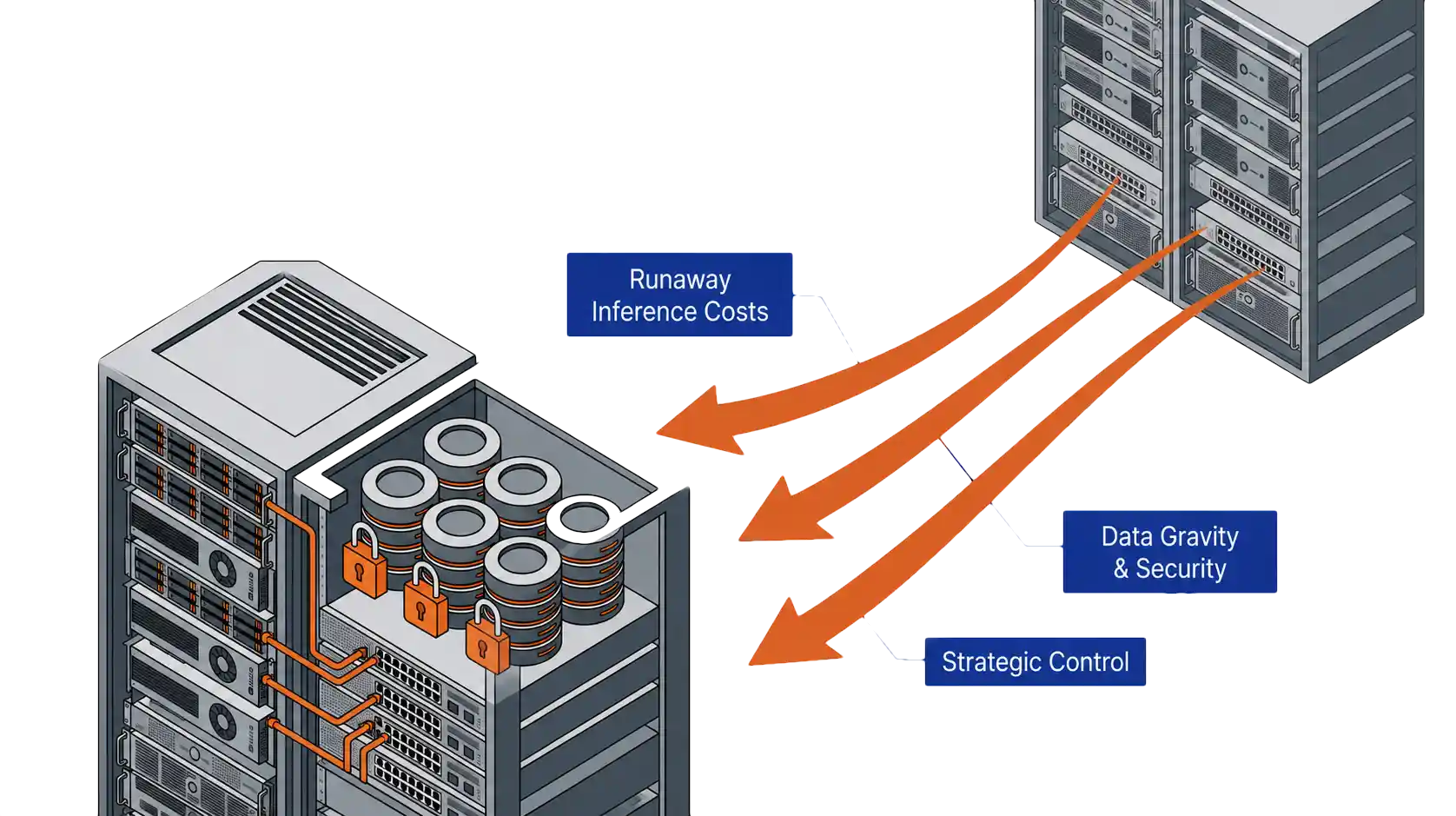
Why an AI-ready VMware alternative matters: cost, data gravity, and strategic control

Cost

Public AI platforms charge for every interaction (Token Costs). A handful of occasional questions costs little, and an assistant used by hundreds of employees, a document analysis platform processing millions of records, or a customer-facing application serving thousands of daily requests creates a very different economic picture. Recurring inference costs grow faster than expected, and at some point, owning the infrastructure costs less than renting for every transaction.

Data Gravity

The most valuable AI systems depend on internal documents, customer records, operational procedures, financial data, and institutional knowledge. Moving that data into external AI environments introduces governance, compliance, security, and operational concerns. The more valuable the data, the stronger the incentive to keep the AI system close to the source.

Strategic Control

AI is rapidly becoming part of an organization’s competitive advantage. When customer service workflows, software development assistance, and decision support systems depend entirely on external providers, pricing changes, model updates, and availability decisions remain outside the organization’s control.

Not every AI workload belongs in the data center, and public AI services continue to play an important role. Most organizations will identify a set of AI workloads that cost less, are governed more cleanly, and operate more strategically on their own infrastructure. The platform selected during the VMware exit is also the foundation for those workloads. An AI-ready VMware alternative pulls both jobs together from day one.

Key Terms
Private Cloud Operating System (PCOS)
A single integrated codebase for compute, storage, networking, protection, and AI. Different from hyperconverged platforms that wrap separate products behind one management GUI.
NVIDIA vGPU 20
NVIDIA’s virtual GPU release for the 2026 generation of accelerators. Lets a single physical GPU host multiple virtual machine workloads.
Multi-Instance GPU (MIG)
A partitioning technology that splits a physical GPU into independent slices, each with its own memory and compute. Different workloads share one accelerator without contending for resources.
VergeIQ
VergeIO’s integrated AI runtime. Runs private language models, retrieval-augmented generation applications, document analysis systems, and AI assistants on the same cluster that hosts virtual machines and containers.
Retrieval-Augmented Generation (RAG)
An AI pattern that pulls relevant content from a private document store at query time and feeds it to a language model. Keeps proprietary data inside the organization and improves answer accuracy.

What to Look For in an AI-Ready VMware Alternative

Most organizations begin their VMware evaluation with a familiar checklist. Those requirements remain important. The first job of any VMware alternative is replacing the platform that already runs the business.

Virtualization baseline: the five requirements of an AI-ready VMware alternative

Migration Simplicity

Existing VMware workloads should move without application redesign, operating system changes, or lengthy conversion projects. The migration process should preserve virtual machines, networking, and storage configurations and minimize downtime. Less time rebuilding workloads means faster realization of savings.

Feature Parity

High availability, live migration, snapshots, distributed resource management, virtual networking, and integrated storage services need to operate as mature production capabilities, not features that require workarounds to reach the same outcome.

Stronger Protection

A VMware migration is the opportunity to improve recovery capabilities, not duplicate them. Native replication, immutable snapshots, ransomware detection, rapid recovery workflows, and integrated disaster recovery all belong in the evaluation.

Live Webinar · June 11
Beyond the Hypervisor Swap

Greg Campbell and former VMware CTO Kit Colbert walk through the VergeOS 2026 architecture and how one platform handles VMs, containers, GPUs, and AI services.

Register Now

Operational Simplicity

Many organizations left VMware over more than licensing. They also became frustrated with a virtualization stack that had evolved into multiple products, each with its own management, upgrade, troubleshooting, and expertise. Storage, networking, virtualization, security, automation, monitoring, and recovery became independent layers, often behind a unified interface that hid the seams.

The platform should reduce operational complexity, not recreate it. A unified architecture should run virtualization, storage, networking, protection, and automation as part of a single system. The default decision of swapping hypervisors, replacing VMware with another loosely integrated stack, exchanges one form of complexity for another. The goal is simplification, not substitution.

Licensing Simplicity

Licensing costs were the catalyst for leaving VMware in the first place. Replacing one complicated licensing structure with another postpones the problem. The alternative should deliver predictable economics that hold steady as the environment grows and not penalize the organization for increasing density, which is the consequence of a “per-core” licensing model.

These five requirements form the foundation of an AI-ready VMware alternative, and they are where most evaluations stop. None of them answers the next infrastructure question. They determine whether a platform replaces VMware, not whether that same platform supports the AI workloads many organizations will bring into their own data centers. A platform can satisfy every item on this checklist and still force a second infrastructure decision a year or two later. The missing consideration is AI readiness.

The Missing Criterion of an AI-Ready VMware Alternative

The search for an AI-ready VMware alternative begins where most evaluations end. Many platforms start to fall short on feature parity with VMware. Most also lack a clear path to AI. Some require separate platforms or additional licensing to support containers. Others support GPUs through disconnected infrastructure. Many force organizations to build, operate, and support an entirely separate AI environment.

Virtual machines and AI workloads on a single platform: the AI-ready VMware alternative

The result is a platform that solves today’s virtualization challenge and creates tomorrow’s infrastructure challenge.

As AI workloads move into the private data center, requirements change. Containers become as important as virtual machines. GPU resources become shared infrastructure. AI services need the same data, protection, networking, and recovery framework as the rest of the business.

A platform that cannot meet those requirements forces a second infrastructure decision. New hardware gets purchased, a separate AI environment goes online, and a second team starts supporting it. The organization that set out to simplify operations ends up adding complexity.

The better approach is to select an AI-ready VMware alternative that handles both traditional virtualization and private AI from day one.

Kubernetes as a First-Class Workload

Most modern AI applications deploy as containers. Kubernetes should operate on the same infrastructure as virtual machines and share the same networking, protection, and disaster recovery framework. Containers should not require a separate infrastructure stack.

GPU Sharing and Virtualization

GPUs are among the most expensive resources in the data center, and few organizations justify dedicating an entire accelerator to a single workload. The platform should support NVIDIA vGPU 20 and universal Multi-Instance GPU (MIG) so AI inference, VDI, engineering, and analytics workloads share one physical GPU.

Integrated AI Runtime

Running private AI should not require building a separate AI platform. Solutions such as VergeIQ deploy private language models, retrieval-augmented generation applications, document analysis systems, and AI assistants directly on the cluster that already hosts virtual machines and containers.

Storage Performance

Inference workloads depend on rapid access to models, embeddings, and vector databases. Infrastructure delivering millions of IOPS with sub-millisecond latency on standard NVMe eliminates the bottlenecks that traditionally justified dedicated AI infrastructure.

Architectural and Operational Simplicity

AI should not introduce another set of servers, storage systems, and management tools, nor require a dedicated infrastructure team. The goal is one platform that supports virtual machines, containers, GPUs, and AI services within a single operational framework managed by the same infrastructure team.

That is where many VMware alternatives fall short. They solve the virtualization problem and leave the AI problem for next year. Organizations that avoid a second platform decision choose a platform that handles both from day one.

VMware Exit: Today’s Checklist vs. Tomorrow’s Workload

CapabilityVirtualization-First ChecklistAI-Ready VMware Alternative
ContainersSeparate cluster, separate licenseKubernetes as a first-class workload
GPU supportOptional add-on, often per-hostvGPU and MIG sharing across workloads
AI runtimeBuild it yourselfIntegrated runtime (VergeIQ)
StorageTuned for VM I/ONVMe-native, sub-millisecond latency
Operational modelSeparate team for AIOne team, one operational framework

Prove an AI-Ready VMware Alternative on Hardware You Already Own

Evaluating an AI-ready VMware alternative does not require new hardware. The best proof of concept runs on the cluster already sitting in the data center, whether VxRail, ReadyNode, or commodity servers. On that hardware, migrate a virtual machine, deploy a Kubernetes workload, and run a private AI inference workload.

Measure the migration effort. Measure the infrastructure needed to support containers. Measure how GPUs get shared and managed across workloads. The most telling question is whether one team can manage it all through a common operational framework.

The real test is not whether a platform runs virtual machines. Nearly every alternative does that. The test is whether the platform becomes the foundation for the next decade of infrastructure. If virtual machines, containers, GPUs, and AI services each require different platforms, tools, and teams, then the evaluation has already produced its answer.

Organizations evaluating an AI-ready VMware alternative have one opportunity to make a single platform decision. The harder requirement is picking the platform that eliminates the need for another infrastructure decision eighteen months from now.

Take a VergeOS Test Drive and see how virtual machines, Kubernetes, GPU virtualization, and VergeIQ operate on a single platform. Greg Campbell and former VMware CTO Kit Colbert walk through the architecture live on June 11. Registration is open.
Frequently Asked Questions
What is an AI-ready VMware alternative?
An AI-ready VMware alternative is a platform that replaces VMware for traditional virtualization and also runs the containers, GPU workloads, and private AI services that follow. It treats Kubernetes, GPU sharing, integrated AI runtime, and high-performance NVMe storage as first-class capabilities, not bolt-ons.
Why does AI readiness factor into a VMware replacement?
AI workloads are arriving in production faster than most infrastructure cycles. Cost, data governance, and strategic control will push most successful AI projects into the private data center within the same window as the typical VMware exit. A VMware alternative chosen for virtualization alone will struggle to handle the containers, GPUs, and AI runtime that follow.
What is a Private Cloud Operating System?
A Private Cloud Operating System integrates compute, storage, networking, protection, and AI in a single codebase. The integration happens in the code, not in a management GUI that ties separate products together. The result is one platform, one operational model, and one team.
Does an AI-ready VMware alternative need NVIDIA vGPU and MIG support?
Yes. VergeOS supports NVIDIA vGPU 20 and universal MIG, allowing a single physical GPU to host multiple isolated virtual machine or container workloads. AI inference, VDI, engineering applications, and analytics workloads share the same accelerator infrastructure.
How does VergeIQ fit into an AI-ready VMware alternative?
VergeIQ runs on the same VergeOS cluster that hosts virtual machines and containers. Organizations deploy private language models, retrieval-augmented generation applications, document analysis systems, and AI assistants directly on the platform that already runs the rest of the business. No separate AI infrastructure required.
Can an AI-ready VMware alternative run on the same hardware that hosted VMware?
Yes. VergeOS runs on existing VxRail, ReadyNode, and commodity server hardware. Most VMware replacement evaluations begin on hardware already in production, which removes the need for a separate hardware purchase to validate the platform.

Filed Under: AI Tagged With: AI, Alternative, Container Platform, IT infrastructure, VMware

May 26, 2026 by George Crump

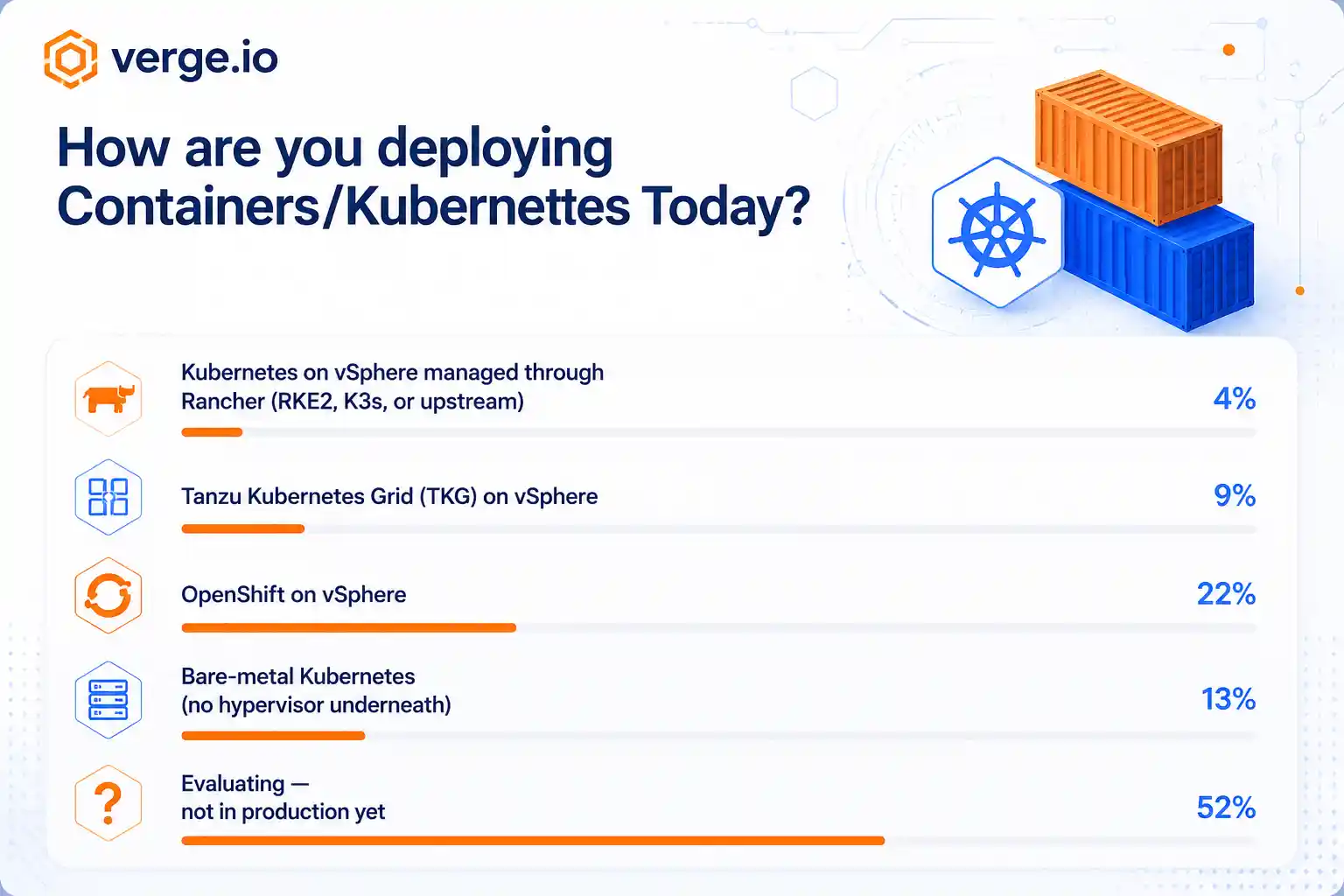
Live webinars produce one piece of data no white paper captures cleanly. That data is the audience poll. On May 20, the first poll on Kubernetes Without the VMware Tax asked attendees how their team runs Kubernetes in production today. Roughly half answered the same way. Kubernetes is still in the evaluation column, not yet running in production.

May 20 webinar poll results showing roughly half of attendees still evaluating Kubernetes

The trade press paints a picture of every enterprise running Kubernetes for years, and the poll told a different story. For a team in that evaluating column, the exit from VMware has become the new priority. The real question is whether the team can evaluate Kubernetes and exit VMware at the same time.

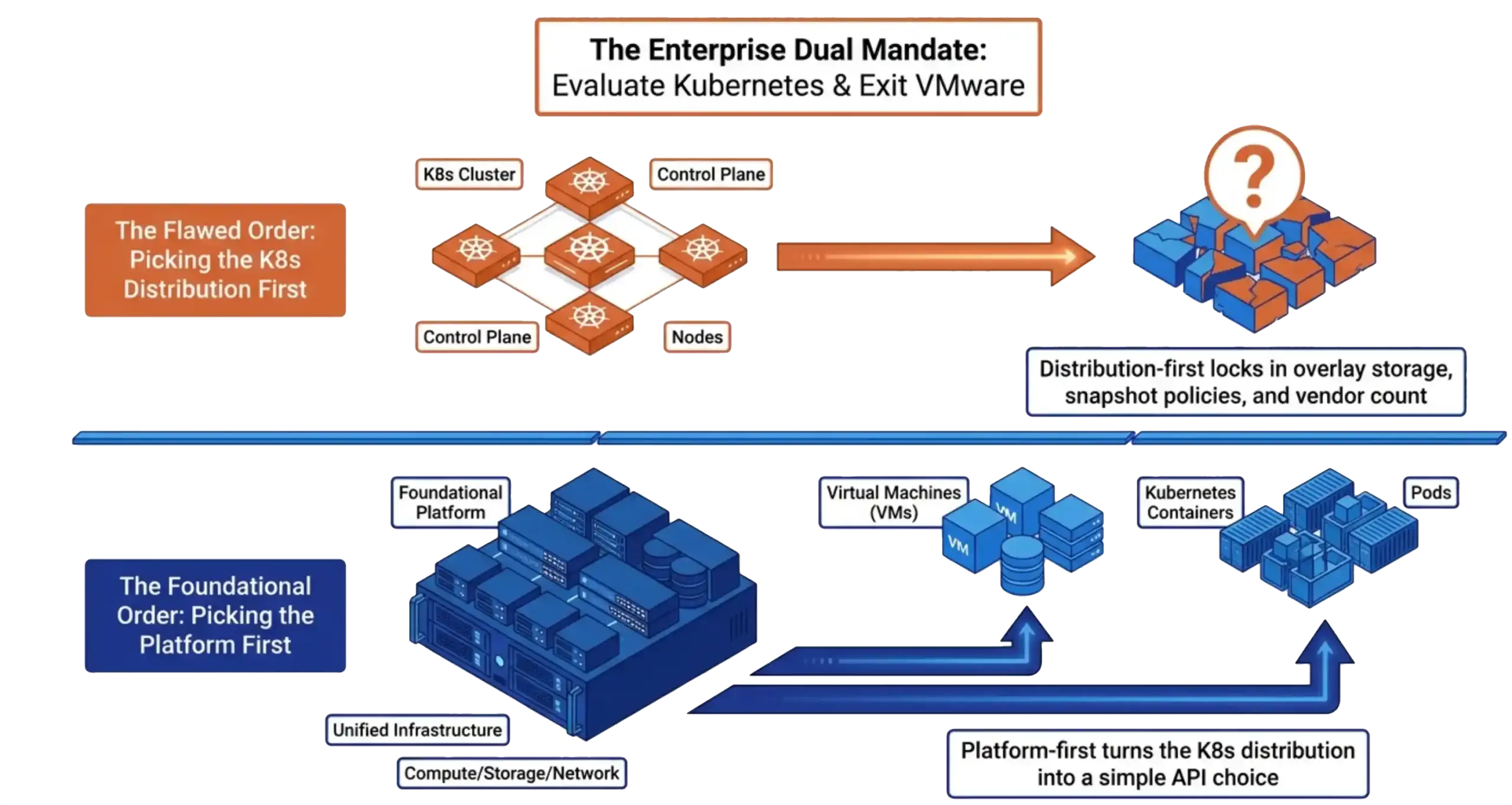
The argument is straightforward. The platform underneath the Kubernetes layer decides more of the long-run operations math than the distribution does. The full architectural case lives in Collapsing the Kubernetes Stack, the long-form companion paper to this post, and the dollar math gets walked separately in The Kubernetes VMware Exit Math, Explained. Pick the platform last, and the distribution choice locks in the storage layer, the snapshot policy, and the vendor count. Pick it first, and the distribution choice becomes a distribution choice.

Key Takeaways
  • Pick the platform first. Exiting VMware to a platform that understands containers answers the foundation question and the distribution question inside the same project.
  • Running Kubernetes on a hypervisor not designed for container workloads adds a translation tax in storage, networking, and lifecycle, and that tax compounds at every renewal.
  • VergeOS publishes three Helm charts from a single Cluster Repository on GitHub, ships persistent volumes natively from the same storage that runs the VMs, and presents both workload types through Rancher. One platform, one support contract, two workload types.

Does the environment need Kubernetes?

The hardest question for a team evaluating Kubernetes is not which distribution to pick. The hardest question is whether the environment needs Kubernetes at all. Plenty of environments need Kubernetes for the right reasons. Plenty of others do not, and the honest answer matters more than the marketing.

The honest answer in the room on May 20 came from David Zarzycki, the engineer who did most of the work on the VergeOS Kubernetes integration. His phrasing was the right one. Is your environment complex enough to warrant the complexity of running Kubernetes at all?

Kubernetes earns its keep when applications change frequently, when teams ship daily, when multi-tenancy is real, when GPU scheduling matters, and when developer self-service is a stated requirement. A two-tier ERP application with a six-month release cycle does not need Kubernetes. A microservices platform with twenty deploy events per day does. Most production environments have both kinds of workloads sitting side by side, and that mix is exactly why the foundation question matters more than the distribution question.

A clean example of a Kubernetes-shaped workload looks like a retail analytics platform that ingests several million transaction events per hour, runs a dozen microservices scaling independently against the event stream, and ships code multiple times a day with feature flags and blue-green rollouts. Storage demand spikes during peak hours. Compute demand spikes around marketing campaigns. The engineering team treats every service as independently deployable. That workload pattern is what Kubernetes was built for, and the platform underneath has to keep up with it. The two-tier ERP application sitting next to that platform does not need any of that machinery, and asking Kubernetes to run it is the wrong tool for the wrong job.

Key Terms
Foundational Platform
The compute, storage, and networking substrate underneath the Kubernetes cluster. A true foundational platform combines hypervisor, storage system, network fabric, and container orchestration on a single code base, with one management plane and one support contract for both VM and container workloads. The foundational platform sets the operational ceiling for everything running on top of it.
Kubernetes distribution
A packaged version of upstream Kubernetes with vendor support, lifecycle tools, and sometimes additional CRDs. Examples include Tanzu Kubernetes Grid, Red Hat OpenShift, SUSE Rancher Prime, and upstream RKE2 or K3s.
Cluster Repository
A registered Helm chart source that Rancher can pull from. VergeOS publishes a single Cluster Repository on the verge-io GitHub. One Rancher registration brings the node driver and pins the three platform charts (CSI, Cloud Controller, Cluster Autoscaler) to verified upstream versions.
Overlay storage
A separate storage system layered on top of the hypervisor storage to give Kubernetes pods persistent volumes. Longhorn, Portworx, OpenEBS, and Rook/Ceph are common examples. The deeper case for treating Kubernetes persistent storage as an architectural coordination problem sits in the analyst piece on StorageSwiss. Overlay storage is the classic indicator the underlying platform does not natively support container workloads.
Translation tax
The operational and architectural cost of bridging between a Kubernetes layer and a hypervisor layer not built together. Shows up as duplicate snapshot policies, separate networking control planes, two backup systems, and three support contracts.

The foundation question, not the distribution question

Kubernetes evaluations almost always start with the distribution shortlist. The standard candidates are Tanzu, OpenShift, Rancher Prime with RKE2 or K3s, and upstream Kubernetes on bare metal. Tanzu’s long goodbye makes that grading harder for any team still committed to vSphere. Each shortlist gets graded against developer experience, ecosystem depth, support contracts, and price. The platform underneath the cluster nodes is a separate conversation. The hypervisor, the storage layer, and the network fabric get graded last, if at all.

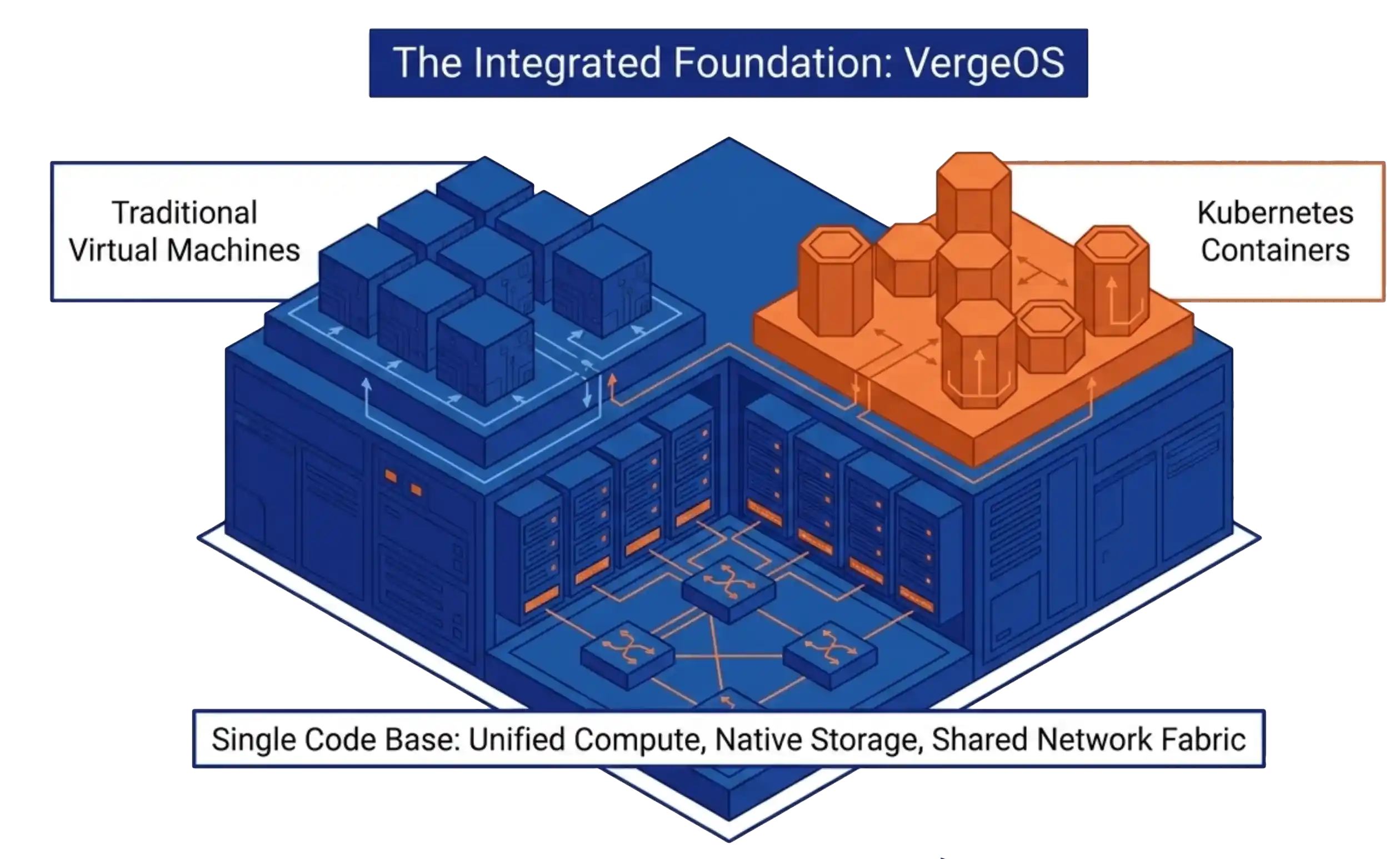
The dual mandate of running VMs and Kubernetes containers on a single integrated platform

That order is backward. The platform underneath decides how persistent volumes get carved, how cluster nodes scale, how snapshot and replication policies coordinate across VMs and pods, and how many vendor support contracts the operations team carries forever. The Kubernetes distribution determines which API the developer interacts with. Both matter, and the platform decides more.

The reason the order keeps getting reversed is that the distribution choice is louder. There are conferences for Tanzu and conferences for OpenShift. There is no conference for “the platform underneath.” Teams evaluating Kubernetes hear the loudest voices first and rank the platform later. The five-year math punishes that order.

The platform question reduces to a simple test. Count the support contracts the operations team will carry once the evaluation is over. Count the snapshot engines. Count the storage systems. Count the network control planes. Every number greater than one in that list is a translation tax line item. Every one of those line items comes from picking the distribution first and letting the distribution dictate the platform.

What changes when the platform underneath is integrated

VergeOS as a unified foundation for both VMs and Kubernetes containers

VergeOS treats VMs and Kubernetes containers as workloads on the same code base. The hypervisor, the storage layer, the network fabric, and the Kubernetes integration share one platform. Three Helm charts pulled from one Cluster Repository on the verge-io GitHub. A CSI driver provisions persistent volumes from VergeFS directly, with no overlay storage layer between the pod and the disk. A Cloud Controller Manager handles networking and node lifecycle events through the standard Kubernetes interface. A Cluster Autoscaler handles node-count management through the same upstream project every other distribution uses.

What that means in practice. Rancher remains the management plane the operations team already knows. The cluster object stays standard. The persistent volume comes off the same storage fabric the VMs use, with no Longhorn to license and no Portworx contract to manage. The Kubernetes distribution is whichever flavor Rancher provisions, usually RKE2 or K3s, both upstream. The platform underneath handles the rest, on the same code base it uses to run the VM side of the house. The Kubernetes Without the VMware Tax datasheet lays the architecture diagram and the deployment flow side by side for teams that want the one-page reference.

The typical vSphere Kubernetes stack vs an integrated platform

Capability Typical vSphere Kubernetes Stack VergeOS
Hypervisor licensing VCF subscription, per-core pricing Included in the platform
Kubernetes distribution Tanzu, OpenShift, or Rancher Prime, separate contract RKE2 or K3s via Rancher, no separate licensing
Persistent volumes (CSI) Vendor CSI driver, overlay storage often required (Longhorn, Portworx) Native VergeOS CSI driver, no overlay storage
Networking and load balancing Vendor CNI plus separate load-balancer contract Cloud Controller Manager via standard Kubernetes interface
Snapshot and replication Two policy engines, one for VMs, one for K8s One snapshot and replication engine, both workload types
Vendor support contracts Three or more One
Cluster create time (May 20 live demo) Variable, often 15 to 20 minutes Six minutes, on a lightweight lab system

Why Rancher?

VergeOS works with any Kubernetes distribution that runs on standard upstream nodes. The integration is upstream by design, three Helm charts and a node driver, no fork and no proprietary kernel extension. A team already running OpenShift or Tanzu can keep that distribution and put VergeOS underneath it.

A team that has not committed to a distribution yet should start with Rancher. The reasoning is practical. Rancher carries the lightest commercial weight of the major management planes, with no separate licensing layer attached to RKE2 or K3s. The node driver integration is the cleanest path to a working cluster on VergeOS. The cluster lifecycle, upgrade, and visibility story all sit in one console the operations team learns quickly. Standing up a first cluster on Rancher takes minutes, and the resulting cluster is upstream Kubernetes. No fork, no proprietary distribution to retrain against, and no vendor exit story to plan for later.

Production proof, named on the live call

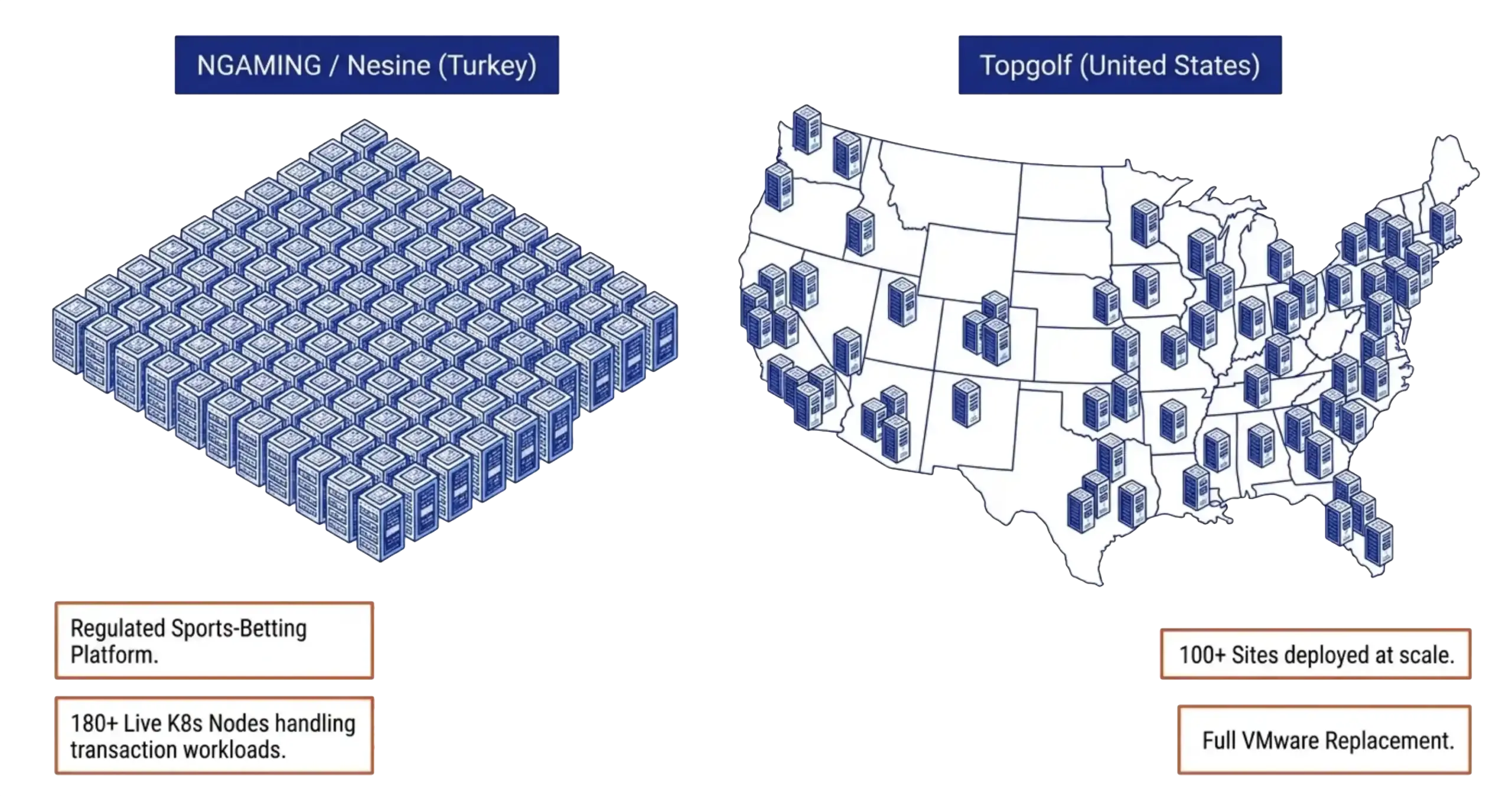
Two customers got named on the May 20 webinar, and both are cleared for public use. NGAMING / Nesine in Turkey runs a regulated sports-betting platform on VergeOS, with over 180 Kubernetes nodes carrying live transaction workload. The same production validation appears in the VergeIO Kubernetes general availability announcement.

Production VergeOS Kubernetes deployments at NGAMING / Nesine and Topgolf

Their feedback in the rollout was that the engineering response cycle felt like having a software development shop on call, even across time zones. That kind of feedback is rare, and it came up for one reason. The engineers who wrote the VergeOS SDKs are the same engineers who wrote the Kubernetes integration. Same team, same code base, same release cadence.

Topgolf is the second name. Over a hundred VergeOS sites across the United States, replacing VMware. The reason Topgolf gave for choosing VergeOS was not the platform alone. It was the platform plus the partnership, agile enough to respond at scale and capable enough to run the full environment. Both customers are evidence that the integrated-platform argument scales from a 180-node Kubernetes cluster in Turkey to a hundred-site VMware replacement in the United States, on the same code base.

How to start evaluating Kubernetes the right way

The clean path for a team evaluating Kubernetes from a standing start looks like this. Stand up VergeOS as the platform. Register the verge-io Cluster Repository in Rancher. Provision a test cluster through the Rancher UI. Run workloads on it. Cluster creation took six minutes on the live demo, on a lightweight home-lab system with two cores and four gigabytes of RAM per node. Production environments run faster. The three Helm charts come from the same repository. The persistent volumes come from VergeOS storage. The Rancher cluster object behaves exactly the way it would on any other Rancher node driver.

Keep going on Kubernetes Without the VMware Tax

The webinar walks the live demo on real hardware. The white paper walks the full architectural argument.

Watch the on-demand webinar
Read the white paper

From there the distribution question becomes which flavor of upstream Kubernetes Rancher provisions for the team, with RKE2, K3s, or upstream Kubernetes as the practical options. The platform decision is already made. The vendor count is one. The migration question other teams are still working through does not show up at all. There is nothing to migrate from. The team that picks the platform first gets to keep the evaluation focused on the part that matters, which is whether Kubernetes fits the workload, not whether the storage layer fits the Kubernetes distribution.

The fastest way to validate the foundation argument against a specific environment is a 30-minute architecture overview with one of the engineers who built the integration. Aaron Richman, Field Evangelist at VergeIO and one of the presenters on the May 20 webinar, runs these sessions directly. The agenda is the team’s environment, the workloads under consideration, and the path from the current VMware footprint to a VergeOS deployment that handles VMs and Kubernetes on one platform. No slide deck. The session works against a real environment. Book a session and the conversation starts where the webinar left off.

Why this matters to a team still evaluating Kubernetes

The CloudBolt CII study and the most recent CNCF surveys both show the same pattern. Teams deploying Kubernetes on top of a hypervisor not designed for container workloads spend more on storage, more on vendor support, and more on operations than teams picking an integrated platform from the start.

The gap widens at every renewal. Most evaluations get the order wrong, and the reason is consistent. The distribution choice is louder, and the platform choice shapes the next five years.

The teams in the evaluating column during the May 20 webinar still have a chance to get this order right. The teams that have already moved are working through the migration version of the same question. The order matters more than the urgency.

Frequently Asked Questions
We are not running Kubernetes yet. Do we still need to think about a platform like VergeOS now?
Yes. The platform underneath the cluster decides storage, networking, snapshot policy, and vendor count. Picking the platform after the distribution locks in choices harder to reverse than the distribution decision itself.
Can VergeOS run alongside our existing VMware environment during evaluation?
Yes. VergeOS runs on standard x86 hardware and supports parallel deployment. Most evaluations stand up a VergeOS cluster on dedicated hardware, run the Kubernetes workload on it, and migrate VMs over on the team’s timeline.
Which Kubernetes distribution does VergeOS provision?
Rancher provisions the distribution. The default Rancher choices are RKE2 and K3s, both upstream Kubernetes. VergeOS does not fork or modify the distribution. The three platform Helm charts (CSI, Cloud Controller, Cluster Autoscaler) work with the upstream cluster.
Do we have to commit to Rancher to use VergeOS Kubernetes support?
Rancher is the supported management plane today. The Helm charts themselves are upstream and run on any Kubernetes cluster the operations team chooses to manage with kubectl. Rancher is the recommended path for three reasons. UI continuity for operations, node driver integration, and the full cluster lifecycle story in one place.
What happens to our existing VMs when we add Kubernetes workloads?
VMs and Kubernetes containers run on the same VergeOS code base. The same storage. The same networking. The same snapshot and replication policies. The operations team manages one platform, one console, one support contract.
How long does a real production cluster take to provision?
On the May 20 live demo, a three-node RKE2 cluster came up in six minutes on a lightweight home-lab system. Production environments with proper resource allocation typically come up faster. The time is dominated by Rancher provisioning the cluster runtime on the VMs, not by VergeOS provisioning the VMs themselves.

Next steps

The Collapsing the Kubernetes Stack white paper, the Kubernetes Without the VMware Tax datasheet, and the on-demand recording of the May 20 webinar all live in the Kubernetes Without the VMware Tax research center. The fastest way to validate the foundation argument is on your own hardware, with your own workloads. Take a Test Drive Today and provision a Kubernetes cluster through Rancher on VergeOS the same way David showed live.

Filed Under: Private Cloud Tagged With: Container Platform, Kubernetes, Kubernetes Evaluation, Rancher, RKE2, VergeOS, VMware alternative

855-855-8300

Get Started

  • Versions
  • Request Tour

VergeIO For

  • VMware Alternative
  • SAN Replacement
  • Solving Infrastructure Modernization Challenges
  • Artificial Intelligence
  • Hyperconverged
  • Server Room
  • Secure Research Computing

Product

  • Benefits
  • Documents
  • Architecture Overview
  • Use Cases
  • Videos

Company

  • About VergeIO
  • Blog
  • Technical Documentation
  • Legal

© 2026 VergeIO. All Rights Reserved.