• Skip to main content
  • Architecture
    • Overview
      Learn about VergeOS’ unique unfied architecture that integrates virtualization, storage, networking, AI, backup and DR into a single data center operating system
    • Infrastructure Wide Deduplication
      VergeOS transforms deduplication from a storage-only commodity into a native, infrastructure-wide capability that spans storage, virtualization, and networking, eliminating hidden resource taxes
    • VergeFS
      VergeFS is a distributed, high-performance global file system integrated into VergeOS, unifying storage across nodes, tiers, and workloads while eliminating the need for external SANs
    • VergeFabric
      VergeFabric is VergeOS’s integrated virtual networking layer, delivering high-speed, low-latency communication across nodes while eliminating the complexity of traditional network configurations.
    • Infrastructure Automation
      VergeOS integrates Packer, Terraform, and Ansible to deliver an end-to-end automation pipeline that eliminates infrastructure drift and enables predictable, scalable deployments.
    • VergeIQ
      Unlock secure, on-premises generative AI—natively integrated into VergeOS. With VergeIQ, your enterprise gains private AI capabilities without the complexity, cloud dependency, or token-based pricing.
  • Features
    • Virtual Data Centers
      A VergeOS Virtual Data Center (VDC) is a fully isolated, self-contained environment within a single VergeOS instance that includes its own compute, storage, networking, and management controls
    • High Availability
      VergeOS provides a unified, easy-to-manage infrastructure that ensures continuous high availability through automated failover, storage efficiency, clone-like snapshots, and simplified disaster recovery
    • ioClone
      ioClone utilizes global inline deduplication and a blockchain-inspired file system within VergeFS to create instant, independent, space-efficient, and immutable snapshots of individual VMs, volumes, or entire virtual data centers.
    • ioReplicate
      ioReplicate is a unified disaster-recovery solution that enables simple, cost-efficient DR testing and failover via three‑click recovery of entire Virtual Data Centers—including VMs, networking, and storage.
    • ioFortify
      ioFortify creates immutable, restorable VDC checkpoints and provides proactive ransomware detection with instant alerts for rapid recovery and response.
    • ioMigrate
      ioMigrate enables large-scale VMware migrations, automating the rehosting of hundreds of VMs (including networking settings) in seconds with minimal downtime by seamlessly transitioning entire VMware environments onto existing hardware stacks.
    • ioProtect
      ioProtect offers near-real-time replication of VMware VMs—including data, network, and compute configurations—to a remote disaster‑recovery site on existing hardware, slashing DR costs by over 60% while supporting seamless failover and testing in an efficient, turnkey VergeOS Infrastructure.
    • ioOptimize
      ioOptimize leverages AI and machine learning to seamlessly integrate new and old hardware and automatically migrate workloads from aging or failing servers.
    • ioGuardian
      ioGuardian is VergeIO’s built-in data protection and recovery capability, providing near-continuous backup and rapid VM recovery during multiple simultaneous drive or server failures.
  • IT Initiatives
    • VMware Alternative
      VergeOS offers seamless migration from VMware, enhancing performance and scalability by consolidating virtualization, storage, and networking into a single, efficient platform.
    • Hyperconverged Alternative
      VergeIO’s page introduces ultraconverged infrastructure (UCI) via VergeOS, which overcomes HCI limitations by supporting external storage, scaling compute and storage independently, using existing hardware, simplifying provisioning, boosting resiliency, and cutting licensing costs.
    • SAN Replacement / Storage Refresh
      VergeIO’s storage by replacing aging SAN/NAS systems within its ultraconverged infrastructure, enhancing security, scalability, and affordability.
    • Infrastructure Modernization
      Legacy infrastructure is fragmented, complex, and costly, built from disconnected components. VergeOS unifies virtualization, storage, networking, data protection, and AI into one platform, simplifying operations and reducing expenses.
    • Secure Research Computing
      VergeIO's Secure Research Computing solution combines speed, isolation, compliance, scalability, and resilience in a cohesive platform. It’s ideal for institutions needing segmented, compliant compute environments that are easy to deploy, manage, and recover.
    • Venues, Remote Offices, and Edge
      VergeOS delivers resiliency and centralized management across Edge, ROBO, and Venue environments. With one platform, IT can keep remote sites independent while managing them all from a single pane of glass.
  • Blog
      • Could a 24 TB Hard Drive Replace a $10,000 SSD?A 24 TB hard drive costs about $56 per TB, and a 15.36 TB SSD costs over $700. See how VergeOS puts hard drives back to work inside HCI clusters.
      • Refurbished Hardware Made ResilientRefurbished hardware funds your VMware exit. VergeOS keeps it running through drive and server failures with RF2, RF3, and ioGuardian.
      • Storage Tiering is Not the Problem. Losing Control of It Is.Auto-tiering guesses which data is hot, and the guess costs money in both directions: flash held too long, or flash withheld too late. VergeOS puts storage tiering control back with the team running the workload, moving live VMs between tiers instantly, shrinking what the next flash refresh has to buy.
    • View All Posts
  • Resources
    • Become a Partner
      Get repeatable sales and a platform built to simplify your customers’ infrastructure.
    • Technology Partners
      Learn about our technology and service partners who deliver VergeOS-powered solutions for cloud, VDI, and modern IT workloads.
    • White Papers
      Explore VergeIO’s white papers for practical insights on modernizing infrastructure. Each paper is written for IT pros who value clarity, performance, and ROI.
    • In The News
      See how VergeIO is making headlines as the leading VMware alternative. Industry analysts, press, and partners highlight our impact on modern infrastructure.
    • Press Releases
      Get the latest VergeOS press releases for news on product updates, customer wins, and strategic partnerships.
    • Case Studies
      See how organizations like yours replaced VMware, cut costs, and simplified IT with VergeOS. Real results, real environments—no fluff.
    • Webinars
      Explore VergeIO’s on-demand webinars to get straight-to-the-point demos and real-world infrastructure insights.
    • Documents
      Get quick, no-nonsense overviews of VergeOS capabilities with our datasheets—covering features, benefits, and technical specs in one place.
    • Videos
      Watch VergeIO videos for fast, focused walkthroughs of VergeOS features, customer success, and VMware migration strategies.
    • Technical Documentation
      Access in-depth VergeOS technical guides, configuration details, and step-by-step instructions for IT pros.
  • How to Buy
    • Schedule a Demo
      Seeing is believing, set up a call with one of our technical architects and see VergeOS in action.
    • Versions
      Discover VergeOS’s streamlined pricing and flexible deployment options—whether you bring your own hardware, choose a certified appliance, or run it on bare metal in the cloud.
    • Test Drive – No Hardware Required
      Explore VergeOS with VergeIO’s hands-on labs and gain real-world experience in VMware migration and data center resiliency—no hardware required
  • Company
    • About VergeIO
    • Support
      Get fast, expert help from VergeIO’s support team—focused on keeping your infrastructure running smoothly.
    • Careers
      Join VergeIO and help reshape the future of IT infrastructure. Explore open roles and growth opportunities.
  • 855-855-8300
  • Contact
  • Search
  • 855-855-8300
  • Contact
  • Search
  • Architecture
    • Overview
    • VergeFS
    • VergeFabric
    • Infrastructure Automation
    • VergeIQ
  • Features
    • Virtual Data Centers
    • High Availability
    • ioClone
    • ioReplicate
    • ioFortify
    • ioMigrate
    • ioProtect
    • ioOptimize
    • ioGuardian
  • IT Initiatives
    • VMware Alternative
    • Hyperconverged Alternative
    • SAN Replacement / Storage Refresh
    • Infrastructure Modernization
    • Secure Research Computing
    • Venues, Remote Offices, and Edge
  • Blog
  • Resources
    • Become a Partner
    • Technology Partners
    • White Papers
    • In The News
    • Press Releases
    • Case Studies
    • Webinars
    • Documents
    • Videos
    • Technical Documentation
  • How to Buy
    • Schedule a Demo
    • Versions
    • Test Drive – No Hardware Required
  • Company
    • About VergeIO
    • Support
    • Careers
×
  • Architecture
    • Overview
    • VergeFS
    • VergeFabric
    • Infrastructure Automation
    • VergeIQ
  • Features
    • Virtual Data Centers
    • High Availability
    • ioClone
    • ioReplicate
    • ioFortify
    • ioMigrate
    • ioProtect
    • ioOptimize
    • ioGuardian
  • IT Initiatives
    • VMware Alternative
    • Hyperconverged Alternative
    • SAN Replacement / Storage Refresh
    • Infrastructure Modernization
    • Secure Research Computing
    • Venues, Remote Offices, and Edge
  • Blog
  • Resources
    • Become a Partner
    • Technology Partners
    • White Papers
    • In The News
    • Press Releases
    • Case Studies
    • Webinars
    • Documents
    • Videos
    • Technical Documentation
  • How to Buy
    • Schedule a Demo
    • Versions
    • Test Drive – No Hardware Required
  • Company
    • About VergeIO
    • Support
    • Careers

Tiering

September 29, 2026 by George Crump

Flash now costs 12 to 14 times more per terabyte than a hard drive, and that gap changes how an HCI cluster gets built.

A 24 TB hard drive sells for about $1,350 today, and a 15.36 TB enterprise NVMe SSD sells for $10,850 or more, a gap wide enough to reopen a storage decision most IT teams considered closed years ago. Dave Vincent and I ran into it this month while pricing drives for our labs, where the SSD quote came in near $12,000 and the hard drive quote barely registered by comparison.

Key Takeaways
  • At September 2026 list prices, flash costs 12 to 14 times more per terabyte than a 24 TB hard drive.
  • All-flash HCI ties every terabyte of capacity growth to the most inflated component in the data center.
  • VergeOS runs hard drives and flash in one cluster, moves running VMs between them on command, and protects the hard drive tier with frequent snapshots and ioGuardian.

The Math Behind a $10,000 SSD

These are street prices, checked on September 28, 2026, that show the gap, and they move week to week right now.

DriveCapacityPriceCost per TB
Kioxia KCMYXRUG15T3 NVMe15.36 TB$10,850$706
Solidigm D7-PS1010 NVMe15.36 TB$12,500$814
WD Ultrastar DC HC580 SATA24 TB$1,350$56

The price of one 15.36 TB SSD buys eight 24 TB hard drives, 192 TB of raw capacity for the same money. VergeIO calls this data center inflation, hardware costs rising faster than IT budgets, driven by AI demand for memory and flash. Flash and memory prices climbed 70 to 95 percent through the first half of 2026, and AI buildouts absorb new fab capacity as fast as it comes online. I plan as if this pricing is permanent.

24 TB hard drive versus 15.36 TB SSD, cost per terabyte Kioxia 15.36 TB NVMe SSD at $706 per TB, Solidigm 15.36 TB NVMe SSD at $814 per TB, and a WD 24 TB hard drive at $56 per TB, based on street prices checked September 28, 2026. Cost per terabyte, street prices, September 28, 2026 $0 $200 $400 $600 $800 Kioxia 15.36 TB NVMe SSD: $10,850, or $706 per TB Kioxia 15.36 TB NVMe $10,850 per drive $706 Solidigm D7-PS1010 15.36 TB NVMe SSD: $12,500, or $814 per TB Solidigm 15.36 TB NVMe $12,500 per drive $814 WD Ultrastar DC HC580 24 TB hard drive: $1,350, or $56 per TB WD 24 TB hard drive $1,350 per drive $56 12 to 14 times less per terabyte
A 24 TB hard drive costs $56 per terabyte against $706 to $814 for a 15.36 TB NVMe SSD. Hover a bar for drive prices.

All-Flash HCI Turns a Media Choice into a Refresh Bill

Live Webinar · October 7 · 2:00 PM ET

How to use HCI and Hard Drives to Fight Data Center Inflation

George Crump and Dave Vincent move a running VM from flash to hard drives and back, live from Palo Alto.

Register Now

Every HCI platform sold today defaults to all-flash, a decision the platform made for the customer years ago, back when flash prices fell every quarter and the assumption looked safe. That default now means every terabyte added at refresh time pays the flash price, and capacity-based licensing charges a second time for the same terabyte.

Most workloads need far less performance than all-flash delivers. File shares, VDI profiles, dev and test environments, log retention and a large share of general-purpose VMs sit idle for most of the day. Hard drives are slower than flash, but they stay online, handle most of this work at a speed users accept and cost a fraction as much.

Aging All-Flash Array? Let the Refresh Replace It

An aging dedicated all-flash array faces the same price sheet at its next refresh. The array vendor buys NAND from the same fabs that supply every SSD in the table above, so the quote for new controllers or more capacity arrives with data center inflation already built in. Many arrays also add a per-terabyte software license on top of the hardware, which charges the inflated flash price a second time. For many IT teams, that refresh falls in the same year as a VMware renewal.

Use the refresh to replace the array and exit VMware in one project. VergeOS runs virtualization, storage and networking on standard x86 servers, so the next purchase buys off-the-shelf flash at server prices instead of flash sold through an array vendor. Global inline deduplication means you buy less of that flash, and the file shares, VM templates, aging VMs and snapshots that sit idle on the array today move to 24 TB hard drives at $56 per TB. The separate storage network and the array support contract go away with it. The Storage Refresh vs. Storage Inflation datasheet walks through the math.

Replacing an aging all-flash array and VMware hosts with VergeOS at refresh Animated diagram. Today, VMware hosts reach a dedicated all-flash array over a separate storage network, and the working set, file shares, VM templates, aging VMs and snapshots all pay the flash price. At refresh, VergeOS replaces the hosts and the array. The working set runs on off-the-shelf flash inside the servers, and everything else moves to 24 TB hard drives in the same cluster. Today At refresh, with VergeOS VMware hosts separate storage network Dedicated all-flash array Working set File shares VM templates Aging VMs and snapshots Every terabyte pays the flash price Replaced at refresh refresh VergeOS cluster ServerServerServer FlashFlashFlash 24 TB24 TB24 TB HDDHDDHDD Less flash, off the shelf. The rest at $56 per TB.
At refresh, VergeOS replaces the VMware hosts and the array. The working set runs on off-the-shelf flash inside the servers, and everything else moves to 24 TB hard drives.

Can a 24 TB Hard Drive Keep Up?

For most workloads, yes. Random-I/O databases still belong on flash, but for the rest of the data center the answer comes down to the platform in front of the drive. One of our customers ran a hosting business that sold both flash and spinning-disk capacity with VergeOS underneath. Their customers tested their workloads on hard drives, saw little difference, and kept moving more of them to disk. Dave Vincent saw the same result when he moved a live SQL workload from NVMe to spinning disk and commit latency stayed under a millisecond on both tiers.

VergeOS makes that result repeatable for any IT team. Global inline deduplication runs across every tier, so the cluster stores fewer blocks and more of the working set fits in cache. VergeOS caches data in RAM on the server running the VM, which VergeIO testing shows produces four to five times the cache hit rate of array-side caching. On the write side, VergeOS reorders and groups incoming writes into sequential runs before they reach the platter, the access pattern hard drives handle best.

How VergeOS makes a 24 TB hard drive tier keep up Animated diagram of the VergeOS I/O path. Reads are served from a RAM cache on the server running the VM. Random writes pass through global inline deduplication and are reordered and grouped into sequential runs before they reach the hard drive. VM any workload RAM cache on the server running the VM Reads served from RAM, 4 to 5 times the hit rate of array-side cache Random writes in Dedupe, reorder and group fewer blocks, longer runs Sequential runs out 24 TB hard drive Hard drives handle long sequential runs best. VergeOS shapes the write stream to match before it reaches the platter.
Reads come from RAM next to the VM. Writes arrive random and leave as sequential runs, the pattern a spinning drive handles best.

Afraid of Tiering? Select Tiering That Puts You in Control

Many IT teams steer clear of tiering, and automated tiering is the reason, after two decades of burning plenty of them. An auto-tiering algorithm samples activity, waits for a threshold and makes placement calls without knowing the business behind the workload. It is slow to spot cold data, it misses anything outside its sampling window, and it is slowest of all on the trip back to flash, usually right when users start to notice.

VergeOS puts the IT team in charge of placement instead. The people who run the workloads already know the business calendar, such as a tax application that is write-heavy through April 15 and read-heavy on April 16, and they need no algorithm to predict it. The IT team moves a running VM to the hard drive tier or back to flash on command, in either direction and with no maintenance window, and pins the workloads that must stay hot to a preferred tier. I covered why tiering itself was never the issue in Storage Tiering Is Not the Problem. Losing Control of It Is.

VergeOS moves a running VM between the flash tier and the hard drive tier on command Animated diagram. A running VM sits on the Tier 1 NVMe flash tier, moves down to the Tier 4 hard drive tier on command with the workload online, then moves back to flash the same way. Tier 1 NVMe flash Working set, random-I/O databases Tier 4 24 TB hard drives File shares, templates, aging VMs Move down on command Move back Running VM online the whole time Lab test: API acknowledged the move in 1.3 seconds. A 25 GB disk finished moving in 13 seconds.
The IT team decides placement. A running VM moves to the 24 TB hard drive tier and back on command, with no maintenance window.

Three Ways VergeOS Makes Hard Drives Safe to Use

Tiering under IT control. VergeOS supports six storage tiers inside one vSAN, with tiers 4 and 5 designed for high-capacity hard drives, and the IT team moves a running VM’s disk between tiers on command. In VergeIO lab testing, the API acknowledged the move in 1.3 seconds and a 25 GB disk finished moving in 13 seconds with the workload running. Be aggressive with it, moving a workload to hard drives and moving it back in seconds if someone complains two weeks later.

Frequent snapshots. VergeOS snapshots run on a schedule the IT team controls, hourly by default, which gives every VM on the hard drive tier recent recovery points inside the same system.

ioGuardian. Large drives raise a fair question about exposure during a rebuild. ioGuardian answers it by pulling missing or corrupted blocks from a synchronized remote VergeOS system after a failure that exceeds the cluster’s redundancy, such as multiple drive failures spread across nodes.

VergeOS licenses per server, so the money saved on hard drives and deduplication stays in the budget instead of feeding a capacity meter.

Key Terms

Data center inflation

Hardware costs rising faster than IT budgets, driven by AI demand for memory and flash.

Storage tier

A class of drives in the VergeOS vSAN, numbered 0 through 5, running from metadata NVMe to archival hard drives.

Preferred tier

The VergeOS setting that names the first-choice tier for a VM disk, used to keep critical workloads on flash.

ioGuardian

The VergeOS repair server that restores blocks from a synchronized remote system after a failure beyond redundancy tolerance.

All-Flash HCI and VergeOS Flash Plus Hard Drives

All-flash HCIVergeOS flash plus hard drives
Capacity cost at refreshFlash price for every TBFlash for the working set, $56 per TB for the rest
Workload placementEverything on flashIT team places each VM, moves it live
LicensingOften per TBPer server
Media mixFlash onlyFlash and hard drives in one cluster

See the Answer Live on October 7

Dave and I will answer the question in the title live from Palo Alto on Wednesday, October 7, at 2:00 PM ET, in How to use HCI and Hard Drives to Fight Data Center Inflation. Dave will move a running VM from flash to hard drives and back on camera, and I will walk through the refresh math for a real cluster, so register for the webinar.

Frequently Asked Questions

Can a 24 TB hard drive replace an SSD for every workload?

Random-I/O databases still belong on flash, and VergeOS lets you pin them to a preferred flash tier and place everything else on hard drives.

Does deduplication work on the hard drive tier?

VergeOS runs global inline deduplication across all six tiers, so the hard drive tier gets the same capacity savings as flash.

How long does it take to move a VM back to flash?

The move starts on command and runs with the VM online, and in lab testing small disks finish the trip back to flash in seconds.
Filed Under: Storage Tagged With: Deduplication, flash inflation, HCI, HCIandHDD, ioGuardian, Tiering

March 18, 2026 by George Crump

The question came up during our webinar on the flash and memory supercycle, and it is worth a full answer. If flash is expensive and scarce, do hard drives provide a way out? The short answer is no. The longer answer explains why — and points to a better path forward.

Key Takeaways
  • Hard drives are not an escape from the flash and memory supercycle — HDD supply is tightening for the same reason flash supply is: AI infrastructure demand.
  • RAM is the root cause. Every VMware host consumes tens of gigabytes before a single VM starts, thereby increasing cost pressures on both DRAM and flash simultaneously.
  • The supercycle is a consumption problem, not a capacity problem. Platforms that waste flash and RAM are the issue — adding cheaper storage does not fix wasteful architecture.
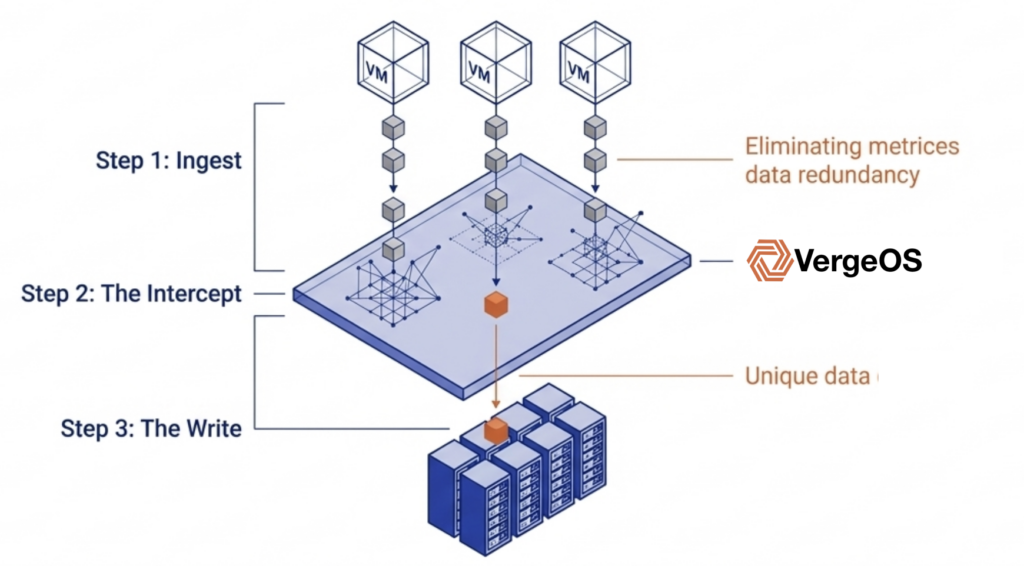
  • VergeOS global inline deduplication runs before data is written, reducing flash consumption at the storage layer and enabling the cache to hold only unique data blocks.
  • Hard drives still have a legitimate role for cold archive data and predictable tiering — VergeOS supports live VM migration between storage tiers, including HDD.

The Appeal Is Understandable

Hard drives are cheap relative to flash and seem like a viable solution to the flash and memory supercycle. A petabyte of spinning disk still costs a fraction of an equivalent flash footprint. If your flash capacity is constrained by price or supply, adding hard drives looks like a logical pressure valve.

Key Terms
Flash and Memory Supercycle
The simultaneous convergence of DRAM price increases (171% YoY through 2027), NAND flash price increases (55–60% in Q1 2026 alone), multi-month server delivery delays, and VMware/Broadcom licensing shock — creating compounding infrastructure cost pressure for enterprise IT.
Global Inline Deduplication
VergeOS storage-layer deduplication that runs before data is written to disk. Because the underlying storage pool is already deduplicated, the read cache naturally holds only unique data blocks — enabling the same cached block to serve dozens of VMs simultaneously across all nodes without running a separate cache dedup algorithm.
DRAM (Dynamic Random Access Memory)
The primary system memory used by servers to run workloads. Prices are up 171% year-over-year due to AI demand and the end of DDR4 production. Every hypervisor platform consumes DRAM as overhead before workloads start.
NAND Flash
The storage technology used in SSDs and NVMe drives. NAND contract prices jumped 55–60% in Q1 2026, with enterprise SSD premiums widening over commodity NVMe as AI factories compete for supply.
HDD Tiering
Moving workloads or data between flash and hard disk storage tiers to reduce flash consumption. Automated tiering moves data based on age; manual tiering with live VM migration (supported by VergeOS) moves entire VMs between tiers based on predicted I/O demand.
ioGuardian
VergeOS data availability feature that provides RF2+/RF3+ protection via synchronous replication rather than erasure coding. Surviving copies serve reads at full speed during a drive failure — no reconstruction, no degraded mode — and global deduplication reduces effective replication cost to approximately N+1.
flash and memory supercycle storage comparison — hard drives vs flash

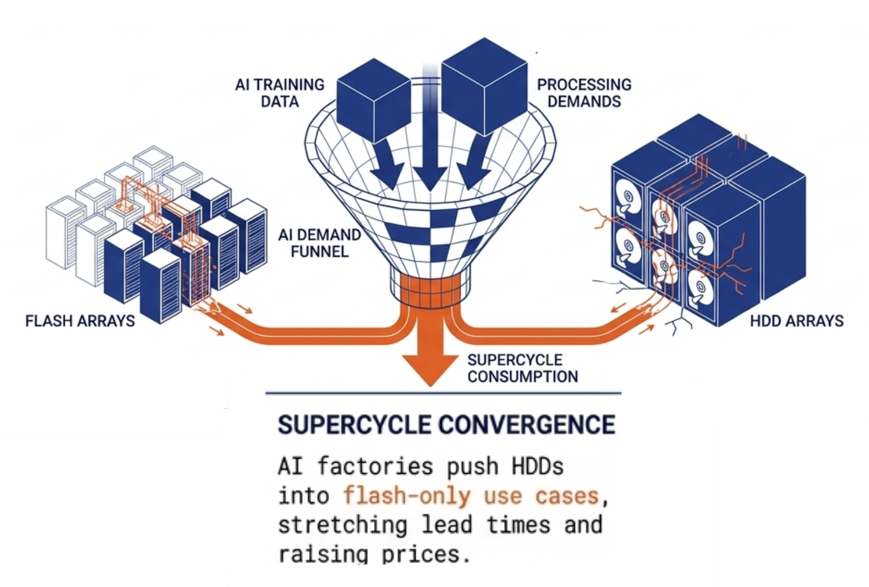
The problem is that the valve is closing. HDD supply is tightening alongside flash supply. AI infrastructure is consuming hard drives for training data storage at the same pace it consumes flash for active workloads. As flash supply continues to tighten, AI factories are pushing hard drives into use cases that were previously flash-only. HDD prices are rising and lead times are stretching. The supply chain disruption that created the flash supercycle is now touching spinning disk as well.

Hard drives are not an escape from the supercycle. They are increasingly part of it.

HDDs Never Really Left the Performance Problem

IT moved away from day-to-day HDD use for good reasons. Hard drives are slow. Latency is measured in milliseconds, not microseconds. Performance is unpredictable under mixed workloads. A single failed drive forces a rebuild that hammers performance across the entire array for days. Flash wears out, but flash failure is trackable and trending — you can see it coming. A hard drive can fail without warning on a Tuesday afternoon.

Tiering helps, but only at the margins. Automated tiering moves older data down to spinning disk based on access age. The formula assumes that data will rarely, if ever, become active again. That is not reality. When dormant data becomes active, users want it now, regardless of how old it is. For anything IT actually touches — active VMs, databases, application data — hard drives create performance unpredictability that most organizations cannot accept.

Manual tiering through live migration of workloads across storage tiers gives more control than age-based automation. VergeOS supports live migration of VMs between storage tiers, including hard disk tiers, and that capability is especially useful when performance spikes are predictable. With VergeOS automation, you can script moving a VM to an HDD tier when its I/O demands are low and back to flash before demand heats up. Even if that happens daily, live VM migration with automation makes it operationally trivial — and the performance impact is barely noticeable.

RAM Is the Root Cause of the Flash and Memory Supercycle

flash and memory supercycle storage comparison — hard drives vs flash

Before addressing flash consumption, it is worth establishing why the flash and memory supercycle are connected problems. RAM is at the center of both.

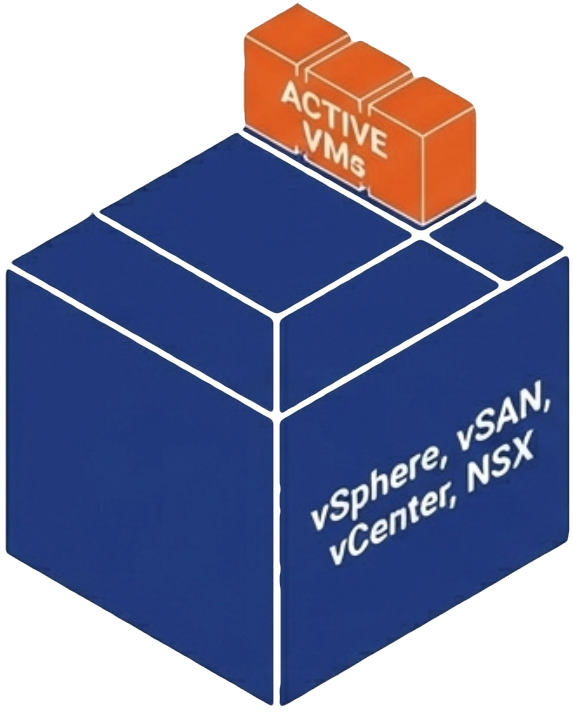
DRAM prices are up 171% year-over-year and analysts project that pressure extending through 2027 and beyond. Every VMware host consumes significant RAM before a single VM starts. vSphere, vSAN, vCenter, and NSX together consume tens of gigabytes of platform overhead per host. Organizations running VMware on flash-heavy HCI configurations face a compounding problem: they are paying inflated prices for the RAM that runs the stack and inflated prices for the flash the stack writes to.

VergeOS attacks RAM consumption at the platform level. The entire VergeOS stack — hypervisor, storage, networking, and data protection — runs at 2–3% memory overhead. Global inline deduplication ensures that only unique data blocks are added to the read cache. Because the underlying storage pool is already deduplicated before data reaches the cache, the cache naturally holds only unique blocks without running a separate deduplication algorithm. That same cached block can then serve dozens of VMs simultaneously across every node in the cluster. The result is greater cache effectiveness per gigabyte of RAM, meaning organizations get more workload capacity from existing servers without forcing a server refresh at supercycle prices. We cover the full scope of what the supercycle means for infrastructure economics here.

The Second Flash and Memory Supercycle Problem: Consumption

The drive portion of the flash and memory supercycle is not primarily a capacity problem. It is a consumption problem. Platforms built on VMware consume more flash than necessary — because of virtualization overhead, because of how data is written, because of the architectural assumptions baked into virtualization stacks that were designed when flash was cheap and plentiful.

If you reduce the amount of flash your infrastructure consumes, you need less of it. That changes the economics without depending on hard drives to fill the gap. We looked at exactly how much more expensive a traditional storage refresh has become in The Even Higher Cost of a Storage Refresh in 2026.

VergeOS addresses flash consumption directly. Global inline deduplication runs at the storage layer before data is written. Because the storage pool is already deduplicated, the read cache naturally holds only unique data blocks. That cache is global — the same cached block serves dozens of VMs simultaneously across all nodes in the cluster. Topgolf reduced storage from 20 TB per venue to 5 TB per node — not by adding hard drives, but by eliminating redundant data before it ever reached the drive. Alinsco Insurance migrated off VMware and vSAN onto the same VxRail hardware with the same internal SSDs and gained capacity headroom without adding a single drive.

That is the answer the flash-and-memory supercycle actually calls for. Not cheaper storage on the bottom of a tiered stack, but a platform that requires less storage at every tier.

Hard Drives Still Have a Role

This is not an argument against hard drives entirely. Your infrastructure — whether an ultraconverged solution like VergeOS or a dedicated array — should support HDDs as a tier. As discussed with live VM migration between tiers, the performance impact of an HDD recall can be minimized, particularly when performance demands are predictable. Cold archive data, backup target storage, compliance archives, and long-retention datasets are all appropriate candidates for HDD tiers. If your infrastructure has a genuine cold data problem, tiering to hard drives is a sound approach.

The mistake is expecting hard drives to solve a hot data efficiency problem. Your active workloads do not care that HDDs are cheaper. They care about latency and consistency. As HDD supply tightens alongside flash, even the cost saving argument weakens.

What Actually Solves the Flash and Memory Supercycle

The organizations navigating the flash and memory supercycle without major budget pain share a common trait: they run platforms that consume less of what is scarce. Less RAM per workload. Less flash per VM. Fewer servers per site. Data availability and protection capabilities that let them run safely on refurbished hardware — servers and storage — without the risk of workload outages or data loss. The next five years of IT infrastructure will be defined by exactly this kind of platform flexibility. You need to run infrastructure that requires less.

VergeOS was built with this efficiency at its core — not as a feature added after the fact, but as an architectural decision that affects every layer from the hypervisor to the storage pool to the network. The supercycle exposed the cost of platforms that were not built this way. Hard drives do not fix that. A more efficient platform does.

?
Frequently Asked Questions
Will hard drive prices come down as flash prices rise?
Not reliably. HDD demand is rising in parallel with flash demand because AI infrastructure is consuming spinning disk for training data storage at scale. Lead times are stretching and prices are rising across both storage types. The supply chain disruption that created the flash supercycle is now touching HDDs as well. Waiting for prices to normalize on either front is not a strategy.
Can I use hard drives in a VergeOS cluster?
Yes. VergeOS supports mixed storage configurations including HDD tiers within the same cluster. You can use hard drives for cold archive data, backup targets, or tiered workloads. VergeOS supports live migration of VMs between storage tiers — including moving a VM from flash to HDD and back — with automation that makes the transition operationally transparent.
What is automated tiering and does it actually solve the flash supercycle problem?
Automated tiering moves data from faster flash storage to slower hard disk storage based on access age. It is useful for genuinely cold data but does not solve the supercycle problem. Your hot data tier is still flash, flash is still expensive, and automated tiering does nothing to reduce how much flash your platform consumes. The supercycle is a consumption problem. Tiering is a placement strategy.
How does VergeOS reduce flash consumption?
VergeOS runs global inline deduplication at the storage layer before data is written to disk. Because the underlying storage pool is already deduplicated, the read cache naturally holds only unique data blocks — without running a separate deduplication algorithm inside the cache. That same cached block serves dozens of VMs simultaneously across all nodes in the cluster. The result is fewer total writes to flash, lower effective capacity requirements, and dramatically better cache hit rates per gigabyte of installed storage.
Is it safe to run VergeOS on refurbished hardware?
Yes. VergeOS is designed to run safely on commodity and refurbished x86 hardware, including refurbished NVMe drives. Global inline deduplication reduces total writes per drive, directly extending drive life. ioGuardian provides RF2+/RF3+ data protection via synchronous replication — when a drive fails, surviving copies serve data at full speed with no reconstruction and no degraded mode. The combination of reduced write load and fault-tolerant replication makes refurbished hardware production-safe.
Will hard drive prices come down as flash prices rise?

Not reliably. HDD demand is rising in parallel with flash demand because AI infrastructure is consuming spinning disk for training data storage at scale. Lead times are stretching and prices are rising across both storage types. The supply chain disruption that created the flash supercycle is now touching HDDs as well. Waiting for prices to normalize on either front is not a strategy.

Can I use hard drives in a VergeOS cluster?

Yes. VergeOS supports mixed storage configurations including HDD tiers within the same cluster. You can use hard drives for cold archive data, backup targets, or tiered workloads. VergeOS supports live migration of VMs between storage tiers — including moving a VM from flash to HDD and back — with automation that makes the transition operationally transparent.

What is automated tiering and does it actually solve the flash supercycle problem?

Automated tiering moves data from faster flash storage to slower hard disk storage based on access age. It is useful for genuinely cold data, but does not solve the supercycle problem. Your hot data tier is still flash, flash is still expensive, and automated tiering does nothing to reduce how much flash your platform consumes. The supercycle is a consumption problem. Tiering is a placement strategy.

How does VergeOS reduce flash consumption?

VergeOS runs global inline deduplication at the storage layer before data is written to disk. Because the underlying storage pool is already deduplicated, the read cache naturally holds only unique data blocks — without running a separate deduplication algorithm inside the cache. That same cached block serves dozens of VMs simultaneously across all nodes in the cluster. The result is fewer total writes to flash, lower effective capacity requirements, and dramatically better cache hit rates per gigabyte of installed storage.

Is it safe to run VergeOS on refurbished hardware?

Yes. VergeOS is designed to run safely on commodity and refurbished x86 hardware, including refurbished NVMe drives. Global inline deduplication reduces total writes per drive, directly extending drive life. ioGuardian provides RF2+/RF3+ data protection via synchronous replication — when a drive fails, surviving copies serve data at full speed with no reconstruction and no degraded mode. The combination of reduced write load and fault-tolerant replication makes refurbished hardware production-safe.

Filed Under: Storage Tagged With: FlashAndMemorySupercycle, Memory, RAM, Storage, Tiering

855-855-8300

Get Started

  • Versions
  • Request Tour

VergeIO For

  • SAN Replacement
  • Solving Infrastructure Modernization Challenges
  • Artificial Intelligence
  • Hyperconverged
  • Server Room
  • Secure Research Computing

Product

  • Benefits
  • Documents
  • Architecture Overview
  • Use Cases
  • Videos

Company

  • Blog
  • Technical Documentation
  • Legal

© 2026 VergeIO. All Rights Reserved.