• Skip to main content
  • Architecture
    • Overview
      Learn about VergeOS’ unique unfied architecture that integrates virtualization, storage, networking, AI, backup and DR into a single data center operating system
    • Infrastructure Wide Deduplication
      VergeOS transforms deduplication from a storage-only commodity into a native, infrastructure-wide capability that spans storage, virtualization, and networking, eliminating hidden resource taxes
    • VergeFS
      VergeFS is a distributed, high-performance global file system integrated into VergeOS, unifying storage across nodes, tiers, and workloads while eliminating the need for external SANs
    • VergeFabric
      VergeFabric is VergeOS’s integrated virtual networking layer, delivering high-speed, low-latency communication across nodes while eliminating the complexity of traditional network configurations.
    • Infrastructure Automation
      VergeOS integrates Packer, Terraform, and Ansible to deliver an end-to-end automation pipeline that eliminates infrastructure drift and enables predictable, scalable deployments.
    • VergeIQ
      Unlock secure, on-premises generative AI—natively integrated into VergeOS. With VergeIQ, your enterprise gains private AI capabilities without the complexity, cloud dependency, or token-based pricing.
  • Features
    • Virtual Data Centers
      A VergeOS Virtual Data Center (VDC) is a fully isolated, self-contained environment within a single VergeOS instance that includes its own compute, storage, networking, and management controls
    • High Availability
      VergeOS provides a unified, easy-to-manage infrastructure that ensures continuous high availability through automated failover, storage efficiency, clone-like snapshots, and simplified disaster recovery
    • ioClone
      ioClone utilizes global inline deduplication and a blockchain-inspired file system within VergeFS to create instant, independent, space-efficient, and immutable snapshots of individual VMs, volumes, or entire virtual data centers.
    • ioReplicate
      ioReplicate is a unified disaster-recovery solution that enables simple, cost-efficient DR testing and failover via three‑click recovery of entire Virtual Data Centers—including VMs, networking, and storage.
    • ioFortify
      ioFortify creates immutable, restorable VDC checkpoints and provides proactive ransomware detection with instant alerts for rapid recovery and response.
    • ioMigrate
      ioMigrate enables large-scale VMware migrations, automating the rehosting of hundreds of VMs (including networking settings) in seconds with minimal downtime by seamlessly transitioning entire VMware environments onto existing hardware stacks.
    • ioProtect
      ioProtect offers near-real-time replication of VMware VMs—including data, network, and compute configurations—to a remote disaster‑recovery site on existing hardware, slashing DR costs by over 60% while supporting seamless failover and testing in an efficient, turnkey VergeOS Infrastructure.
    • ioOptimize
      ioOptimize leverages AI and machine learning to seamlessly integrate new and old hardware and automatically migrate workloads from aging or failing servers.
    • ioGuardian
      ioGuardian is VergeIO’s built-in data protection and recovery capability, providing near-continuous backup and rapid VM recovery during multiple simultaneous drive or server failures.
  • IT Initiatives
    • VMware Alternative
      VergeOS offers seamless migration from VMware, enhancing performance and scalability by consolidating virtualization, storage, and networking into a single, efficient platform.
    • Hyperconverged Alternative
      VergeIO’s page introduces ultraconverged infrastructure (UCI) via VergeOS, which overcomes HCI limitations by supporting external storage, scaling compute and storage independently, using existing hardware, simplifying provisioning, boosting resiliency, and cutting licensing costs.
    • SAN Replacement / Storage Refresh
      VergeIO’s storage by replacing aging SAN/NAS systems within its ultraconverged infrastructure, enhancing security, scalability, and affordability.
    • Infrastructure Modernization
      Legacy infrastructure is fragmented, complex, and costly, built from disconnected components. VergeOS unifies virtualization, storage, networking, data protection, and AI into one platform, simplifying operations and reducing expenses.
    • Virtual Desktop Infrastructure (VDI)
      VergeOS for VDI delivers a faster, more affordable, and easier-to-manage alternative to traditional VDI setups—offering organizations the ability to scale securely with reduced overhead
    • Secure Research Computing
      VergeIO's Secure Research Computing solution combines speed, isolation, compliance, scalability, and resilience in a cohesive platform. It’s ideal for institutions needing segmented, compliant compute environments that are easy to deploy, manage, and recover.
    • Venues, Remote Offices, and Edge
      VergeOS delivers resiliency and centralized management across Edge, ROBO, and Venue environments. With one platform, IT can keep remote sites independent while managing them all from a single pane of glass.
  • Blog
      • Why Are VMware Executives Joining VergeIO?Zia Yusuf, VMware's former ecosystem chief, invested in VergeIO and joined its board, the second VMware leader in weeks after CTO Kit Colbert. One built the partner engine, the other set the technology. Both reached the same verdict: leaving VMware means moving to a private cloud operating system.
      • Using Infrastructure to Prepare for RansomwareMost data centers still react to ransomware through backup, and the recovery gap costs them days. Using infrastructure to prepare for ransomware changes the posture. VergeOS contains attacks inside a VDC, holds clean immutable snapshots, detects encryption in the storage layer within minutes, and recovers the data center, not one VM.
      • How an AI-Powered VMware Alternative WorksAn AI-powered VMware alternative now runs in production. Verge CLI gives VergeOS three parts, a command-line interface, an MCP server, and agent skills, so an AI assistant operates compute, storage, networking, and data protection through one API in plain language. See how it works and why one code base changes the result.
    • View All Posts
  • Resources
    • Become a Partner
      Get repeatable sales and a platform built to simplify your customers’ infrastructure.
    • Technology Partners
      Learn about our technology and service partners who deliver VergeOS-powered solutions for cloud, VDI, and modern IT workloads.
    • White Papers
      Explore VergeIO’s white papers for practical insights on modernizing infrastructure. Each paper is written for IT pros who value clarity, performance, and ROI.
    • In The News
      See how VergeIO is making headlines as the leading VMware alternative. Industry analysts, press, and partners highlight our impact on modern infrastructure.
    • Press Releases
      Get the latest VergeOS press releases for news on product updates, customer wins, and strategic partnerships.
    • Case Studies
      See how organizations like yours replaced VMware, cut costs, and simplified IT with VergeOS. Real results, real environments—no fluff.
    • Webinars
      Explore VergeIO’s on-demand webinars to get straight-to-the-point demos and real-world infrastructure insights.
    • Documents
      Get quick, no-nonsense overviews of VergeOS capabilities with our datasheets—covering features, benefits, and technical specs in one place.
    • Videos
      Watch VergeIO videos for fast, focused walkthroughs of VergeOS features, customer success, and VMware migration strategies.
    • Technical Documentation
      Access in-depth VergeOS technical guides, configuration details, and step-by-step instructions for IT pros.
  • How to Buy
    • Schedule a Demo
      Seeing is believing, set up a call with one of our technical architects and see VergeOS in action.
    • Versions
      Discover VergeOS’s streamlined pricing and flexible deployment options—whether you bring your own hardware, choose a certified appliance, or run it on bare metal in the cloud.
    • Test Drive – No Hardware Required
      Explore VergeOS with VergeIO’s hands-on labs and gain real-world experience in VMware migration and data center resiliency—no hardware required
  • Company
    • About VergeIO
      Learn who we are, what drives us, and why IT leaders trust VergeIO to modernize and simplify infrastructure.
    • Support
      Get fast, expert help from VergeIO’s support team—focused on keeping your infrastructure running smoothly.
    • Careers
      Join VergeIO and help reshape the future of IT infrastructure. Explore open roles and growth opportunities.
  • 855-855-8300
  • Contact
  • Search
  • 855-855-8300
  • Contact
  • Search
  • Architecture
    • Overview
    • VergeFS
    • VergeFabric
    • Infrastructure Automation
    • VergeIQ
  • Features
    • Virtual Data Centers
    • High Availability
    • ioClone
    • ioReplicate
    • ioFortify
    • ioMigrate
    • ioProtect
    • ioOptimize
    • ioGuardian
  • IT Initiatives
    • VMware Alternative
    • Hyperconverged Alternative
    • SAN Replacement / Storage Refresh
    • Infrastructure Modernization
    • Virtual Desktop Infrastructure (VDI)
    • Secure Research Computing
    • Venues, Remote Offices, and Edge
  • Blog
  • Resources
    • Become a Partner
    • Technology Partners
    • White Papers
    • In The News
    • Press Releases
    • Case Studies
    • Webinars
    • Documents
    • Videos
    • Technical Documentation
  • How to Buy
    • Schedule a Demo
    • Versions
    • Test Drive – No Hardware Required
  • Company
    • About VergeIO
    • Support
    • Careers
×
  • Architecture
    • Overview
    • VergeFS
    • VergeFabric
    • Infrastructure Automation
    • VergeIQ
  • Features
    • Virtual Data Centers
    • High Availability
    • ioClone
    • ioReplicate
    • ioFortify
    • ioMigrate
    • ioProtect
    • ioOptimize
    • ioGuardian
  • IT Initiatives
    • VMware Alternative
    • Hyperconverged Alternative
    • SAN Replacement / Storage Refresh
    • Infrastructure Modernization
    • Virtual Desktop Infrastructure (VDI)
    • Secure Research Computing
    • Venues, Remote Offices, and Edge
  • Blog
  • Resources
    • Become a Partner
    • Technology Partners
    • White Papers
    • In The News
    • Press Releases
    • Case Studies
    • Webinars
    • Documents
    • Videos
    • Technical Documentation
  • How to Buy
    • Schedule a Demo
    • Versions
    • Test Drive – No Hardware Required
  • Company
    • About VergeIO
    • Support
    • Careers

George Crump

March 9, 2026 by George Crump

The ability to reduce RAM consumption may be the most important factor in choosing a VMware alternative in 2026. What started as a licensing decision after Broadcom’s acquisition has become an infrastructure economics decision. Organizations began evaluating replacements to escape licensing uncertainty. Then the Flash and Memory Supercycle hit.

Key Takeaways
The Memory and Flash Supercycle is driving DRAM prices up 171% YoY through 2027, NAND flash up 55–60% in a single quarter, and server deliveries delayed by months. VMware licensing changes from Broadcom compound the pressure.
Memory ballooning, transparent page sharing, and hypervisor swapping are reactive workarounds that manage scarcity after it occurs. None of them reduce total physical RAM requirements.
VergeOS integrates virtualization, storage, networking, and data protection into a single code base that runs at 2–3% memory overhead, compared to the double-digit percentages consumed by multi-product stacks.
Topgolf reduced server count by 50% per venue across 100+ locations. Alinsco Insurance migrated a mission-critical VxRail environment during business hours with zero downtime and gained memory headroom on the same hardware.
VergeOS runs safely on commodity NVMe drives, uses global inline deduplication to reduce flash capacity requirements, and delivers snapshot-driven local replication through ioGuardian that protects against multiple simultaneous drive failures without hardware RAID.
The platform’s global deduplicated cache operates across all VMs across all nodes, caching only unique data blocks from the already-deduplicated storage pool. This drives higher cache hit rates and fewer flash reads without wasting RAM on redundant cached data.

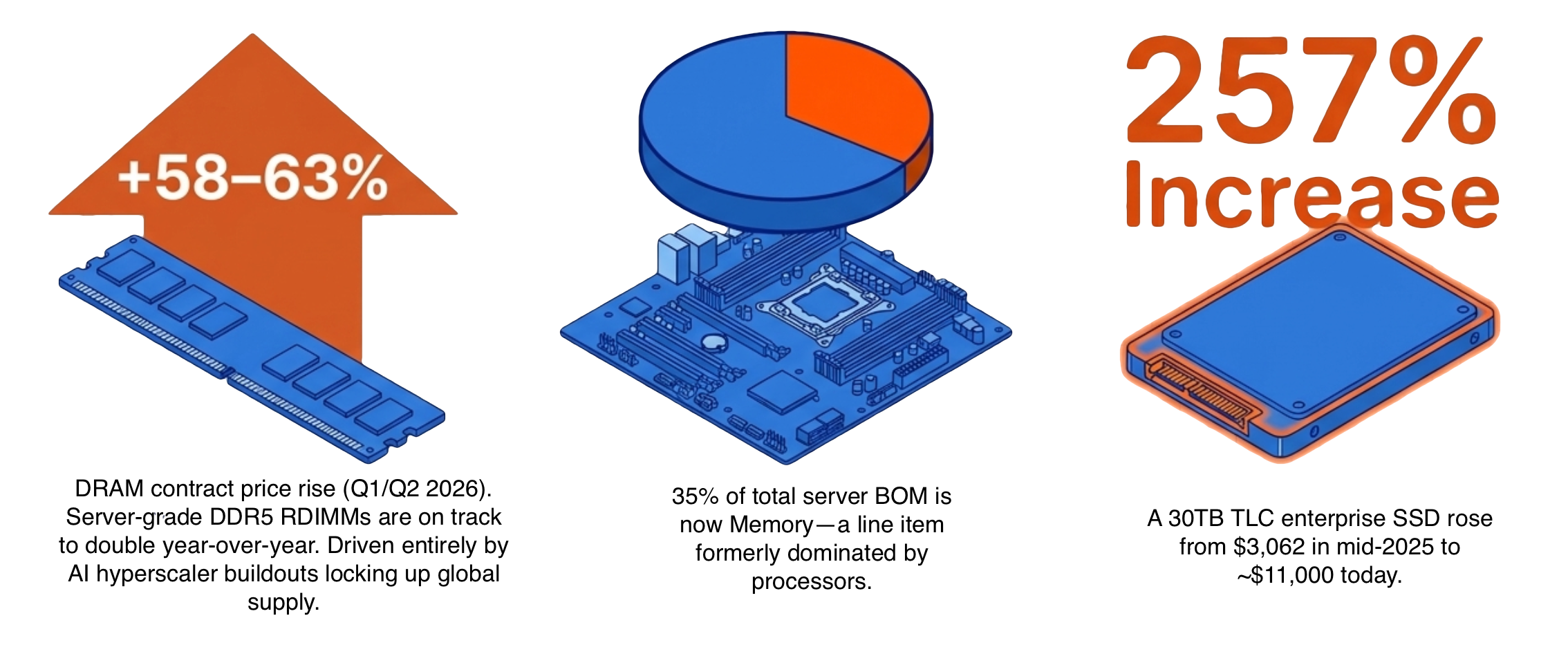
How a Hypervisor Can Reduce RAM ConsumptionDRAM prices are expected to increase 171% year-over-year through 2027. NAND flash contract prices jumped 55–60% in Q1 2026 alone. Server orders that once shipped in weeks now face multi-month delivery delays. The platform you choose now determines how much RAM, flash, and hardware you need for the next three to five years.

171%
Projected YoY DRAM price increase through 2027
55–60%
NAND flash contract price increase in Q1 2026
Months
Server delivery delays in categories that shipped in weeks

Finding a VMware alternative is still the primary mission. But the supercycle raises the bar. It is no longer enough to swap one hypervisor for another just because it costs less to license. The replacement must also reduce RAM consumption per workload, require fewer servers, and reduce flash storage costs. Any platform that relies on memory ballooning, transparent page sharing, or hypervisor swapping to manage RAM is using the same software tricks the industry has relied on for years. Those techniques react to memory pressure after it occurs. None of them reduce the total physical RAM your infrastructure actually requires.

Key Terms
Memory and Flash Supercycle

A sustained period of rising DRAM and NAND flash prices driven by AI infrastructure demand, DDR4 end-of-life, and constrained fabrication capacity. Industry analysts project tight supply through at least 2027.

Memory Ballooning

A hypervisor technique that uses a guest driver to reclaim unused RAM from idle VMs. Reactive by design, it fails under tight VM sizing and causes cascading performance degradation when multiple VMs spike simultaneously.

Transparent Page Sharing (TPS)

A memory deduplication technique that merges identical OS pages across VMs. Limited to identical pages, disabled by default in VMware since 2014 due to security concerns, and ineffective for application data.

Global Inline Deduplication

VergeOS technology that identifies and eliminates duplicate data blocks at the storage layer before they are written to flash. Reduces total flash capacity requirements, lowers write amplification to extend drive life, and feeds only unique blocks into the RAM cache.

Global Deduplicated Cache

A VergeOS RAM cache that operates across all VMs across all nodes and draws from the already-deduplicated storage pool. Holds only unique data blocks, increasing effective cache capacity and hit rates without the CPU overhead of a separate cache-level deduplication algorithm.

ioGuardian

VergeOS data availability technology that uses snapshot-driven local replication to protect against multiple simultaneous drive failures. Eliminates the need for hardware RAID controllers and delivers consistent performance during failures and rebuilds.

Commodity NVMe

Standard NVMe solid-state drives that cost significantly less than enterprise or server-class SSDs. VergeOS makes commodity drives production-safe through software-managed wear leveling, global deduplication to reduce writes, and ioGuardian replication to handle failures gracefully.

Our on-demand webinar goes deeper into each of these points. Watch Architecting for the Flash and Memory Supercycle to see how the platform decisions you make today determine your infrastructure costs for the next three to five years.

Start with an Efficient Code Base That Reduces RAM Consumption

The first question to ask any VMware alternative is how much RAM the platform itself consumes before a single VM even starts. VMware environments running vSphere, vSAN, vCenter, and NSX stack four separate products on every host. Each product reserves memory for its own management processes. Add external replication software and hardware RAID controllers, and the cumulative overhead climbs even further.

VergeOS takes a different architectural approach. It delivers a complete private cloud operating system that integrates virtualization, storage, networking, and data protection as services within a single code base. There is no separate storage product. There is no separate networking product. The platform is built with global deduplication, enabling synchronous replication without the typical capacity impact and delivering better, more consistent performance in production and during failures.

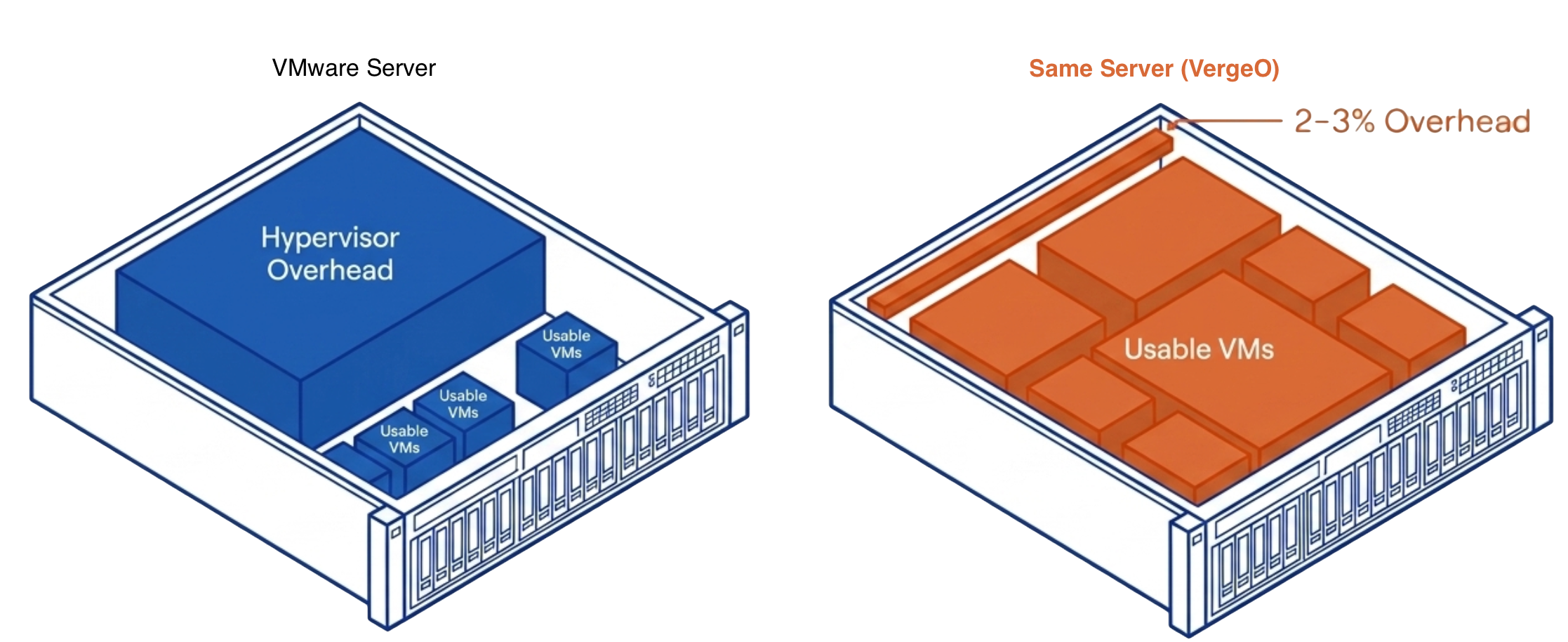
Memory usage comparison across virtualization platformsIt eliminates the need for hardware RAID controllers, which are also increasing in price because they consume RAM. VergeOS includes built-in data replication for disaster recovery, and its global inline deduplication reduces capacity costs at the disaster recovery site as well. The entire platform runs at 2–3% memory overhead. Compare that to the double-digit percentages consumed by multi-product virtualization stacks and HCI platforms that reserve tens of gigabytes per node before workloads even start.

A lower baseline means more RAM available for production workloads on the same hardware. During a supercycle, that difference translates directly into fewer servers needing to be purchased at inflated prices.

Use Existing Hardware and Reduce How Much You Need

Server reduction through VergeOS consolidationVergeOS installs on any x86 server from any manufacturer. Organizations migrating from VMware continue to run on the same physical servers they already own. There is no hardware forklift upgrade. No waiting six months for new server deliveries that keep getting pushed back as memory and flash shortages worsen. The servers, RAM, and SSDs already purchased and deployed remain in production.

Getting there does not require the purchase of a parallel environment or even a maintenance window. VergeOS supports node-by-node migration from VMware. Evacuate workloads from one host, install VergeOS on that host, migrate VMs onto the new platform, and repeat across the remaining hosts. Production continues running throughout the process. Alinsco Insurance completed this on a five-node VxRail cluster running a mission-critical insurance application that cannot tolerate downtime. The team migrated node by node during business hours with zero downtime. Critical web servers were moved at night out of an abundance of caution, but even those migrations produced no service interruption. During a supercycle, this approach eliminates the capital expense of purchasing a second set of servers to stand up alongside the existing environment.

On-Demand Webinar
Architecting for the Flash and Memory Supercycle

How the platform decisions you make today determine your infrastructure costs for the next three to five years.

Watch On-Demand →

Because VergeOS consumes less RAM per host, organizations can increase VM density and consolidate to fewer servers. Topgolf, operating more than 100 venues globally, reduced each site from six-node VxRail clusters to three-node VergeOS clusters. That is a 50% server reduction per venue. Alinsco Insurance continued to run on the same VxRail hardware and internal SSDs after migration, and servers that felt constrained under VMware gained additional headroom under VergeOS.

The freed servers create immediate value. One becomes a dedicated ioGuardian server, delivering N+2 or greater (N+X) data protection without purchasing new hardware or hardware RAID. The remaining servers become part donors. Pull the DRAM and NVMe drives and redistribute them across the active production nodes. VergeOS supports mixed node types and mixed node roles in the same cluster, so the redistribution does not require matching hardware specifications.

Freed servers from VergeOS consolidation become parts donors or ioGuardian nodesThe consolidation math works across an entire fleet. An organization running 100 six-node VMware clusters that consolidates to 100 three-node VergeOS clusters frees 300 servers for repurposing, retirement, or spare parts — during a supercycle where replacement hardware is both expensive and slow to ship.

Reduce Flash Costs with Commodity SSDs

The supercycle affects flash storage as well as memory. Enterprise and server-class SSDs carry steep price premiums that continue to climb alongside NAND contract prices. Commodity NVMe drives are rising in price, too. But the price gap between enterprise and commodity is widening, not narrowing, and commodity drives do seem to be more readily available. Organizations that can safely run on commodity flash pay less per terabyte today relative to enterprise alternatives than they did a year ago.

VergeOS runs safely on commodity SSDs. The platform’s storage engine manages I/O scheduling and wear management at the software layer, reducing dependence on the drive’s internal controller. Global inline deduplication reduces total writes to each drive, directly extending drive life. ioGuardian’s snapshot-driven local replication protects against multiple simultaneous drive failures without data loss or downtime, so that a commodity drive that wears out faster than an enterprise drive is replaced gracefully. No hardware RAID controller is required. The combination makes commodity flash a production-safe choice at a fraction of the cost of enterprise SSDs.

A Cache That Benefits from Deduplication

Unified RAM cache across VergeOS nodes drawing from deduplicated storage poolMost virtualization platforms cache storage data independently on each node. If ten nodes access the same data block, ten separate copies sit in ten separate caches. That wastes RAM on redundant data across the cluster.

VergeOS approaches caching differently. The platform performs global inline deduplication at the storage layer, so the storage pool contains only unique blocks. The RAM cache operates across all VMs across all nodes and draws from that already-deduplicated pool. The cache holds only unique data without running a separate deduplication algorithm inside the cache itself. More unique blocks fit in the same physical RAM, driving higher cache hit rates and fewer reads from flash.

An important factor in making this work across nodes is VergeOS’s optimized internode communication protocol, purpose-built for this use case and free from the overhead of chatty iSCSI or NFS protocols. We will explore the technical details of this architecture in an upcoming post. The takeaway for now: VergeOS does not waste RAM caching duplicate data.

The VMware Alternative Decision Just Got Bigger

The search for a VMware alternative is no longer just about licensing. The supercycle means the platform you choose determines your RAM consumption, your flash costs, your server count, and how long your existing hardware stays in production. Choose a platform that relies on the same memory tricks the industry has used for decades, and you inherit the same overhead during the most expensive hardware market in years. Choose a platform built to reduce RAM consumption from a single efficient code base with built-in data availability, and you start with less overhead, run on the servers you already own, and reduce how many you need going forward.

Frequently Asked Questions
What is the Memory and Flash Supercycle?
A sustained period of rising DRAM and NAND flash prices driven by AI infrastructure demand, DDR4 end-of-life, and constrained fabrication capacity. DRAM prices are expected to increase 171% year-over-year through 2027, and NAND flash contract prices jumped 55–60% in Q1 2026 alone. Server delivery times have extended to multi-month delays.
Why don’t memory ballooning and transparent page sharing solve the problem?
These are reactive techniques that manage memory pressure after it occurs. Memory ballooning reclaims unused RAM from idle VMs but fails under tight sizing. Transparent page sharing merges identical OS pages but has been disabled by default in VMware since 2014 due to security concerns. Neither technique reduces the total physical RAM your infrastructure requires.
How much RAM overhead does VergeOS consume?
The entire VergeOS platform — including virtualization, storage, networking, and data protection — runs at 2–3% memory overhead. Compare that to multi-product VMware stacks that consume double-digit percentages, or HCI platforms like Nutanix that reserve 24–32 GB per node for controller VMs before workloads start.
Can I migrate from VMware without buying new servers?
Yes. VergeOS installs on any x86 server from any manufacturer and supports node-by-node migration from VMware. Evacuate workloads from one host, install VergeOS, migrate VMs onto the new platform, and repeat. The servers, RAM, and SSDs you already own stay in production. Alinsco Insurance completed this on a five-node VxRail cluster during business hours with zero downtime.
How does VergeOS reduce the number of servers needed?
Lower platform overhead means more RAM is available for production workloads on each host, increasing VM density. Topgolf reduced each venue from six-node VxRail clusters to three-node VergeOS clusters — a 50% reduction in servers across more than 100 locations. Freed servers become parts donors or dedicated ioGuardian data protection nodes.
Is it safe to run commodity NVMe drives in production?
With VergeOS, yes. The storage engine manages I/O scheduling and wear management at the software layer. Global inline deduplication reduces total writes to each drive, extending drive life. ioGuardian’s snapshot-driven local replication protects against multiple simultaneous drive failures without hardware RAID, so a commodity drive that wears faster is replaced gracefully with no data loss or downtime.
How does VergeOS cache data differently from VMware or Nutanix?
Most platforms cache storage data independently on each node, meaning duplicate blocks are cached separately on every host. VergeOS performs global inline deduplication at the storage layer first, then the RAM cache draws from the already-deduplicated pool. The cache holds only unique blocks across all VMs across all nodes, using an optimized internode protocol instead of iSCSI or NFS. More unique data fits in the same physical RAM, driving higher cache hit rates.
What happens to servers freed up after consolidation?
One freed server becomes a dedicated ioGuardian node, delivering N+2 or greater data protection without a new hardware purchase and without hardware RAID. The remaining servers become parts donors — pull the DRAM and NVMe drives and redistribute them across active production nodes. VergeOS supports mixed node types and mixed node roles, so no matching hardware specifications are required.

Filed Under: Private Cloud Tagged With: Cache, data protection, Deduplication, FlashAndMemorySupercycle, Migration, Performance, servers, Storage, VergeOS, VMware, VMware alternative

March 2, 2026 by George Crump

The supply of RAM and flash storage is not keeping up with demand. The shortage is driving prices higher and pushing delivery times out by months. According to an SK Hynix internal analysis, high prices and constrained supply are expected to continue through at least 2028. For IT planners already facing the rising cost of VMware licensing and looking for a VMware alternative, the timing is brutal. The solution is to consolidate VMs onto fewer hosts, but then IT needs to account for the hidden risk of VM Density, the blast radius.

Key Takeaways
  • RAM and flash supply constraints are expected to last through at least 2028. Reducing protection levels to offset rising prices puts data at risk during the period when that data is most valuable.
  • VM consolidation saves money but increases blast radius. When a dense host fails, it takes more VMs, more CPU, more memory, and more storage offline simultaneously than a traditional environment.
  • ioOptimize uses AI to proactively migrate workloads off degrading servers before failure and intelligently redistribute displaced VMs across surviving hosts based on actual resource demands.
  • RF2 mirrored redundancy and ioGuardian work together to extend protection from N+1 to N+2 without the performance overhead of RAID 6 or erasure coding.
  • Integrated replication and virtual data centers turn the DR site into an active protection layer, with cross-site ioGuardian recovery and full application stack failover in minutes.
  • RF3 triple mirroring, new in VergeOS 26.1, combined with ioGuardian delivers N+X availability where data remains accessible as long as one production server and the repair server are running.
  • VergeOS’s layered protection architecture scales with density, letting organizations capture the full cost savings of VM consolidation without accepting the availability risk that density traditionally creates.

If the risks of VM density can be contained or eliminated, the return on investment from increasing VM density is significant under normal market conditions. During a memory and flash supercycle, it becomes a strategic imperative.

Key Terms
  • Blast Radius — The scope of operational impact caused by a single failure event. In dense environments, one server going offline removes more VMs, CPU, memory, and storage from the cluster simultaneously.
  • VM Consolidation — The practice of running more virtual machines per physical host to reduce hardware costs, power, cooling, and data center footprint.
  • ioOptimize — VergeOS technology that uses AI and machine learning to balance workloads across mixed-generation servers, proactively migrate VMs off degrading hardware, and intelligently redistribute displaced VMs during failures.
  • RF2 Mirrored Redundancy — N+1 data protection that maintains two copies of every data block on separate fault domains. Provides fast rebuilds through direct block copies rather than parity reconstruction.
  • ioGuardian — A dedicated VergeOS instance that holds a protected third copy of data and provides inline VM recovery during failures. Extends protection from N+1 to N+2 without hosting production workloads.
  • RF3 Triple Mirroring — N+2 data protection new in VergeOS 26.1 that maintains three complete copies of every data block. Combined with ioGuardian, it delivers N+X availability.
  • N+X Availability — Protection level achieved by combining mirroring with an ioGuardian repair server. Data remains accessible as long as one production server and the repair server are running, without reaching for backups.
  • Virtual Data Centers — VergeOS technology that encapsulates entire application stacks for rapid failover to a remote site in minutes, without VM-by-VM configuration at the DR site.
  • Granular Replication — New in VergeOS 26.1, the ability to replicate specific workloads or data sets rather than replicating everything, reducing WAN bandwidth consumption and giving finer control over cross-site protection.

The ROI of VM Density

Every server removed from the environment eliminates its share of RAM, flash, power, cooling, licensing, and rack space costs. VergeOS customers who reduce server count by 25% do not just save on the servers themselves. They avoid purchasing RAM and NVMe drives for those servers at supercycle pricing. A four-server reduction in a 16-server cluster removes roughly 25% of the organization’s exposure to price increases in memory and flash in a single move.

VM density blast radius

The 30% reduction in per-VM memory allotment compounds the savings. A VM that required 16GB of RAM under VMware runs on 11GB under VergeOS. Multiply that savings across hundreds of VMs, and the organization reclaims terabytes of RAM capacity that it no longer needs to purchase, license, or replace at inflated prices. That reclaimed capacity either extends the life of existing hardware or reduces the bill of materials on the next refresh.

The combined effect is fewer servers, less memory per VM, and commodity drives instead of vendor-priced components. Organizations that achieve this level of consolidation spend less on infrastructure during the supercycle while maintaining or increasing their total workload capacity. The ROI is clear. The question is whether the protection architecture can keep pace with the density. That is the blast radius problem.

The VM Density Blast Radius Problem

Higher VM density means more VMs per host and more storage capacity inside each host. With modern hardware, the odds of a server or SSD drive failure are low. The odds of a second or third simultaneous failure are even lower. The real concern is the blast radius, meaning how much of the operation a single failure impacts.

When a host running 40 VMs goes offline, it does not just remove drives from the storage pool. It removes 40 running workloads, along with their CPU, memory, and network connections. The surviving hosts absorb the displaced VMs on top of their existing workloads and any storage rebuild I/O. A workload spike on a dense host creates a ripple effect, forcing resource contention across the cluster and degrading performance for every VM, not just the one experiencing the spike.

Traditional infrastructure spreads this risk across more physical servers, with fewer VMs per server. VM density concentrates it. The savings from higher density are real, but only if the protection architecture accounts for the larger blast radius.

How VergeOS Protects VM Dense Environments

VergeOS addresses the VM density blast radius with a layered protection architecture. Each layer targets a different failure scenario, from early degradation warnings to complete site loss.

ioOptimize uses AI and machine learning to continuously monitor the health, performance, and capacity of every server in the environment. Its algorithms distribute workloads based on each server’s actual capabilities, assigning lighter tasks to aging hardware and directing demanding workloads to newer servers. This intelligent placement lets organizations run mixed-generation environments without prematurely retiring older servers. The scale-down capability goes further, consolidating VMs and storage onto denser configurations to reduce power, cooling, and physical footprint. The result is fewer servers doing more work, which directly reduces the hardware exposed to the memory and flash supercycle pricing.

VM density blast radius

ioOptimize also changes how the cluster responds to server failures. It monitors for early indicators of degradation and proactively migrates workloads off at-risk servers before a hard failure occurs. When a server does fail unexpectedly, ioOptimize evaluates the resource demands of each displaced VM and matches them against available capacity on the surviving hosts. Instead of dumping 40 VMs onto the nearest available server and creating a new hotspot, it distributes them based on actual CPU, memory, and I/O requirements. That intelligent redistribution keeps the blast radius contained and prevents a single failure from cascading into a cluster-wide performance problem.

RF2 Mirrored Redundancy keeps two copies of every data block on separate fault domains. When a drive or server fails, the surviving copy handles all requests without degrading performance. Rebuilds are fast because the process copies intact blocks directly from the surviving mirror rather than reconstructing data from parity calculations.

VM density blast radius

ioGuardian maintains a protected third copy of data on a separate VergeOS instance that can provide inline recovery of VMs. The ioGuardian server does not host production workloads. Its dedicated role is to feed missing data blocks back to the production environment during failures, keeping production hosts focused on running VMs rather than diverting resources to data reconstruction. This extends protection from N+1 to N+2 without adding the performance overhead of RAID 6 or erasure coding.

ioReplicate sends both production data and ioGuardian data to a remote site. If the primary site’s ioGuardian instance fails at the same time as a production failure, the ioGuardian at the DR site can still perform inline recovery to the production cluster at the primary site. This cross-site protection layer covers failure scenarios that no single-site architecture can address.

Virtual Data Centers make recovery at the remote site straightforward when the primary site fails completely. Entire application stacks restart at the DR site in minutes, not hours. The encapsulation of full workload environments means the DR site does not need to be configured VM by VM.

VergeOS 26.1 Strengthens the Protection Stack

RF3 Triple Mirroring, new in VergeOS 26.1, provides N+2 availability for organizations that demand maximum protection. Three complete copies of every data block mean two simultaneous failures cause zero data loss and near-zero performance impact. When combined with ioGuardian, RF3 enables the environment to reach N+X availability, where data remains accessible as long as one production server and the repair server are running.

VergeOS 26.1 increases replication performance by 2x, cutting the time required to synchronize data between sites. Faster replication narrows the window where the DR site lags behind the primary, reducing the amount of data at risk during a site-level failure.

Version 26.1 also introduces granular replication, allowing IT planners to replicate specific workloads or data sets rather than replicating everything. This precision reduces bandwidth consumption on the WAN link and gives organizations finer control over which data gets the highest level of cross-site protection.

Density Without the Risk

VM density reduces hardware costs, shrinks the data center footprint, and frees budget for strategic initiatives. The risk is that traditional protection methods were designed for environments with fewer VMs per host and less data per server. As density increases, the blast radius of each failure grows.

VergeOS addresses this with a layered protection architecture that scales with density. ioOptimize keeps workloads balanced and migrates VMs off failing servers before they crash. RF2 handles single failures with no performance impact. ioGuardian extends protection to N+2 with a dedicated repair path that does not compete with production workloads. Integrated replication and virtual data centers add cross-site recovery that activates in minutes. Now with 26.1, RF3 combined with ioGuardian delivers N+X availability for environments where any downtime is unacceptable.

The result is an infrastructure that captures the full cost savings of VM density without accepting the availability risk that density traditionally creates.

Why does VM consolidation increase risk?

Packing more VMs onto fewer hosts means each server failure takes more workloads offline at once. The surviving hosts absorb those displaced VMs on top of their existing workloads and any storage rebuild I/O, creating resource contention that can degrade performance across the entire cluster.

How does ioOptimize prevent failures from cascading?

ioOptimize monitors every server for early signs of degradation and proactively migrates workloads before a hard failure occurs. When a server does fail, it evaluates the resource demands of each displaced VM and distributes them across surviving hosts based on actual CPU, memory, and I/O capacity rather than dumping them onto the nearest available server.

What is the difference between RF2 and RF3?

RF2 keeps two copies of every data block and provides N+1 protection, sustaining one device failure without data loss. RF3 keeps three copies and provides N+2 protection, sustaining two simultaneous failures. RF3 is new in VergeOS 26.1 and is designed for organizations that demand maximum availability.

How does ioGuardian extend protection beyond RF2 or RF3?

ioGuardian maintains a protected copy of data on a separate VergeOS instance that does not host production workloads. During failures, it feeds missing data blocks back to the production environment in real time. Combined with RF2 it delivers N+2 protection. Combined with RF3 it delivers N+X availability, where data stays accessible as long as one production server and the repair server are running.

Can ioGuardian work across sites?

Yes. Integrated replication sends both production data and ioGuardian data to a remote site. If the primary site’s ioGuardian fails at the same time as a production failure, the ioGuardian at the DR site can still perform inline recovery to the primary production cluster over the WAN.

What happens if the primary site fails completely?

Virtual data centers encapsulate entire application stacks for failover at the remote site. The DR site does not need VM-by-VM configuration. Full workload environments restart in minutes, not hours.

How long will RAM and flash prices stay elevated?

According to SK Hynix internal analysis, commodity DRAM supply is projected to remain constrained through at least 2028. Multiple industry analysts expect high prices and tight supply to persist until new fabrication facilities reach volume production.

How does VergeOS reduce exposure to the memory supercycle?

VergeOS’s single-codebase architecture reduces physical server count by up to 25% and per-VM memory allotment by 30%. Its ultraconverged design supports commodity NVMe drives and standard memory instead of vendor-specific components with inflated pricing. Fewer servers consuming less memory per VM means less hardware exposed to supercycle pricing.

What is granular replication?

New in VergeOS 26.1, granular replication lets IT planners replicate specific workloads or data sets to a remote site rather than replicating everything. This reduces WAN bandwidth consumption and gives organizations finer control over which data receives the highest level of cross-site protection.

Frequently Asked Questions
  • Why does VM consolidation increase risk? — Packing more VMs onto fewer hosts means each server failure takes more workloads offline at once. The surviving hosts absorb those displaced VMs on top of their existing workloads and any storage rebuild I/O, creating resource contention that can degrade performance across the entire cluster.
  • How does ioOptimize prevent failures from cascading? — ioOptimize monitors every server for early signs of degradation and proactively migrates workloads before a hard failure occurs. When a server does fail, it evaluates the resource demands of each displaced VM and distributes them across surviving hosts based on actual CPU, memory, and I/O capacity rather than dumping them onto the nearest available server.
  • What is the difference between RF2 and RF3? — RF2 keeps two copies of every data block and provides N+1 protection, sustaining one device failure without data loss. RF3 keeps three copies and provides N+2 protection, sustaining two simultaneous failures. RF3 is new in VergeOS 26.1 and is designed for organizations that demand maximum availability.
  • How does ioGuardian extend protection beyond RF2 or RF3? — ioGuardian maintains a protected copy of data on a separate VergeOS instance that does not host production workloads. During failures, it feeds missing data blocks back to the production environment in real time. Combined with RF2 it delivers N+2 protection. Combined with RF3 it delivers N+X availability, where data stays accessible as long as one production server and the repair server are running.
  • Can ioGuardian work across sites? — Yes. Integrated replication sends both production data and ioGuardian data to a remote site. If the primary site’s ioGuardian fails at the same time as a production failure, the ioGuardian at the DR site can still perform inline recovery to the primary production cluster over the WAN.
  • What happens if the primary site fails completely? — Virtual data centers encapsulate entire application stacks for failover at the remote site. The DR site does not need VM-by-VM configuration. Full workload environments restart in minutes, not hours.
  • How long will RAM and flash prices stay elevated? — According to SK Hynix internal analysis, commodity DRAM supply is projected to remain constrained through at least 2028. Multiple industry analysts expect high prices and tight supply to persist until new fabrication facilities reach volume production.
  • How does VergeOS reduce exposure to the memory supercycle? — VergeOS’s single-codebase architecture reduces physical server count by up to 25% and per-VM memory allotment by 30%. Its ultraconverged design supports commodity NVMe drives and standard memory instead of vendor-specific components with inflated pricing. Fewer servers consuming less memory per VM means less hardware exposed to supercycle pricing.
  • What is granular replication? — New in VergeOS 26.1, granular replication lets IT planners replicate specific workloads or data sets to a remote site rather than replicating everything. This reduces WAN bandwidth consumption and gives organizations finer control over which data receives the highest level of cross-site protection.

Filed Under: Protection Tagged With: dataprotection, Disaster Recovery, IT infrastructure

February 23, 2026 by George Crump

Can an organization generate an ROI from disaster recovery? Most IT planners view the infrastructure and costs associated with disaster recovery (DR) as purely an expense item. It is a necessary expense to protect the organization in case of a major outage in its primary data center. But VergeIO, with the additional capabilities in VergeOS 26.1, can turn a DR expense into an investment that delivers a rapid return. The key is making the DR site work for the business every day, not just during a disaster.

▸ Key Takeaways
Disaster recovery does not have to be a pure expense. Organizations that put their DR site to active use can generate measurable ROI through testing, peak load management, and workload recovery.
Seamless workload portability is the foundation. VergeOS Virtual Data Centers encapsulate VMs, network settings, storage settings, and configurations into a single movable unit that restarts at the DR site in three clicks.
Hardware abstraction lets DR sites run workloads at production-level performance, even on older, last-generation servers, making the DR site viable for testing and peak load overflow.
VergeOS eliminates the need for full-site failover. VDC technology restarts only the affected workloads at the DR site, and ioGuardian rebuilds missing data blocks in real time without taking production offline.
Active DR sites are more recovery-ready. Daily use validates connectivity, replication, and workflows continuously, replacing the artificial confidence of annual DR tests with operational proof.

Workload Portability: The Foundation of Disaster Recovery ROI

The foundational requirement for generating ROI from disaster recovery is seamless workload portability. Workloads have to restart in the other data center seamlessly, using only a few mouse clicks and as little post-movement configuration as possible. VergeOS accomplishes this with its multi-tenant Virtual Data Center (VDC) technology. These tenants encapsulate the entire data center, including all Virtual Machines and their specific settings, all network settings, and all storage settings. Customers can create VDCs by workload type, by line of business, or in the case of service providers, by customer.

▸ Key Terms
Virtual Data Center (VDC)
A multi-tenant construct in VergeOS that encapsulates an entire workload environment, including VMs, network settings, storage settings, and VM configurations, into a single portable unit. VDCs can be organized by workload type, line of business, or customer.
Workload Portability
The ability to move workloads between data center sites with minimal clicks and no post-movement reconfiguration. In VergeOS, VDC encapsulation enables three-click restarts at the DR site.
Hardware Abstraction
Decoupling workloads from the underlying physical server hardware so VMs can run on any available resources. Allows DR sites with older, last-generation servers to run workloads at production-level performance.
Consistency Group
A set of interrelated resources that must be captured together to produce a recoverable snapshot. VergeOS VDCs act as automatic consistency groups, capturing all VMs, network, and storage components without additional configuration.
ioGuardian
A VergeOS technology that feeds missing data blocks from the DR site back to production in real time when drive failures cause data loss. Rebuilds the production environment without taking workloads offline or initiating a formal DR event.
VM-Centric Replication
A DR approach that replicates individual virtual machines to a secondary site. Misses network settings, storage configurations, and inter-VM dependencies, requiring extensive manual reconfiguration at the DR site.
DR Readiness
The confidence level that a disaster recovery environment will perform as expected during a real event. Active DR sites that run daily workloads validate connectivity, replication, and recovery workflows continuously, replacing the uncertainty of annual testing.

VDC-level encapsulation solves a problem that other DR approaches cannot. VM-centric replication misses network settings, storage configurations, and dependencies between interrelated VMs. It creates dozens of moving parts that an administrator must reassemble at the DR site before workloads can run. Data-center-wide replication goes to the other extreme. It forces everything to replicate together, offers no granularity, and makes it difficult to prioritize recovery of critical workloads over low-value ones.

VDCs hit the middle ground. They segment workloads into logical groups that match how the business actually operates. Each VDC acts as an automatic consistency group, capturing all the components a workload needs to run. No extra configuration. No extra cost. The result is a three-click restart at the DR site, with the workload running exactly as it did in production.

CapabilityVM-Centric DRData Center Wide DRVergeOS VDC DR
Network settingsManual reconfigurationMight be included, but no granularityEncapsulated per VDC
Storage settingsManual reconfigurationMight be included, but no granularityEncapsulated per VDC
VM configurationsReplicated individuallyReplicated as a wholeGrouped by workload, LOB, or customer
Interrelated VM dependenciesMissed or manually trackedIncluded but cannot isolateAutomatic consistency groups
Recovery granularityPer VM (many moving parts)All or difficult per VMPer VDC (right-sized groups)
Recovery prioritizationManual triage at DR siteDifficult to prioritizeVDC-level priority sequencing
Post-failover configurationExtensiveMinimal but inflexibleThree clicks, no reconfiguration

Why DR Site Hardware Utilization Matters for Cost Savings

The second requirement for disaster recovery ROI is efficient hardware utilization at the DR site. Mirroring production hardware at a secondary location is expensive, and most organizations avoid that cost by running last-generation servers at their DR sites. The hardware is older, slower, and less capable than what runs in production.

This creates a problem for any organization that wants to use DR infrastructure for more than standby. If the DR site cannot run workloads at production-level performance, it cannot serve as a reliable testing environment or handle overflow during peak demand.

VergeOS addresses this through hardware abstraction. The platform decouples workloads from the underlying server hardware, allowing VMs to run on whatever physical resources are available. VergeOS uses that hardware efficiently, extracting maximum performance from every core, drive, and network link. The result is that workloads run as well at the DR site as they do in production, even on older equipment.

Two Ways to Generate ROI from Your DR Investment

With seamless portability and efficient hardware utilization in place, organizations can put their DR investment to work in two ways that generate measurable disaster recovery cost savings.

The first way to generate ROI from disaster recovery is to use the DR site becomes a testing environment. Instead of maintaining a dedicated lab or consuming production resources for QA, staging, and validation work, IT teams can run test workloads on the DR infrastructure. A VDC containing the test environment can be created at the DR site in 3 clicks. When testing is complete, the VDC stops, and the resources return to standby. The organization avoids the capital and operational costs of a separate test lab. If the test is successful, IT can move the validated VDC back to the primary site as a direct replacement for the production VDC. The DR site becomes a staging ground where updates are tested and promoted to production in a single workflow.

ROI from disaster recovery

A second way to generate ROI from disaster recovery is to use it as a pressure valve for peak loads. When production demand spikes, administrators can move lower-priority workloads to the DR site, freeing resources for the applications that need them most. Or they can move the peak workload itself to the DR site, giving it dedicated access to the full hardware pool without competing for resources. Either approach turns idle DR capacity into active compute that supports the business during its most demanding periods. Speed and simplicity of transfer are critical here. If the process is too difficult, IT teams will not bother. If it cannot be executed within a few minutes, the peak demand may pass before the transfer is complete. VDC portability in VergeOS makes both the decision and the execution fast enough to act on in real time.

ROI from disaster recovery

Both use cases generate direct, measurable returns:

  • Lab infrastructure the organization no longer needs to buy or maintain
  • Production performance that improves during peak periods without additional hardware purchases
  • Tested updates that promote directly from DR to production without rebuilding
  • Idle standby capacity that pays for itself through active daily use

How VergeOS Keeps Production Running Without Full-Site Failover

Another way to generate ROI from disaster recovery is to leverage it to offload some of the production site’s investment in data availability and protection. Traditional DR assumes a binary choice when a catastrophic failure hits the production site. The organization either fails over everything to the DR site or suffers downtime until the production environment is repaired. Full-site failover is disruptive, time-consuming, and in some cases takes longer than just fixing the primary site.

VergeOS offers a third option. When drive failures exceed the protection scope or multiple production servers fail, VergeOS can restart just the affected critical workloads at the DR site using VDC technology. There is no full-site failover. Unaffected workloads keep running in production. Only the impacted VDCs move.

ROI from disaster recovery

ioGuardian takes this further. When data segments are lost due to drive failures, ioGuardian feeds the missing blocks from the DR site back to production, one block at a time, in real time. The production environment rebuilds from the replica without taking workloads offline or initiating a formal DR event. The organization stays operational while the platform repairs itself in the background.

Active DR Sites Are More Recovery-Ready

DR readiness is one of the least-discussed benefits of generating ROI from disaster recovery by putting the secondary site into active use. Most organizations test their disaster recovery plans once or twice a year. Between tests, the DR environment sits idle. Configurations drift. Firmware falls behind. Network paths go unvalidated. When a real disaster hits, the DR site that passed its annual test six months ago may not perform the way the team expects.

An active DR site eliminates this risk. Every time IT moves a test workload to the DR site, runs a peak load scenario, or promotes a validated VDC back to production, the team is exercising the same processes and infrastructure that a real recovery event requires. Network connectivity between sites gets validated with every transfer. Storage replication gets confirmed with every sync. The team builds muscle memory on the exact workflows they would execute during a disaster.

This continuous validation replaces the artificial confidence of annual DR tests with operational proof. The DR site is not a cold standby that the team hopes will work. It is a working environment that the team knows will work because they used it yesterday.

ROI from disaster recovery

VergeOS VDC portability enables this continuous readiness. Moving workloads between sites for testing or peak load management uses the same three-click process as a disaster recovery event. The tools are identical. The workflows are identical. The only difference is the trigger. Organizations that use their DR site daily do not need to wonder whether it will perform during a crisis. They already know.

Turn Disaster Recovery from an Expense into an Investment

DR Readiness is critical and using your DR Site for something other than a disaster actually improves your readiness. Disaster recovery does not have to be a pure cost center. Organizations that deploy VergeOS can use the same DR infrastructure for testing, peak load management, and targeted workload recovery. The foundational capabilities, VDC encapsulation, hardware abstraction, and ioGuardian, transform idle standby capacity into an active infrastructure that delivers value every day, not just during a disaster.

▸ Frequently Asked Questions
Can I really use my DR site for production workloads without compromising recovery readiness?
Yes. VergeOS VDC portability uses the same three-click process for daily workload transfers as it does for disaster recovery events. Every time you move a workload to the DR site for testing or peak load management, you are validating the same connectivity, replication, and recovery workflows that a real disaster would require.
What if my DR site runs older hardware than my production site?
VergeOS decouples workloads from the underlying hardware through abstraction. VMs run on whatever physical resources are available, and VergeOS extracts maximum performance from every core, drive, and network link. Organizations routinely run production-level workloads on last-generation DR hardware.
How is VDC-based DR different from VM-centric replication?
VM-centric replication copies individual virtual machines but misses network settings, storage configurations, and dependencies between interrelated VMs. VDCs encapsulate the entire workload environment, including all VMs, network, and storage settings, into a single portable unit that restarts at the DR site without reconfiguration.
Do I have to fail over my entire site if production servers fail?
No. VergeOS can restart just the affected VDCs at the DR site while unaffected workloads keep running in production. ioGuardian can also rebuild missing data blocks from the DR site back to production in real time, avoiding a formal DR event entirely.
Can I test updates at the DR site and then promote them to production?
Yes. IT teams can start a VDC at the DR site, validate updates in that environment, and then move the validated VDC back to the primary site as a direct replacement for the production VDC. The DR site becomes a staging ground where updates are tested and promoted in a single workflow.
How fast can I move workloads to the DR site during a peak demand event?
VDC transfers execute in minutes through a three-click process. This speed is critical for peak load scenarios. If the transfer takes too long, the demand spike may pass before the move is complete. VergeOS makes both the decision and the execution fast enough to act on in real time.
Can I really use my DR site for production workloads without compromising recovery readiness?

Yes. VergeOS VDC portability uses the same three-click process for daily workload transfers as it does for disaster recovery events. Every time you move a workload to the DR site for testing or peak load management, you are validating the same connectivity, replication, and recovery workflows that a real disaster would require.

What if my DR site runs older hardware than my production site?

VergeOS decouples workloads from the underlying hardware through abstraction. VMs run on whatever physical resources are available, and VergeOS extracts maximum performance from every core, drive, and network link. Organizations routinely run production-level workloads on last-generation DR hardware.

How is VDC-based DR different from VM-centric replication?

VM-centric replication copies individual virtual machines but misses network settings, storage configurations, and dependencies between interrelated VMs. VDCs encapsulate the entire workload environment, including all VMs, network, and storage settings, into a single portable unit that restarts at the DR site without reconfiguration.

Do I have to fail over my entire site if production servers fail?

No. VergeOS can restart just the affected VDCs at the DR site while unaffected workloads keep running in production. ioGuardian can also rebuild missing data blocks from the DR site back to production in real time, avoiding a formal DR event entirely.

Can I test updates at the DR site and then promote them to production?

Yes. IT teams can start a VDC at the DR site, validate updates in that environment, and then move the validated VDC back to the primary site as a direct replacement for the production VDC. The DR site becomes a staging ground where updates are tested and promoted in a single workflow.

How fast can I move workloads to the DR site during a peak demand event?

VDC transfers execute in minutes through a three-click process. This speed is critical for peak load scenarios. If the transfer takes too long, the demand spike may pass before the move is complete. VergeOS makes both the decision and the execution fast enough to act on in real time.

Filed Under: Protection

February 18, 2026 by George Crump

When IT professionals evaluate a VMware alternative, two concerns immediately surface: what the migration will look like and how steep the learning curve is. When those professionals encounter VergeOS — a platform that replaces the hypervisor, storage array, backup product, and network overlay in a single installation — those concerns sharpen. A key question is whether the platform’s breadth makes initial testing, migration, and daily operations more difficult.

▶ Key Takeaways
  • Platform breadth reduces complexity: VergeOS replaces the hypervisor, storage array, backup product, and network overlay in a single installation. One codebase means one install, one UI, one API, and one update path.
  • Independent verification exists: 2GuysTek recorded the full VergeOS installation process on camera without a script or a VergeIO sales engineer present. The entire process completes in a single sitting.
  • Customers confirm fast deployments: Topgolf migrates a full venue in a single day. ZebraHost racked and installed in half a day. IAC Group completed its first site in under three hours with no prior platform experience.
  • Hands-on labs require no hardware: Three self-paced labs run on VergeOS multi-tenancy, each completable in 15 to 20 minutes. The delivery mechanism demonstrates a core platform capability before the first exercise is finished.
  • AI-assisted documentation answers questions in context: The built-in AI assistant draws from the full documentation set and is optimized against hallucination. If it does not know the answer, it says so.
  • Four paths to evaluate with no commitment: Watch the independent installation video, complete hands-on labs, explore AI-assisted documentation, or schedule a technical overview with a Principal Solutions Architect.

The opposite is true, and the breadth of VergeOS is precisely why. VergeOS is a single codebase. One install, one UI, one API, one update path. Administrators do not create and maintain separate VMs for storage controllers, backup servers, or network management. There are no third-party dependencies for core infrastructure functions. The integration work that makes competing VMware alternatives difficult to deploy and operate does not exist in VergeOS because there is nothing to integrate.

▶ Key Terms
  • VMware Alternative — A platform that replaces VMware’s virtualization stack. Most alternatives swap only the hypervisor. A Private Cloud OS replaces the hypervisor, storage, networking, and data protection in a single installation.
  • Private Cloud Operating System — A unified operating system that treats compute, storage, networking, and data protection as native functions of a single codebase rather than separate products coordinated through automation.
  • Single Codebase — An architecture where all infrastructure functions ship in one software package with one installation, one UI, one API, and one update path. Eliminates integration work between separate products.
  • Multi-Tenancy — The ability to create isolated virtual environments on shared physical hardware. VergeOS uses this capability to host its own hands-on labs, delivering each participant a secure, independent tenant.
  • Virtual Data Center (VDC) — A fully isolated, self-contained environment within a VergeOS instance that includes its own compute, storage, networking, and management controls. VDCs enable multi-tenancy without separate physical infrastructure.
  • Proof of Concept (POC) — A controlled evaluation where an IT team installs and tests a platform in its own environment before committing budget. VergeOS POCs run on existing hardware with no forklift required.
  • Hands-On Lab — A self-paced, cloud-hosted environment that gives IT professionals direct access to a platform without deploying hardware. VergeIO’s labs run on VergeOS multi-tenancy, demonstrating the platform’s isolation capabilities as part of the experience.

How to Install This VMware Alternative — An Independent Walkthrough

VergeOS installation

Rich Teslow at 2GuysTek, a respected independent voice in the infrastructure community, walked through the full VergeOS installation process on camera, without a script and without a VergeIO sales engineer present. In the video, he covers the entire process from bootable media to a running system in a single sitting. No separate installation steps for storage, networking, or management. No prerequisite certifications. No multi-day professional services engagements.

VergeOS customers reinforce the point:

  • Topgolf describes the installation process as “efficient and repeatable,” enabling the team to complete a full VMware-to-VergeOS migration of an entire venue in a single day.
  • ZebraHost Managing Partner Nate Battles calls the setup speed “mind-boggling,” noting the team racked, installed, and spun up its first VergeOS cluster within half a day.
  • IAC Group had no prior experience with the platform. The first site installation took less than three hours. The second site took less than two.
  • InterBel Telephone IT Manager Tom Rasmussen confirmed that the lab setup proved the company’s claims, taking under two hours to complete with additional nodes integrated in fifteen minutes.
VergeOS installation

Test VergeOS Without Hardware — Hands-On Labs

After watching Rich’s video and reviewing the customer results, the next step is moving from watching to doing. VergeIO’s hands-on labs provide direct access to VergeOS without deploying hardware. VergeIO hosts these labs on VergeOS itself — each participant receives a secure, isolated tenant within the platform’s integrated virtual data center technology. The delivery mechanism demonstrates a core platform capability before the participant completes the first exercise.

Three labs are available today, each self-paced and completable in 15 to 20 minutes: Getting Started with VergeOS, Data Protection and Recovery, and live migration of VMs from node to node. Every lab is fully scripted to walk participants step by step through core platform processes, including VM creation, snapshot protection, and recovery. Administrators finish each lab with hands-on experience performing the tasks they will perform in production—not a guided tour of someone else’s screen. All three labs are available 24/7 with no hardware required.

easy to install VMware alternative

AI-Assisted Documentation for Day-to-Day Operations

IT professionals rarely have the time or patience to read documentation cover to cover. The VergeOS documentation site addresses this directly with a built-in AI assistant that answers questions in context as administrators work through labs or begin a proof of concept. Ask it a question like “Before I start installing VergeOS, what networking considerations should I be aware of?” and receive a specific, platform-aware answer drawn from the full documentation set. The assistant is optimized against hallucination — if it does not know the answer, it says so.

Start a VergeOS Proof of Concept

easy to install VMware alternative

The final step is trying VergeOS in your own environment. We recommend starting with a product demonstration from one of our Principal Solutions Architects. They walk through the platform in action, including a live VMware migration, and provide a license for your test environment. Schedule that conversation here.

Why Ease of Use Matters When Choosing a VMware Alternative

IT teams evaluating infrastructure platforms need to answer two questions before committing budget and staff time. First, does the platform deliver the capabilities the organization requires? Second, can the existing team operate it without adding headcount or investing in new certifications?

VergeOS addresses the first question through its integrated architecture—compute, storage, networking, snapshots, replication, and multi-tenancy—shipped in a single installation package with no bill of materials to assemble. The installation video, hands-on labs, and AI-assisted documentation address the second question by allowing IT professionals to verify operational simplicity firsthand. An independent reviewer installing the platform in one sitting, self-paced labs that take 15 minutes to complete, and an AI assistant that answers operational questions on demand say more about day-to-day operations than any datasheet.

Get Started with VergeOS

Four paths, no commitment required:

  • Watch the independent installation walkthrough from 2GuysTek
  • Do the hands-on labs — no hardware, no cost
  • Explore the documentation and AI assistant
  • Schedule a technical overview with a Principal Solutions Architect
▶ Frequently Asked Questions
▶ How long does it take to install VergeOS?

The 2GuysTek independent walkthrough shows a full installation completing in a single sitting. Customer results confirm the timeline: IAC Group finished its first site in under three hours with no prior platform experience. ZebraHost racked, installed, and launched its first cluster in half a day.

▶ Do I need new hardware to try VergeOS?

No. The hands-on labs run entirely on a VergeIO data center using VergeOS multi-tenancy. No hardware, no cost, no commitment. When you move to a proof of concept, VergeOS installs on existing servers. There is no hardware compatibility matrix to satisfy.

▶ What do the hands-on labs cover?

Three labs are available today: Getting Started with VergeOS, Data Protection and Recovery, and Live VM Migration. Each is self-paced and completable in 15 to 20 minutes. Every lab is fully scripted, walking participants step by step through core platform processes including VM creation, snapshot protection, and recovery.

▶ Why does VergeOS replace more than just the hypervisor?

VergeOS is a single codebase that integrates compute virtualization, distributed storage, networking, and data protection. One install replaces the hypervisor, the storage array, the backup product, and the network overlay. There are no third-party dependencies for core infrastructure functions and no integration work between separate products.

▶ Does the AI documentation assistant hallucinate?

The assistant is optimized against hallucination. It draws answers from the full VergeOS documentation set and responds in context as administrators work. If it does not know the answer, it says so rather than generating an inaccurate response.

▶ Who recorded the independent installation video?

Rich Teslow at 2GuysTek, an independent voice in the infrastructure community. He walked through the full installation without a script or a VergeIO sales engineer present. The video covers the entire process from bootable media to a running system.

▶ Do I need VMware experience to operate VergeOS?

No. IAC Group had no prior experience with the platform and completed its first installation in under three hours. VergeOS operates through a single UI that manages compute, storage, networking, and data protection. There are no prerequisite certifications and no multi-day professional services engagements required.

▶ What is the next step after the hands-on labs?

Schedule a technical overview with a Principal Solutions Architect. They walk through the platform in action, including a live VMware migration, and provide a license for your test environment. The conversation is a working session, not a sales pitch.

How long does it take to install VergeOS?

The 2GuysTek independent walkthrough shows a full installation completing in a single sitting. Customer results confirm the timeline: IAC Group finished its first site in under three hours with no prior platform experience. ZebraHost racked, installed, and launched its first cluster in half a day.

Do I need new hardware to try VergeOS?

No. The hands-on labs run entirely on a VergeIO data center using VergeOS multi-tenancy. No hardware, no cost, no commitment. When you move to a proof of concept, VergeOS installs on existing servers. There is no hardware compatibility matrix to satisfy.

What do the hands-on labs cover?

Three labs are available today: Getting Started with VergeOS, Data Protection and Recovery, and Live VM Migration. Each is self-paced and can be completed in 15 to 20 minutes. Every lab is fully scripted, walking participants step by step through core platform processes including VM creation, snapshot protection, and recovery.

Why does VergeOS replace more than just the hypervisor?

VergeOS is a single codebase that integrates compute virtualization, distributed storage, networking, and data protection. One installation replaces the hypervisor, storage array, backup product, and network overlay. There are no third-party dependencies for core infrastructure functions and no integration work between separate products.

Does the AI documentation assistant hallucinate?

The assistant is optimized against hallucination. It draws answers from the full VergeOS documentation set and responds in context as administrators work. If it does not know the answer, it says so rather than generating an inaccurate response.

Who recorded the independent installation video?

Rich Teslow at 2GuysTek, an independent voice in the infrastructure community. He walked through the full installation without a script or a VergeIO sales engineer present. The video covers the entire process from bootable media to a running system.

Do I need VMware experience to operate VergeOS?

No. IAC Group had no prior experience with the platform and completed its first installation in under three hours. VergeOS operates through a single UI that manages compute, storage, networking, and data protection. There are no prerequisite certifications and no multi-day professional services engagements required.

What is the next step after the hands-on labs?

Schedule a technical overview with a Principal Solutions Architect. They walk through the platform in action, including a live VMware migration, and provide a license for your test environment.

Filed Under: VMwareExit Tagged With: Getting Started, Intallation

February 14, 2026 by George Crump

DCIG recently published its 2026 report on VMware Alternatives, which highlights the often overlooked criteria for VMware alternatives. The research team evaluated 19 solutions across more than 400 features to identify a shortlist of candidates. That level of analysis takes serious effort, and the resulting reports give IT leaders a structured way to compare options.

Key Takeaways
  • The VMware alternative market is growing rapidly: Most new entrants are existing products that bolted on KVM hypervisors to chase a market condition, not vendors building long-term platform strategies.
  • Vendor commitment matters more than features: Infrastructure decisions last a decade. Vendors capitalizing on a temporary opportunity will not invest in their platforms the same way dedicated vendors will.
  • Support capabilities vary dramatically: Unified codebases enable faster issue resolution. Vendors new to KVM depend on open-source community guidance when hypervisor-level problems arise.
  • Hardware independence extends infrastructure life: True alternatives run on commodity servers from any manufacturer, mix generations in the same cluster, and keep hardware in production until it fails rather than until a compatibility list expires.
  • Efficiency determines real-world performance: Stacked architectures consume resources before workloads get any. Platforms built as single operating systems eliminate overhead and return capacity to production.
  • RAM optimization is often overlooked: Per-guest storage caching fragments memory across VMs. Infrastructure-level caching through deduplicated storage pools eliminates this waste.
  • Scope separates hypervisor swaps from platform modernization: A hypervisor swap addresses licensing. An integrated platform replaces storage arrays, backup software, replication tools, and networking products that cost 5X more than the hypervisor.
  • VergeOS predates the VMware disruption: Founded in 2012 to serve cloud service providers, the architecture existed long before Broadcom created the market opportunity. DCIG named VergeOS a TOP 5 VMware Alternative for both SME and SLED markets.

But the feature comparison tells only part of the story.

The VMware Alternative Bandwagon Is Growing

The Overlooked Criterion for VMware Alternatives

The first takeaway from this research is that the VMware alternative market is expanding rapidly. More vendors are jumping in every quarter. In almost every case, these are not new products. They are existing solutions that added a hypervisor, almost always KVM, to capitalize on a market condition. This is the IT equivalent of ambulance chasing.

Taking advantage of a market opportunity is not the same as building a long-term platform strategy. The VMware exit is a real multi-year market condition, similar to the memory supercycle now underway, but it will not last forever. The market will eventually evolve from VMware migration into migration between alternatives. Customers who have grown comfortable moving off VMware will start looking for solutions that solve broader infrastructure challenges. Vendors treating this as a hypervisor-only opportunity will not keep pace with those building Private Cloud platforms.

Key Terms
KVM (Kernel-based Virtual Machine)
An open-source hypervisor built into the Linux kernel. Most VMware alternatives use KVM as their virtualization layer, but mastering it requires years of development experience.
Private Cloud Operating System
A platform that virtualizes the entire data center as one integrated system, replacing separate compute, storage, networking, and data protection products with a unified software layer.
Stacked Architecture
Infrastructure built from separate modules developed by separate teams. Each module runs its own processes, memory footprint, and I/O overhead, consuming resources before workloads get any.
Hardware Compatibility List (HCL)
Vendor-maintained lists of certified hardware configurations. These lists limit purchasing options, enforce vendor lock-in, and force hardware retirement based on certification expiration rather than actual failure.
Per-Guest Memory Allocation
A storage caching approach where each virtual machine reserves its own RAM for cache, whether needed or not. This fragments memory across workloads and forces organizations to overprovision RAM.
Infrastructure-Level Caching
A storage caching approach that handles caching through a shared, deduplicated storage pool rather than per-VM allocation. Eliminates fragmented memory reserves and allows more workloads on the same physical memory.
VergeFS
VergeOS’s integrated software-defined storage service with inline deduplication, eliminating the need for external storage arrays.
VergeFabric
VergeOS’s software-defined networking layer, included at no additional cost. Eliminates the need for separate network virtualization products like VMware NSX.
ioGuardian
VergeOS feature enabling N+X redundancy, allowing a VergeOS instance to maintain full data availability through multiple simultaneous hardware failures rather than accepting the limits of mirroring or RAID.
Virtual Data Center (VDC)
A VergeOS capability that encapsulates entire environments as portable objects. VDCs can failover and recover in minutes, simplifying disaster recovery without third-party software.
DCIG TOP 5
Recognition from the Data Center Intelligence Group identifying the top five solutions in a product category. DCIG evaluated 19 VMware alternatives across 425+ features to determine the TOP 5 for SME and SLED markets.


What Should Matter When Choosing a VMware Alternative

Given this landscape, what are the considerations that feature matrices miss entirely?

Vendor Commitment

The overlooked criterion for VMware alternatives that has to be examined first is the vendor’s commitment to the platform. Are they taking advantage of a temporary market condition, or is this a core part of their strategy? The distinction matters because infrastructure decisions last a decade. A vendor that bolted on a hypervisor to chase VMware exits will not invest as much in the platform as a vendor that built infrastructure virtualization from the ground up.

Vendor Support Capabilities

When it comes to technical support, established vendors like VMware and Nutanix are showing signs of struggling to meet customer expectations. The weight of their stacks creates the problem. Separate modules built by separate development teams may accelerate time to market, but they add inefficiency and make supporting the complete solution far more difficult. A unified codebase developed by a single team delivers faster issue resolution and eliminates the finger-pointing that happens when problems cross module boundaries.

The Overlooked Criterion for VMware Alternatives

The vendors that recently bolted a KVM-based hypervisor onto their existing product face a different support problem. KVM is not for the faint of heart. It is powerful, but it is also complex, and mastering it requires years of development experience. These new entrants do not have that experience. When customers encounter hypervisor-level issues, these vendors are at the mercy of the open-source KVM community to help them understand code they did not write and do not fully grasp. That dependency creates support delays and limits how deeply the vendor can troubleshoot problems. Customers end up waiting while their vendor waits for community guidance.

Hardware Independence

Another overlooked criterion for VMware alternatives is hardware independence. Most VMware alternatives carry their own hardware compatibility lists and certification requirements. These lists limit your purchasing options and lock you into specific vendors and refresh cycles. True hardware independence means running on commodity servers from any manufacturer, mixing generations within the same system, and keeping hardware in production until it actually fails rather than until a compatibility list expires.

Efficiency

The Overlooked Criterion for VMware Alternatives

Potentially, the most overlooked criterion for VMware alternatives is efficiency. Stacked architectures consume resources before your workloads even get any. Each separate module, running its own processes, memory footprint, and I/O overhead, takes capacity away from production. A platform built as a single operating system eliminates that overhead and returns it to workloads, where it belongs. Customers routinely report better performance on the same hardware after migration to a Private Cloud platform.

RAM optimization deserves particular attention. Memory is expensive, and traditional virtualization platforms waste significant amounts of it. Most solutions require per-guest memory allocation for storage caching, meaning each virtual machine reserves RAM for its own cache, whether it needs it or not. This approach fragments memory across workloads and forces organizations to overprovision RAM to maintain performance. A platform that handles caching at the infrastructure level rather than the guest level eliminates this waste and allows memory to serve workloads rather than redundant caches.

Solving Infrastructure, Not Just Hypervisor

The biggest non-feature of all is the lack of scope. A hypervisor swap alone, addresses licensing costs. It does not address the storage arrays, backup software, replication tools, and networking products that surround virtualization. Those components cost five times what the hypervisor costs and consume far more operational effort. A platform that replaces the entire stack with integrated compute, storage, networking, and data protection delivers a fundamentally different outcome than a platform that only replaces the hypervisor.

How VergeOS Addresses Each Criterion

VergeOS was not built to chase VMware exits. The platform predates Broadcom’s acquisition of VMware by more than a decade. VergeIO was founded in 2012 to build infrastructure software for Cloud Service Providers who needed efficient multi-tenant capabilities. That vision expanded to include Managed Service Providers facing similar challenges. Later, the platform evolved to serve enterprises seeking a Private Cloud Operating System rather than just a virtualization solution. It was then that VergeIO added seamless VMware migration capabilities that can migrate thousands of VMs in under a minute. The VMware disruption created market awareness, but the VergeOS architecture existed long before the VMware exit opportunity did.

Vendor Commitment

VergeIO has one product: VergeOS. The company does not sell storage arrays, backup software, or networking appliances alongside a hypervisor. Every engineering resource, every support technician, and every product decision focuses on making the platform better. When the VMware exit market evolves into competition between alternatives, VergeIO will still be further innovating the same platform it started building in 2012.

Vendor Support Capabilities

VergeOS runs as a single codebase. When a customer opens a support ticket, the engineering team that built the storage also built the networking, the hypervisor, and the data protection. That entire team is 100% available to the support organization. There is no handoff between teams, no finger-pointing between modules, no waiting for community input, and no waiting for a third party to diagnose its component. Support engineers can trace issues across the entire stack because the entire stack is one piece of software.

Register Now

VergeIO’s deep experience with KVM sets it apart from vendors who recently adopted the hypervisor. More than a decade of integration work connecting KVM to VergeOS storage, networking, and data protection has given the engineering team comprehensive understanding of the hypervisor’s behavior. When issues arise at the virtualization layer, VergeIO engineers troubleshoot from direct knowledge rather than waiting for community guidance.

Hardware Independence

VergeOS runs on commodity x86 servers from any manufacturer. Organizations can mix Dell, HPE, Supermicro, and Lenovo servers in the same system. They can run different processor generations side by side. They can repurpose existing VMware servers, including the internal SSDs, without being forced to purchase new hardware. The platform balances workloads intelligently across heterogeneous hardware, placing demanding workloads on faster nodes while lighter workloads can run on older equipment.

Efficiency

VergeOS integrates compute, storage, and networking into a single operating system rather than stacking separate products. This architecture eliminates the redundant processes, memory consumption, and I/O overhead that stacked solutions introduce. Customers consistently report that workloads run faster on VergeOS using the same hardware they previously ran on VMware. The efficiency gain comes from removing layers, not from requiring better hardware.

RAM efficiency is a particular strength. VergeOS requires lower memory overhead per virtual machine than traditional platforms. More importantly, the platform handles storage caching at the infrastructure level through a deduplicated storage pool rather than requiring per-guest RAM allocation for caching. This approach eliminates fragmented memory reserves across individual VMs and allows organizations to run more workloads on the same physical memory. RAM costs are an economic shift driving private cloud adoption.

Solving Infrastructure, Not Just Hypervisor

VergeOS replaces more than just the hypervisor. The platform includes VergeFS, an integrated software-defined storage capability that runs as a service, with global inline deduplication eliminating the need for external storage arrays. It includes VergeFabric, software-defined networking at no additional cost, eliminating the need for separate network virtualization products. It includes snapshot-based data protection with site-to-site replication, lessening the dependence on separate backup and DR software. A single VergeOS deployment can replace VMware ESXi, vSAN, NSX, and third-party backup products in a single migration, rather than four separate projects.

The capabilities of VergeHV, VergeFS, and VergeFabric would be meaningless if you could not maintain data availability and protect against data loss. VergeOS integrates high availability directly into the platform, including live VM migration between nodes and storage tiers without downtime or performance impact. N+X redundancy, enabled by ioGuardian, allows a VergeOS instance to maintain full data availability even in the face of multiple simultaneous hardware failures, rather than accepting the limits of mirroring or RAID’s single- or dual-component loss. Built-in replication delivers site-to-site protection without third-party software, and virtual data center technology makes disaster recovery straightforward by encapsulating entire environments as portable objects that can failover and recover in minutes.

The Real Evaluation Criteria

Feature comparisons help you understand what a product does, but they often do not consider the overlooked criteria for VMware alternatives. They do not tell you whether the vendor will still be investing in the platform five years from now, whether support will resolve issues quickly, whether you can run the hardware you already own, or whether the architecture will free up resources or consume them. Those questions determine long-term success far more than any individual feature checkbox.

When DCIG named VergeOS a TOP 5 VMware Alternative for both SME and SLED markets, the recognition validated more than a feature list. It validated an architecture built to solve infrastructure challenges rather than just capitalize on a temporary market condition.

Frequently Asked Questions
Why are so many vendors suddenly offering VMware alternatives?

Broadcom’s acquisition of VMware created a market opportunity. Most new entrants are existing products that added a KVM-based hypervisor to capitalize on this condition. Taking advantage of a market opportunity is not the same as building a long-term platform strategy.

What happens when the VMware exit market evolves?

Customers who grow comfortable migrating off VMware will start evaluating alternatives against each other, not just against VMware. Vendors treating this as a hypervisor-only opportunity will not keep pace with those building Private Cloud platforms that solve broader infrastructure challenges.

Why does vendor commitment matter more than features?

Infrastructure decisions last a decade. A vendor that bolted on a hypervisor to chase VMware exits will not invest in the platform the same way a vendor that built infrastructure virtualization from the ground up. Feature lists tell you what a product does today, not whether the vendor will still be investing five years from now.

Why do vendors new to KVM struggle with support?

KVM is powerful but complex, and mastering it requires years of development experience. Vendors that recently adopted KVM depend on the open-source community to help them understand code they did not write. When customers encounter hypervisor-level issues, these vendors wait for community guidance before they can troubleshoot.

What is hardware independence and why does it matter?

Most VMware alternatives carry hardware compatibility lists that limit purchasing options and enforce refresh cycles. True hardware independence means running on commodity servers from any manufacturer, mixing generations in the same cluster, and keeping hardware in production until it fails rather than until a compatibility list expires.

How do stacked architectures affect performance?

Stacked architectures run separate modules with their own processes, memory footprints, and I/O overhead. These layers consume resources before workloads get any. Platforms built as a single operating system eliminate this overhead and return capacity to production workloads.

Why is RAM optimization often overlooked?

Traditional virtualization platforms require per-guest memory allocation for storage caching. Each VM reserves RAM for its own cache whether it needs it or not, fragmenting memory and forcing organizations to overprovision. Infrastructure-level caching through a deduplicated storage pool eliminates this waste.

What is the difference between a hypervisor swap and platform modernization?

A hypervisor swap addresses licensing costs but preserves storage arrays, backup software, replication tools, and networking products that cost five times more than the hypervisor. Platform modernization replaces the entire stack with integrated compute, storage, networking, and data protection in a single migration.

When was VergeOS created?

VergeIO was founded in 2012 to build infrastructure software for Cloud Service Providers. The platform later expanded to Managed Service Providers and then enterprises. VMware migration capabilities were added after the architecture was already mature. The VMware disruption created market awareness, but the architecture predates Broadcom’s acquisition by more than a decade.

What does the DCIG TOP 5 recognition mean?

DCIG evaluated 19 VMware alternative solutions across more than 425 features spanning data resilience, deployment, licensing, management, modern infrastructure, and support. VergeOS was named a TOP 5 VMware Alternative for both SME and SLED markets, validating an architecture built to solve infrastructure challenges rather than capitalize on a temporary market condition.

Why are so many vendors suddenly offering VMware alternatives?

Broadcom’s acquisition of VMware created a market opportunity. Most new entrants are existing products that added a KVM-based hypervisor to capitalize on this condition. Taking advantage of a market opportunity is not the same as building a long-term platform strategy.

What happens when the VMware exit market evolves?

Customers who grow comfortable migrating off VMware will start evaluating alternatives against each other, not just against VMware. Vendors treating this as a hypervisor-only opportunity will not keep pace with those building Private Cloud platforms that solve broader infrastructure challenges.

Why does vendor commitment matter more than features?

Infrastructure decisions last a decade. A vendor that bolted on a hypervisor to chase VMware exits will not invest in the platform the same way a vendor that built infrastructure virtualization from the ground up. Feature lists tell you what a product does today, not whether the vendor will still be investing five years from now.

Why do vendors new to KVM struggle with support?

KVM is powerful but complex, and mastering it requires years of development experience. Vendors that recently adopted KVM depend on the open-source community to help them understand code they did not write. When customers encounter hypervisor-level issues, these vendors wait for community guidance before they can troubleshoot.

What is hardware independence and why does it matter?

Most VMware alternatives carry hardware compatibility lists that limit purchasing options and enforce refresh cycles. True hardware independence means running on commodity servers from any manufacturer, mixing generations in the same cluster, and keeping hardware in production until it fails rather than until a compatibility list expires.

How do stacked architectures affect performance?

Stacked architectures run separate modules with their own processes, memory footprints, and I/O overhead. These layers consume resources before workloads get any. Platforms built as a single operating system eliminate this overhead and return capacity to production workloads.

Why is RAM optimization often overlooked?

Traditional virtualization platforms require per-guest memory allocation for storage caching. Each VM reserves RAM for its own cache whether it needs it or not, fragmenting memory and forcing organizations to overprovision. Infrastructure-level caching through a deduplicated storage pool eliminates this waste.

What is the difference between a hypervisor swap and platform modernization?

A hypervisor swap addresses licensing costs while preserving storage arrays, backup software, replication tools, and networking products that cost five times as much as the hypervisor. Platform modernization replaces the entire stack with integrated compute, storage, networking, and data protection in a single migration.

When was VergeOS created?

VergeIO was founded in 2012 to build infrastructure software for Cloud Service Providers. The platform later expanded to Managed Service Providers and then enterprises. VMware migration capabilities were added after the architecture was already mature. The VMware disruption created market awareness, but the architecture predates Broadcom’s acquisition by more than a decade.

What does the DCIG TOP 5 recognition mean?

DCIG evaluated 19 VMware alternative solutions across more than 425 features spanning data resilience, deployment, licensing, management, modern infrastructure, and support. VergeOS was named a TOP 5 VMware Alternative for both SME and SLED markets, validating an architecture built to solve infrastructure challenges rather than capitalize on a temporary market condition.

Filed Under: VMwareExit Tagged With: Alternative, VMware

February 2, 2026 by George Crump

The conventional wisdom is to move from VMware to an alternative hypervisor, but should organizations move from VMware to private cloud instead? VMware licensing pressure affects enterprises of all sizes. The default response swaps hypervisor vendors. The better response evaluates whether private cloud infrastructure actually addresses the operational and economic problems driving VMware’s exit, especially given the second crisis of rising RAM and flash prices.

Key Takeaways
  • VMware exits should evaluate private cloud infrastructure, not just alternative hypervisors. Hypervisor swaps address licensing costs but preserve fragmented infrastructure complexity.
  • Private cloud extends abstraction to the entire infrastructure. Compute, storage, networking, and data protection consolidate into one platform with a single control plane.
  • Four servers is minimum viable scale. Private cloud platforms like VergeOS require at least two nodes for production, but four nodes provide comfortable headroom and scale naturally to hundreds.
  • Hardware retention changes the economics. VergeOS runs on existing x86 servers without vendor restrictions, dropping capital requirements to near zero for organizations with serviceable hardware.
  • Efficiency improvements reduce server requirements. Platform-level caching and 3X to 4X deduplication increase VM density, allowing organizations to run more workloads on fewer servers.
  • Two private cloud models operate differently. Orchestrated platforms (Dell Private Cloud) coordinate separate products through automation. Integrated platforms (VergeOS) consolidate functions into one operating system.
  • Growth happens without architectural changes. Adding nodes extends capacity automatically without redesigning storage arrays, SAN fabrics, or backup infrastructure.
  • Private cloud addresses the operational problem. Hypervisor swaps address licensing problems. Organizations should choose based on which problem costs more.

VMware exits create an opportunity to consolidate infrastructure rather than just swap hypervisor vendors. For organizations running four or more servers, this consolidation path delivers better outcomes than replacing the hypervisor alone. The question is not which hypervisor to choose. The question is whether you rebuild the same fragmented architecture with a different hypervisor or move to a private cloud infrastructure that actually simplifies operations.

from VMware to private cloud
Key Terms
Private Cloud
Infrastructure architecture that extends abstraction beyond compute to include software-defined storage, virtualized networking, and infrastructure-aware data protection managed through a single control plane.
Virtualization
Technology that abstracts physical servers into virtual machines using a hypervisor, but leaves storage, networking, and data protection as separate traditional infrastructure components.
Orchestrated Private Cloud
Private cloud architecture that coordinates separate products (compute servers, storage arrays, hypervisors) through automation layers. Each component retains its own lifecycle and management requirements.
Integrated Private Cloud
Private cloud architecture that consolidates compute, storage, networking, and data protection as native capabilities of a single operating system without separate products requiring coordination.
Hardware Abstraction
Platform capability that treats physical servers as pooled capacity resources rather than individual systems, enabling workload distribution and hardware refresh without migration projects.
Platform-Level Caching
Caching mechanism that operates at the infrastructure platform level rather than within individual VMs, reducing per-VM RAM requirements and participating in global deduplication.
Control Plane
The management layer that governs infrastructure operations. Fragmented control planes require coordinating multiple products. Unified control planes manage all infrastructure functions through one system.
Software-Defined Storage
Storage architecture that distributes data across cluster nodes through software rather than requiring external storage arrays, eliminating separate storage refresh cycles and SAN fabric dependencies.

Virtualization vs. Private Cloud: Understanding the Difference

from VMware to private cloud

The distinction between virtualization and private cloud determines your operational model for the next decade. Virtualization abstracts servers. A hypervisor carves physical servers into virtual machines. Storage remains external, networking remains physical, and data protection requires separate products. Teams manage virtualization, but everything else stays traditional.

Private cloud extends abstraction to the entire infrastructure. Compute becomes virtualized. Storage becomes software-defined. Networking becomes virtualized. Data protection becomes infrastructure-aware. Hardware resources pool into a capacity managed through a single control plane.

The architectural difference matters for teams of any size. Virtualization creates expertise silos. Someone manages the hypervisor. Someone manages storage. Someone handles networking. Someone maintains backup infrastructure. Organizations with small teams spread individuals across multiple domains. Organizations with large teams build specialized groups that require coordination. The operational burden compounds as infrastructure grows.

from VMware to private cloud

Private cloud consolidates these domains into one operational model. Teams provision workloads by allocating resources from a shared pool rather than coordinating across products. Data protection happens through platform policies rather than a separate backup infrastructure. Capacity expansion means adding servers rather than evaluating whether storage arrays can handle additional load. The consolidation reduces operational overhead regardless of team size.

Three Servers to Three Hundred: Private Cloud Scales Across the Range

Private cloud deployments start small and scale naturally. Organizations evaluating private cloud wonder about the minimum viable scale. The answer depends on platform architecture rather than organization size.

Private cloud platforms like VergeOS require at least two nodes for production deployments. Three nodes provide better fault tolerance. Four nodes create comfortable capacity headroom for growth. VergeOS efficiency enables growth well beyond four servers within a single instance. Small organizations start at this scale and remain there. Large enterprises start pilot deployments at this scale before expanding to hundreds of nodes.

The operational model remains constant as scale increases. Teams managing four nodes use the same interface, same procedures, and same troubleshooting approach as teams managing four hundred nodes. Operational knowledge compounds rather than fragments. Skills developed at a small scale remain valuable at a large scale. The platform handles workload distribution, data placement, and failure recovery automatically, regardless of node count.

Private Cloud Hardware Retention Changes the Economics

Most VMware alternatives assume a hardware refresh accompanies a hypervisor change. You buy new servers, deploy the new platform, migrate workloads, and decommission old hardware. Capital requirements double during migration. The financial burden delays projects or forces compromises in capacity. RAM and flash storage prices compound the problem.

Private cloud platforms supporting broad hardware compatibility change the economic equation. VergeOS runs on commodity x86 servers without vendor restrictions. Organizations install the platform on existing servers and continue using that hardware as the software layer modernizes. Capital requirements drop to near zero for organizations with serviceable hardware.

Hardware abstraction protects existing investments and creates procurement flexibility. Refresh decisions focus on capacity requirements and price performance rather than vendor certification matrices. Organizations buy hardware based on economics rather than platform mandates. The separation between software value and hardware cost clarifies total cost of ownership in ways vendor-locked platforms cannot match.

Private Cloud Efficiency Improvements

Efficiency gains determine whether the private cloud justifies the migration effort. Private cloud platforms deliver efficiency improvements that hypervisor swaps alone cannot match. VergeOS customers increase VM density per physical host compared to their previous VMware deployments. The improvement comes from how the platform manages resources, not just how it schedules workloads.

VergeOS includes platform-level caching that reduces VM-level RAM allocation requirements. Traditional virtualization requires each VM to carry its own cache allocation. Platforms must over-provision RAM to account for caching overhead across all VMs.

VergeOS handles caching at the platform level, so each VM requires less RAM but maintains performance. Platform-level caching participates in VergeOS global inline deduplication, making it 3X to 4X more effective.

The practical result is that the same physical servers support more VMs running on a private cloud platform than they did running traditional virtualization. Organizations need fewer servers than they planned. Teams that planned six-node deployments find four nodes sufficient. Teams running four nodes now have the capacity headroom they lacked before.

from VMware to private cloud

Processor requirements also decline. VergeOS integrates virtualization, storage, and networking into a single codebase. The integration eliminates the overhead of coordinating separate products. Traditional virtualization stacks dedicate CPU cycles to managing relationships between the hypervisor, storage arrays, and network infrastructure. Private cloud platforms reclaim those cycles for actual workloads.

Scaling Without Architectural Changes

Organizations evaluating private cloud need platforms that support growth trajectories. Three servers today become six servers next year. Six servers become twelve servers over three years. Platforms must accommodate growth without architectural changes or migration projects.

Private cloud platforms handle growth naturally. You add nodes to the system. Platforms automatically redistribute workloads, extend storage capacity, and increase network bandwidth.

There is no storage array that must be refreshed separately from servers. There is no SAN fabric to redesign. There is no separate backup infrastructure to scale independently. Growth means adding capacity rather than coordinating procurement across multiple products.

Large enterprises benefit from the same model. Adding 100 servers uses the same process as adding 1 server. The platform scales linearly without introducing new operational patterns or management tools. Complexity remains constant as capacity grows.

Not All Private Clouds Are the Same

Understanding the architectural distinction between private cloud models prevents costly platform selection errors. The term “private cloud” gets applied to architectures that operate very differently. Learn more about the different types of Private Cloud in our upcoming webinar and demonstration.

Orchestrated Private Clouds

Orchestrated private clouds coordinate separate products through automation layers. Dell Private Cloud, its alternative to VxRail, exemplifies this approach. Platforms combine external storage arrays, separate hypervisors, and automation tooling to make disparate components act as one system.

Orchestration works until system interdependencies fail. Storage upgrades happen independently from compute refreshes. Hypervisor patches follow different schedules than storage firmware. Failures cascade across product boundaries. Automation masks complexity rather than eliminating it. Coordination overhead accumulates over time. The orchestrated model collapses under its own weight as scale increases.

Private Cloud Operating System

Private Cloud Operating Systems consolidate infrastructure functions into one platform. VergeOS represents this approach. Compute, storage, networking, and data protection run as native capabilities of a single operating platform.

There are no separate products to coordinate. The integration allows organizations to migrate from VMware quickly and gradually expand into full private cloud capabilities. You start by replacing the hypervisor. You end up with a consolidated infrastructure that runs on fewer servers and is less complex. Integration delivers durability that orchestration cannot match.

The architectural difference determines operational reality. Orchestrated platforms require teams to understand and manage multiple products. Private Cloud Operating Systems consolidate operational knowledge into one system. Small teams eliminate expertise silos. Large teams reduce coordination overhead between specialized groups.

When to Make the Move

VMware licensing pressure creates the immediate forcing function. Organizations must decide whether to swap hypervisors or consolidate infrastructure. Several indicators suggest that private cloud delivers better outcomes than hypervisor replacement alone.

Your team manages multiple infrastructure silos. Storage teams operate independently from virtualization teams. Network teams coordinate separately. Backup teams run their own infrastructure. The coordination overhead consumes time and creates friction. Private cloud consolidates these silos into one operational model.

Hardware refresh cycles never align. Storage refreshes happen on different timelines than server refreshes. Network infrastructure updates independently. You coordinate procurement across multiple product families rather than managing one platform lifecycle. Private cloud unifies refresh cycles into platform expansion events.

Troubleshooting crosses product boundaries. Performance problems require investigating compute utilization, storage array metrics, network bandwidth, and hypervisor scheduling separately. You coordinate across vendor support organizations. Private cloud troubleshoots within one system with unified diagnostics.

Capacity planning requires multi-product coordination. You evaluate whether storage arrays can support additional load before adding compute capacity. You assess network bandwidth separately from storage performance. Private cloud treats capacity as pooled resources allocated through platform policies.

Migration projects consume months rather than days. Moving from one hypervisor to another requires extensive planning, compatibility testing, and risk mitigation. Private cloud platforms supporting broad hardware compatibility run on existing servers. Migration timelines compress from months to weeks.

Efficiency improvements could avoid hardware purchases. RAM and flash prices make capacity expansions expensive. Platform-level caching and deduplication reduce resource requirements per VM. Organizations avoid server purchases through efficiency gains rather than capital expenditure.

The Path Forward

The VMware disruption creates space for organizations to modernize infrastructure in ways that were not previously feasible. The change can be incremental, swapping VMware for another hypervisor and keeping everything else the same. Or the change can be structural, consolidating infrastructure into a platform that actually reduces complexity.

For organizations running four or more servers, private cloud delivers what virtualization promised but never quite achieved. One platform replaces multiple products. One interface replaces multiple management tools. One operational model replaces coordinated complexity. Hardware investments remain protected. Efficiency improves. Costs drop.

The question is not which hypervisor to choose next. The question is whether your infrastructure requirements demand architectural consolidation or just license renegotiation. Private cloud addresses the operational problem. Hypervisor swaps address the licensing problem. Choose based on which problem actually costs your organization more.

Frequently Asked Questions
Why is four servers the minimum for private cloud?

Private cloud platforms like VergeOS require at least two nodes for production deployments to provide fault tolerance. Three nodes improve resilience. Four nodes create comfortable capacity headroom for growth and maintain full operational capability during hardware maintenance or failures.

Can I run VergeOS on my existing VMware hardware?

Yes. VergeOS runs on commodity x86 servers without vendor restrictions. Organizations install the platform on existing servers and continue using that hardware as the software layer modernizes. Capital requirements drop to near zero for organizations with serviceable hardware.

What’s the difference between orchestrated and integrated private cloud?

Orchestrated private clouds (like Dell Private Cloud) coordinate separate products through automation layers. Each component retains its own lifecycle and management requirements. Integrated private clouds (like VergeOS) consolidate compute, storage, networking, and data protection as native capabilities of a single operating system without separate products.

How does platform-level caching reduce VM RAM requirements?

Traditional virtualization requires each VM to carry its own cache allocation. VergeOS handles caching at the platform level, so each VM requires less RAM but maintains performance. Platform-level caching also participates in global inline deduplication, making it 3X to 4X more effective than VM-level caching.

Will I need fewer servers than I currently run with VMware?

Organizations moving to VergeOS discover they need fewer servers than planned. Teams that planned six-node deployments find four nodes sufficient. Teams running four nodes gain capacity headroom they lacked before. The efficiency comes from platform-level caching, deduplication, and eliminating coordination overhead between separate products.

Does private cloud work for large enterprises or just SMEs?

Private cloud works across the range. Small organizations start at four nodes and remain there. Large enterprises start pilot deployments at four nodes before expanding to hundreds. The operational model remains constant as scale increases. Teams managing four nodes use the same interface and procedures as teams managing four hundred nodes.

How long does migration from VMware to VergeOS take?

Private cloud platforms supporting broad hardware compatibility run on existing servers. Migration timelines compress from months to weeks. VergeOS runs on current hardware, eliminating the need to purchase parallel infrastructure, deploy new platforms, and coordinate forklift migrations.

When should I choose private cloud over hypervisor replacement?

Choose private cloud over hypervisor replacement if your team manages multiple infrastructure silos, hardware refresh cycles never align, troubleshooting crosses product boundaries, capacity planning requires multi-product coordination, or efficiency improvements could avoid hardware purchases. Private cloud addresses operational problems. Hypervisor swaps address licensing problems.

Is four servers the minimum for private cloud?

No. Private cloud platforms like VergeOS require at least two nodes for production deployments to provide fault tolerance. Three nodes improve resilience. Four nodes create comfortable capacity headroom for growth and maintain full operational capability during hardware maintenance or failures.

Can I run VergeOS on my existing VMware hardware?

Yes. VergeOS runs on commodity x86 servers without vendor restrictions. Organizations install the platform on existing servers and continue using that hardware as the software layer modernizes. Capital requirements drop to near zero for organizations with serviceable hardware.

What’s the difference between an orchestrated and an integrated private cloud?

Orchestrated private clouds (such as Dell Private Cloud) integrate separate products through automation layers. Each component retains its own lifecycle and management requirements. Integrated private clouds (such as VergeOS) consolidate compute, storage, networking, and data protection as native capabilities within a single operating system, without separate products.

How does platform-level caching reduce VM RAM requirements?

Traditional virtualization requires each VM to carry its own cache allocation. VergeOS handles caching at the platform level, so each VM requires less RAM but maintains performance. Platform-level caching also participates in global inline deduplication, making it 3X to 4X more effective than VM-level caching.

Will I need fewer servers than I currently run with VMware?

Organizations moving to VergeOS discover they need fewer servers than planned. Teams that planned six-node deployments find four nodes sufficient. Teams running four nodes regain the capacity headroom they previously lacked. The efficiency comes from platform-level caching, deduplication, and the elimination of coordination overhead between separate products.

Does private cloud work for large enterprises or just SMEs?

Private cloud works across the range. Small organizations start at four nodes and remain there. Large enterprises start pilot deployments at four nodes before expanding to hundreds. The operational model remains constant as scale increases. Teams managing four nodes use the same interface and procedures as teams managing four hundred nodes.

How long does migration from VMware to VergeOS take?

Private cloud platforms supporting broad hardware compatibility run on existing servers. Migration timelines compress from months to weeks. VergeOS runs on current hardware, eliminating the need to purchase parallel infrastructure, deploy new platforms, and coordinate forklift migrations.

When should I choose a private cloud over a hypervisor replacement?

Choose private cloud over hypervisor replacement if your team manages multiple infrastructure silos, hardware refresh cycles never align, troubleshooting crosses product boundaries, capacity planning requires multi-product coordination, or efficiency improvements could avoid hardware purchases. Private cloud addresses operational problems. Hypervisor swaps address licensing problems.

Filed Under: Private Cloud Tagged With: Alternative, IT infrastructure, VMware

  • « Go to Previous Page
  • Page 1
  • Interim pages omitted …
  • Page 4
  • Page 5
  • Page 6
  • Page 7
  • Page 8
  • Interim pages omitted …
  • Page 37
  • Go to Next Page »

855-855-8300

Get Started

  • Versions
  • Request Tour

VergeIO For

  • VMware Alternative
  • SAN Replacement
  • Solving Infrastructure Modernization Challenges
  • Artificial Intelligence
  • Hyperconverged
  • Server Room
  • Secure Research Computing

Product

  • Benefits
  • Documents
  • Architecture Overview
  • Use Cases
  • Videos

Company

  • About VergeIO
  • Blog
  • Technical Documentation
  • Legal

© 2026 VergeIO. All Rights Reserved.