VergeOS 26.2 Demo: One Server at the Edge, Recovered at the Main Site
A retail store runs on a single VergeOS 26.2 server, replicates to the main data center with site sync, and comes back up in a virtual data center at the core.
A retail store runs on a single VergeOS 26.2 server, replicates to the main data center with site sync, and comes back up in a virtual data center at the core.
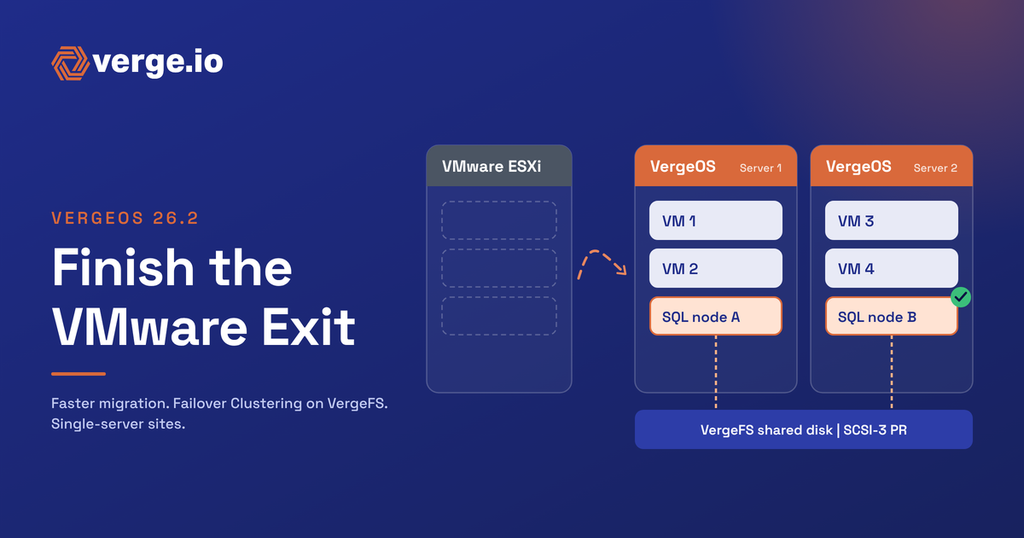
A two-node Windows failover cluster runs SQL Server and a clustered file server on VergeFS shared disks, with no external SAN.
Watch a VMware VM transfer into VergeOS 26.2. Same import workflow, with asynchronous I/O on NBD transfers underneath.
We moved a live SQL database from NVMe to 10K spinning disk with the performance monitor running, and the latency line held where it was. This storage tiering demo puts the numbers on screen: 727 filings per second on flash, 473 on spinning disk, both under a millisecond.

VergeIO Principal Engineer David Zarzycki provisions a fresh Kubernetes cluster from inside Rancher, on top of VergeOS, in under three minutes — click to running on a two-core, four-GB lab node. The cluster-create flow proves two things in one motion: Rancher really is the management plane teams already use, and the VergeOS integration ships as standard upstream Kubernetes through three Helm charts in the verge-io Cluster Repository — not a fork, not a proprietary distribution, not a second console.

In this technical demonstration, Paul Hodges, Field CTO at VergeIO, walks through how VergeOS delivers GPU-accelerated infrastructure from a single interface. The demo covers GPU-enabled VDI, AI inference workloads, and multi-tenant development environments running on VergeOS without the complexity of traditional virtualization stacks.
