• Skip to main content
  • Architecture
    • Overview
      Learn about VergeOS’ unique unfied architecture that integrates virtualization, storage, networking, AI, backup and DR into a single data center operating system
    • Infrastructure Wide Deduplication
      VergeOS transforms deduplication from a storage-only commodity into a native, infrastructure-wide capability that spans storage, virtualization, and networking, eliminating hidden resource taxes
    • VergeFS
      VergeFS is a distributed, high-performance global file system integrated into VergeOS, unifying storage across nodes, tiers, and workloads while eliminating the need for external SANs
    • VergeFabric
      VergeFabric is VergeOS’s integrated virtual networking layer, delivering high-speed, low-latency communication across nodes while eliminating the complexity of traditional network configurations.
    • Infrastructure Automation
      VergeOS integrates Packer, Terraform, and Ansible to deliver an end-to-end automation pipeline that eliminates infrastructure drift and enables predictable, scalable deployments.
    • VergeIQ
      Unlock secure, on-premises generative AI—natively integrated into VergeOS. With VergeIQ, your enterprise gains private AI capabilities without the complexity, cloud dependency, or token-based pricing.
  • Features
    • Virtual Data Centers
      A VergeOS Virtual Data Center (VDC) is a fully isolated, self-contained environment within a single VergeOS instance that includes its own compute, storage, networking, and management controls
    • High Availability
      VergeOS provides a unified, easy-to-manage infrastructure that ensures continuous high availability through automated failover, storage efficiency, clone-like snapshots, and simplified disaster recovery
    • ioClone
      ioClone utilizes global inline deduplication and a blockchain-inspired file system within VergeFS to create instant, independent, space-efficient, and immutable snapshots of individual VMs, volumes, or entire virtual data centers.
    • ioReplicate
      ioReplicate is a unified disaster-recovery solution that enables simple, cost-efficient DR testing and failover via three‑click recovery of entire Virtual Data Centers—including VMs, networking, and storage.
    • ioFortify
      ioFortify creates immutable, restorable VDC checkpoints and provides proactive ransomware detection with instant alerts for rapid recovery and response.
    • ioMigrate
      ioMigrate enables large-scale VMware migrations, automating the rehosting of hundreds of VMs (including networking settings) in seconds with minimal downtime by seamlessly transitioning entire VMware environments onto existing hardware stacks.
    • ioProtect
      ioProtect offers near-real-time replication of VMware VMs—including data, network, and compute configurations—to a remote disaster‑recovery site on existing hardware, slashing DR costs by over 60% while supporting seamless failover and testing in an efficient, turnkey VergeOS Infrastructure.
    • ioOptimize
      ioOptimize leverages AI and machine learning to seamlessly integrate new and old hardware and automatically migrate workloads from aging or failing servers.
    • ioGuardian
      ioGuardian is VergeIO’s built-in data protection and recovery capability, providing near-continuous backup and rapid VM recovery during multiple simultaneous drive or server failures.
  • IT Initiatives
    • VMware Alternative
      VergeOS offers seamless migration from VMware, enhancing performance and scalability by consolidating virtualization, storage, and networking into a single, efficient platform.
    • Hyperconverged Alternative
      VergeIO’s page introduces ultraconverged infrastructure (UCI) via VergeOS, which overcomes HCI limitations by supporting external storage, scaling compute and storage independently, using existing hardware, simplifying provisioning, boosting resiliency, and cutting licensing costs.
    • SAN Replacement / Storage Refresh
      VergeIO’s storage by replacing aging SAN/NAS systems within its ultraconverged infrastructure, enhancing security, scalability, and affordability.
    • Infrastructure Modernization
      Legacy infrastructure is fragmented, complex, and costly, built from disconnected components. VergeOS unifies virtualization, storage, networking, data protection, and AI into one platform, simplifying operations and reducing expenses.
    • Secure Research Computing
      VergeIO's Secure Research Computing solution combines speed, isolation, compliance, scalability, and resilience in a cohesive platform. It’s ideal for institutions needing segmented, compliant compute environments that are easy to deploy, manage, and recover.
    • Venues, Remote Offices, and Edge
      VergeOS delivers resiliency and centralized management across Edge, ROBO, and Venue environments. With one platform, IT can keep remote sites independent while managing them all from a single pane of glass.
    • Fight Data Center Inflation
      DRAM, SSD and server prices keep climbing. VergeOS uses as much as 50% less RAM per VM than VMware, runs on the servers you already own, and moves cold data to low-cost hard drives.
  • Blog
      • The Midsize Enterprise Needs Greater ResiliencyResiliency belongs in every VMware alternative evaluation for small IT teams. See how VergeOS keeps midsize enterprise workloads running through drive and server failures, locks snapshots against ransomware, and turns Patch Tuesday from a weekend maintenance window into a weekday task.
      • Edge Disaster Recovery: Keep Customer-Facing Locations OpenEdge disaster recovery for stores and venues. VergeOS runs a site on one server, recovers it locally from snapshots and fails it over to the core.
      • VMware Migration Testing Is Critical to Completing Your ExitVMware migration testing decides whether your exit finishes. VergeOS keeps the VMware image, takes instant snapshots and isolates each workload in a VDC.
    • View All Posts
  • Resources
    • Become a Partner
      Get repeatable sales and a platform built to simplify your customers’ infrastructure.
    • Technology Partners
      Learn about our technology and service partners who deliver VergeOS-powered solutions for cloud, VDI, and modern IT workloads.
    • White Papers
      Explore VergeIO’s white papers for practical insights on modernizing infrastructure. Each paper is written for IT pros who value clarity, performance, and ROI.
    • In The News
      See how VergeIO is making headlines as the leading VMware alternative. Industry analysts, press, and partners highlight our impact on modern infrastructure.
    • Press Releases
      Get the latest VergeOS press releases for news on product updates, customer wins, and strategic partnerships.
    • Case Studies
      See how organizations like yours replaced VMware, cut costs, and simplified IT with VergeOS. Real results, real environments—no fluff.
    • Webinars
      Explore VergeIO’s on-demand webinars to get straight-to-the-point demos and real-world infrastructure insights.
    • Documents
      Get quick, no-nonsense overviews of VergeOS capabilities with our datasheets—covering features, benefits, and technical specs in one place.
    • Videos
      Watch VergeIO videos for fast, focused walkthroughs of VergeOS features, customer success, and VMware migration strategies.
    • Technical Documentation
      Access in-depth VergeOS technical guides, configuration details, and step-by-step instructions for IT pros.
  • How to Buy
    • Schedule a Demo
      Seeing is believing, set up a call with one of our technical architects and see VergeOS in action.
    • Versions
      Discover VergeOS’s streamlined pricing and flexible deployment options—whether you bring your own hardware, choose a certified appliance, or run it on bare metal in the cloud.
    • Test Drive – No Hardware Required
      Explore VergeOS with VergeIO’s hands-on labs and gain real-world experience in VMware migration and data center resiliency—no hardware required
  • Company
    • About VergeIO
    • Support
      Get fast, expert help from VergeIO’s support team—focused on keeping your infrastructure running smoothly.
    • Careers
      Join VergeIO and help reshape the future of IT infrastructure. Explore open roles and growth opportunities.
  • 855-855-8300
  • Contact
  • Search
  • 855-855-8300
  • Contact
  • Search
  • Architecture
    • Overview
    • VergeFS
    • VergeFabric
    • Infrastructure Automation
    • VergeIQ
  • Features
    • Virtual Data Centers
    • High Availability
    • ioClone
    • ioReplicate
    • ioFortify
    • ioMigrate
    • ioProtect
    • ioOptimize
    • ioGuardian
  • IT Initiatives
    • VMware Alternative
    • Hyperconverged Alternative
    • SAN Replacement / Storage Refresh
    • Infrastructure Modernization
    • Secure Research Computing
    • Venues, Remote Offices, and Edge
    • Fight Data Center Inflation
  • Blog
  • Resources
    • Become a Partner
    • Technology Partners
    • White Papers
    • In The News
    • Press Releases
    • Case Studies
    • Webinars
    • Documents
    • Videos
    • Technical Documentation
  • How to Buy
    • Schedule a Demo
    • Versions
    • Test Drive – No Hardware Required
  • Company
    • About VergeIO
    • Support
    • Careers
×
  • Architecture
    • Overview
    • VergeFS
    • VergeFabric
    • Infrastructure Automation
    • VergeIQ
  • Features
    • Virtual Data Centers
    • High Availability
    • ioClone
    • ioReplicate
    • ioFortify
    • ioMigrate
    • ioProtect
    • ioOptimize
    • ioGuardian
  • IT Initiatives
    • VMware Alternative
    • Hyperconverged Alternative
    • SAN Replacement / Storage Refresh
    • Infrastructure Modernization
    • Secure Research Computing
    • Venues, Remote Offices, and Edge
    • Fight Data Center Inflation
  • Blog
  • Resources
    • Become a Partner
    • Technology Partners
    • White Papers
    • In The News
    • Press Releases
    • Case Studies
    • Webinars
    • Documents
    • Videos
    • Technical Documentation
  • How to Buy
    • Schedule a Demo
    • Versions
    • Test Drive – No Hardware Required
  • Company
    • About VergeIO
    • Support
    • Careers

UCI

September 5, 2023 by George Crump

Hyperconverged Infrastructures (HCI) were supposed to ease IT professionals’ management burdens, but flaws in their design explain why HCI doesn’t simplify IT. These flaws have led HCI, which should be the one infrastructure for the enterprise, to be a niche solution for corner use cases within the data center. Instead of simplifying through convergence, HCI solutions from companies like VMware and Nutanix exacerbate complexity.

The HCI Flaws

  1. HCI Isn’t Scalable
  2. HCI Isn’t Flexible
  3. HCI Isn’t Secure

Because of these three flaws, complex and expensive three-tier architectures with dedicated storage arrays, restrictive compute tiers, and proprietary network switches continue to flourish despite their own challenges. Can HCI be fixed so it can finally deliver its full promise?

HCI Isn’t Scalable

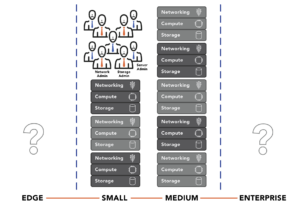
How can an architecture like HCI that is scale out by design, not scale? It’s true, though; HCI can’t scale large, and it can’t scale small. Most HCI vendors force you to start with three nodes, making HCI impractical for Edge and small offices. The inability to scale small and scale large is one reason why HCI doesn’t simplify IT.
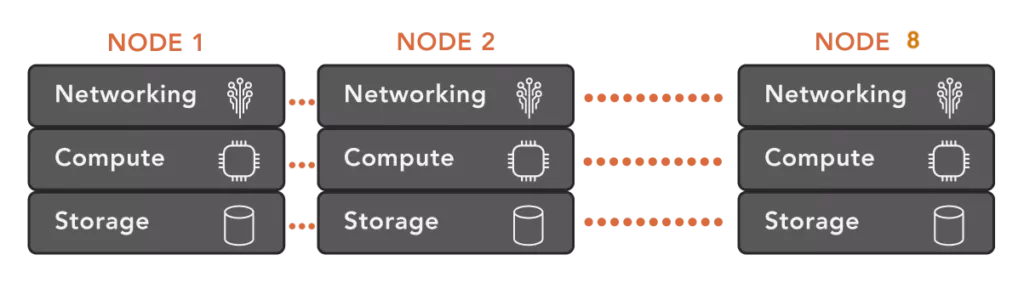
Lack of a unified code base is one reason Why HCI doesn't simplify IT
HCI Doesn’t Converge, It Squeezes

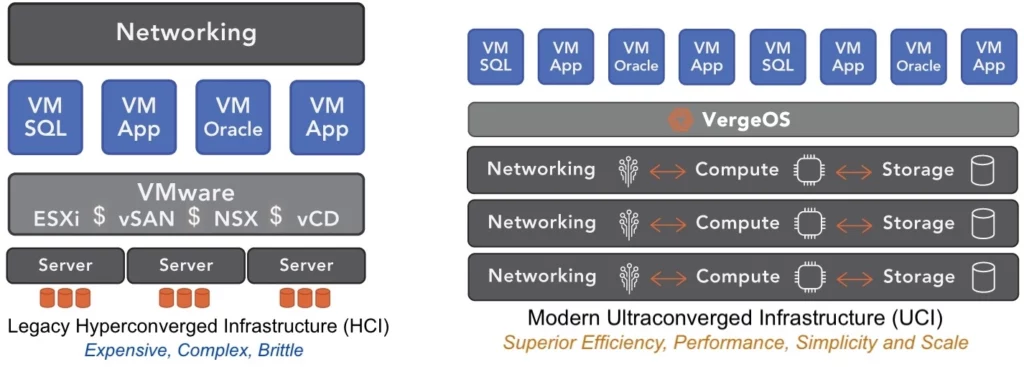
At the same time, most HCI solutions can’t scale beyond eight or so nodes without serious performance concerns. These performance concerns stem from the fact that HCI solutions don’t actually converge the three data center tiers (networking, computing, and storage). They are three separate software packages, often from three separate vendors. HCI squeezes the three separate software-based tiers onto a single server. Each of these tiers has different lanes of communication between the servers. As a result, internode communication is exponentially increased by a factor of three.

UCI Solves the HCI Scale Issue

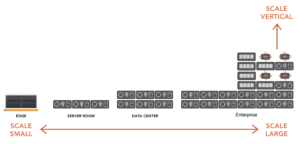
Ultraconverged Infrastructure (UCI) solutions, like VergeOS, solve both aspects of the scale issue. It can scale small, and it can scale large. Instead of using a separate application for networking, another for compute, and still another for storage, UCI is a single piece of very efficient code.
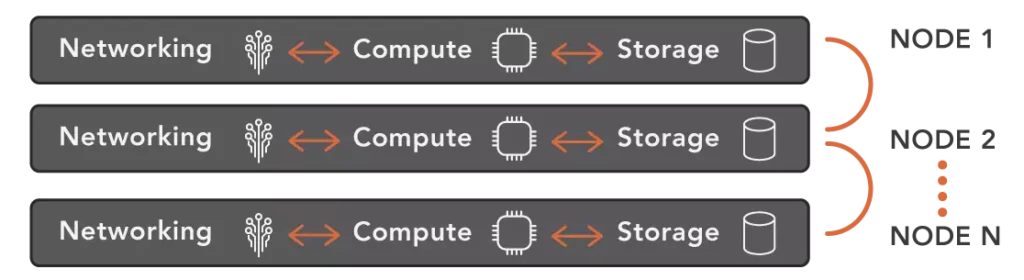
Lack of a unified code base is one reason HCI doesn't simplify IT. UCI has a Unified Code Base
UCI Converges Networking, Compute, and Storage Into a Single Code Base

Thanks to UCI’s unification of the legacy IT stack into a single piece of software, there is only a need for a single lane of communication between nodes. The reduction in east-west traffic enables scaling beyond 200 nodes without significant network overhead. At the same time, the efficiency of the code base enables a two-node UCI environment to deliver the performance and cost-effectiveness that Edge and remote locations need. The common code base also means a unified GUI for simple administration and day-to-day operations. UCI simplifies IT by providing a single software package. It can support small offices and Edge locations while scaling to meet the needs of the primary data center.

HCI Isn’t Flexible

Another reason why HCI doesn’t simplify IT is that it restricts the type of nodes users can add to the cluster. The idea behind HCI is that as you add additional servers to the environment, you automatically scale each of the three data center tiers to support new applications or additional users. The reality is that most organizations don’t need or want to scale all three of these tiers simultaneously; sometimes, you only need additional computing power, and other times, you only need additional storage capacity.

While some HCI solutions can now add “storage-only” nodes, they compromise performance and place restrictions on data protection and efficiency. Practically speaking, most HCI solutions must use nearly identical nodes as they scale, or create an entirely separate instance with an entirely different node configuration. Each additional HCI instance further adds to data center fragmentation instead of converging it.

In some cases, vendors require customers to replace servers, even if they are only a few years old, to support the latest version of their software. This requirement is not optional with them; upgrading to the new hardware means replacing older hardware.

UCI Solves the Flexibility Issue

UCI simplifies IT by solving the flexibility issue. It allows a mixture of different nodes within the same instance. Within the instance, VergeOS can group like nodes together. Then IT can allocate some or all those resources to specific workloads. This flexible intelligence also means that customers don’t have to upgrade or replace hardware to run the latest version of the HCI software.

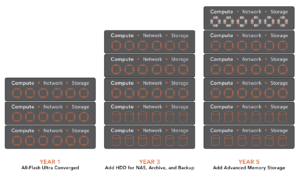
The efficiency of VergeOS enables customers to extract more serviceable life from aging servers while fully exploiting the capabilities of modern servers that are only a few months old. Servers within a single VergeOS instance can be from different decades, processor manufacturers, and storage types.
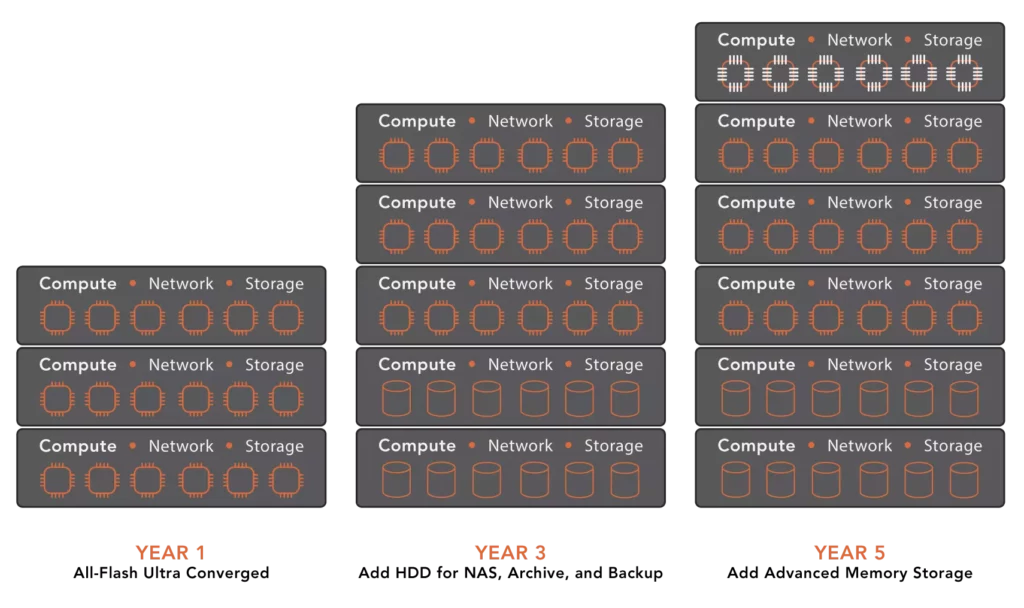
Lack of a flexible scale is another reason why HCI doesn't simplify IT. UCI delivers complete flexibility.

Nodes can also have different areas of focus. Some can be heavily weighted for computing power while using the storage from other nodes in the instance, and others can be heavily weighted for storage capacity or performance and provide that storage or performance to the rest of the instance.

HCI Isn’t Secure

The lack of a robust security strategy is another reason why HCI doesn’t simplify IT. Customers must fill data protection and ransomware resiliency gaps by using third-party applications and creating additional infrastructures. As a result, legacy HCI forces IT planners to look at threats like ransomware as a backup and recovery problem instead of as an infrastructure problem, which is what it really is.

After IT discovers a ransomware attack, the malware file must be found, stopped, and removed. Then, IT must methodically recover data. By only looking at ransomware as a data protection problem, the average downtime associated with a ransomware attack is typically measured in days and sometimes weeks.

UCI is Hardened and Secure

UCI simplifies IT by providing infrastructure-wide data protection and resiliency capabilities. First, VergeIO’s Virtual Data Centers (VDC), which encapsulate the entire data center, also shrink the attack surface available to ransomware. It is nearly impossible for a malware file infecting one VDC to cross over to another VDC.
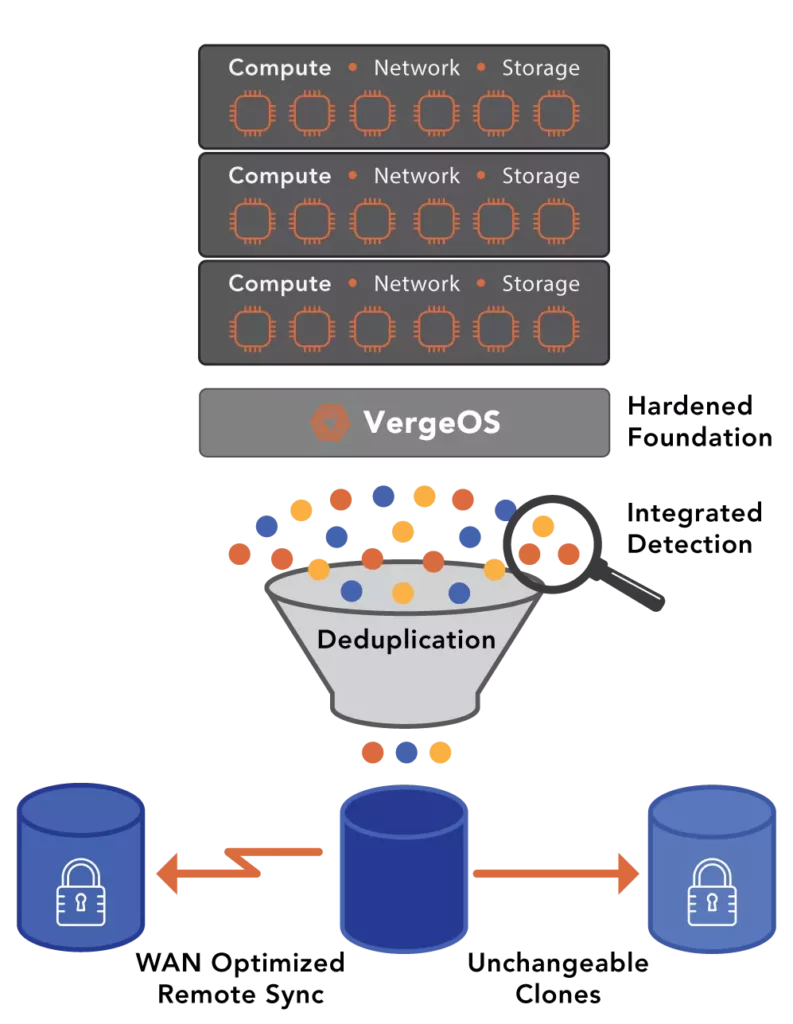
Second, VergeOS’ snapshot capabilities are powered by IOclone, which provides independent, immutable copies. However, because VergeOS implements global inline deduplication at its core, clone/snapshot copies are also space efficient. Taking frequent immutable snapshots without impacting performance provides the second layer of defense against ransomware.

Third, VergeOS’ IOfortify provides early detection of a ransomware attack. With it, your notification comes minutes after an attack starts instead of coming from confused users hours later. This early detection, combined with frequent, immutable clones, means recovery occurs within minutes and with little to no data loss.

Finally, VergeOS operates as read-only firmware at its core and injects a copy of itself into each VDC. As a result, if a cyber-attack could ever get to the actual VergeOS operating environment, a known good copy at the core is available to replace it.

The Impact of HCI Complexity

The impact of HCI complexity and its limitations means that IT must use the legacy three-tier architecture. It is also why most IT professionals don’t think HCI can replace a SAN, even though it should be a better option for virtualized environments. While legacy three-tier architectures are more complicated and more expensive, they, through brute force, work through some of the issues mentioned above.

UCI fulfills and extends the potential of legacy HCI. Using a single code base allows IT to manage all aspects of infrastructure in a cohesive, straightforward manner. UCI has flexible scalability, extending to both large and small needs. UCI can mix nodes of different types, which enables true and long-lasting actual convergence. UCI’s integrated data protection capabilities eliminate the dependency on a separate data protection infrastructure. As a result, UCI delivers more widespread convergence than HCI, while delivering infrastructure-wide data resiliency.

To learn more about UCI and VergeIO, register to watch the VergeOS Architecture Deep Dive with our CTO and founder, Greg Campbell. You can also sign up for a virtual test drive and start running VergeOS in minutes.
Filed Under: HCI Tagged With: HCI, UCI

August 11, 2023 by Aaron Richman

Companies partner to extend reach of Ultraconverged Infrastructure solutions to Asia Pacific

Ann Arbor, Mich, August 1, 2023 — VergeIO, the Ultraconverged Infrastructure (UCI) company, today announced that it is partnering with Transformists Network, an IT distribution company delivering next-generation solutions, to provide organizations across APAC with the benefits of UCI.

Headquartered in Singapore, Transformists Network is focused on building strategic, unique solutions and technologies for companies. Its capabilities are in providing sales and services, offering partner support and providing training. As the regional representative for VergeIO, Transformists Network is able to help joint customers lower their IT spend by 70% while significantly simplifying IT operations.

“From consulting to enablement to providing technical expertise, we are ideally suited to helping VergeIO extend their global presence while providing their transformative technology to our clients,” said Nicholas Yong, Director at Transformists Network. “As the sole distributor of VergeIO in Asia, we are excited to be able to offer organizations powerful software that simplifies the IT process by virtualizing the data center and consolidating all of their workloads into a single infrastructure. VergeOS a solution that will play very well across the APAC region.”

VergeOS moves beyond legacy HCI configuration with its ultraconverged infrastructure (UCI), which integrates virtualization, storage and networking into a single piece of software. This integration provides a high degree of efficiency that enables VergeOS to deliver more performance from existing hardware and a wider range of scale. VergeOS can scale up to meet the needs of the most demanding enterprise and scale down to fit the constraints of the edge.

“We are pleased to partner with the Transformists team to extend sales territories into new regions and have them bring their area expertise to our worldwide sales operations,” said Chris Lehman, Sr. Vice President of Sales at VergeIO. “Whether organizations are looking for a more economical approach to their storage and networking infrastructure, want to be able to deploy their data center operations on site or at the edge, or are looking to scale beyond their current capabilities to support their particular workloads, VergeOS is the resource that will be able to provide them the solution they need. We look forward to working with Transformists to best support sales and support operations throughout Asia.”

Organizations in Asia looking to learn more about the benefits of VergeOS or who wish to meet with a representative from Transformist Network can visit https://www.transformists.net/vendor-vergeio for more information.

About VergeIO

VergeIO is the Ultraconverged Infrastructure (UCI) company. Unlike hyperconverged infrastructure (HCI), it rotates the traditional IT stack (compute, storage and networking) into an integrated data center operating system, VergeOS. Its efficiency enables greater workload density on the same hardware with high levels of data resiliency. The result is dramatically lower costs and greatly simplified IT.

Media Contact:
Judy Smith, JPR Communications
818-522-9673
[email protected]

Filed Under: Press Release Tagged With: Press Release, UCI

August 8, 2023 by George Crump

HCI isn't an Infrastructure

As IT leaders consider the practicality of a VMware exit, they will also consider hyperconverged infrastructure. However, the inability to scale flexibly means that HCI isn’t an infrastructure they can use as a replacement platform. Even the few HCI solutions that are not dependent on VMware as their hypervisor suffer the problem of brittle scalability.

The Three Requirements of Flexible Infrastructure

A flexible infrastructure must meet these three requirements:

  1. The ability to scale small, less than three nodes for Edge, Remote Office, and small business data centers.
  2. The ability to scale large, dozens to hundreds of nodes, to meet the demands of an enterprise data center.
  3. The ability to manage nodes of different types, CPU brands, compute-only, and storage-only, so that it can adapt to the ever-changing needs of the data center.

The inability to meet these requirements with a single solution means that if an organization selects HCI as its infrastructure strategy, it likely will either need multiple HCI solutions to cover the organization’s needs, or at least multiple instances of the same HCI solution. Ironically, Hyperconverged Infrastructure (HCI) isn’t an infrastructure, nor does it converge.

UCI is Infrastructure

Because of its inflexibility, a counter to HCI, which is relegated to niche use cases, is Ultraconverged Infrastructure (UCI). UCI is an infrastructure, Data Center Operating System (DCOS), and does truly provide convergence. VergeOS is a UCI solution that can scale small, large, and is flexible which allows it to adapt to the changing needs of organizations. Additionally, it is not dependent on VMware, which makes it an ideal alternative for customers looking for a VMware exit.

Infrastructure Must Scale Small

Not every business is an enterprise, but most need compute capabilities beyond what cloud-based SaaS applications can provide. As those businesses scale, the cost of the cloud becomes a significant factor. The point of entry for most HCI solutions is a three-server configuration which becomes nodes in its cluster. This requirement is often too large for Edge, Remote Office, and Small Data Center use cases.

As a result of the inability to scale small, most IT planners rule out HCI for these use cases and compromise with standalone servers and an inexpensive shared storage solution. The compromise increases the cost of acquiring the hardware and software for Edge, Remote Office, and Small Data Center use cases, and it increases complexity in an area that must have simplicity. These use cases have limited or no IT administrators, especially at the Edge.

UCI Scales Small

Users can start with as few as two nodes, and because of VergeOS’ efficiency, those nodes can be very cost-effective mini-servers, ideal for the Edge or Remote Office use cases. Even small data centers can run comfortably on two or three low-end to mid-range servers, reducing hardware acquisition costs by 50% or more. Learn more about the advantages of using UCI in small data centers here.

VergeOS’ efficiency comes from its tight integration of the network, compute, and storage tiers into a single, cohesive data center operating system (DCOS). The actual convergence of those tiers, instead of HCI’s approach of an “elegant bundle,” means the elimination of redundant metadata tables, databases, APIs, and management tools. The result is that the underlying hardware is unchained and enabled to reach its full potential.

Infrastructures Must Scale Large

Small businesses grow to medium-sized businesses and then eventually to large businesses. Starting over with a new infrastructure as the business grows is costly and risky.

Again, most HCI solutions start too big to be viable for small data centers or Edge, but the few that focus on the smaller end of the market often can’t scale large enough to meet the organization’s demands as it grows. They often can’t scale past six to eight nodes. The result is IT must replace the “starter-HCI” solution with another more scalable solution. The replacement often includes replacing hardware since each HCI solution seems to have a unique hardware compatibility list or comes “bundled” with hardware.

Even so-called enterprise HCI solutions have limitations and can scale to only a few dozen nodes, which is not large enough to provide complete infrastructure consolidation. There is also a practical limit to how large HCI solutions can scale. Most vendors use standard IO protocols to communicate between nodes, which means that every node must be “touched” every time a packet is received by the cluster, creating an untenable amount of internode, or east-west traffic.

Yet another part of the challenge is that most HCI solutions don’t include complete layer 2 and layer 3 networking functionality in their product. At most, they provide virtual switching or they bundle in, yet again, another third-party software-defined networking product. The lack of native networking functionality means that HCI clusters can’t practically scale to more than a dozen nodes without suffering a performance impact.

These challenges are why the legacy three-tier architecture continues to be the bread-and-butter infrastructure for enterprises. It is also why most IT leaders believe that HCI cannot replace standalone networking, virtualization, and storage.

HCI isn't an Infrastructure

UCI Scales Large

VergeOS can not only start as small as two nodes, but it can grow to well over one hundred nodes. Organizations of any size can start using VergeOS with confidence that it can grow or shrink, to meet their needs. The team at VergeIO also developed a proprietary networking protocol that optimizes internode communication, significantly reducing east-west traffic and making scale technically possible and practical.

Infrastructure Must Scale Flexibly

Infrastructure flexibility is a critical requirement because small and large businesses evolve. Their IT needs are not static, and neither should their infrastructure be. It needs to adapt to innovations in hardware and business needs.

Most HCI solutions are rigid in their configuration, only supporting specific hardware and forcing customers to upgrade to new hardware as the infrastructure software is updated. In HCI terms, scaling up typically means adding identical nodes, making it difficult to take advantage of the latest hardware advancements or adopt new types of nodes, such as storage-only or compute-only. HCI’s lack of flexible scaling also poses challenges when organizations want to retire or replace outdated equipment. Mixing old and new equipment within the same cluster is almost impossible.

The typical HCI setup often means organizations must create separate instances for workloads and hardware types. This approach fragments the overall infrastructure and creates more complexity, reducing operational efficiency and leading to underutilized resources. The inability to mix and match different types of nodes within the same cluster further diminishes the flexibility and cost-effectiveness of HCI.

UCI Scales Flexibly

On the other hand, UCI provides an answer to the rigidness of HCI. VergeOS supports multiple types of nodes, such as compute-only or storage-only nodes, which allows it to scale flexibly to match the dynamic needs of the business. As technology evolves and new hardware becomes available, VergeOS users can integrate these advances seamlessly into their existing setup. Customers can, for example, mix in AMD, Intel, and GPU nodes into the same instance.

Furthermore, with VergeOS, it’s possible to maintain a diverse set of hardware in a single instance, preventing infrastructure fragmentation. This capability allows businesses to adjust their IT setup as the organization grows and its needs change, ensuring they always have the most cost-effective and efficient infrastructure.

HCI isn't an Infrastructure


Conclusion

VergeOS is an ideal solution for businesses seeking a flexible, scalable, and efficient IT infrastructure. UCI surpasses HCI in meeting the demands of a dynamic business environment, ensuring that businesses can focus on their core competencies without worrying about their infrastructure. Whether it’s a small enterprise looking to grow or a large organization needing to maintain agility and efficiency, VergeOS has the features and flexibility to accommodate their needs. Compare HCI with UCI here.

To learn more about scaling IT infrastructure, watch our on-demand webinar, “How to Eliminate the Data Center Scale Problem.”

Filed Under: HCI Tagged With: HCI, UCI

May 31, 2023 by George Crump

While it used to be a project for highly regulated industries, designing a compliant IT infrastructure is now on the project list for many organizations. We saw this evidence in the InBrief session with TruthInIT a few weeks ago. Questions around compliance were some of the most commonly asked.

The top three requirements for designing a compliant IT Infrastructure are:

  1. Security and Privacy
  2. Data Protection and Retention
  3. Disaster Recovery

One of the challenges faced by IT is the varying compliance requirements within an organization, with some departments having stricter needs than others. Addressing the compliance needs of each department can be a significant challenge. Additionally, creating a compliant infrastructure can be both expensive and complex, often requiring multiple products.

Securing a Compliant IT Infrastructure

When designing a compliant IT infrastructure, the initial step is to ensure its security through the implementation of strong authentication mechanisms and robust access controls. Occasionally, a department with stringent compliance requirements may require customized networking or storage configurations.

Certain departments may have unique data privacy needs and must ensure that their data is not accessible to other departments. Privacy measures may include dedicated computing and storage resources for specific departments or ensuring a certain level of performance.

Security without Silos

Many organizations are required to create secure environments by building separate infrastructure silos, each tailored to the unique needs of a department or use case. However, silos of infrastructure are costly and lead to additional compliance requirements for protection, retention, and disaster recovery.

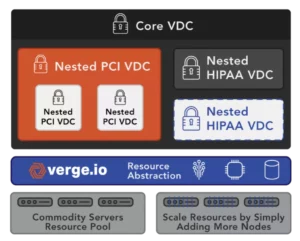
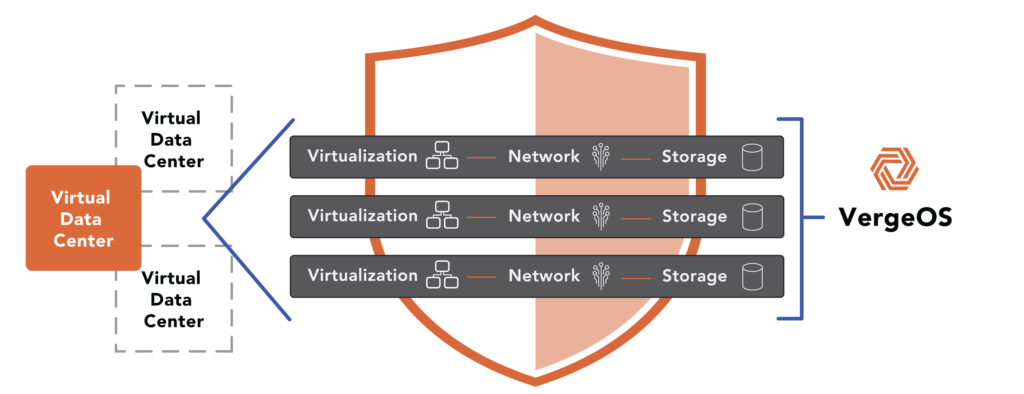
Fortunately, VergeOS offers a solution with its Virtual Data Center (VDC) technology. Similar to how a virtual machine encapsulates a physical server, a VDC encapsulates an entire data center. By utilizing VergeOS, customers can establish a VDC for each department, meeting all the aforementioned needs. Each VDC can have its own access controls, authentication requirements, and user management functions.

Nested VDC makes managing Compliant IT Infrastructure easy
Create multiple nested compliant virtual data centers with VergeOS

The Power of Virtual Data Centers

VDCs also allow for allocating specific computing and storage resources to particular departments, preventing other departments from accessing those assets. IT can effectively create a unique compliant IT Infrastructure for each department as needed. Plus, the VDC provides flexibility to reallocate resources when the department or workload no longer needs them. or IT can allocate more resources as a project ramps up. Organizations can create a highly compliant VDC for regulated functions and a more general-purpose VDC for other use cases.

A key benefit is that IT can manage all VDCs from a single user interface and run on the foundational operating environment, VergeOS. This reduces complexity by using a single piece of software and enables the management of all VDCs through a single interface. It also lowers costs through more efficient resource allocation and higher utilization.

Perfect Compliant IT Infrastructures with Recipe Marketplace

Another key benefit of VergeOS is it also includes a Recipe Marketplace, which enables customers to pre-build complete data centers and then deploy them with the click of a button. This makes quickly deploying HIPAA or PCI-compliant VDCs easy. Also, because of the recipe engine, you can deploy them perfectly every time without worrying about missing that one setting that could otherwise move your VDC from compliant to non-compliance.

The combination of VDCs and the Recipe Marketplace makes IT more agile. Usually, if the organization needs a PCI environment and a HIPAA environment, IT would normally build two separate silos and then have them independently audited for compliance. If the organization needs another compliant environment, then they have to stand up another separate silo and then have that silo audited. IT must resubmit a compliant silos for another round of auditing if it needs to scale by adding additional computing power or storage capacity.

Without VDC and the Recipe Marketplace, IT must build each environment to handle the capacity and throughput of where it will end, which may take years to scale to, if ever. With VDCs and the Recipe Marketplace, IT can share resources across a variety of compliant environments. Once IT creates a“golden” VDC for each use case and it passes the audit (PCI/HIPAA), then IT can spawn nested VDCs each time the organization has a new request. No additional auditing is required.

To learn more, check out this VergeOS Architecture Deep Dive with our CTO, Greg Campbell.

Protecting and Retaining Data for a Compliant IT Infrastructure

It is essential to protect the IT resources of every department within an organization from data loss or hardware failure. When designing a compliant IT infrastructure, however, some departments may have more stringent requirements than others. To meet these needs, IT often has to use multiple products. In most cases, separate backup and retention products are necessary, even if the processes can be applied across departments. It is common for data between departments with different compliance needs not to intermix. As a result, each silo requires a sub-silo of data protection.

Protection and Retention without sub-silos

With VergeOS, you can customize data protection and retention strategies for each VDC, and the platform includes built-in tools to meet the unique needs of every department. While many solutions offer snapshot capabilities, most are limited by performance issues, restricting the number of active snapshots and how long they can be retained. Deleting snapshots to free up disk capacity can also be a tedious and lengthy process.

As a result, many customers opt for data cloning, creating copies for backup and archiving purposes. However, managing multiple copies is time-consuming, costly, and requires additional storage capacity. It also increases the likelihood of errors since IT needs to integrate two or three separate processes.

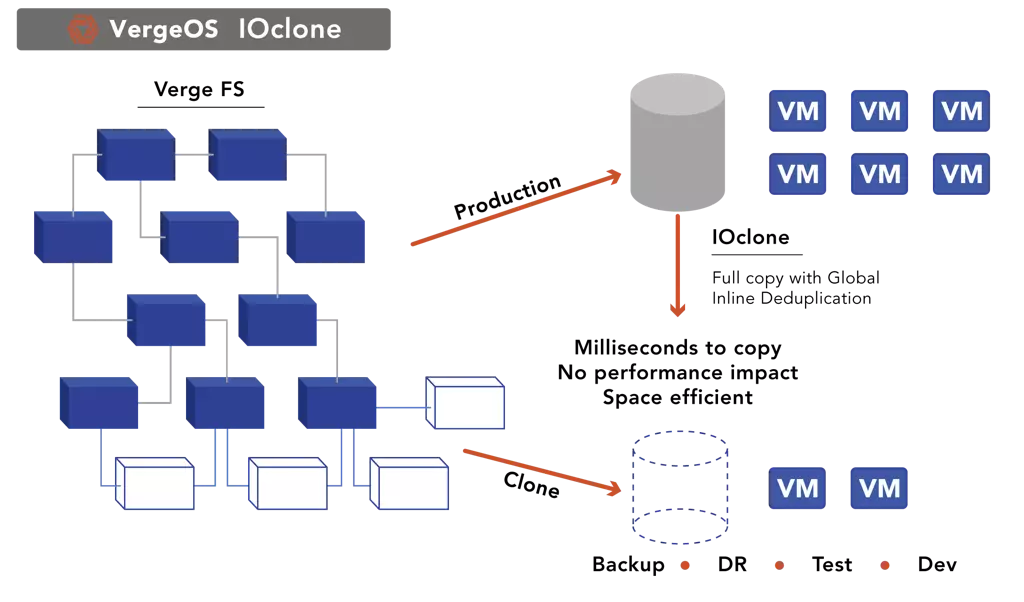
VergeOS’s IOclone, combines the best capabilities of snapshots and clones by leveraging our unique Global Inline Deduplication technology, which is at the core of VergeOS instead of a bolted-on afterthought. IOclone enables each snapshot to be independent of the VM or Virtual Data Center it is copying. Still, because of the deduplication process, these copies are made in milliseconds and are space efficient. IOclone snapshots are also immutable so that nothing can alter them, which is often another compliance requirement.

Compliant IT Infrastructure must include data protection
IOclone delivers the best of snapshots and clones with no performance impact

The independence of IOclone’s snapshots means that VergeOS customers can have an almost unlimited number of snapshots. IT can repurpose those snapshots for other use cases or applications and can retain them indefinitely without impacting performance.

To learn more about the differences between snapshots, clones, and how IOclone brings the best of both technologies together, watch our on-demand TechTalk, “TechTalk: Deep Dive on Virtual Infrastructure File Systems.”

Recovering a Compliant IT Infrastructure After Disaster

There are strict disaster protection regulations that apply to data centers. Designing a compliant IT infrastructure requires additional measures to ensure preparedness, which can be quite demanding. IT may need to establish a separate DR silo with specific products to meet compliance requirements. Moreover, the DR site must meet the same standards as the primary site, which adds more complexity and cost.

A DR Strategy Minus DR Silos

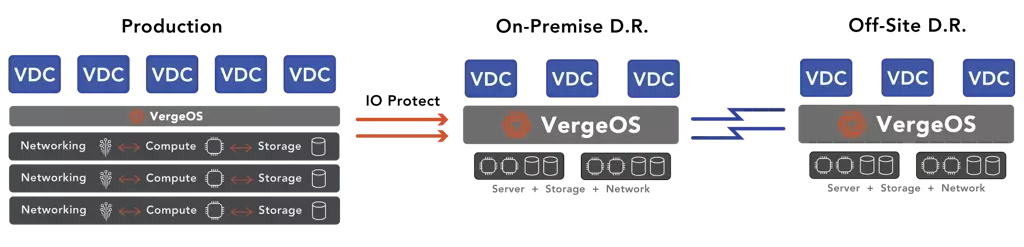
VergeOS’ IOprotect also leverages our Global Inline Deduplication to provide Wide Area Network (WAN) intelligent data movement between locations. Multiple physical data centers can replicate to a single DR data center, but redundant data between them will not be sent.

Virtual Data Centers (VDCs) play a crucial role in disaster recovery. With each department’s data center encapsulated within a replicated VDC, all the necessary information is readily available for quick recovery in case of a disaster. This makes it possible for IT to bring departments back online within minutes after a site failure without the need to consult a DR runbook or the need for ad-hoc fine-tuning to reconfigure network, security, or storage policies. VergeOS’ IOprotect capability is so cost-effective you can have an on-premises DR and an off-premises DR for 50% less than the cost of your current DR strategy, enabling you to be prepared for both major and minor disasters.

Compliant IT Infrastructure must include DR.
VergeOS-DR is so affordable you can create an on-prem and DR site recovery environment for at least 50% less than your current solution

To dive deep into VMware disaster recovery (DR) Sign up for our Video Learning Guide – Each week, our experts take you through a critical part of making your infrastructure environment more resilient.

Conclusion

Designing a compliant IT infrastructure usually means a significant increase in IT spend and consumption of IT administrative time. Creating separate silos for compliant departments within the organization also leads to increased long-term costs and the inability to adapt the infrastructure to the organization’s future demands flexibly.

VegeOS, through its VDC technology, enables IT to create compliant IT infrastructures while leveraging existing hardware dynamically. It also provides capabilities like IOclone and IOreplicate to meet the data protection, data retention, and disaster recovery requirements for IT.

You can try out the full power of VergeOS right now without having to borrow hardware. Signup for a test drive, and we will create a VDC just for you. You can then create your VMs and even compliant and non-compliant VDCs.

Filed Under: Research Tagged With: Compliance, UCI

May 16, 2023 by George Crump

Ann Arbor, Mich, May 15, 2023 — VergeIO, the Ultraconverged Infrastructure (UCI) company, today announced its inclusion in the 2023-24 DCIG TOP 5 Rising Vendors HCI Software
Solutions Report
. The company was awarded placement on this list based
on an evaluation of VergeOS features in the categories of deployment
capabilities, data protection, product and performance management, and
technical support.

VergeIO is a Top 5 HCI Solution

DCIG evaluated 15 software solutions for hyperconverged infrastructure
(HCI) use cases across these four different categories. The report
provides guidance on the TOP 5 Rising Vendors that organizations should
consider for HCI software solutions, including a profile of VergeIO and
the notable features that earned it a DGIG TOP 5 award. The report is
available for free download.

“IT organizations have a number of issues to consider these days, such
as funding challenges, limited resources, management complexity, and
providing IT services at the edge,” writes report author Todd Dorsey,
Senior Storage Analyst at DCIG. “IT leaders look for solutions that
solve problems and provide positive outcomes in many ways. HCI software
fulfills these goals while addressing current IT challenges.”

VergeOS moves beyond legacy HCI configuration with its
ultra-converged infrastructure (UCI), which integrates virtualization,
storage, and networking into a single piece of software. This
integration provides a high degree of efficiency that enables VergeOS to
deliver more performance from existing hardware and a wide range of
scale. VergeOS can scale up to meet the needs of the enterprise and
scale down to fit the constraints of the edge.

UCI provides superior efficiency, performance, simplicity, and scalability

This ability to create a data center operating system from a single
piece of software was among the “Distinguishing Features” listed in the
report for VergeOS, as were the benefits of data center agility and
unified management of disparate clusters. These characteristics were
included with the benefits provided by HCI software, in general, to
offer IT leaders a solution that they can deploy to adapt to the
changing needs of their organization to ensure that they can respond to
new business requirements and opportunities.

A Single Data Center Operating System delivers superior efficiency, performance and scale

“I am thrilled that Verge.IO has been recognized as a DCIG TOP 5 HCI
solution,” said Yan Ness, CEO of VergeIO. “Our goal has always been to
deliver a simple, efficient, and scalable IT infrastructure solution
that is easy to use and provides superior performance and value to our
customers. This recognition is a testament to our team’s hard work and
dedication and the impact that VergeIO is having on our
customers’ businesses.”

Dorsey joins DCIG’s Principal Storage Analyst Ken Clipperton and
VergeIO’s CMO George Crump for a live, 1-hour webinar discussing how to
overcome “The Not So Magnificent Seven Challenges of Small to Medium
Sized Data Centers” on May 24 at 1 p.m. EDT. Part of the event covers
the DCIG evaluation of the 15 HCI/UCI software solutions from the report
and how they narrowed down the list to the DCIG TOP 5 solutions. The
full webinar agenda with a registration link is available here.

About DCIG

The Data Center Intelligence Group (DCIG) empowers the IT industry with
actionable analysis. DCIG analysts provide informed third-party analysis
of various cloud, data protection, and data storage technologies. DCIG’s
audiences include C-level executives, IT managers, IT professionals,
magazine editors, bloggers, analysts, and providers within the IT and
cloud service industry.

About VergeIO

VergeIO is the Ultraconverged Infrastructure (UCI) company. Unlike
hyperconverged infrastructure (HCI), it rotates the traditional IT stack
(compute, storage, and networking) into an integrated data center
operating system, VergeOS. Its efficiency enables greater workload
density on the same hardware with high levels of data resiliency. The
result is dramatically lower costs and greatly simplified IT.

Media Contact:
Judy Smith, JPR Communications
818-522-9673
[email protected]

Filed Under: Press Release Tagged With: HCI, Hyperconverged, UCI, ultraconverged

May 10, 2023 by George Crump

If you are frustrated with VMware’s high prices, exorbitant renewal fees, stalled innovation, and declining support, you may be looking at the Public Cloud as a VMware alternative. Public Cloud providers like Amazon AWS, Microsoft Azure, and Google Cloud have their use cases. Still, as we’ve seen in the recent rash of cloud repatriation moves, the Cloud is not necessarily the ideal solution for all use cases.

The first question is, “Does the Public Cloud meet the requirements of a VMware Alternative?”

Requirements for a VMware Alternative:

  • Have a lower upfront cost
  • Lower long-term costs
  • Provide superior performance and capabilities
  • Offer world-class support

This blog will explore how the Public Cloud stands up to these requirements.

The Upfront Costs of the Public Cloud

Upfront costs are an area where most analysts suggest that the Public Cloud has an advantage over VMware and other VMware alternative solutions. But does it? In the VMware alternative use case, you already have the hardware! The bigger question is, can the potential VMware alternative use your hardware? In most cases, the answer is “no” or “not very well,” so in those cases, the Public Cloud has an upfront cost advantage because you only have to pay the first month’s “rent” for the hardware and software you need.

VergeOS is an Ultraconverged Infrastructure that rotates the traditional IT stack (hypervisor, storage, and network) into a linear plane and a single software code base. This integration is essential because it creates a data center operating system that is 50% or more efficient than legacy, fragmented solutions. Unlike traditional Hyperconverged Infrastructure (HCI), VergeOS can run on existing hardware and deliver more capacity and performance. See our HCI to UCI comparison page for more details.

The Long-Term Costs of the Public Cloud

An area where the Public Cloud as a VMware alternative does not fare well is in the long-term cost calculation. The repeated monthly rental of the same infrastructure adds up quickly, which is why we see a rash in Public Cloud departures. The Public Cloud is ideal for short-term projects that you will spin up quickly and then tear down after getting the answers you need or validating a concept. It is not ideal for long-term, relatively static environments that will run for years, even decades.

Most customers we speak to looking for a VMware replacement have been running their VMware infrastructure for five years or more. The servers that support that environment are typically three to five years old. Even if you are very judicious about cloud resource utilization (which most people don’t have the time for), over five years, you will spend significantly more for the cost of renting that compute from the Public Cloud versus owning it outright, especially in the VMware or VMware alternative use case.

VergeIO has a long-term cost advantage over the Public Cloud, VMware, and VMware alternatives, thanks again to the extreme efficiency of VergeOS. Our software allows you to extend the life of IT infrastructure further than you ever thought possible. Many VergeOS customers are running on servers and storage that are over six years old.

The Performance of the Public Cloud

In theory, the performance of the Public Cloud should be an advantage when IT Professionals consider it a VMware alternative. If you need more processing power, rent more processors; if you don’t, deactivate them. This theory may hold if your application is scalable across multiple processors and cores. Most applications are not that threaded, and throwing more processing power at them doesn’t help. Additionally, performance isn’t just about processor performance. In most cases, the bottleneck is either poor application code or storage I/O performance.

Storage performance is an area where the Public Cloud struggles. High performance is costly and often far more challenging to configure. The built-in capabilities of the Public Cloud, especially in terms of storage, are so weak that there are dozens of products from third-party software developers that organizations need to sift through to try to fill the gaps.

VergeIO’s approach directly integrates a complete suite of storage services into VergeOS. Storage is an equal citizen alongside the hypervisor and network capabilities. The storage capabilities of VergeOS are so powerful that many companies begin their VMware Exit Strategy by selecting VergeOS instead of going through yet another SAN replacement.

World Class Support

The Public Cloud as a VMware Alternative

The quality of support from both VMware and the Public Cloud varies wildly. With VergeIO, all customers, regardless of size, experience high-quality support with quick resolution to your questions. VergeIO also provides customers with a world-class support experience. We know that VergeOS doesn’t live in a vacuum, and we go above and beyond, even helping customers resolve issues with non-VergeOS-related challenges. Quality support is easy to claim but harder to deliver. Take our product for a test drive, experience our support firsthand, or speak with our customers.

How to Start Your VMware Exit

VergeOS is usually 50% less than the price of VMware, and it leverages your existing hardware so you can benefit from those savings almost immediately. Our efficiency will extend the life of your current hardware, further increasing your savings. Finally, the operating system delivers better performance, data protection, and greatly simplified operations.

You can start by scheduling a test drive. Using our Virtual Data Center technology, we create a virtual environment. Within minutes you’ll be up and running without having to deploy hardware.

Your next step might be using VergeOS as a disaster recovery copy of your VMware environment. If you have a few different servers, you can load our software on them and create a complete VMware disaster recovery plan without a substantial financial outlay. This option allows you to take an inexpensive extended use of our solution while adding value to and reducing the cost of your current infrastructure.

While using VergeOS as a VMware DR solution, you might also want to use your VergeOS infrastructure for new workloads. Then when you’re ready, you can use our DR technology to move your VMware environment to VergeOS seamlessly. Again, transition at your pace, knowing we will be there every step of the way.

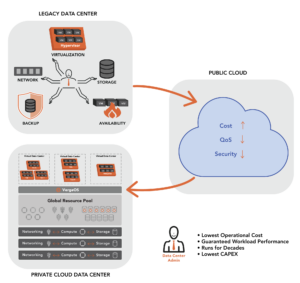
Filed Under: Private Cloud Tagged With: AWS, Azure, Public Cloud, UCI, VMware

  • « Go to Previous Page
  • Page 1
  • Page 2
  • Page 3

855-855-8300

Get Started

  • Versions
  • Request Tour

VergeIO For

  • SAN Replacement
  • Solving Infrastructure Modernization Challenges
  • Artificial Intelligence
  • Hyperconverged
  • Server Room
  • Secure Research Computing

Product

  • Benefits
  • Documents
  • Architecture Overview
  • Use Cases
  • Videos

Company

  • Blog
  • Technical Documentation
  • Legal

© 2026 VergeIO. All Rights Reserved.