• Skip to main content
  • Architecture
    • Overview
      Learn about VergeOS’ unique unfied architecture that integrates virtualization, storage, networking, AI, backup and DR into a single data center operating system
    • Infrastructure Wide Deduplication
      VergeOS transforms deduplication from a storage-only commodity into a native, infrastructure-wide capability that spans storage, virtualization, and networking, eliminating hidden resource taxes
    • VergeFS
      VergeFS is a distributed, high-performance global file system integrated into VergeOS, unifying storage across nodes, tiers, and workloads while eliminating the need for external SANs
    • VergeFabric
      VergeFabric is VergeOS’s integrated virtual networking layer, delivering high-speed, low-latency communication across nodes while eliminating the complexity of traditional network configurations.
    • Infrastructure Automation
      VergeOS integrates Packer, Terraform, and Ansible to deliver an end-to-end automation pipeline that eliminates infrastructure drift and enables predictable, scalable deployments.
    • VergeIQ
      Unlock secure, on-premises generative AI—natively integrated into VergeOS. With VergeIQ, your enterprise gains private AI capabilities without the complexity, cloud dependency, or token-based pricing.
  • Features
    • Virtual Data Centers
      A VergeOS Virtual Data Center (VDC) is a fully isolated, self-contained environment within a single VergeOS instance that includes its own compute, storage, networking, and management controls
    • High Availability
      VergeOS provides a unified, easy-to-manage infrastructure that ensures continuous high availability through automated failover, storage efficiency, clone-like snapshots, and simplified disaster recovery
    • ioClone
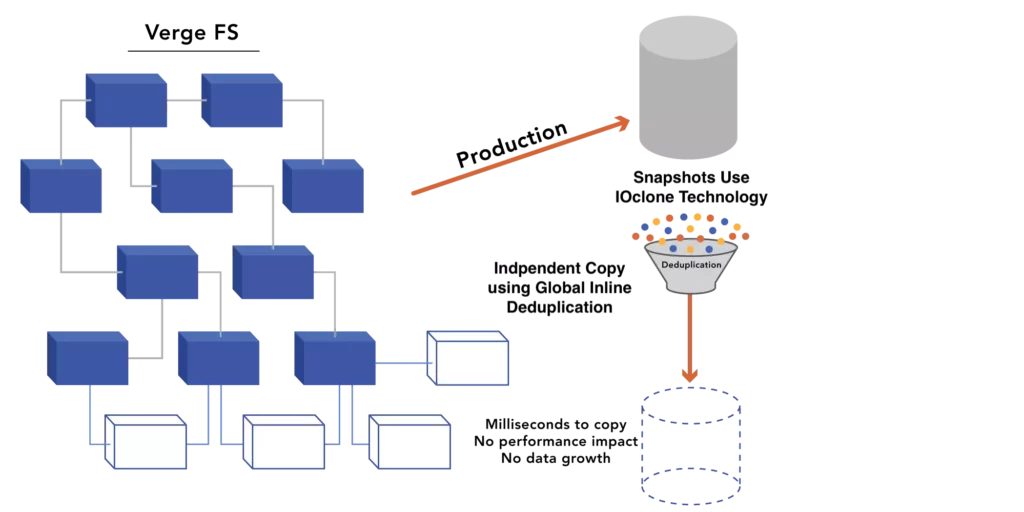
      ioClone utilizes global inline deduplication and a blockchain-inspired file system within VergeFS to create instant, independent, space-efficient, and immutable snapshots of individual VMs, volumes, or entire virtual data centers.
    • ioReplicate
      ioReplicate is a unified disaster-recovery solution that enables simple, cost-efficient DR testing and failover via three‑click recovery of entire Virtual Data Centers—including VMs, networking, and storage.
    • ioFortify
      ioFortify creates immutable, restorable VDC checkpoints and provides proactive ransomware detection with instant alerts for rapid recovery and response.
    • ioMigrate
      ioMigrate enables large-scale VMware migrations, automating the rehosting of hundreds of VMs (including networking settings) in seconds with minimal downtime by seamlessly transitioning entire VMware environments onto existing hardware stacks.
    • ioProtect
      ioProtect offers near-real-time replication of VMware VMs—including data, network, and compute configurations—to a remote disaster‑recovery site on existing hardware, slashing DR costs by over 60% while supporting seamless failover and testing in an efficient, turnkey VergeOS Infrastructure.
    • ioOptimize
      ioOptimize leverages AI and machine learning to seamlessly integrate new and old hardware and automatically migrate workloads from aging or failing servers.
    • ioGuardian
      ioGuardian is VergeIO’s built-in data protection and recovery capability, providing near-continuous backup and rapid VM recovery during multiple simultaneous drive or server failures.
  • IT Initiatives
    • VMware Alternative
      VergeOS offers seamless migration from VMware, enhancing performance and scalability by consolidating virtualization, storage, and networking into a single, efficient platform.
    • Hyperconverged Alternative
      VergeIO’s page introduces ultraconverged infrastructure (UCI) via VergeOS, which overcomes HCI limitations by supporting external storage, scaling compute and storage independently, using existing hardware, simplifying provisioning, boosting resiliency, and cutting licensing costs.
    • SAN Replacement / Storage Refresh
      VergeIO’s storage by replacing aging SAN/NAS systems within its ultraconverged infrastructure, enhancing security, scalability, and affordability.
    • Infrastructure Modernization
      Legacy infrastructure is fragmented, complex, and costly, built from disconnected components. VergeOS unifies virtualization, storage, networking, data protection, and AI into one platform, simplifying operations and reducing expenses.
    • Secure Research Computing
      VergeIO's Secure Research Computing solution combines speed, isolation, compliance, scalability, and resilience in a cohesive platform. It’s ideal for institutions needing segmented, compliant compute environments that are easy to deploy, manage, and recover.
    • Venues, Remote Offices, and Edge
      VergeOS delivers resiliency and centralized management across Edge, ROBO, and Venue environments. With one platform, IT can keep remote sites independent while managing them all from a single pane of glass.
  • Blog
      • Beyond the VMware Exit Consolidate Every Platform onto VergeOS with VeeamMost VMware alternatives only promise a home for vSphere workloads. With official VergeOS support in Veeam Backup & Replication 13.1, one restore job moves workloads from vSphere, Hyper-V, Nutanix AHV, AWS, Azure, GCP, and physical servers onto VergeOS. Consolidate onto VergeOS from every platform you run, and retire the rest.
      • The Maintenance Line You Can’t EscapeScott Bartgis stopped paying VMware maintenance and froze Saratoga Casino Holdings at version 7. The license type was never the problem. The renewal curve was. Here is what a VMware perpetual license buys you, what it costs to hold one unsupported in a regulated environment, and the terms that got him back under support.
      • Storage Tiering Without the Capacity TaxStorage tiering was never an array feature. It was a placement decision that lived where the intelligence sat. Lab measurements show a VergeOS tier change acknowledged in 1.3 seconds with the VM still running, and per-node licensing that decides who captures the data reduction: the customer or the vendor's meter.
    • View All Posts
  • Resources
    • Become a Partner
      Get repeatable sales and a platform built to simplify your customers’ infrastructure.
    • Technology Partners
      Learn about our technology and service partners who deliver VergeOS-powered solutions for cloud, VDI, and modern IT workloads.
    • White Papers
      Explore VergeIO’s white papers for practical insights on modernizing infrastructure. Each paper is written for IT pros who value clarity, performance, and ROI.
    • In The News
      See how VergeIO is making headlines as the leading VMware alternative. Industry analysts, press, and partners highlight our impact on modern infrastructure.
    • Press Releases
      Get the latest VergeOS press releases for news on product updates, customer wins, and strategic partnerships.
    • Case Studies
      See how organizations like yours replaced VMware, cut costs, and simplified IT with VergeOS. Real results, real environments—no fluff.
    • Webinars
      Explore VergeIO’s on-demand webinars to get straight-to-the-point demos and real-world infrastructure insights.
    • Documents
      Get quick, no-nonsense overviews of VergeOS capabilities with our datasheets—covering features, benefits, and technical specs in one place.
    • Videos
      Watch VergeIO videos for fast, focused walkthroughs of VergeOS features, customer success, and VMware migration strategies.
    • Technical Documentation
      Access in-depth VergeOS technical guides, configuration details, and step-by-step instructions for IT pros.
  • How to Buy
    • Schedule a Demo
      Seeing is believing, set up a call with one of our technical architects and see VergeOS in action.
    • Versions
      Discover VergeOS’s streamlined pricing and flexible deployment options—whether you bring your own hardware, choose a certified appliance, or run it on bare metal in the cloud.
    • Test Drive – No Hardware Required
      Explore VergeOS with VergeIO’s hands-on labs and gain real-world experience in VMware migration and data center resiliency—no hardware required
  • Company
    • About VergeIO
      Learn who we are, what drives us, and why IT leaders trust VergeIO to modernize and simplify infrastructure.
    • Support
      Get fast, expert help from VergeIO’s support team—focused on keeping your infrastructure running smoothly.
    • Careers
      Join VergeIO and help reshape the future of IT infrastructure. Explore open roles and growth opportunities.
  • 855-855-8300
  • Contact
  • Search
  • 855-855-8300
  • Contact
  • Search
  • Architecture
    • Overview
    • VergeFS
    • VergeFabric
    • Infrastructure Automation
    • VergeIQ
  • Features
    • Virtual Data Centers
    • High Availability
    • ioClone
    • ioReplicate
    • ioFortify
    • ioMigrate
    • ioProtect
    • ioOptimize
    • ioGuardian
  • IT Initiatives
    • VMware Alternative
    • Hyperconverged Alternative
    • SAN Replacement / Storage Refresh
    • Infrastructure Modernization
    • Virtual Desktop Infrastructure (VDI)
    • Secure Research Computing
    • Venues, Remote Offices, and Edge
  • Blog
  • Resources
    • Become a Partner
    • Technology Partners
    • White Papers
    • In The News
    • Press Releases
    • Case Studies
    • Webinars
    • Documents
    • Videos
    • Technical Documentation
  • How to Buy
    • Schedule a Demo
    • Versions
    • Test Drive – No Hardware Required
  • Company
    • About VergeIO
    • Support
    • Careers
×
  • Architecture
    • Overview
    • VergeFS
    • VergeFabric
    • Infrastructure Automation
    • VergeIQ
  • Features
    • Virtual Data Centers
    • High Availability
    • ioClone
    • ioReplicate
    • ioFortify
    • ioMigrate
    • ioProtect
    • ioOptimize
    • ioGuardian
  • IT Initiatives
    • VMware Alternative
    • Hyperconverged Alternative
    • SAN Replacement / Storage Refresh
    • Infrastructure Modernization
    • Virtual Desktop Infrastructure (VDI)
    • Secure Research Computing
    • Venues, Remote Offices, and Edge
  • Blog
  • Resources
    • Become a Partner
    • Technology Partners
    • White Papers
    • In The News
    • Press Releases
    • Case Studies
    • Webinars
    • Documents
    • Videos
    • Technical Documentation
  • How to Buy
    • Schedule a Demo
    • Versions
    • Test Drive – No Hardware Required
  • Company
    • About VergeIO
    • Support
    • Careers

HCI

May 27, 2025 by George Crump

The hidden costs of HCI often prevent IT professionals, who are looking to exit VMware, from seriously considering the architecture as a viable alternative. Hyperconverged Infrastructure (HCI) vendors capitalize on this scenario, positioning their solutions as streamlined platforms that seamlessly unify virtualization, compute, storage, and networking. However, this initial promise of simplified infrastructure management frequently masks significant hidden costs and complexities.

The hidden costs of HCI

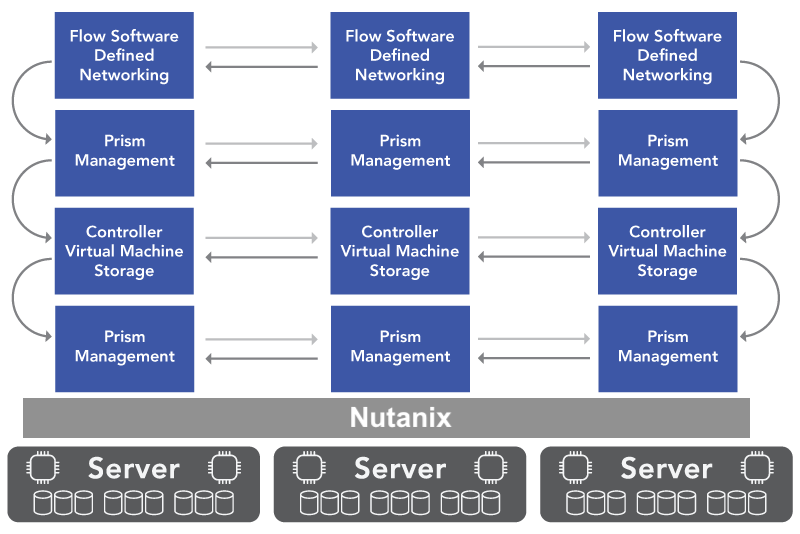
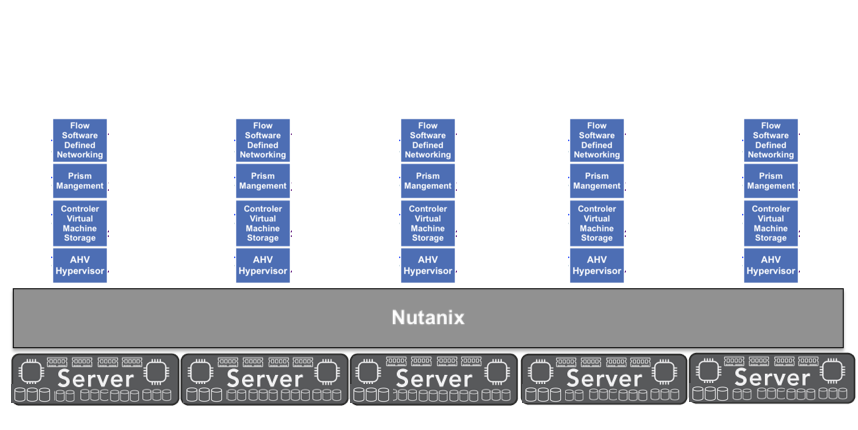
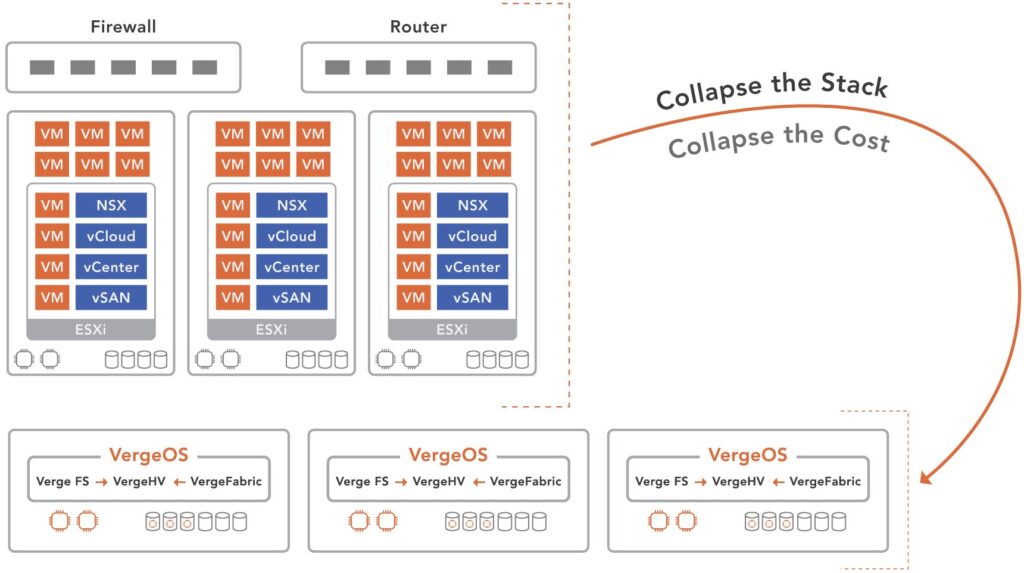
Initially intended to unify infrastructure components, traditional HCI has failed to deliver true integration. Compute, storage, and networking resources remain operationally separate, requiring distinct layers in the form of virtual machines (VMs) communicating with the hypervisor. Commonly deployed solutions utilize separate VMs for storage management (e.g., Nutanix’s CVM or VMware’s vSAN), distinct networking stacks (Nutanix Flow, VMware NSX), and individual management VMs (Nutanix Prism, VMware vCenter). True operational simplification remains elusive; what began as convergence is merely the virtualization of legacy three-tier architectures.

How VergeOS Solves the Convergence Problem

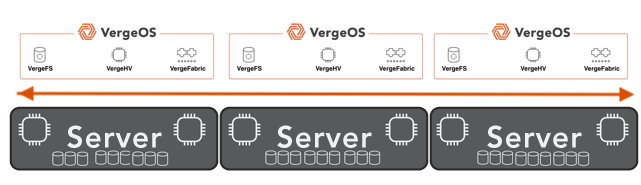
VergeOS achieves true convergence through its ultraconverged design. By integrating storage, networking, virtualization, and data services directly into a unified operating environment, VergeOS eliminates silos and redundant communication layers. This cohesive design simplifies operations, reducing complexity, administrative overhead, and resource inefficiency.

Dive deeper with our on-demand webinar: “Comparing HCI as VMware Alternatives.”


The Efficiency Problem

The hidden costs of HCI include its inability to deliver meaningful infrastructure efficiency. Despite sharing hardware, HCI components remain distinct entities, each consuming substantial resources. Dedicated storage VMs, management VMs, separate networking stacks, and additional abstraction layers cumulatively drain compute cycles and memory. Application VMs running within these infrastructures consequently suffer degraded performance and higher latency, forcing organizations to compensate with additional hardware investment rather than benefiting from the initially promised efficiency gains.

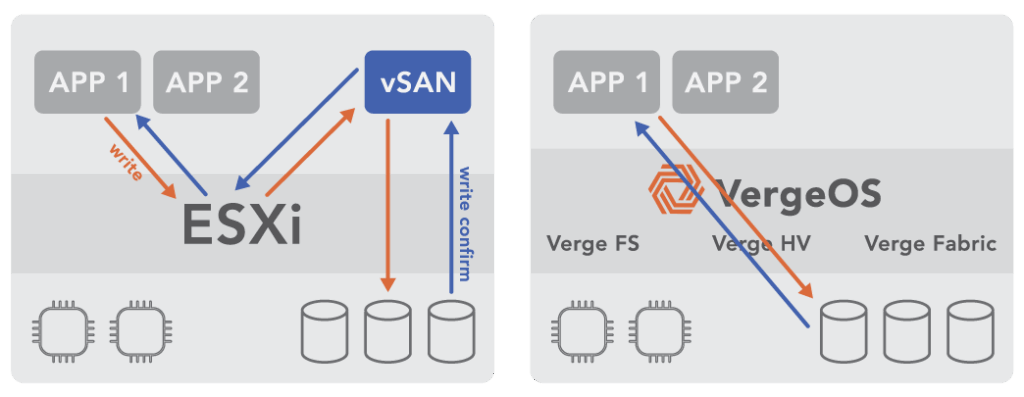
For instance, a typical I/O operation in an HCI environment begins at the hypervisor level, proceeds through a storage controller (virtualized as a separate VM), traverses network infrastructure, and finally reaches physical storage media. Each extra step consumes CPU resources, adds latency, and reduces performance efficiency. As workloads scale, the cumulative impact of these inefficiencies affects application responsiveness and resource utilization.

Some HCI vendors utilize data locality to mitigate some of these issues; however, this technology further complicates operations and negatively impacts performance during node or drive failure.

The hidden costs of HCI

How VergeOS Solves the Efficiency Problem

VergeOS integrates all services, including storage and networking, directly into its operating system, eliminating performance overhead associated with separate management virtual machines or additional software layers. Its lightweight architecture ensures maximum resource efficiency, optimizing performance and dramatically reducing hardware requirements and infrastructure costs.


The High Cost of HCI Inefficiency

The hidden costs of HCI inefficiencies necessitate significant investment in higher-performance hardware to compensate for architectural shortcomings. IT must procure more powerful servers, increased core counts, expanded memory, and faster networking. Furthermore, licensing models that charge per CPU core or capacity exacerbate costs, forcing organizations into substantial capital expenditures. These license models compel customers to purchase less optimal hardware to contain software licensing costs.

How VergeOS Reduces the Cost of Inefficiency

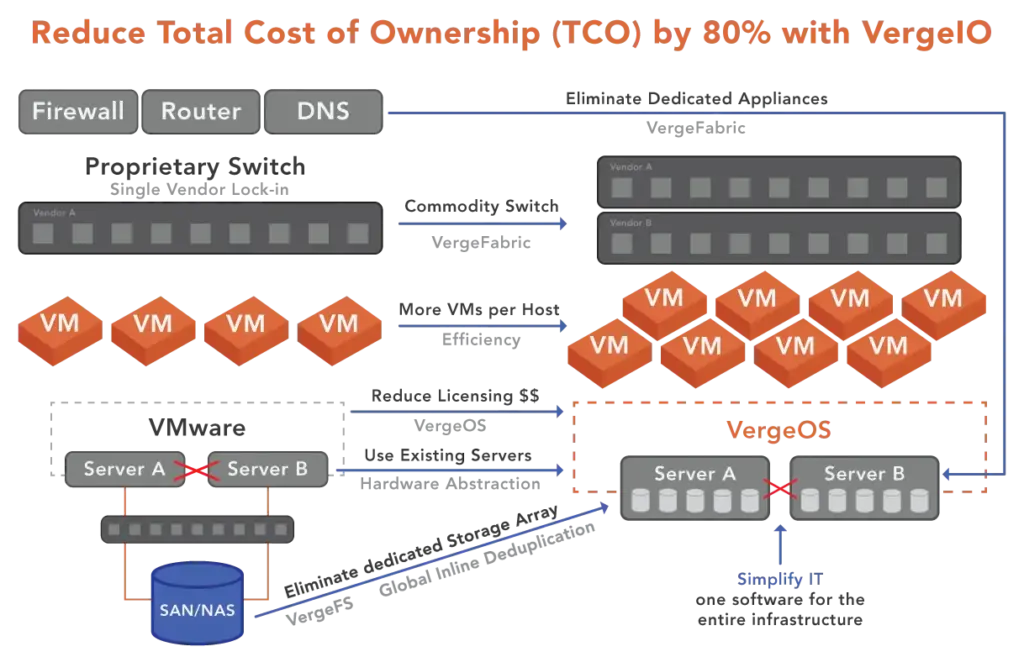
With a streamlined architecture, VergeOS maximizes hardware resource utilization. Its efficient code base and integrated design enable organizations to achieve optimal performance using commodity or existing hardware, reducing initial capital expenditures and ongoing operational expenses. VergeIO licenses VergeOS per-server without penalties for using high-core-count or high-capacity servers.


The High Cost of HCI Data Availability

HCI solutions employ synchronous mirroring—continuous real-time data duplication across nodes—to protect against hardware failures. Vendors commonly refer to redundancy levels as Replication Factor (RF) or Fault Tolerance Level (“failures to tolerate” or FTT). Nutanix refers to protection from one node failure as Replication Factor 2 (RF2), meaning two copies of data are maintained. VMware terms this configuration Failures to Tolerate of 1 (FTT=1).

To protect from two simultaneous node failures or multiple drive failures across nodes, Nutanix uses Replication Factor 3 (RF3)—three data copies—while VMware uses FTT=2. This triple redundancy greatly increases storage capacity and resource requirements. RF3 requires at least five nodes, becoming prohibitively expensive for smaller deployments. In larger environments, limiting resiliency to two node failures is insufficient, as risk increases with node count.

These requirements force prioritizing specific workloads for enhanced protection (RF3), relegating others to standard availability (RF2). Limited redundancy beyond RF3 leads organizations to increase the cluster count per site, resulting in cluster sprawl, which in turn causes additional administrative complexity, higher costs, and uneven availability guarantees.

To maintain performance during node failures, Nutanix and VMware require reserving a portion of resources on each server equal to the capacity of one full node. In a four-server environment, 25% of each server’s resources are reserved for failover, which substantially reduces the available capacity during regular production operations.

How VergeOS Delivers Cost-Effective Data Availability

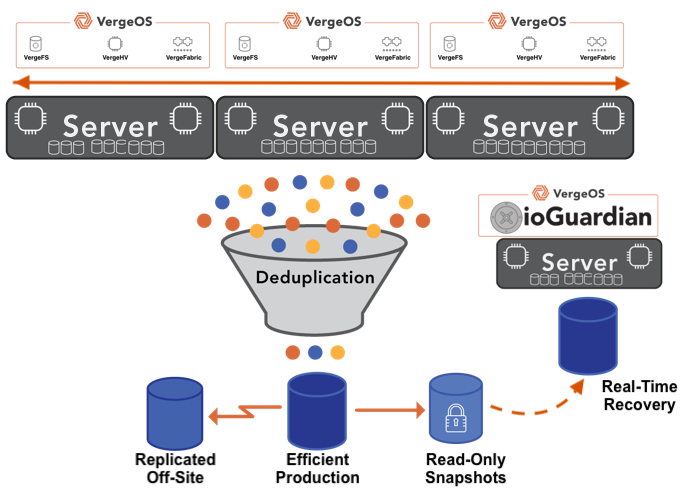
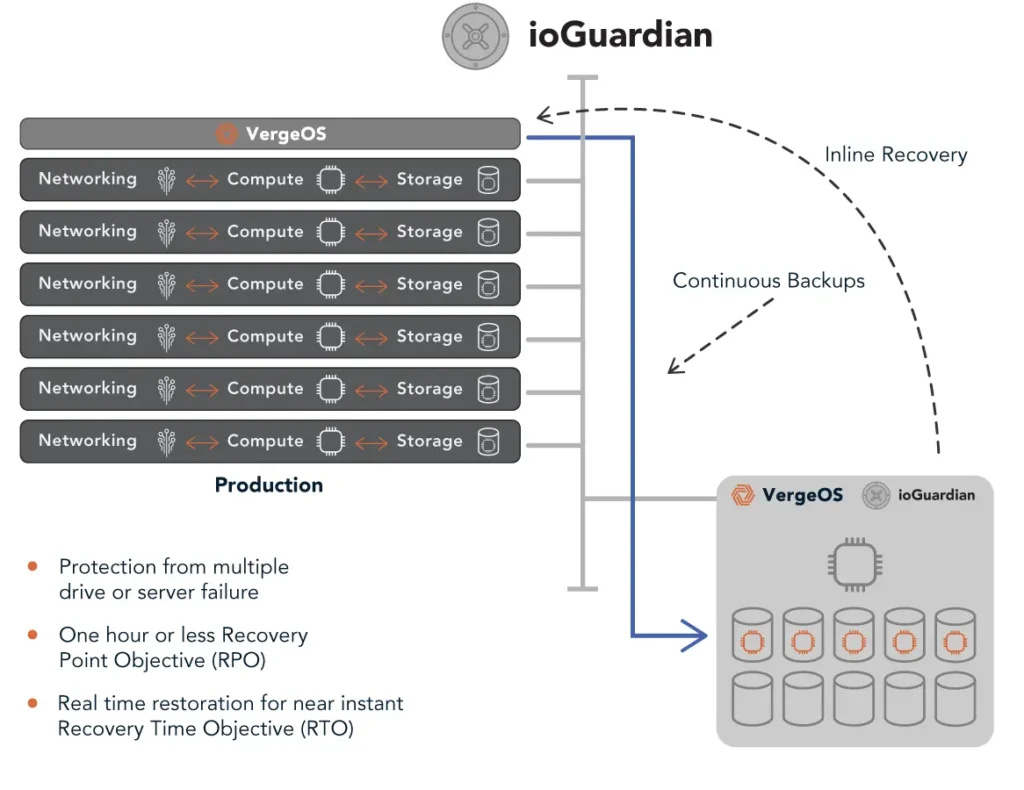
VergeOS leverages ioGuardian, a deduplicated third-copy data protection method. This efficiently safeguards against multiple simultaneous hardware failures without excessive storage overhead or node count requirements of traditional RF3 implementations. ioGuardian provides robust availability at an economical cost, without requiring workload prioritization, delivering superior resilience at a lower price and complexity.

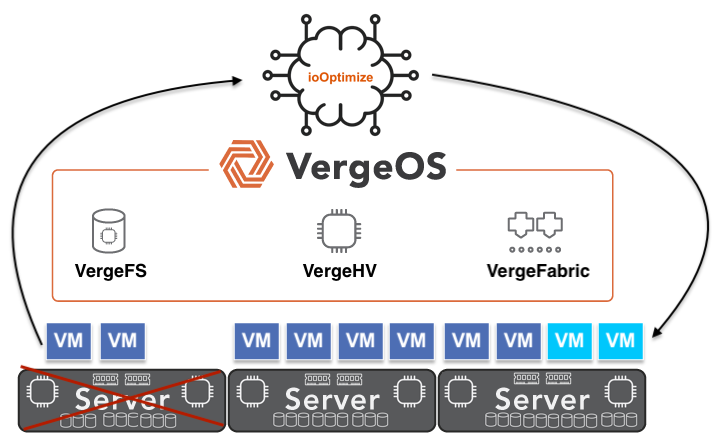
No reservation of server resources is required. If a node fails, VergeIO’s ioOptimize technology intelligently and automatically reallocates affected VMs to other nodes based on each VM’s resource demands and available server capacities.


The High Cost of HCI Data Protection

The Practice of Snapshotting

Snapshotting commonly provides additional recovery points beyond the capabilities of backup software. However, snapshot-intensive environments impose severe performance penalties, resulting in increased storage I/O and network resource demands. Frequent snapshots or long-term snapshot retention require complex metadata management, demanding more powerful servers, additional memory, and faster storage media. This results in escalated hardware and licensing costs, especially in per-core or per-capacity licensing models common to HCI.

Snapshot chains or numerous simultaneous snapshots greatly increase complexity, hindering disaster recovery processes. Restoring across heterogeneous hardware or hypervisor environments becomes challenging, restricting operational flexibility.

How VergeOS Simplifies Data Protection

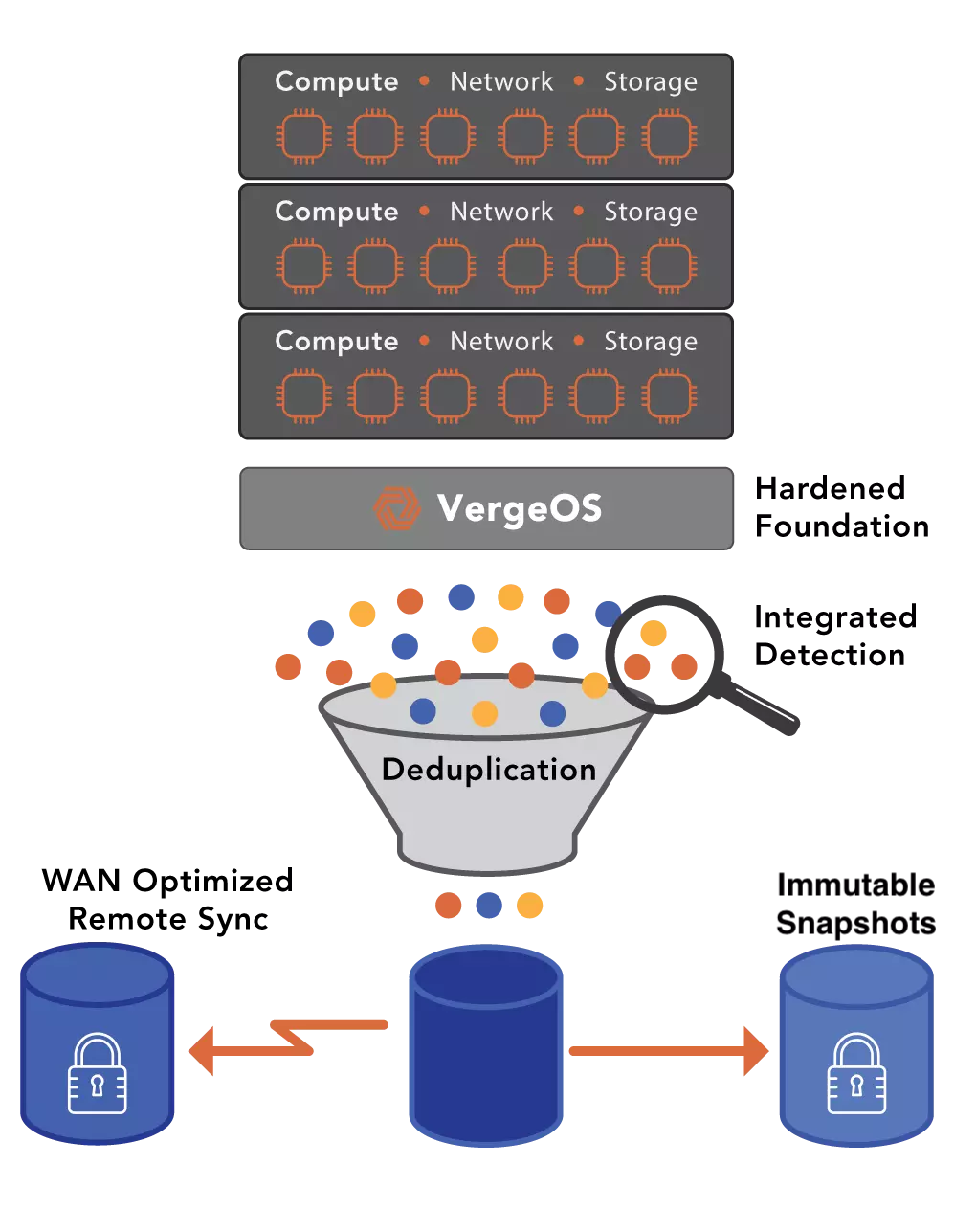
VergeOS utilizes ioClone technology, integrated with its global inline deduplication, to create space-efficient, independent snapshots with minimal metadata overhead. ioClone’s architecture supports near-continuous snapshot execution and indefinite retention without performance degradation, enabling rapid and efficient data protection without the need for costly hardware upgrades or complex snapshot management. The combination of ioGuardian and ioClone also reduces the organization’s dependency on backup, lowering the costs of backup software licensing and backup hardware infrastructure.

The High Cost of HCI Inflexibility

The hidden costs of HCI architectures imposing strict hardware compatibility and homogeneity requirements are significant. Expanding storage or compute resources mandates identical hardware, limiting flexibility and increasing long-term infrastructure costs. Adding nodes of different brands, generations, or capabilities creates additional clusters, which fragment management and reduce efficiency.

How VergeOS Enhances Infrastructure Flexibility

VergeOS supports heterogeneous hardware environments, enabling organizations to integrate diverse hardware configurations into unified, scalable clusters seamlessly. This flexibility reduces costs, simplifies expansion, and maximizes investment longevity, enabling adaptive infrastructure growth without imposed constraints on homogeneity.

overcome the hidden costs of HCI inflexibility


An Example of The Hidden Costs of HCI vs. VergeOS

Consider a three-node infrastructure using traditional Hyperconverged Infrastructure (HCI), where the organization’s goal is to maintain continuous data availability even after two simultaneous node failures. Traditional HCI solutions, such as Nutanix or VMware vSAN, require at least five nodes configured with Replication Factor 3 (RF3), or a Fault Tolerance Level of 2 (FTT=2), ensuring continuous availability despite two node failures. In addition, these solutions require maintaining sufficient free storage capacity at all times to accommodate a complete rebuild in the event of node failures, thereby reserving capacity equivalent to an entire node, which further reduces usable storage space.

Because the customer wants to leverage their existing hardware—a heterogeneous mix of Dell and HPE servers—traditional HCI platforms present immediate compatibility and cost challenges. Traditional HCI requires uniform hardware for seamless operation, which adds complexity and cost.

Cost Analysis for Traditional HCI

Achieving protection from two simultaneous node failures requires:

  • Minimum Node Count: 5 nodes (uniform hardware required).
  • Replication Method: RF3 or FTT=2 (three synchronous copies of all data).
  • Usable Capacity: Reduced to approximately 33% due to triple mirroring overhead.
  • Reserved Free Capacity: Additional storage space equal to one node’s full storage capacity, always kept available to allow immediate rebuilds after failures.

In this scenario, the customer faces:

  • The necessity of purchasing additional uniform hardware due to vendor compatibility guidelines.
  • Higher software licensing costs, typically calculated per CPU core.
  • Significant reserved resources on each node (compute and storage) are allocated exclusively for node failure scenarios.

This dramatically increases capital and operational expenses, requiring significant investment in new hardware and licenses, thereby negating the anticipated HCI savings.

Cost Analysis with VergeOS

In the same scenario, VergeOS offers substantial advantages:

  • Minimum Node Count: 3 nodes (uses existing Dell and HPE hardware).
  • Replication Method: Integrated distributed mirroring combined with VergeOS’s independent, deduplicated third data copy via ioGuardian, which can be installed on any available standby server.
  • Usable Capacity: Approximately 50% (due to two-way mirroring), augmented by ioGuardian’s deduplication efficiency.
  • Reserved Free Capacity: Minimal additional storage capacity needed due to ioGuardian’s efficient data protection strategy, reducing rebuild space requirements compared to traditional RF3 architectures.

With VergeOS, you benefit from:

  • No need for uniform hardware, allowing immediate use of existing Dell and HPE servers.
  • Reduced licensing and hardware costs, as no additional nodes or extensive resource reservations are required.
  • Enhanced data availability beyond traditional two-node failure protection without extensive reserved storage, reducing overhead and complexity.


Summary of Cost Benefits

Traditional HCI requires two additional nodes (totaling five) and mandates uniform hardware, increasing both capital and operational expenses, compounded by large reserved capacity requirements for rebuilding data. VergeOS provides superior resilience, operational continuity, and cost efficiency by leveraging existing heterogeneous hardware and substantially reducing the need for reserved rebuild capacity.

Conclusion

While hyperconverged infrastructure initially promises simplicity, efficiency, and cost savings, underlying architectural limitations quickly surface as substantial hidden costs. Challenges such as insufficient convergence, operational inefficiencies, costly availability and protection schemes, and restrictive infrastructure flexibility erode promised benefits. Organizations should carefully assess these hidden costs when evaluating HCI solutions, prioritizing converged, integrated infrastructures like VergeOS that fundamentally address these critical challenges, enabling efficient, cost-effective, and future-ready IT environments.

Register for our HCI Data Availability Analysis

Filed Under: HCI Tagged With: Alternative, HCI, Hyperconverged, UCI, VMware

May 19, 2025 by George Crump

Triple mirroring, or Replication Factor 3 (RF3), presents hidden challenges when evaluating VMware alternatives and hyperconverged architectures. Although RF3 enhances data resiliency beyond single drive or node failures, many organizations face unexpected costs, operational complexity, and scalability constraints, which are pronounced in smaller or larger deployments, where resource efficiency and manageability become critical issues. These unexpected triple mirroring challenges force most IT professionals to avoid the technology completely, but with the right design, a triple mirror can provide better availability at a lower cost.

The Basics of Triple Mirroring

Triple mirroring replicates data across three separate nodes or storage devices. This approach ensures data availability even if two nodes, or drives with those nodes, fail simultaneously, providing a higher degree of redundancy and resilience compared to dual replication (RF2). On the surface, this redundancy sounds ideal for critical workloads, but deeper examination reveals several substantial drawbacks.

Costly and Impractical for Small Environments

One major limitation of triple mirroring is its inefficiency in smaller environments. RF3 configurations require a minimum of five nodes to maintain adequate redundancy and quorum, even though the storage and computing demands may not necessitate this level of investment. For small data centers or departmental deployments, this requirement results in a prohibitively high entry cost, as the infrastructure must be oversized to achieve adequate redundancy.

Triple Mirroring requires five nodes

In these scenarios, the high infrastructure cost, coupled with a reduced usable storage capacity—approximately a 66% reduction compared to single-copy storage—can be problematic, as it inflates the total cost of ownership without providing proportional operational value.

Scalability Challenges for Large Deployments

At the opposite end of the spectrum, large-scale deployments find triple mirroring delivers diminishing returns. In environments spanning dozens or more nodes, the risk of multiple simultaneous failures increases. For instance, protecting against dual node failures in a 32-node cluster may prove insufficient, as larger clusters inherently present greater statistical risks. Consequently, the likelihood of multiple concurrent failures can quickly exceed what RF3 is designed to handle. Moreover, even if an organization was willing to implement a higher redundancy level, such as “quad-mirroring,” available solutions do not offer this capability.

As environments scale, the inefficiency of triple mirroring grows exponentially. It requires a substantial upfront investment in storage and computing capacity to maintain adequate redundancy across all nodes. These demands escalate infrastructure complexity, increasing management overhead and resource consumption.

The Hidden Costs of Triple Mirroring

Triple mirroring introduces hidden long-term costs that extend beyond maintaining a third copy of data. First, the third data copy requires deployment on identical, production-class servers and storage media, as triple mirroring technologies cannot dedicate specific nodes solely for data storage without also utilizing them for compute tasks.

Secondly, the significant expense associated with triple mirroring forces IT teams into complex trade-offs, as they manage multiple storage volumes with varying resiliency levels, with some set at RF2 and others at RF3. This dual-resiliency model increases complexity and compels IT to prioritize specific applications, granting them higher availability while relegating less critical applications to lower protection levels. Additionally, many solutions employing RF3 lack the flexibility to revert seamlessly from RF3 to RF2 or upgrade from RF2 to RF3 without requiring a complete recovery of VM data from backup, which adds further operational burdens, limits flexibility, and increases the risk of downtime.

A More Efficient Alternative with VergeIO ioGuardian

A far more efficient and powerful solution is VergeIO’s ioGuardian technology, which delivers the resiliency advantages of triple mirroring without the associated overhead and complexity. ioGuardian maintains an independent, deduplicated third copy of data on a single, cost-effective storage server, reducing storage overhead and increasing resiliency beyond two node failures.

Triple mirroring on a secondary server that extends beyond the capabilities of a triple mirror.

For smaller environments, ioGuardian offers an optimal approach by requiring only one additional, affordable storage server, eliminating the need for multiple fully provisioned nodes. In larger environments, ioGuardian provides extensive protection against numerous simultaneous node failures by delivering a robust, real-time, and accessible backup repository that is independent of the primary operational infrastructure. With ioGuardian, organizations no longer need to selectively allocate protection levels, ensuring comprehensive availability for all applications.

Simplified Management and Lower Costs with ioGuardian

VergeIO’s ioGuardian simplifies infrastructure management, reduces complexity, and lowers costs. Its dedicated storage server approach minimizes resource consumption, as the server focuses solely on secure data storage and recovery, rather than hosting active virtual workloads. Furthermore, ioGuardian’s global inline deduplication dramatically reduces storage capacity requirements, directly decreasing both capital and operational expenses.

How ioGuardian Works

By decoupling redundancy from operational nodes and centralizing it into ioGuardian’s dedicated backup repository, organizations achieve superior data resiliency. In scenarios involving multiple simultaneous node or drive failures—situations that even exceed the protections provided by RF3—ioGuardian immediately ensures continuous data availability through real-time redirection of requests. When production nodes detect missing or unavailable data blocks due to hardware failures, VergeOS transparently redirects these requests to redundant data blocks stored within the independent ioGuardian server, enabling uninterrupted application performance and seamless user access.

Eliminate Triple Mirroring. Backup and Data Availability in one simple solution.

Critically, ioGuardian maintains operational efficiency by deferring data migration back into primary production nodes until failed drives or nodes are physically replaced or explicitly marked for replacement. When the drives are replaced, ioGuardian automatically repopulates data onto the repaired or newly replaced hardware, minimizing unnecessary data movement and preserving the performance of the production infrastructure.

Additionally, ioGuardian serves as a comprehensive traditional backup solution. It enables organizations to restore virtual machines, individual files, or specific data versions directly from their repository when needed, providing reliable access to historical data snapshots. This capability simplifies recovery processes following data corruption events, accidental deletions, or ransomware attacks, thereby enhancing overall data integrity and reducing costs further.

Conclusion: Rethinking Triple Mirroring with VergeIO

While triple mirroring initially appears straightforward for ensuring data availability and redundancy, its hidden complexities, high costs, and scalability limitations often overshadow its intended benefits. Modern IT infrastructures demand more flexible, efficient, and scalable redundancy solutions. VergeIO’s ioGuardian offers organizations—from small departmental setups to large enterprise clusters—a simplified, robust, and cost-effective approach to data protection, surpassing traditional triple-mirroring strategies. Data redundancy is one aspect of a VMware Alternative’s capabilities that IT should consider. They should look for solutions that encompass all aspects of data availability as part of their selection process.

To explore these advantages further, join our upcoming live webinar, Comparing HCI Architecture.

Filed Under: Protection Tagged With: Alternative, HCI, VMware

December 16, 2024 by George Crump

The ROI of High-Performance HCI would be a compelling alternative to the high cost of dedicated All-Flash Arrays. However, as application performance demands increase, many HCI solutions struggle to deliver the required performance, scalability, and efficiency. Legacy HCI solutions struggle to keep pace with the demands of modern mainstream applications, let alone today’s high-performance applications. The result is that hyperconverged infrastructure (HCI), which has long promised simplification and cost savings, has never delivered on this promise.

The ROI of High-Performance HCI is achieved only when these platforms meet the demands of today’s workloads. Applications such as virtual desktops and databases require high performance and low latency—capabilities that many legacy HCI platforms fail to provide due to architectural inefficiencies.

Ultraconverged Infrastructure (UCI) is High-Performance HCI

the ROI of high-performance HCI

UCI is the next evolution in data center software, designed to overcome the limitations of legacy HCI by deeply integrating virtualization, storage, and networking into a single codebase. Unlike traditional HCI, where storage is often a second-class citizen running as a virtual machine, UCI treats storage as a first-class service, ensuring optimal performance and resource utilization. By addressing these challenges head-on, UCI solutions like VergeOS deliver superior performance and unparalleled ROI.

Want to learn more? Register for VergeIO’s upcoming webinar to see these high-performance results live on cost-effective hardware:
👉 Live Demonstration: Break the Performance Shackles of HCI

Eliminating Expensive Storage Hardware

UCI improves the ROI of high-performance HCI by eliminating expensive dedicated storage controller hardware and vendor-marked-up storage media, which can cost up to 10 times more than off-the-shelf consumer-grade SSDs. These enterprise-class drives are designed with features like capacitors and error-correcting code (ECC) to ensure data integrity, but they significantly inflate infrastructure costs.

Legacy All-Flash Arrays (AFAs) and HCI solutions depend heavily on these specialized components because they rely on the hardware for data resiliency and verification. In contrast, UCI solutions like VergeOS integrate these functions into the software, ensuring data resiliency and integrity without depending on expensive, proprietary hardware. This software-first mentality also enables UCI platforms to mix hardware from different vendors and generations, providing greater flexibility for organizations to scale and upgrade their infrastructure without forklift overhauls.

Matching and Surpassing All-Flash Array Features

Maintaining UCI’s improvements to the ROI of high-performance HCI requires that UCI platforms like VergeOS match and surpass the feature set of traditional all-flash arrays. Enterprises have come to expect capabilities such as:

the ROI of high-performance HCI
  • Unlimited snapshots without performance degradation: VergeOS supports instant snapshots without impacting IOPS or latency, allowing IT teams to back up and restore data seamlessly. VergeOS snapshots go beyond traditional snapshots because they are actually deduplicated clones, providing independence and scalability between snapshot generations.
  • Global Inline Deduplication: VergeOS performs global inline deduplication without slowing down I/O operations, enabling organizations to maximize storage efficiency without sacrificing performance. Unlike most deduplication technologies, which are added as an afterthought to the software and introduce latency, VergeOS’s deduplication was integrated from day one and has no noticeable impact on performance. Global deduplication also makes disaster recovery data transfers more efficient by reducing the amount of data that needs to be sent, particularly in many-to-one disaster recovery scenarios.
  • Replication to remote sites: Built-in replication ensures data can be efficiently copied to offsite locations, supporting robust disaster recovery strategies. When combined with VergeOS Virtual Data Centers, which encapsulate the entire data center, replication provides a simple and comprehensive solution for failover and recovery.

Traditionally associated with high-end storage arrays, these features are fully integrated into VergeOS’s UCI platform. By providing these capabilities within a consolidated, software-driven solution, VergeOS simplifies operations and delivers unmatched value.

High Performance with Low Latency

A critical challenge to improving the ROI of high-performance HCI is delivering high performance while maintaining low latency. Many HCI platforms struggle under demanding workloads because they must balance virtual machine and storage responsibilities within the same infrastructure. UCI, by contrast, is architected to ensure resource optimization and eliminate contention. When storage performance demands are extreme, VergeOS can even dedicate servers to specific functions, i.e., compute-only, GPU-only, and storage-only nodes.

By treating storage as a first-class service within its hypervisor, VergeOS achieves consistently low latency and sub-millisecond response times, even under heavy load. This deep integration allows VergeOS to allocate resources intelligently, ensuring that both compute and storage operations run smoothly without interference. Whether running I/O-intensive workloads or supporting mission-critical applications, VergeOS delivers the performance and responsiveness needed to keep pace with future demands.

Real-World Proof: VergeOS in Action

The advantages of UCI ROI versus the ROI of high-performance HCI are best demonstrated through real-world testing. Recently, VergeIO published a benchmark showcasing the performance of VergeOS under demanding workloads. The test utilized eight servers costing less than $1,500 per node, demonstrating that high performance does not require high-cost infrastructure. Key results included:

  • 1.5 Million+ Read IOPS using 64K blocks
  • 24 GB/s of Write Throughput on a 25 GB/s network

It’s worth noting that VergeOS achieved these results using 64K block sizes, which provide a more realistic representation of enterprise workloads compared to the more commonly benchmarked 4K blocks. Again, these tests were performed on off-the-shelf servers configured well below the typical data center-class server.

Want to see these results live? Join VergeIO’s upcoming webinar to learn how VergeOS delivers high performance on affordable hardware:
👉 Want to See UCI Outperform an AFA? Join us for a Live Demonstration

Conclusion: UCI Delivers The ROI of High-performance HCI

With UCI solutions like VergeOS, the ROI of High-Performance HCI is no longer a theoretical concept but a practical reality. By eliminating the dependency on expensive hardware, matching and surpassing the capabilities of traditional storage arrays, and delivering consistent low-latency performance, VergeOS enables organizations to meet the demands of modern workloads without breaking their budgets.

the ROI of high-performance HCI

UCI represents the logical evolution of infrastructure software, combining the simplicity of HCI with the performance and flexibility enterprises require. For organizations looking to consolidate operations, reduce costs, and scale efficiently, UCI is the path forward.

Filed Under: HCI Tagged With: HCI, Storage

December 10, 2024 by George Crump

Real-World HCI IOPS Results: 1 Million+ IOPS Using 64K Blocks

Ann Arbor, Michigan – December 10, 2024 – VergeIO, a leader in ultra-converged infrastructure (UCI), today announced the release of VergeOS Version 4.13, a breakthrough update developed in partnership with Solidigm, a leading provider of innovative NAND flash memory solutions. This release sets new benchmarks in hyperconverged infrastructure (HCI) performance, scalability, and affordability for enterprise environments.

Testing with 64K block sizes provides a more accurate representation of real-world virtualized environments that often use larger block sizes for storage I/O. Unlike traditional 4K block testing, which primarily evaluates raw storage performance, 64K blocks better reflect the demands of modern virtualized workloads, including virtual machines, databases, and large-file applications. These tests demonstrate how VergeOS and Solidigm can collaborate to deliver meaningful performance improvements for enterprise environments.

All About Storage Performance

VergeOS Version 4.13 focuses on delivering unparalleled storage performance through advanced networking optimizations that reduce latency and improve throughput.

Extreme Performance Powered by Solidigm

The Extreme Performance test for VergeOS 4.13 was conducted by Solidigm, showcasing the full potential of Solidigm’s technology. Key results included:

  • A 6-node cluster with mainstream dual Gold CPUs and Solidigm Gen 5 NVMe SSDs surpassed 1 million random read IOPS using 64K blocks, a common configuration in virtualized infrastructures, all while maintaining sub-millisecond response times.
  • In 64K random write performance, the configuration achieved 485K IOPS at more than 30 GB/s throughput, again with sub-millisecond response times, demonstrating exceptional efficiency and reliability in HCI environments.
  • The raw performance of the Solidigm SSDs using 4K blocks reached 17 million IOPS, pushing the boundaries of storage technology while maintaining sub-millisecond response times.
  • VergeOS’ data protection and deduplication features were fully active during these tests, highlighting VergeOS 4.13’s ability to maintain peak performance while delivering critical enterprise-grade capabilities.

Response time measurements were taken by deploying separate VMs outside the testing cluster to monitor latency under load. This method ensured real-world accuracy and demonstrated that sub-millisecond response times were consistently achieved, even under noisy neighbor conditions.

“Solidigm’s tests of VergeOS 4.13 demonstrate the unmatched performance and efficiency that our SSDs deliver in demanding workloads,” said Roger Corell, Director of Leadership Marketing at Solidigm. “The ability to achieve over 1 million IOPS with 64K blocks, coupled with sub-millisecond latency and enterprise-grade data protection, highlights the power of our collaboration with VergeIO to redefine hyperconverged infrastructure.”

Affordable Scalability Without Compromise

VergeIO demonstrated the cost-efficiency of VergeOS 4.13 with an eight-node cluster built in its labs using $1,500 servers equipped with consumer-class AMD Ryzen 9 7940HX CPUs, 96GB RAM, and 25Gbps Ethernet connectivity. This affordability test, conducted in VergeIO’s labs, delivered the following results:

  • 1.5 million random read IOPS using 64K blocks at a total cost of $10,000, equating to a cost of just 0.67 cents per IOPS, with sub-millisecond response times, setting a new benchmark for cost-efficiency in HCI solutions.
  • 195,000 random write IOPS using 64K blocks, achieving 12 GB/s throughput, effectively utilizing the network’s 25Gbps bandwidth, with sub-millisecond response times.

“These results demonstrate our commitment to making enterprise-grade performance accessible to organizations of all sizes,” said Greg Campbell, Founder and CTO of VergeIO. “Our affordability test shows that you don’t need expensive hardware to achieve remarkable results. With VergeOS 4.13, customers get a high-performance, scalable solution that fits within their budgets.”

Live Storage Migration: Critical for Next-Gen Storage Technologies

VergeOS 4.13 also introduces live storage migration for virtual machines, an essential feature in the era of advanced storage technologies like Solidigm’s 122TB QLC NVMe drives. These high-density drives, while delivering exceptional capacity, present unique challenges as they are integrated into existing environments.

Live storage migration allows organizations to dynamically move workloads between different storage tiers, optimizing performance, ensuring seamless continuity, and extending the life of storage media. During the December 17 webinar, VergeIO will demonstrate the live storage tiering capabilities of VergeOS 4.13, showcasing how the platform bridges high-performance and high-density storage seamlessly.

“VergeIO and Solidigm’s latest collaboration demonstrates how modern infrastructure can address the challenges of performance, scalability, and density,” said Marc Staimer, President of Dragon Slayer Consulting. “The results of both tests highlight the incredible synergy between VergeOS and Solidigm’s high-density SSDs. Combined with live storage migration, these capabilities empower organizations to adopt next-generation storage technologies without sacrificing performance or reliability, all while reducing costs and operational complexity.”

Experience It Live – December 17th Webinar

VergeIO invites IT professionals and decision-makers to experience VergeOS 4.13 in action during a live webinar on December 17, 2024. The event will feature a live demonstration of the platform’s capabilities and an in-depth discussion on how VergeIO and Solidigm are reshaping hyperconverged infrastructure. Register Here

About VergeIO

VergeIO is the future of virtualization and infrastructure. It is the ideal choice for those seeking an alternative to VMware. VergeIO is a leading provider of ultra-converged infrastructure (UCI) solutions, integrating virtualization, storage, and networking into a single, easy-to-manage platform. VergeIO’s software enables organizations to reduce costs, simplify IT operations, and achieve unmatched performance.

For more information on VergeOS Version 4.13 or to register for the webinar, visit www.vergeio.com.

About Solidigm

Solidigm is a leading global provider of innovative NAND flash memory solutions. Solidigm technology unlocks data’s unlimited potential for customers, enabling them to fuel human advancement. Originating from the sale of Intel’s NAND and SSD business, Solidigm became a standalone U.S. subsidiary of semiconductor leader SK hynix in December 2021. Headquartered in Rancho Cordova, California, Solidigm is powered by the inventiveness of team members in 13 locations around the world. For more information, please visit solidigm.com and follow us on Twitter and LinkedIn.

Media Contact:

Judy Smith, JPR Communications

Email: [email protected]

Filed Under: Press Release Tagged With: HCI, Storage, ultraconverged

October 30, 2024 by George Crump

As IT professionals seek VMware alternatives, they often encounter hyperconverged infrastructure (HCI) solutions, but these systems can’t deliver the media and node flexibility of Ultraconverged Infrastructure (UCI). UCI solutions like VergeIO provide businesses with enhanced adaptability to support diverse storage media and node types. This approach better aligns with real-world demands and long-term infrastructure goals.

What is Ultraconverged Infrastructure?

Unlike traditional HCI or three-tier architectures, UCI integrates storage and networking directly into the hypervisor, running as services rather than virtual machines (VMs). Traditional three-tier systems rely on separate networking, virtualization, and storage hardware components. At the same time, HCI typically bundles these functions but still operates them as independent layers, each running as independent VMs.

With UCI, these critical functions are embedded within the hypervisor, improving efficiency and higher performance. This architectural shift also delivers greater flexibility in choosing media and server (node) types, allowing IT teams to scale infrastructure resources precisely according to their specific workload demands. VergeIO’s implementation of UCI is VergeOS.

The Limitations of Traditional HCI in Mixing Media and Node Types

Traditional hyperconverged infrastructures have rigid configurations requiring identical nodes for computing and storage. Organizations must scale both resources equally, which may not meet their needs. Additionally, traditional HCI solutions can’t support multiple storage types in the same environment, like flash and HDDs. These limitations force businesses to overprovision resources and spend unnecessarily on high-performance storage not aligned with their workloads.

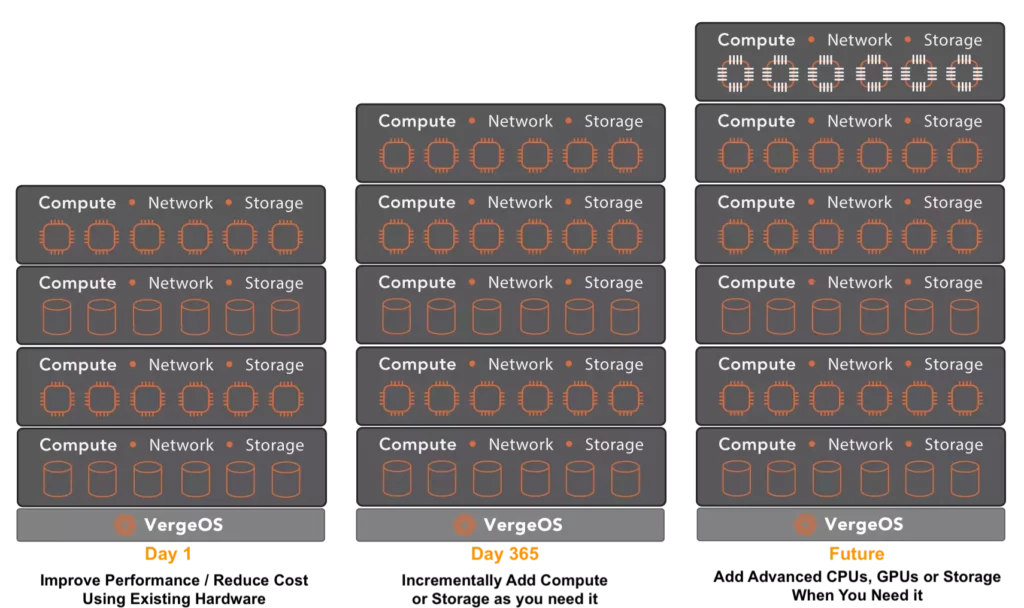
Ultraconverged Infrastructure (UCI) addresses these challenges by enabling independent scaling of compute and storage through a mixed-node approach. It supports various storage media types, allowing IT teams to use high-density QLC flash, high-endurance TLC flash, and HDDs for optimized performance. This flexibility lets organizations assign workloads to the best resources for cost efficiency and improved performance.

Comparing HCI and UCI

The following table summarizes key differences between HCI and UCI, emphasizing how UCI overcomes many of the limitations faced by traditional HCI:

FeatureHyperconverged Infrastructure (HCI)Ultraconverged Infrastructure (UCI)
Node FlexibilityRequires identical nodes with balanced compute and storage resourcesSupports mixed nodes (compute-heavy, storage-heavy, GPU-heavy), allowing independent scaling
Media FlexibilityAllows independent scaling, adding only storage or computing as neededSupports a wide range of media types (TLC, QLC, HDD) tailored to workload requirements
ScalabilityMust add identical nodes, scaling compute and storage equallyAllows independent scaling, adding only storage or compute as needed
Cost EfficiencyHigher costs due to forced resource overprovisioningReduced costs by scaling based on actual workload needs
Resource AllocationLimited flexibility, requires additional hardware to meet diverse workloadsFlexible resource allocation across different node types for varied workloads
PerformanceOften limited by storage and compute configuration; may not fully utilize advanced hardwareMaximizes performance by optimizing workload placement and storage tiering
Data PlacementTypically lacks fine-grained control, with limited storage tieringSupports advanced data placement and storage tiering, utilizing high-density QLC, TLC, and HDD
Use CasesSuitable for basic virtualization needs, with uniform resource requirementsSupports diverse workloads (VDI, ML, AI, data lakes, backup) by adjusting to specific needs
High Availability and RecoveryBasic high availability, often requires more servers to maintain stabilityEnhanced high availability with efficient recovery, requiring fewer servers
ROI and Resource UtilizationLower ROI due to higher hardware costs and limited resource optimizationHigh ROI, optimized resource use through flexible node and media support
Hardware RefreshAll servers must be refreshed at onceServers can be refreshed gradually, one at a time, as needs change

Leveraging Mixed Storage Media: TLC, QLC, and HDDs

The Media and Node Flexibility of Ultraconverged

A key strength of UCI is its ability to support a variety of storage media, including TLC (Triple-Level Cell) flash, QLC (Quad-Level Cell) flash, and traditional HDDs. Each storage type offers unique benefits, and UCI enables IT teams to assign workloads to the most appropriate media, optimizing cost and performance without compromise.

  • TLC NVMe Flash: High-performance, high-endurance TLC flash is ideal for applications requiring frequent access to data, such as real-time analytics or transactional databases. UCI platforms allocate TLC flash where speed is critical.
  • QLC NVMe Flash: Cost-effective and high-density, QLC flash can store large datasets with minimal expense. QLC media, like Solidigm’s new 60TB+ QLC drives, is optimal for workloads with significant storage needs but lower performance requirements.
  • HDDs: HDDs remain a cost-effective choice for archival storage and backup, as they offer high capacity without the expense of flash storage. UCI allows organizations to assign archival or backup data to HDDs, reducing costs and freeing up flash resources for more demanding tasks.

In a recent evaluation, StorageReview verified VergeOS’s multi-media support, showcasing its flexibility to handle diverse storage types within a single environment. Readers can watch our on-demand webinar, in which VergeIO, StorageReview, and Solidigm discuss the test results and how these media options enhance the platform’s performance. Click here to register for the on-demand session.

Scaling Storage and Compute Independently with Mixed Node Types

UCI supports mixed node types, enabling independent scaling of compute and storage resources. Traditional HCI solutions require identical nodes for expansion, which is inefficient for businesses with unequal compute and storage demands. For example, data-intensive applications may need more storage without extra compute, whereas HPC tasks might require more compute with less storage.

The Media and Node Flexibility of Ultraconverged

In UCI, storage-heavy nodes or compute-heavy nodes can be added independently within the same instance, enabling organizations to scale up only what they need. This flexibility offers significant advantages for specific workloads:

  • Data Lakes and Analytics: Storage-heavy nodes provide the capacity required for large data lakes, while compute-heavy nodes and GPU-heavy nodes can seamlessly access the storage, creating a powerful path to analytics, machine learning (ML), and AI workloads—all supported by the media and node flexibility of Ultraconverged Infrastructure (UCI).
  • Virtual Desktop Infrastructure (VDI): Compute-heavy nodes can handle the CPU resources needed for VDI. In contrast, fewer storage-heavy nodes are used for backend storage, ensuring cost-effective scaling without excess.
  • Backup and Archival: Storage-heavy nodes offer the necessary space for long-term backup and archival data without requiring additional compute resources. When paired with GPU-heavy nodes, this configuration provides a high-capacity, cost-efficient foundation supporting AI-driven data analysis or data mining when needed.

This combination of mixed nodes enables organizations to flexibly support a wide range of workloads, from storage-intensive tasks to GPU-powered analytics and AI applications, all while optimizing resource use and reducing overprovisioning.

ioOptimize: Maximizing Efficiency in Mixed-Node and Mixed-Media Environments

In VergeIO’s UCI implementation, VergeFS boosts efficiency by allowing data to be placed across various media and optimizing computing and storage use. IT can allocate performance-critical data to TLC flash and assign archival data to QLC flash or HDDs. Additionally, IT can direct high-performance workloads to compute-heavy nodes, freeing storage-heavy nodes for data-intensive applications. This management prevents resource bottlenecks and maximizes ROI throughout the infrastructure.

The Advantages of UCI’s Flexibility in Media and Node Types

Combining mixed storage media and mixed node types allows UCI to deliver several essential benefits for modern data centers:

  1. Cost Efficiency: Organizations can optimize storage costs by matching storage media to workload requirements without compromising performance. High-density QLC and HDDs help reduce expenses, while high-performance TLC flash is allocated to applications that truly need it.
  2. Scalability: Mixed node types allow organizations to scale only the resources they need, adding storage or compute independently for greater scalability and control over infrastructure growth.
  3. Enhanced Flexibility: The media and node flexibility of Ultraconverged Infrastructure (UCI) allows businesses to fine-tune infrastructure according to specific workload requirements, reducing waste and maximizing resource utilization.
  4. Future-Proofing: UCI supports a broad range of storage and compute configurations, allowing businesses to adopt new storage technologies and accommodate changing needs over time, ensuring the infrastructure remains resilient and adaptable.

Conclusion: Ultraconverged Infrastructure for True Flexibility and Efficiency

Flexibility is essential in today’s complex IT landscape. Ultraconverged Infrastructure (UCI) provides media and node flexibility unmatched by traditional HCI, supporting high-performance TLC flash, high-capacity QLC flash, and cost-effective HDDs. UCI allows businesses to mix compute-heavy and storage-heavy nodes, scaling resources to meet real-world demands and reduce costs.

Solutions like ioOptimize enhance UCI’s effectiveness by optimally placing data and maximizing resource efficiency across mixed-node environments. By adopting UCI, businesses attain a future-ready infrastructure that scales flexibly, aligns with workload needs, and minimizes overprovisioning—ideal for organizations transitioning from VMware to a more adaptable, cost-effective platform.

Filed Under: Storage Tagged With: HCI, Storage, UCI

October 22, 2024 by George Crump

Data centers have come a long way since the early days of server infrastructure, but one question remains: Why do most data centers still rely on dual-processor servers with 16 or 32 cores despite the availability of quad-processor servers? Quad-processor systems, after all, offer significant advantages like reduced server count, lower total costs, and decreased power and cooling requirements. Yet, many organizations must forgo these benefits.

This article explores the historical context of quad-processor servers, the real reasons behind their limited adoption, and why modern virtualization solutions are required to help organizations fully unlock the potential of these powerful machines.

The History of Quad-Processor Servers

Quad-processor servers have existed for over twenty years. Intel first offered quad-processor server support with its Xeon MP processors in the early 2000s. Designed for high-performance workloads, these servers provide notable benefits in computing power, minimized server footprint, and efficiency. Theoretically, they should have represented a straightforward option for data centers looking to streamline their infrastructure and lower operating costs.

However, despite these early promises, the adoption of quad-processor servers has remained limited.

Why Haven’t Quad-Processor Servers Taken Off?

At first glance, the main reason organizations might avoid quad-processor servers seems to be cost. However, a closer look reveals that hardware cost is not the primary barrier. In fact, when you account for fewer servers, reduced energy consumption, and lower cooling requirements, quad-processor systems result in a lower total cost of ownership compared to the cost of delivering the same compute capacity using dual-processor servers.

So, why do data centers still rely on dual processor servers? The answer lies in inefficient virtualization software and licensing models.

1. Inability to Fully Utilize Additional Compute and Storage Capacity

A key challenge lies in virtualization solutions’ storage and compute utilization capabilities. Even when quad-processor servers are deployed, many virtualization platforms struggle to effectively distribute workloads across the increased number of cores and more densely packed storage.

Virtualization solutions were initially designed around smaller dual-processor servers. These architectures are not inherently optimized to take full advantage of the increased computing power and memory that quad-processor systems offer. As a result, these systems often bog down, forcing IT teams to reconfigure environments to extract performance gains manually.

2. Virtualization Solutions Aren’t Optimized for Scaling Down

Why Do Data Centers Still Rely on Dual Processor Servers
Lack of Affordable Quad-Processor Support = Server Sprawl

If the virtualization software can efficiently use them, quad-processor servers should lead to fewer physical servers, and the data center should actually shrink in size. Another reason why data centers still rely on dual-processor servers is that traditional virtualization solutions don’t have an easy way to scale down, making refreshing to fewer, more powerful servers very complex. The result is server sprawl, which is the opposite of sustainability.

3. The Licensing Problem: Software Costs Outpacing Hardware Savings

Perhaps the most significant reason why data centers still rely on dual-processor servers is how most virtualization software is licensed. Most major virtualization platforms, including VMware, have adopted licensing models based on the number of CPU cores. This strategy effectively makes the software cost significantly more expensive than the hardware costs when moving from dual-processor to quad-processor servers.

As a result, the software cost cancels out any potential savings from reduced hardware, power, and cooling expenses. This dynamic leaves many organizations feeling trapped, unable to justify the transition to quad-processor systems despite their clear benefits.

Part of the issue is that legacy virtualization solutions often hide their inefficiencies by requiring customers to maintain more physical servers in a cluster than their compute demands truly justify. These platforms spread workloads across an unnecessarily large number of servers, compensating for their inefficiencies. When introducing a quad-processor server, which should theoretically allow for fewer servers, these inefficiencies become even more exposed.

Traditional licensing strategies often hide these inefficiencies behind twice as many servers as the customer needs. In this scenario, virtualization vendors profit from increased server counts and core-based licensing, while customers are left with an infrastructure that is neither fully optimized nor cost-efficient.

VergeIO and ioOptimize: A Common-Sense Approach to Virtualization

To truly take advantage of today’s powerful servers, organizations need a virtualization solution designed to optimize performance across dual—and quad-processor environments. This is especially important for environments in transition, where a mix of dual—and quad-processor servers may exist.

Server Based Licensing

VergeIO offers a server-based licensing model, meaning organizations are not penalized for using more powerful hardware. Whether your infrastructure includes dual or quad-processor systems, VergeIO scales seamlessly across both, helping you maximize your resources without the bloated costs associated with core-based licensing.

Optimize Your Infrastructure

What sets VergeIO apart is ioOptimize, which uses AI and machine learning to dynamically manage workloads, ensuring that your environment operates at peak efficiency. VergeIO’s built-in intelligence can adjust resource allocation in real-time, optimizing both computing and storage for the hardware available, whether running dual-processor or quad-processor servers. This adaptability helps organizations achieve better performance while keeping infrastructure streamlined. It also enables you to “sweat the asset” instead of replacing it, creating a situation that may make you less inclined to go to the cloud.

Scale-Down

Why Do Data Centers Still Rely on Dual Processor Servers

One of the most powerful capabilities of ioOptimize is its autonomous scale-down feature. For instance, a customer operating 12 dual-processor servers can replace them with quad-processor servers simultaneously or incrementally. ioOptimize will intelligently consolidate both VMs and storage, migrating them to the denser, more robust architecture. This process occurs automatically, requiring minimal administrative oversight. The system continuously reallocates workloads and resources, ensuring that the transition maximizes performance while reducing the number of servers. As a result, customers can reduce power consumption, cooling requirements, and data center space without interrupting operations.

The Common-Sense Solution for Modern Data Centers

With a practical focus on eliminating inefficiencies and leveraging modern hardware, VergeIO provides a clear path for data centers looking to optimize their infrastructure. The ability to fully take advantage of dual and quad-processor servers simultaneously—along with AI-driven management through ioOptimize and intelligent storage optimization—enables a scalable, cost-efficient solution that grows with your infrastructure needs.

Whether you’re looking to reduce your server count, lower your energy costs, or simply get more out of your existing hardware, VergeIO provides the flexibility, intelligence, and efficiency that today’s data centers need.

Conclusion

While quad-processor servers have been available for years, the natural barriers to their adoption have not been hardware costs but rather the inefficiencies and licensing models of legacy virtualization solutions. By leveraging AI, machine learning, and flexible, server-based licensing, VergeIO enables organizations to manage dual and quad-processor environments efficiently, taking full advantage of today’s most robust hardware.

Don’t settle for just a VMware alternative—uplevel your infrastructure with VergeIO, where common sense and advanced technology converge to optimize your entire data center.

Next Steps

  • Live Demonstration: Join VergeIO and analyst firm SmallWorldBigData as we explore how a VMware alternative, armed with the right capabilities, can help you extend server lifespans, affordably integrate power-efficient servers, and reduce energy consumption—all without sacrificing performance.
  • White Paper: Read how VergeIO employs machine learning and AI with ioOptimize to enhance hardware lifecycles, maximize performance, and decrease power and cooling expenses.
Why Do Data Centers Still Rely on Dual Processor Servers

Filed Under: Virtualization Tagged With: Alternative, HCI, VMware

  • « Go to Previous Page
  • Page 1
  • Page 2
  • Page 3
  • Page 4
  • Page 5
  • Go to Next Page »

855-855-8300

Get Started

  • Versions
  • Request Tour

VergeIO For

  • VMware Alternative
  • SAN Replacement
  • Solving Infrastructure Modernization Challenges
  • Artificial Intelligence
  • Hyperconverged
  • Server Room
  • Secure Research Computing

Product

  • Benefits
  • Documents
  • Architecture Overview
  • Use Cases
  • Videos

Company

  • About VergeIO
  • Blog
  • Technical Documentation
  • Legal

© 2026 VergeIO. All Rights Reserved.