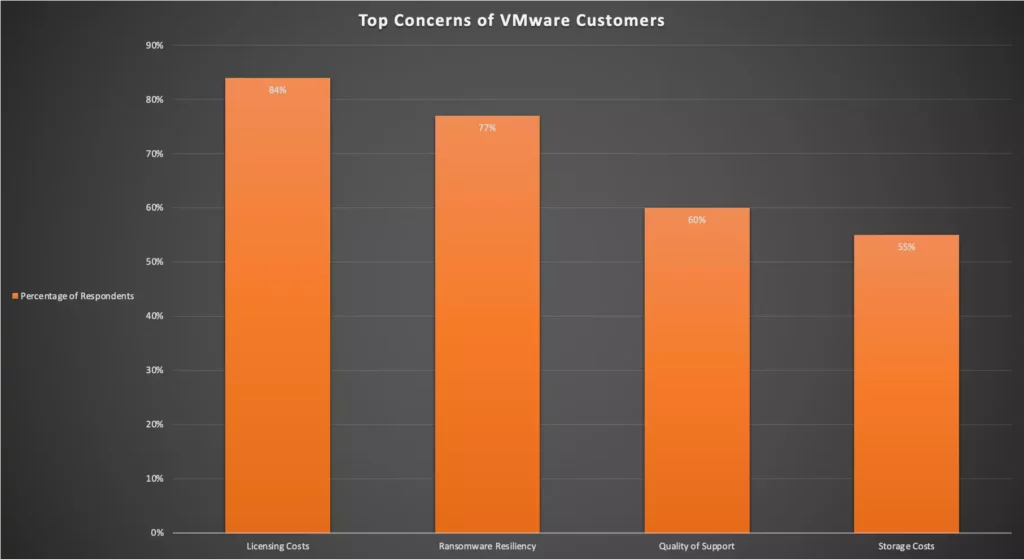
Licensing costs contribute to VMware’s total costs, but IT professionals almost always underestimate the impact of VMware’s inefficiency. They listed licensing costs as their primary concern in our recent survey. Still, other concerns, like required premature server and storage upgrades, lack of virtual machine density, and continual investments in backup infrastructure, highlight its inefficiency.
VMware’s inefficiency is brought on by years of plugging holes in the product through a never-ending series of bolt-on fixes, which often increases licensing costs and requires more hardware than necessary and more IT professionals to manage an increasingly complex environment. Even if VMware were to freeze its prices or even lower them, the ripple impact of its inefficiency makes a VMware exit to a more efficient alternative platform a wise strategy.
Understanding the Layers of Data Center Infrastructure
Most vendors divide the data center infrastructure into three layers. A hypervisor like VMware ESXi virtualizes the compute layer. A storage layer that in most medium to large-sized data centers is a dedicated storage array because of the shortcomings of virtualized storage products like VMware’s vSAN, and a networking layer that is built using proprietary networking hardware because of the expense of software-defined networking solutions like VMware’s NSX.
While it isn’t forgotten about, there is a fourth layer that is, for some reason, not included in the typical infrastructure discussion: backup and disaster recovery. In theory, with the right hypervisor software and storage capabilities, there should be no need for this to be a separate layer. Still, because of shortcomings, most organizations invest a large part of the IT budget into it.
The Impact of VMware’s Inefficient HCI
VMware started as a server virtualization and consolidation solution. Before VMware, each application ran on a dedicated server. VMware made it so IT could safely run multiple applications on a single server as virtual machines (VM). The idea behind hyperconverged infrastructure (HCI) is to extend that concept and eliminate the need for dedicated storage arrays and network appliances by moving the software that drives these dedicated appliances onto the same set of servers that VMware was using.
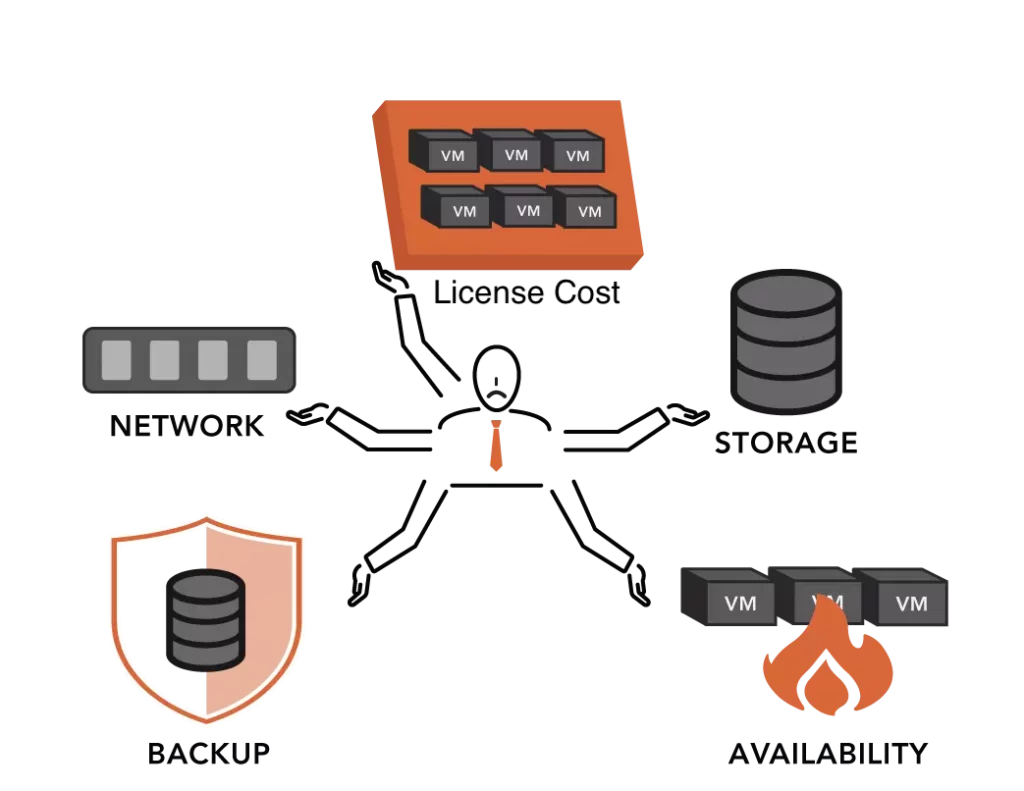
In the same way that VMware lowered costs by eliminating the need for a server for every application, HCI should lower costs by eliminating the need for a dedicated set of appliances for every aspect of storage and networking. The impact of VMware’s inefficiency means that most data centers have chosen not to use HCI and instead continue to use a legacy three-tier architecture. The problem is that most HCI vendors continue to use ESXi and run their storage or networking software as a virtual machine under ESXi, meaning they must navigate through the same VMware tax overhead as virtualized applications.
The result is HCI has not achieved the price advantages nor the operational simplicity that the original entrants into the market claimed. As a result, the legacy three-tier infrastructure is still the most common architecture in data centers.
HCI’s Inefficient Networking Problem
HCI also has an east-west inter-node network issue since storage and network operations must coordinate separately across all the cluster servers. Since each of these services is separate from the hypervisor, it triples the amount of inter-node communication, which limits scalability.
Because of the impact of VMware’s inefficiency, HCI networking limitations go beyond east-west traffic issues. In most cases, HCI vendors offer almost no additional network functionality besides what is embedded into the hypervisor. Or, in the case of VMware’s NSX, which is reasonably robust, it is not included as part of the hypervisor, and the add-on cost significantly increases the VMware license cost. In a recent blog, VMware suggested the best way to overcome its ransomware vulnerabilities was to deploy NSX, which, not coincidentally, almost triples the cost of the license.
VergeOS Eliminates the Layers
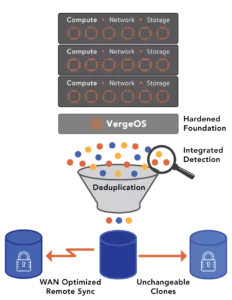
VergeIO is Ultraconverged Infrastructure; instead of re-creating the data center layers in software, VergeOS unifies them, including secure data protection, into a single code base that dramatically increases efficiency. Its efficiency lowers costs, enabling IT to do more with its existing resources while simplifying operations. Most customers can reduce physical server demand by 30% or more, which means running existing servers longer and ordering new servers less frequently.
VergeOS provides complete Layer 2 and Layer 3 network functionality, eliminating the concerns over east-west traffic contention and the need for separate network appliances. It also eases administration as network management becomes a seamless part of the data center infrastructure.

The Impact of VMware’s Inefficient Storage
Most HCI vendors are storage vendors in disguise. They make a storage software solution that can run as a VM within a hypervisor, typically VMware. These solutions, including vSAN, suffer from performance issues, partly because of vendors’ VMware performance tax and odd development choices.
Like HCI in general, storage, specifically in this architecture, should deliver rather significant cost savings and deliver better performance with the right architecture design. IT should be able to add capacity to their existing servers for a fraction of the cost of a “shelf upgrade” using a dedicated storage array. However, the impact of VMware’s inefficiency is felt most severely when HCI tries to provide storage performance and services comparable to a dedicated storage array.
In the survey above, we spoke to a customer looking to add about 300TBs of storage to their three-year-old All-Flash Array. HCI, if it had an efficient storage capability, should eliminate the AFA from consideration because the customer had several servers with twelve or more available storage expansion bays.
A 15.36TB NVMe SSD can be easily had for about $1,500. That means the customer can get 300TB of raw NVMe capacity, delivering well over one million IOPS for about $30,000, and insert them into the empty drive bays in their existing servers. When asked what it would cost to add 300TB of raw capacity to their Pure Storage array, they said at least 10X that cost.
As you can see, storage should be the area where HCI enjoys a significant price advantage, but again, like in other areas, it falls short:
- Since most HCI vendors are storage vendors, charging by the amount of capacity in use, the cost to add storage to HCI quickly rivals that of dedicated storage arrays.
- Most HCI solutions can’t add storage to available drive bays on just a few servers in the HCI instance. The capacity must be added to all the servers, or the customer must buy additional servers that match those in place.
- HCI inefficiencies mean the solutions can’t reach anything close to the performance potential of NVMe flash drives.
- Using storage services like deduplication, data protection, and snapshot retention times, further impacts storage and compute performance.
As an example of how storage services impact HCI’s efficiency, look no further than deduplication. While most HCI solutions support deduplication for capacity efficiency, in most cases, it is a bolt-on solution and not part of the original code base. VMware vSAN, for example, added deduplication years after it first appeared on the market. Nutanix’s deduplication appeared almost a decade after the product first shipped.
As a result, using deduplication from these vendors typically requires the addition of more powerful processors, additional memory, and, in some cases, changes to data protection strategies.
Limitations and compromises are the impact of implementing almost any storage feature as part of a virtualized environment:
- Snapshots are limited to 32 total, and the best practice is not to have a snapshot that is older than a few days.
- Data protection from media failure is complex and takes an undue toll on inter-node connectivity.
- Replication for disaster recovery almost always requires a separate product.
VergeOS Supercharges HCI Storage Performance
Storage services are built into VergeOS and run as an equal citizen to the hypervisor instead of a subservient VM. Storage capacity can be inserted into nodes “post-facto” or storage-mostly nodes (a couple of processors and storage) can be added to the existing instance.
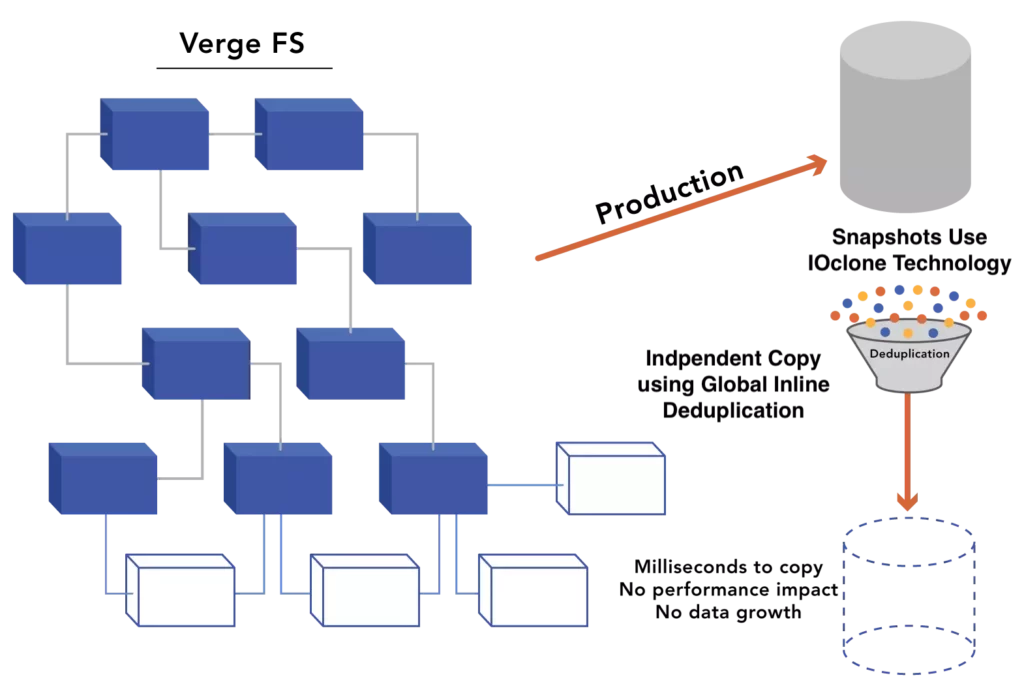
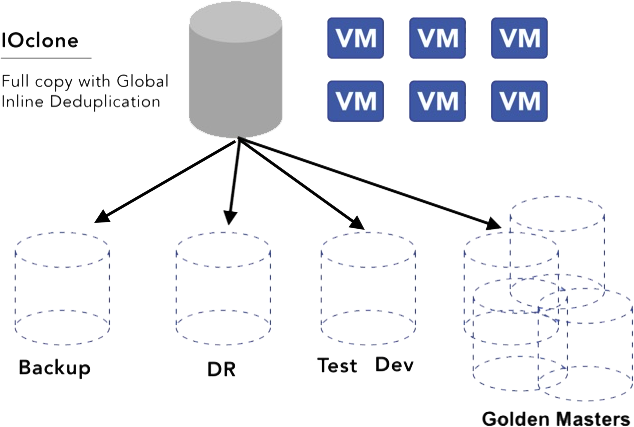
VergeOS provides a complete suite of storage services like deduplication, replication, and unlimited snapshots that can act as backups because they are more like clones, than traditional snapshot technology. Because storage is an equal citizen in VergeOS, our storage software is equally efficient and overcomes the challenges IT faces with VMware’s inefficient approach to storage. All these services can run without impacting performance, limiting their use, or forcing IT to make compromises elsewhere.
It is essential to highlight the VergeIO common sense licensing model. VergeOS is licensed by the physical server, not the number of processors, cores, amount of RAM, or storage capacity. In the above example, the customer can add 300TB of capacity with zero additional licensing charge.
The Impact of VMware’s Inefficient Data Protection
VMware also provides a very inefficient means of data protection, forcing all customers to create a separate backup and disaster recovery infrastructure. While it has basic protection from media failure and the ability, at an extra cost, to migrate VMs if a physical server fails, its snapshot capabilities are anemic at best. And their own best practices state, “Do not use VMware snapshots as backups.” For the most part, VMware’s snapshots are only used one at a time to provide data to a backup application and then quickly removed for fear of negative performance impact.
As a result, most customers implement separate backup software, which sends data to a separate backup storage area, which then must send it to another immutable backup storage area to protect against ransomware. These customers typically have a separate disaster recovery (DR) solution replicating data to a DR site. VMware’s inability to adequately protect itself is the cause of all of this additional investment in data protection.
The backup and recovery infrastructure becomes a separate cost and management point, often requiring specialized IT personnel. However, this additional investment does more than add to the total cost of VMware’s inefficiency. It complicates other tasks, such as patch upgrades.
For example, in our survey, we spoke to a VMware customer using HPE Zerto as a more powerful disaster recovery tool because of concerns about VMware’s ransomware vulnerabilities. There is an obvious cost concern with Zerto, but this customer’s current experience highlights a concern with the bolt-on approach caused by VMware’s inefficient approach to data protection.
In this case, the customer had a critical patch from VMware that closed a vulnerability in ESXi to a known ransomware exploit. However, they found that Zerto was not yet compatible with this latest release of VMware, and it would be at least three months before they were. The use of bolt-on technologies forces the customer into an awkward position. Do they deploy the VMware update and go without disaster recovery for three months, or do they keep disaster recovery working but put the organization at risk for a known ransomware exploit? While this situation does not increase the customer’s hard cost, the impact of VMware’s inefficiency certainly increases their mental overhead and anguish.
VergeOS is Secure and Resilient
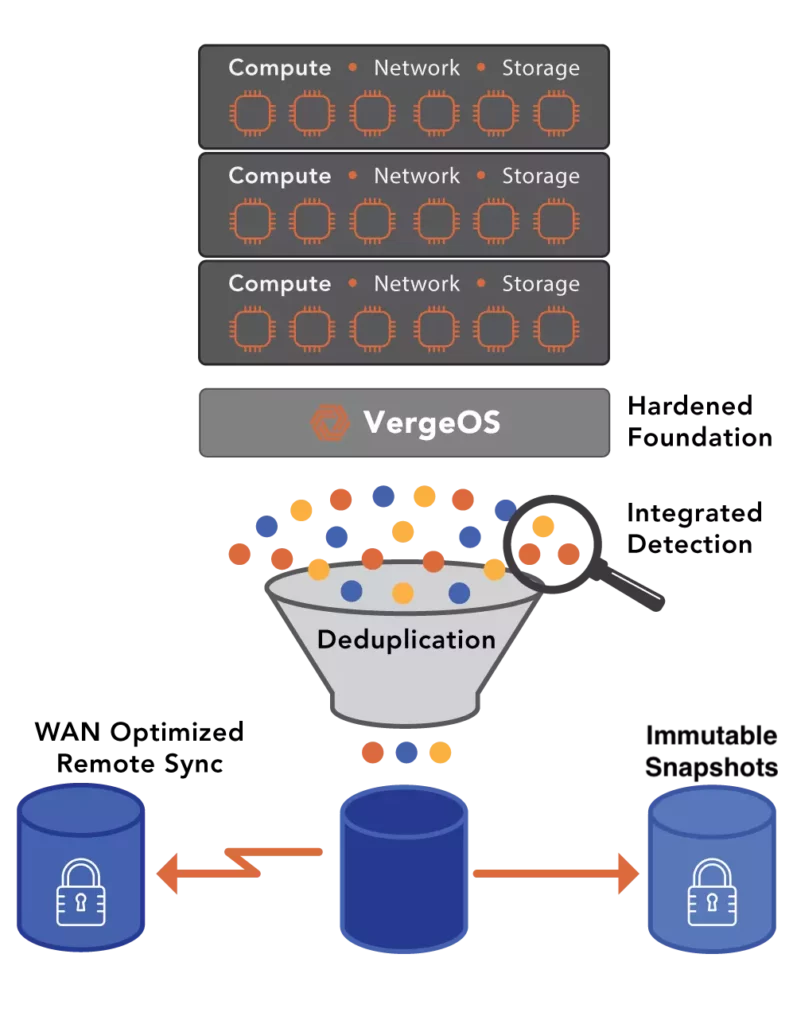
Unlike VMware’s inefficient ransomware protection, VergeOS was built from the start to be a secure infrastructure software. The OS itself is hardened against attack. When combined with virtual data centers, immutable snapshots, and rapid alerting of encryption activity, customers can bounce back from ransomware threats in minutes with no data loss.
Conclusion
While licensing costs are a valid concern, the total cost of VMware’s inefficiency goes well beyond the surface. Inefficient HCI, storage, and data protection layers contribute significantly to operational complexity and expenses. VergeIO’s innovative approach with VergeOS offers a comprehensive solution that eliminates these inefficiencies, reducing costs, and simplifying operations. As data centers evolve, it’s essential to consider alternatives that optimize efficiency and empower IT professionals to do more with existing resources.
To learn more about how VergeOS can revolutionize your data center, watch our on-demand webinar as we discuss the results of our survey of almost 200 VMware customers and provide a live demonstration of VergeOS recovering from a ransomware attack.