• Skip to main content
  • Architecture
    • Overview
      Learn about VergeOS’ unique unfied architecture that integrates virtualization, storage, networking, AI, backup and DR into a single data center operating system
    • Infrastructure Wide Deduplication
      VergeOS transforms deduplication from a storage-only commodity into a native, infrastructure-wide capability that spans storage, virtualization, and networking, eliminating hidden resource taxes
    • VergeFS
      VergeFS is a distributed, high-performance global file system integrated into VergeOS, unifying storage across nodes, tiers, and workloads while eliminating the need for external SANs
    • VergeFabric
      VergeFabric is VergeOS’s integrated virtual networking layer, delivering high-speed, low-latency communication across nodes while eliminating the complexity of traditional network configurations.
    • Infrastructure Automation
      VergeOS integrates Packer, Terraform, and Ansible to deliver an end-to-end automation pipeline that eliminates infrastructure drift and enables predictable, scalable deployments.
    • VergeIQ
      Unlock secure, on-premises generative AI—natively integrated into VergeOS. With VergeIQ, your enterprise gains private AI capabilities without the complexity, cloud dependency, or token-based pricing.
  • Features
    • Virtual Data Centers
      A VergeOS Virtual Data Center (VDC) is a fully isolated, self-contained environment within a single VergeOS instance that includes its own compute, storage, networking, and management controls
    • High Availability
      VergeOS provides a unified, easy-to-manage infrastructure that ensures continuous high availability through automated failover, storage efficiency, clone-like snapshots, and simplified disaster recovery
    • ioClone
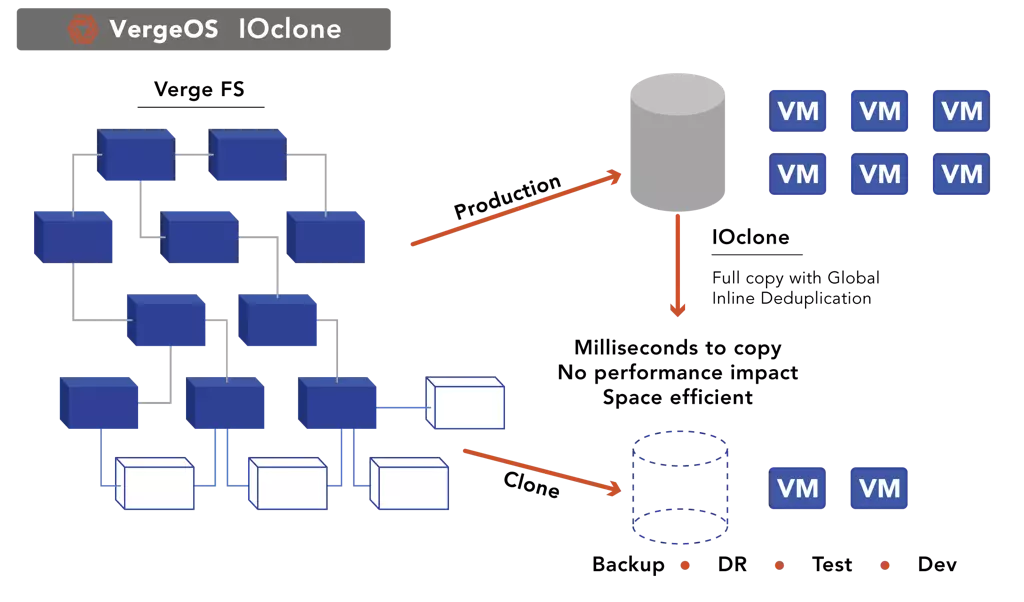
      ioClone utilizes global inline deduplication and a blockchain-inspired file system within VergeFS to create instant, independent, space-efficient, and immutable snapshots of individual VMs, volumes, or entire virtual data centers.
    • ioReplicate
      ioReplicate is a unified disaster-recovery solution that enables simple, cost-efficient DR testing and failover via three‑click recovery of entire Virtual Data Centers—including VMs, networking, and storage.
    • ioFortify
      ioFortify creates immutable, restorable VDC checkpoints and provides proactive ransomware detection with instant alerts for rapid recovery and response.
    • ioMigrate
      ioMigrate enables large-scale VMware migrations, automating the rehosting of hundreds of VMs (including networking settings) in seconds with minimal downtime by seamlessly transitioning entire VMware environments onto existing hardware stacks.
    • ioProtect
      ioProtect offers near-real-time replication of VMware VMs—including data, network, and compute configurations—to a remote disaster‑recovery site on existing hardware, slashing DR costs by over 60% while supporting seamless failover and testing in an efficient, turnkey VergeOS Infrastructure.
    • ioOptimize
      ioOptimize leverages AI and machine learning to seamlessly integrate new and old hardware and automatically migrate workloads from aging or failing servers.
    • ioGuardian
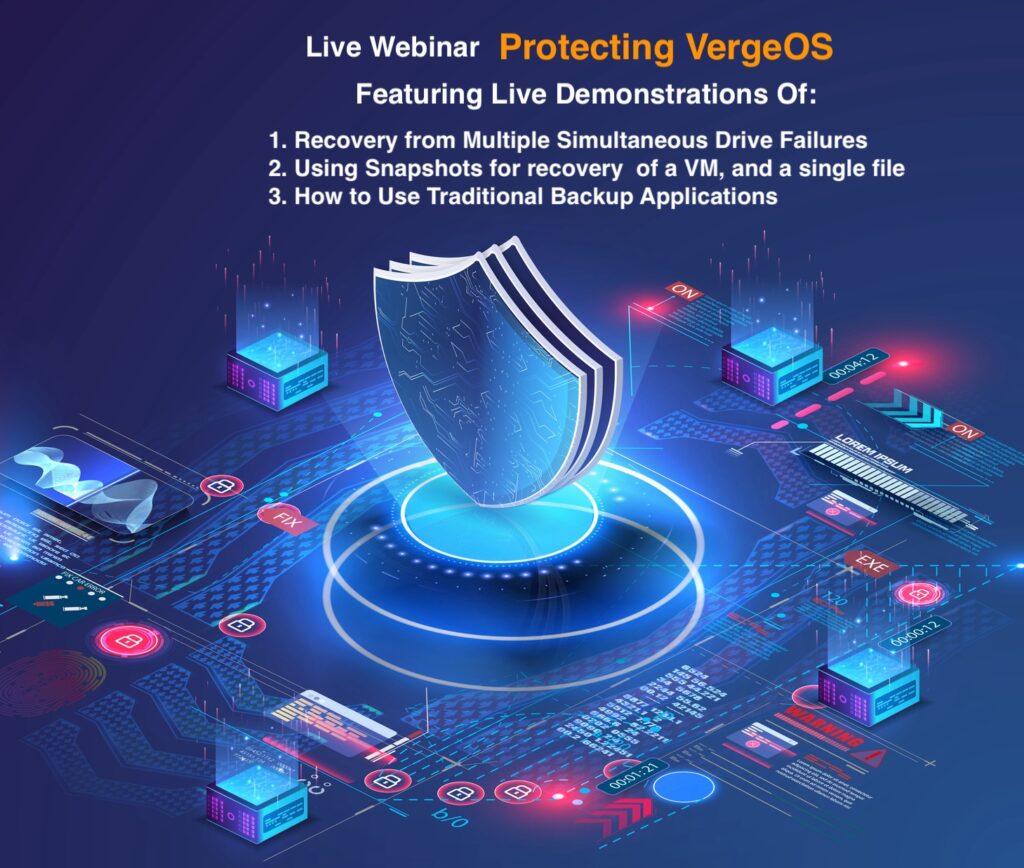
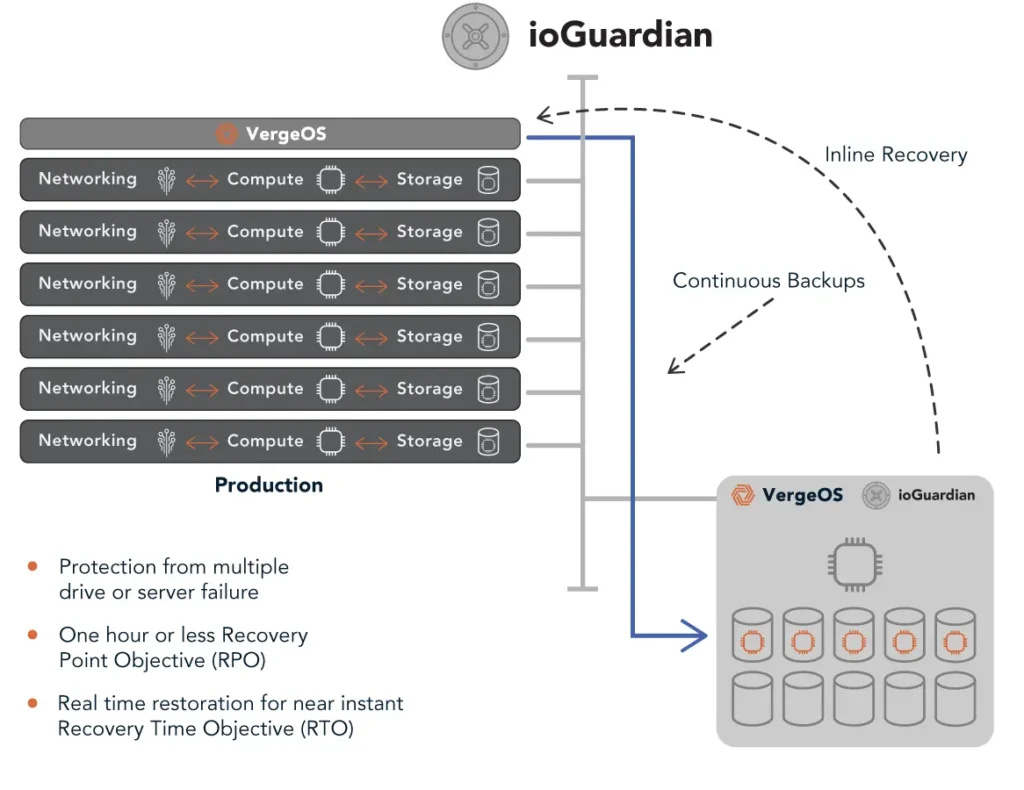
      ioGuardian is VergeIO’s built-in data protection and recovery capability, providing near-continuous backup and rapid VM recovery during multiple simultaneous drive or server failures.
  • IT Initiatives
    • VMware Alternative
      VergeOS offers seamless migration from VMware, enhancing performance and scalability by consolidating virtualization, storage, and networking into a single, efficient platform.
    • Hyperconverged Alternative
      VergeIO’s page introduces ultraconverged infrastructure (UCI) via VergeOS, which overcomes HCI limitations by supporting external storage, scaling compute and storage independently, using existing hardware, simplifying provisioning, boosting resiliency, and cutting licensing costs.
    • SAN Replacement / Storage Refresh
      VergeIO’s storage by replacing aging SAN/NAS systems within its ultraconverged infrastructure, enhancing security, scalability, and affordability.
    • Infrastructure Modernization
      Legacy infrastructure is fragmented, complex, and costly, built from disconnected components. VergeOS unifies virtualization, storage, networking, data protection, and AI into one platform, simplifying operations and reducing expenses.
    • Virtual Desktop Infrastructure (VDI)
      VergeOS for VDI delivers a faster, more affordable, and easier-to-manage alternative to traditional VDI setups—offering organizations the ability to scale securely with reduced overhead
    • Secure Research Computing
      VergeIO's Secure Research Computing solution combines speed, isolation, compliance, scalability, and resilience in a cohesive platform. It’s ideal for institutions needing segmented, compliant compute environments that are easy to deploy, manage, and recover.
    • Venues, Remote Offices, and Edge
      VergeOS delivers resiliency and centralized management across Edge, ROBO, and Venue environments. With one platform, IT can keep remote sites independent while managing them all from a single pane of glass.
  • Blog
      • VxRail Alternatives and VMware ExitsDell directs VxRail customers toward Dell Private Cloud, which reintroduces infrastructure complexity by requiring new servers and external storage arrays. VergeOS runs on existing VxRail hardware, consolidating VMware, vSAN, and networking into a single unified platform without requiring hardware replacement or storage migration projects.
      • Midsize Data Center AutomationMidsize data center automation delivers higher ROI than enterprise implementations but faces sustainability challenges. Small IT teams need automation more than large organizations, but struggle when infrastructure fragmentation forces constant code maintenance. Unified infrastructure makes automation durable by abstracting hardware complexity, enabling resource-constrained teams to sustain automated operations in the long term.
      • In-Place VMware ExitsVergeOS separates the VMware exit from the hardware refresh. Organizations keep their existing servers, add off-the-shelf SSDs, and migrate workloads incrementally. Licensing costs drop 65%. Storage costs drop 80%. Migration completes in weeks, not months. No forklift required.
    • View All Posts
  • Resources
    • Become a Partner
      Get repeatable sales and a platform built to simplify your customers’ infrastructure.
    • Technology Partners
      Learn about our technology and service partners who deliver VergeOS-powered solutions for cloud, VDI, and modern IT workloads.
    • White Papers
      Explore VergeIO’s white papers for practical insights on modernizing infrastructure. Each paper is written for IT pros who value clarity, performance, and ROI.
    • In The News
      See how VergeIO is making headlines as the leading VMware alternative. Industry analysts, press, and partners highlight our impact on modern infrastructure.
    • Press Releases
      Get the latest VergeOS press releases for news on product updates, customer wins, and strategic partnerships.
    • Case Studies
      See how organizations like yours replaced VMware, cut costs, and simplified IT with VergeOS. Real results, real environments—no fluff.
    • Webinars
      Explore VergeIO’s on-demand webinars to get straight-to-the-point demos and real-world infrastructure insights.
    • Documents
      Get quick, no-nonsense overviews of VergeOS capabilities with our datasheets—covering features, benefits, and technical specs in one place.
    • Videos
      Watch VergeIO videos for fast, focused walkthroughs of VergeOS features, customer success, and VMware migration strategies.
    • Technical Documentation
      Access in-depth VergeOS technical guides, configuration details, and step-by-step instructions for IT pros.
  • How to Buy
    • Schedule a Demo
      Seeing is beleiving, set up a call with one of our technical architects and see VergeOS in action.
    • Versions
      Discover VergeOS’s streamlined pricing and flexible deployment options—whether you bring your own hardware, choose a certified appliance, or run it on bare metal in the cloud.
    • Test Drive – No Hardware Required
      Explore VergeOS with VergeIO’s hands-on labs and gain real-world experience in VMware migration and data center resiliency—no hardware required
  • Company
    • About VergeIO
      Learn who we are, what drives us, and why IT leaders trust VergeIO to modernize and simplify infrastructure.
    • Support
      Get fast, expert help from VergeIO’s support team—focused on keeping your infrastructure running smoothly.
    • Careers
      Join VergeIO and help reshape the future of IT infrastructure. Explore open roles and growth opportunities.
  • 855-855-8300
  • Contact
  • Search
  • 855-855-8300
  • Contact
  • Search
  • Architecture
    • Overview
    • VergeFS
    • VergeFabric
    • Infrastructure Automation
    • VergeIQ
  • Features
    • Virtual Data Centers
    • High Availability
    • ioClone
    • ioReplicate
    • ioFortify
    • ioMigrate
    • ioProtect
    • ioOptimize
    • ioGuardian
  • IT Initiatives
    • VMware Alternative
    • Hyperconverged Alternative
    • SAN Replacement / Storage Refresh
    • Infrastructure Modernization
    • Virtual Desktop Infrastructure (VDI)
    • Secure Research Computing
    • Venues, Remote Offices, and Edge
  • Blog
  • Resources
    • Become a Partner
    • Technology Partners
    • White Papers
    • In The News
    • Press Releases
    • Case Studies
    • Webinars
    • Documents
    • Videos
    • Technical Documentation
  • How to Buy
    • Schedule a Demo
    • Versions
    • Test Drive – No Hardware Required
  • Company
    • About VergeIO
    • Support
    • Careers
×
  • Architecture
    • Overview
    • VergeFS
    • VergeFabric
    • Infrastructure Automation
    • VergeIQ
  • Features
    • Virtual Data Centers
    • High Availability
    • ioClone
    • ioReplicate
    • ioFortify
    • ioMigrate
    • ioProtect
    • ioOptimize
    • ioGuardian
  • IT Initiatives
    • VMware Alternative
    • Hyperconverged Alternative
    • SAN Replacement / Storage Refresh
    • Infrastructure Modernization
    • Virtual Desktop Infrastructure (VDI)
    • Secure Research Computing
    • Venues, Remote Offices, and Edge
  • Blog
  • Resources
    • Become a Partner
    • Technology Partners
    • White Papers
    • In The News
    • Press Releases
    • Case Studies
    • Webinars
    • Documents
    • Videos
    • Technical Documentation
  • How to Buy
    • Schedule a Demo
    • Versions
    • Test Drive – No Hardware Required
  • Company
    • About VergeIO
    • Support
    • Careers

George Crump

July 16, 2024 by George Crump

[Ann Arbor, MI] — [July 16th, 2024] — VergeIO, a leading innovator in data center infrastructure solutions, today announced the launch of its new Value-Added Reseller (VAR) program designed to empower IT resellers with a superior product, seamless migration capabilities, financial incentives, technical assurance, and an optimized sales process. This strategic initiative positions VARs to effectively guide their customers through the post-VMware landscape.

Yan Ness, CEO of VergeIO, stated, “VARs need a better partner. In an industry of constant change, aligning with VergeIO sets VARs apart. Our new program equips VARs with the essential tools and support to offer their customers a dependable, cost-effective alternative to VMware. With superior performance and enhanced resilience to hardware failure, VergeIO ensures customer satisfaction and long-term success.”

Key Benefits of the VergeIO VAR Program:

  • Seamless Transition and Financial Incentives:  VARs can smoothly transition their customers from VMware with strong financial incentives, creating a win-win scenario for all stakeholders.
  • Rock-Solid Software for Technical Assurance: Maintain Trusted Advisor Status by recommending VergeOS—a reliable solution that is easy to install and operate, ensuring consistent performance and dependability.
  • No-Sweat Proof of Concept (POC):  Help customers quickly start their evaluations. VergeOS operates on almost any available server hardware, reducing the need for new investments and accelerating the decision-making process.
  • Guaranteed Customer Satisfaction: VergeIO ensures comprehensive support with real human interactions, providing dedicated assistance to resolve issues efficiently and effectively rather than relying on impersonal log file exchanges.

Partner Portal and Marketing Support

The new partner portal offers extensive training and sales support, including a complete marketing kit to help VARs establish a VMware Alternative Practice. This allows VARs to position themselves as consultative experts, confidently and easily guiding their clients through the transition.

With VergeIO, there is no technical risk. VARs can confidently recommend VergeOS, knowing their customers will benefit from a reliable, well-supported solution that enhances data center infrastructure.

About VergeIO:  

VergeIO is the leading VMware Alternative. Unlike hyperconverged infrastructure (HCI), its ultraconverged infrastructure (UCI) collapses the traditional IT stack (computing, storage, and networking) into an integrated data center operating environment, VergeOS. Its efficiency enables greater workload density using existing hardware while improving data resiliency. The result is dramatically lower costs, improved availability, and greatly simplified IT.

For more information about VergeIO’s VAR program, visit [VergeIO Partners – VergeIO ] or contact partners@VergeIO. Also, VergeIO is hosting a special training session this week to help VARs transition customers off VMware. Register here.

Media Contact:

Judy Smith, JPR Communications
818-522-9673
[email protected]

Filed Under: Press Release

July 9, 2024 by George Crump

Many IT professionals are considering alternatives to VMware to reduce licensing costs, but the sustainability benefits of efficient infrastructure software as it replaces VMware should not be overlooked. Infrastructure software that integrates storage services, server virtualization, and network services into a single code base can improve power and cooling costs, as well as resource utilization, to enable organizations to meet sustainability goals.

the sustainability benefits of efficient infrastructure software

By requiring less CPU overhead, these solutions can significantly increase processor efficiency, which enables more virtual machines (VMs) per server, thereby reducing the number of physical servers required. It also extends the operational life of servers. These benefits contribute to environmental sustainability and cost efficiency. An efficient infrastructure software solution can also eliminate vendor lock-in, ensure long-term hardware flexibility, replace dedicated all-flash storage arrays with server-class SSDs, and incorporate backup best practices into the core infrastructure software. Additionally, solutions can reduce power, cooling, data center footprint, and server acquisition costs.

Enhancing Server Performance and Reducing Physical Server Count

Integrating storage, virtualization, and network services into a unified software package can improve server performance. Such software can handle more workloads with fewer physical servers by optimizing resource allocation and management. This reduction in physical infrastructure leads to several sustainability benefits:

  1. Lower Energy Consumption: Fewer servers mean reduced energy requirements for operation and cooling, directly lowering the data center’s carbon footprint.
  2. Reduced E-Waste: Minimizing the number of physical servers significantly decreases the amount of electronic waste generated from obsolete hardware.
  3. Cost Savings: Lower energy consumption and reduced hardware needs translate to substantial cost savings in capital and operational expenditures.

Elimination of Vendor Lock-In with Efficient Infrastructure Software

Vendor lock-in has long been a challenge in enterprise IT environments, and it impacts the sustainability benefits of efficient infrastructure software. Traditional infrastructure solutions bind organizations to specific hardware vendors, limiting flexibility and driving up costs. An efficient infrastructure software solution mitigates this issue by providing hardware-agnostic capabilities:

  1. Freedom of Choice: Organizations can choose hardware based on performance, cost, and sustainability criteria rather than being constrained by vendor compatibility.
  2. Competitive Pricing: The ability to mix and match hardware from different vendors fosters a competitive market, driving down prices and encouraging innovation.
  3. Sustainability Through Longevity: Hardware-agnostic software can support older servers, extending their useful life and reducing the need for frequent hardware replacements.

Efficient Infrastructure Software Delivers Long-Term Hardware Flexibility

One of the significant sustainability benefits of an efficient infrastructure software solution is its support for long-term hardware flexibility. This capability allows organizations to extend the operational life of their servers well beyond the original warranties:

  1. Extended Lifespan: With the correct software optimizations, servers can remain functional and efficient for many years, delaying the need for new hardware.
  2. Reduced Resource Consumption: By prolonging the life of existing hardware, the demand for raw materials and energy associated with manufacturing new servers is minimized.
  3. Economic Efficiency: Extending hardware lifespan translates to reduced capital expenditure on new equipment and better return on investment for existing assets.

However, as servers age, the risk of hardware failure increases. To mitigate this risk, built-in server redundancy and seamless failover capabilities are essential. Efficient infrastructure software should include these features to ensure continuous operation if an older server fails. This built-in redundancy allows workloads to be automatically transferred to functioning servers without disruption, maintaining high availability and reliability. Such resilience ensures that the extended use of older hardware does not compromise the overall stability and performance of the IT environment.

Eliminating Dedicated All-Flash Storage Arrays

Traditional data centers rely on dedicated all-flash storage arrays to meet high-performance processing and storage demands. However, this approach can be resource-intensive and costly. By integrating storage services directly into the server infrastructure and utilizing server-class SSDs, organizations can achieve comparable, if not superior, performance with greater efficiency:

  1. Cost Efficiency: Server-class SSDs are typically more cost-effective than dedicated all-flash storage arrays, reducing initial investment and ongoing maintenance costs.
  2. Improved Resource Utilization: Integrating storage into server infrastructure optimizes the use of existing resources, enhancing overall efficiency.
  3. Environmental Impact: The production of server-class SSDs generally requires fewer resources than all-flash storage arrays, contributing to a smaller environmental footprint.
  4. Elimination of Separate Network Infrastructure: Efficient infrastructure software eliminates the need for a separate network infrastructure dedicated solely to storage traffic, such as Fibre Channel or iSCSI. By consolidating storage traffic over existing Ethernet networks, organizations can reduce complexity, lower costs, and decrease the physical footprint of networking hardware. This simplification also reduces power and cooling requirements, further enhancing the sustainability of the IT environment.

Integrating Backup Best Practices Into Efficient Infrastructure Software

Incorporating backup and data protection best practices directly into the core infrastructure software eliminates the need for separate data protection architectures. This integration offers several sustainability and efficiency benefits:

  1. Simplified Management: A unified approach to data protection streamlines management processes, reducing the need for additional hardware and administrative overhead.
  2. Enhanced Resiliency: Integrated backup solutions ensure that data is consistently protected and readily recoverable, minimizing downtime and data loss.
  3. Resource Optimization: By leveraging existing infrastructure for backup purposes, organizations can avoid the additional energy and material costs associated with dedicated backup systems.
  4. Elimination of Separate Storage Systems and Servers: The integration of the data protection architecture eliminates the need for separate storage systems to store backup data and separate servers to run the backup software. This consolidation reduces the overall hardware footprint, significantly saving space, power, and cooling costs.

The Requirements of Efficient Infrastructure Software

the sustainability benefits of efficient infrastructure software

Efficient infrastructure software must meet several essential requirements to support modern data centers effectively while promoting sustainability and cost-efficiency. These requirements include integrating essential components, multi-tenancy capabilities, data resiliency, high availability, and scalability.

  • Integration of Major Components: The software must integrate the three major components of the data center—storage services, virtualization software, and networking services—into a single piece of software.
  • Integrated Multi-Tenancy: The software should provide integrated multi-tenancy to eliminate the noisy neighbor problem and ensure fair resource distribution among different workloads.
  • Data Resiliency and High Availability It should integrate data resiliency and high-availability features for servers to protect against hardware failures and ensure continuous operation.
  • Scalability: The software must scale from as few as two servers to hundreds of servers, allowing it to meet a wide range of use cases from Remote Office/Branch Office (ROBO) setups all the way up to large Enterprise environments.

Conclusion

Verge.io’s VergeOS meets all the requirements for efficient infrastructure software and delivers on the sustainability benefits discussed. VergeOS integrates storage services, server virtualization, and networking services into a single, cohesive platform, ensuring seamless operation and high performance. Its built-in multi-tenancy eliminates the noisy neighbor problem, and its data resiliency and high-availability features protect against hardware failures.

In addition to these technical advantages, VergeOS offers significant cost savings. Its licensing model is per server instead of per core, enabling customers to purchase fewer, more CPU-dense servers. This approach reduces licensing costs and lowers the overall number of servers required, enhancing sustainability by reducing energy consumption and electronic waste. VergeOS is also software-based, which means you can use your existing hardware or purchase new servers from the vendor of your choice.

Organizations adopting VergeOS can achieve all the sustainability benefits while enjoying upfront savings compared to VMware. VergeOS’s ability to scale from two servers to 200 makes it versatile for various use cases, from small remote offices to large enterprise environments. By choosing VergeOS, organizations can meet their environmental goals and achieve long-term operational success.

Filed Under: Private Cloud Tagged With: HCI, IT infrastructure

June 26, 2024 by George Crump

There are best practices that on-premises IT can learn from MSPs to streamline operations, improve responsiveness, and enhance efficiency simply by applying them. Managed Service Providers (MSPs) and Cloud Service Providers are adept at navigating a rapidly evolving technological landscape, under constant pressure to lower costs. They excel in efficiency, scalability, and security across numerous customers while focusing on cost management, data resiliency, and disaster recovery.

Live Interview and Demo Thursday, June 27th at 1:00 PM ET / 10:00 AM PT – Register Now!

Modernized infrastructure software is critical in enabling MSPs and On-Premises IT to meet these challenges. Modernized infrastructure software combines virtualization services delivered via a hypervisor, storage services, networking services, and cloud services like multi-tenancy.

Applying MSP/CSP Best Practices for Server Longevity

While MSPs/CSPs provide infrastructure to their customers on a subscription basis, they, in most cases, must pay for the hardware upfront. The longer they can extract useful life from that hardware, the better the return on its investment. Maximizing hardware longevity requires infrastructure software with low overhead that leaves more of the available compute resources for customer virtual machines (VMs). It also requires software abstracted from the hardware so that it does not have to remove support for specific hardware configurations as they age and the software advances. Nothing is more frustrating and wasteful than having hardware idle because the software no longer supports it.

In terms of resiliency, the infrastructure software must move beyond no single point of failure, to multiple points of redundancy. Aging hardware is more likely to fail than new hardware; also, maintaining aging hardware under a service contract is more expensive. The infrastructure software should deliver such high levels of redundancy and availability that older servers can run until they fail, and when they fail, there is minimal disruption to operations. This capability also requires the software to be able to mix servers within the infrastructure from different server brands, processor generations, and storage configurations.

On-Premises Server Longevity

On-premises IT can learn from MSPs and use a similar strategy. In these data centers, there are often more than enough computing resources, and the only reason for a server refresh is to maintain warranty coverage. Suppose the infrastructure software can enable these servers to operate safely and with support beyond their original warranty. In that case, the on-premises IT operator can meet the challenge of flat or shrinking IT budgets. If the infrastructure software can also support the intermixing of new and old servers on-premises, IT can gradually add servers to the infrastructure, finally ending the never-ending cycle of storage refreshes and mass migrations.

VergeOS Extends The Life of Servers

VergeOS is unique in infrastructure software. Instead of creating an “IT stack” of loosely coupled software applications, we tightly integrated all infrastructure services into a single code base. This code base includes all the services required for infrastructure, including virtualization services, storage services, networking services, and cloud services. The integration enables VergeOS to deliver near-bare-metal CPU performance, outperform dedicated all-flash arrays, and maximize network efficiency.

VergeOS is also highly portable. It runs on your existing hardware. Its unprecedented level of abstraction from the hardware means that within the same instance, it can support servers of different brands, CPU generations, and storage media types. Six-year-old servers can run alongside six-month-old servers with operational simplicity. As a result, IT can scale its environment from two nodes to over 200 servers within a single instance, and those nodes can come from various server manufacturers with different configurations.

on-premises IT can learn from MSPs

Lastly, VergeOS is resilient. High availability is built into the software. It protects from drive and server failures, and ioGuardian extends the resiliency to withstand multiple drive failures and near-catastrophic server outages. Its Virtual Data Center (VDC) tenant technology, popular with MSPs to isolate customers, also simplifies disaster recovery for on-premises IT because it encapsulates the entire data center as a single, consistent object that makes replication and recovery at a remote site work the first time every time.

Applying MSP/CSP Best Practices for Data Center Density

Successful MSPs/CSPs face the challenge of building highly compact data centers. On-premises IT can learn from MSPs because, like them, they are always looking for ways to reduce their physical footprint, which lowers power and cooling costs. MSPs must also maximize the number of VMs per physical host without compromising performance. This requires an infrastructure software solution that doesn’t burden CPU resources, protects against the disruptive effects of ‘noisy neighbors,’ and has a licensing model that doesn’t penalize customers for investing in robust, dense, quad-processor servers. No one in IT wants to have to explain why the software is twice the price of the hardware.

On-Premises IT Density

On-premises IT operators can benefit from a similar strategy. Imagine cutting the physical server count by two-thirds. While quad-processor servers are more expensive than dual-processor servers, you will need fewer of them, so there is a significant opportunity to reduce server acquisition costs, which will lower power and cooling costs. Using highly dense servers to decrease footprint generally has two problems. First, most infrastructure software solutions are licensed by the number of cores, often making the software more expensive than the server itself.

The second problem is managing potentially double the number of VMs per physical server and protecting against the “noisy neighbor” problem. Most infrastructure software solutions are complex and limited in their ability to isolate workloads.

VergeOS Delivers Affordable Density

VergeOS solves the licensing and noisy neighbor problems. First, it is licensed by the physical host, not by the number of processors or cores. Customers can use the most potent servers without fear of a software penalty. Second, it enables on-premises IT to allocate specific physical hardware resources to specific VDCs. Mission-critical or performance-sensitive workloads could be placed in a particular VDC, and resources could be hard allocated to those VDCs and made available exclusively to those workloads.

Applying MSP/CSP Best Practices for Security

Security is a, if not the, top concern of MSPs. If, for example, ransomware sneaks its way into their environment because of a careless customer, all the customers in their environment could potentially be impacted. They must ensure they invest in capabilities to detect an attack, minimize its impact, and rapidly recover customers in the event of a ransomware detonation. MSPs are looking to move away from the multiple-point solutions they are using to protect and recover from the various attack angles. Instead, they are looking for software that takes an infrastructure-wide approach that is resilient to an attack and can aid recovery.

On-Premises IT Security

On-premises IT can learn from MSPs’ attention to security details. Ransomware protection and recovery are priorities for all organizations, not just MSPs. While the scope of the ransomware event may not be as broad, on-premises IT doesn’t have the same time, budget, or personnel available as MSPs. In addition to the MSP requirements of limiting the attack surface, detection, and recovery, simplicity must be added to the on-premises IT requirements.

VergeOS Delivers Ransomware Resiliency

Storage Features Only

VergeOS takes an infrastructure-wide approach to ransomware protection and recovery. First, it uses multi-factor authentication for all login attempts. Second, when VergeOS is installed, it is installed read-only so that it cannot be modified during an attack. When a VDC is created, a read-write copy of VergeOS is placed inside the VDC. If the OS within the VDC is ever compromised, a quick refresh of the VDC loads a new copy of VergeOS. Each VDC is firewalled off from the others, so an attack within the VDC will not spread to other VDCs. Our alert subscription technology powers our ioFortify product, and you can build an alerting mechanism that allows you to receive near real-time notifications in the event of an attack. We’ve demonstrated this capability on multiple live webinars where we’ve detected an attack within five minutes. Finally, our snapshots are read-only and protected from attack.

All of these capabilities work together to enable you to limit the spread of an attack, detect an attack quickly, and recover to the last known good snapshot prior to the attack within minutes. A typical recovery time for a VergeOS customer to successfully recover from and eliminate a ransomware attack is less than thirty minutes.

Conclusion

On-premises IT can learn from MSPs by adopting their best practices. These practices enhance efficiency, scalability, security, and cost management. Modern infrastructure software, like VergeOS, integrates virtualization, storage, networking, and cloud services, extending server longevity and supporting diverse hardware configurations while ensuring high availability and reducing the need for frequent server refreshes. This approach achieves greater data center density with efficient resource utilization and cost-effective licensing models. VergeOS enhances security with features like multi-factor authentication, read-only OS installations, and isolated Virtual Data Centers (VDCs), ensuring rapid recovery from cyber threats.

Filed Under: MSP Tagged With: Hyperconverged, MSP, ransomware

June 20, 2024 by George Crump

IT professionals considering a hypervisor alternative to reduce costs must also focus on minimizing VMware migration downtime. The requirements for reducing migration downtime extend beyond automated copying and conversion of VMware virtual machines (VMs). Essential steps for reducing VMware migration downtime include:

  1. Seamless pre-preparation of the target hypervisor
  2. Fast identification and complete copying of VMs
  3. Rapid conversion of VMs in seconds, not minutes
  4. Scalable testing of converted VMs
  5. Frequent updating of migrated VMs
  6. Extending migration to VMware DR

Seamless Pre-Preparation of the Target Hypervisor

Minimizing VMware migration downtime

The first step in minimizing VMware migration downtime is preparing the target hypervisor. This involves allocating hardware and getting the hypervisor up and running. Look for hypervisors that can run on existing hardware, particularly those that can operate on older servers that are no longer supported by VMware but are still viable.

Hypervisor vendors offering turnkey hardware and software solutions are less desirable due to added expenses. Even if they provide loaned hardware or extended terms, the duration may not suffice for thoroughly vetting their solution and completing the migration.

Fast Identification and Complete Copying of VMs

Minimizing VMware migration downtime hinges on the speed of initially seeding eligible VMs to the target hypervisor. Opt for solutions with integrated migration functions, avoiding separate or third-party applications. While transfer speeds depend on VM storage requirements and network speed, separate modules can negatively impact transfer times.

Minimizing VMware migration downtime

Ideally, the solution should log directly into vCenter and list VMs available for migration. You should be able to select which VMs to migrate individually or in groups. The migration function should use VMware’s backup APIs for the fastest possible transfer, ensuring all VM data, including configuration information, is captured.

The target hypervisor should initially maintain VMs in their VMware format without converting them on the fly, which would slow transfers. This approach provides an additional checkpoint or backup copy if something goes wrong during testing. The hypervisor should also have integrated deduplication to minimize storage capacity usage for VM backups.

Rapid Conversion of Migrated VMs

Once VM data is transferred, conversion to the new hypervisor format should be quick, taking seconds rather than minutes. During testing, the conversion time is critical. If it takes five minutes per VM, a 100 VM environment would take over eight hours to load for testing.

VergeIO has demonstrated converting VMs in seconds. For example, in the video below, we show how to convert 10 VMs in 10 seconds.

Scalable Testing of Migrated VMs

Reducing VMware migration downtime also requires scalable testing of converted VMs. Efficient and thorough testing reduces the need for frequent data reloads and surprises in production. Multi-tenancy and a robust snapshot capability are critical for creating a scalable testing environment.

With multi-tenancy in place, during conversion, IT can place all converted VMs into a tenant or create tenants by workload, department, or IT team specialty. With the robust snapshot function and deduplication integrated into the hypervisor, IT can instantly create multiple clones of each tenant without consuming capacity or impacting performance. The result is space-efficient “virtual labs” for testing purposes. Each tenant snapshot can be assigned to different teams for testing without fear of one group’s work impacting another.

Frequent Updating of Migrated VMs

Minimizing VMware migration downtime

In typical testing, IT copies a group of VMs to the alternative hypervisor, tests them for compatibility, and performs a final copy before conversion. The source VMware VM often needs to be down during this final transfer, resulting in multiple minutes, if not more, of downtime per VM, leading to hours of total outage.

Minimizing VMware migration downtime requires an alternative hypervisor solution that allows frequent updates of copied VMs via granular data transfer methods like change block tracking (CBT). CBT enables frequent updates of copied VMs, each taking only a few minutes. This approach allows IT to perform tests, verify compatibility, and finalize updates with minimal outages.

Extending VMware Migration to DR

The combination of fast initial transfers, frequent granular updates, and rapid conversion makes the alternative hypervisor an ideal VMware DR solution. VM copies are updated more frequently than typical backups, and the target environment is more robust and production-capable than typical backup storage appliances. Using the VMware alternative for DR provides value until the final cutover.

The 7-minute whiteboard session below explains how to design and use VergeOS for the VMware DR use case.

VergeOS for VMware Migration and DR

VergeOS meets all the requirements with its integrated storage, virtualization, and networking services. It runs on various server hardware, enabling IT to repurpose older hardware for staging or DR environments. VergeOS ioMigrate leverages VMware’s backup API for fast VM copying, maintaining a protected copy for testing.

VergeOS converts VMs quickly, as shown in the video, where 10 VMs are converted in 10 seconds. Its Virtual Data Center technology enables scalable testing, allowing multiple secure virtual labs to be created in seconds. ioMigrate uses VMware Backup APIs for efficient VM repository updates, making VergeOS an ideal DR solution that is better than array-based replication while testing the platform’s functionality.

Conclusion

Minimizing VMware migration downtime is crucial for IT professionals seeking cost-effective hypervisor alternatives. Achieving this requires seamless preparation of the target hypervisor, fast and complete VM copying, rapid conversion, scalable testing, and frequent updates. VergeOS addresses all these needs with its integrated ioMigrate and ioProtect capabilities, ensuring efficient and quick migration while minimizing downtime.

VergeOS offers a robust migration and disaster recovery solution, allowing organizations to repurpose existing hardware, maintain VM integrity during testing, and leverage frequent updates for smooth transitions. By adopting VergeOS, IT departments can reduce migration downtime and enhance their overall DR strategy, adding significant value to their infrastructure.

To watch a full scale test of our VMware Migration and VMware DR capabilities watch our on-demand, registration-free webinar: “Comparing VMware DR Strategies“

Filed Under: VMwareExit Tagged With: Disaster Recovery, VMware

June 18, 2024 by George Crump

BOSTON – June 18, 2024 – IT service provider Cloud Compliance Solutions, Inc. (CCSI) has upgraded its infrastructure with technology from Leostream Corporation, creator of the world-leading Leostream® Remote Desktop Access Platform, and VergeIO, the leading VMware alternative, resulting in significant cost savings, optimized hardware use, and enhanced operational efficiency, the companies announced today.

Founded in 2017, CCSI provides its clients with a complete suite of cloud-related IT and compliance services. As a single provider offering both critical services, CCSI delivers more accurate and cost-effective IT and compliance solutions that significantly reduce its clients’ operational and audit costs.

CCSI opted to replace VMware due to significant challenges, including affordability, scaling and performance for its multi-tenant platform that provides its clients Desktop as a Service (DaaS)/Next-Gen DaaS (NGDaaS), Infrastructure as a Service (IaaS) and Disaster Recovery as a Service (DRaaS). CCSI’s growth had surpassed VMware’s capabilities, and it needed an option that could support denser environments with more powerful servers. Strategically, CCSI had concerns about VMware’s new licensing costs and models that required substantial upfront commitments and the uncertain future of VMware Horizon.

The transition to VergeIO and Leostream has transformed CCSI’s service portfolio, enabling it to offer more robust and scalable services with superior DaaS/NGDaaS, IaaS and DRaaS. With CCSI competing with providers like AWS and Azure, the upgrade allows it to remain price-competitive and provide better service and support.

“VergeOSs multi-tenant virtual data center technology and Leostream’s virtual desktop platform have empowered CCSI to provide customers with fundamentally better performance and efficiency,” said Kelley Allen, CCSI CEO. “This project exemplifies CCSI’s commitment to innovation and customer satisfaction with high-quality, affordable, and reliable IT solutions.”

The phased upgrade began with DaaS/NGDaaS and Leostream for remote desktop services including resource allocation, access control, and policy enforcement. In addition to secure user profile management and support for nearly all end-user devices and display protocols,the combined solution delivered on its promise of increased performance: boot times have dropped to seconds instead of minutes.

Next, CCSI shifted its IaaS offerings to VergeIO to create multi-tenant virtual data centers (VDC), which allows customers to manage the VDC as if it were on-premises technology, with CCSI as backup IT support. While CCSI is a de-facto IT team for many customers with limited or no full-time IT staff, VergeIO’s VDC technology allows CCSI to attract new clients whose IT teams want more control over their infrastructure.

The third phase, also enabled by VergeIO, expanded and simplified CCSI’s DRaaS capability so customers with on-premises IT infrastructure can fail over to CCSI’s infrastructure in a disaster. VergeOS VDC technology seamlessly replicates all components to ensure a successful recovery in CCSI’s data center.

“When industry-leading IT experts like CCSI choose your product for their own internal use, and to deploy to customers, it is the highest possible endorsement,” said Karen Gondoly, Leostream CEO. “This joint infrastructure combining Leostream and VergeIO has been battle-tested in multiple enterprises and we believe it’s the strongest, most feature-rich alternative to VMware, ESXi, and Horizon available today.”

“CCSI’s new architecture will provide long-term cost savings, starting with reduced upfront license costs, maintaining its existing investment in hardware, and enabling more virtual machines and desktops per physical server,” said Yan Ness, CEO of VergeIO. “More importantly, this modernized desktop, infrastructure, and disaster recovery platform has expanded what the company is able to offer its own clients, to truly do more for less.”

If you’re considering a VMware exit, we have the perfect opportunity for you to talk to someone who has made the journey. CCSI is joining VergeIO and Leostream for a live conversation with IT professionals about their switch from VMware to VergeIO/Leostream software on June 27th at 1:00pm EST. Register Here.

The Leostream Remote Desktop Access Platform for hosted desktops and workstations offers a comprehensive solution for remote access to maintain productivity, control costs, and ensure security with strict authentication and authorization built on zero-trust concepts. Its connection management system eliminates clunky corporate VPNs with an ultra-efficient gateway that gives users access to only the specific resources they have permission to use, automatically, regardless of their location or device. The Leostream Platform shines even in environments that rely on complex, specialty applications like energy and science; large files such as media and entertainment; real-time performance like financial services; and bulletproof network security like government and defense.

About VergeIO

VergeIO is the leading VMware Alternative. Unlike hyperconverged infrastructure (HCI), its ultraconverged infrastructure (UCI) rotates the traditional IT stack (computing, storage, and networking) into an integrated data center operating environment, VergeOS. Its efficiency enables greater workload density using existing hardware while improving data resiliency. The result is dramatically lower costs, improved availability, and greatly simplified IT.

About Leostream
The Leostream Remote Desktop Access Platform embodies over 20 years of Leostream research and development in supporting customers with hosted desktop environments, including VDI, hybrid cloud, and high-performance display protocols. It provides the world’s most robust desktop connection management and remote access feature set, allowing today’s enterprises to choose the best-of-breed components to satisfy their complex security, cost, and flexibility needs while working with them as they evolve into tomorrow.

Leostream is a registered trademark of Leostream Corporation in the United States. All other trademarks are the property of their respective owners.

###

JPR Communications

Judy Smith

Filed Under: Press Release Tagged With: Alternative, DRaaS, HCI, IaaS, VMware

June 13, 2024 by George Crump

While VMware’s increasing licensing costs and uncertainty about product direction are concerns, MSPs need more than just a VMware Alternative to remain competitive. MSP is a broad term that covers various business models ranging from providing IT services to customers who have on-premises hardware to providing infrastructure for customers to host their applications on. Still, they all need capabilities beyond those found in the enterprise versions of VMware vSphere.

Assuming the licensing cost is a universal issue, we will break down some unique requirements for each offer that a provider may deliver and how VergeIO can help. You can also register for today’s webinar, “A VMware Alternative Designed for MSPs and CSPs.”

IT as a Service Provider Requirements

There is a group of service providers who provide IT services to customers who have on-premises hardware. The service provider may also sell the customer the hardware and software, or they may take over the support of existing solutions. They may provide all the IT services or augment existing IT staff. These customers are likely complaining about the recent changes at VMware and are asking for an alternative. However, these MSPs need more than a VMware alternative that can just lower prices. They need a solution that makes supporting dozens or even hundreds of remote customers easier.

The customers of these providers are often small to medium-sized businesses (SMBs) with only two or three servers. These customers often have minimal, if any, space allocated to be a data center. Combining functions into a single “pod” helps conserve space, minimize the chance for error, and simplify remote administration.

They may also want a solution that enables them to move beyond IT as a Service. A logical next step for many IT as a Service providers is to offer Disaster Recovery as a Service. The problem is that when using legacy solutions, DRaaS is expensive, complex to configure, and hard to execute a recovery during a disaster.

VergeIO for IT as a Service Providers

VergeIO can assist IT service provider organizations in various ways. Firstly, VergeOS offers seamless migration from VMware to VergeOS. Secondly, in numerous instances, it can utilize their customers’ existing server hardware, making the transition to the new platform effortless.

Third, and specific to IT as a service provider, VergeOS includes an integrated site manager capability. There is no extra software to buy or virtual machines to set up. Site Manager connects to the remote sites in a mesh framework, so there is no single point of management failure. Administrators can remotely login to any provider’s customers quickly and manage the entire customer environment as if they were sitting there.

MSPs need more than a VMware Alternative

Fourth, VergeOS includes storage and network services within the core software. It eliminates the need for an external, dedicated storage array. It also provides firewall, routing, and other network services, eliminating the need for and cost of these appliances. Most businesses with small data centers can use VergeOS to meet all their infrastructure needs with two or three servers.

Fifth, VergeOS’ multi-tenant virtual data center (VDC) technology sets the stage for the provider to offer disaster recovery as a service (DRaaS) capabilities. Providers can create one or multiple VDCs at their supported customer sites and then replicate those VDCs as a single object to the provider’s data center. With VDCs, it is easy to perform DR tests regularly, and successful recovery from a disaster is assured.

Infrastructure as a Service Provider Requirements

There is another group of MSPs that provide infrastructure as a service to their customers. These customers typically have little, if any, on-premises hardware and are using the provider’s data center, paying for physical resources periodically. License pricing is also a concern for these providers because it impacts the competitive pricing they can offer their customers. These MSPs also need more than a VMware alternative. First, they own the hardware, so they need infrastructure software to leverage commodity off-the-shelf hardware but outperform name-brand solutions.

These providers can also benefit from a more flexible VMware alternative. One that not only runs on existing hardware but also can mix different types of hardware so they can leverage the hardware for as long as possible. They also need an infrastructure software solution that enables them to scale quickly to onboard new customers and respond to unexpected demands from current customers.

These MSPs need more than a VMware Alternative because they are in the infrastructure business. An outage can impact dozens, if not hundreds, of customers. They need a solution that provides more than protection against a single point of failure. They need one that can provide multiple points of redundancy so that even if multiple drives or servers fail, customers do not experience extended outages.

They can benefit from having the same multi-tenancy features previously described above. Multi-tenancy enables them to share the same hardware across multiple customers while ensuring data isolation. It enables them to meet the unique needs of each customer without having to create hardware silos based on the use case.

VergeIO for Infrastructure as a Service Providers

These MSPs need more than a VMware alternative as well, and VergeIO delivers. The VergeOS software delivers greater efficiency than VMware. Using the same hardware, most customers report more than 25% better compute efficiency and storage performance. This efficiency breathes new life into the existing hardware investment, enabling the provider to support more customers without buying more hardware.

As these providers scale, they benefit from VergeOS’ hardware flexibility. They can add servers from different vendors, different generations of CPUs and different storage configurations, all within the same VergeOS instance. Our service-based licensing is particularly attractive for these providers, enabling them to expand using very dense, high CPU and core count server configurations without software licensing penalty.

MSPs need more than a VMware Alternative

For Infrastructure as a Service Providers, outages are particularly painful because of the number of customers they can impact. While most infrastructure software includes basic protection from hardware failure, resiliency is often limited to one or two drives or one or two servers. The software can automatically transition and load balance the movement of virtual machines to other nodes in the cluster to maintain the best possible performance profile. VergeOS extends beyond providing protection against a single point of failure to delivering multiple points of redundancy with ioGuardian. It provides real-time, inline data recovery even if multiple drives or servers fail. It is integrated into the product at no additional charge.

VergeOS’ snapshot technology, ioClone, protects against “soft errors” and user mistakes. Traditional snapshot technology works by manipulating inode or file allocation tables. This builds an interdependent series of pseudo-copies that don’t fulfill the requirements of the 3-2-1 rule of backup. ioClone uses VergeOS’ integrated global inline deduplication capabilities to take its snapshots. The result is an independent copy of data that takes a millisecond to create, consumes no additional capacity, can be retained indefinitely, and can be recovered instantly.

MSPs need more than a VMware Alternative

Finally, Infrastructure as a Service Providers can benefit significantly from VergeOS’ integrated multi-tenant virtual data centers (VDCs). For example, each customer can be placed in a unique VDC. Even though the hardware is shared between them, each VDC is isolated, and if something goes wrong in one, the other VDCs are secure. VDCs can also be nested. A customer could have a production environment and testing and development sub-VDCs. Each VDC can have a unique networking and storage configuration. Providers can also hard allocate specific hardware to specific tenants to meet the expectations of different customer service levels.

Conclusion

In a landscape where they face rising licensing costs and uncertainties about product direction, the reasons why MSPs need more than just a VMware alternative are clear. IT as a Service Providers and Infrastructure as a Service Providers have distinct requirements beyond basic hypervisor solutions. VergeIO emerges as a robust option that not only addresses these varied needs but also enhances service delivery and efficiency.

For IT as a Service Providers, VergeOS offers seamless migration from VMware, compatibility with existing hardware, and integrated management capabilities. These features simplify support for remote customers and pave the way for advanced services like DRaaS, making it a compelling choice for MSPs looking to expand their offerings while maintaining cost efficiency.

Infrastructure as a Service Providers benefit from VergeIO’s exceptional efficiency and flexibility. With improved compute and storage performance, hardware flexibility, and superior resilience through multiple points of redundancy, VergeOS ensures providers can deliver high availability and robust performance to their customers. The multi-tenant VDCs provide the necessary isolation and customization, enabling MSPs to cater to diverse customer needs without the complexity of siloed environments.

Ultimately, VergeIO delivers a comprehensive solution that supports the evolving demands of MSPs, helping them remain competitive in a challenging market. By offering more than just an alternative to VMware, VergeIO empowers providers to enhance their service capabilities, improve operational efficiency, and ensure customer satisfaction.

Next Steps

  • Schedule a 45-minute Deep Dive into How VergeIO Will Work in Your Environment
  • Register for Today’s Webinar: “A VMware Alternative Designed for MSPs and CSPs.”

Filed Under: MSP

  • « Go to Previous Page
  • Page 1
  • Interim pages omitted …
  • Page 16
  • Page 17
  • Page 18
  • Page 19
  • Page 20
  • Interim pages omitted …
  • Page 30
  • Go to Next Page »

855-855-8300

Get Started

  • Versions
  • Request Tour

VergeIO For

  • VMware Alternative
  • SAN Replacement
  • Solving Infrastructure Modernization Challenges
  • Artificial Intelligence
  • Hyperconverged
  • Server Room
  • Secure Research Computing

Product

  • Benefits
  • Documents
  • Architecture Overview
  • Use Cases
  • Videos

Company

  • About VergeIO
  • Blog
  • Technical Documentation
  • Legal

© 2026 VergeIO. All Rights Reserved.