• Skip to main content
  • Architecture
    • Overview
      Learn about VergeOS’ unique unfied architecture that integrates virtualization, storage, networking, AI, backup and DR into a single data center operating system
    • Infrastructure Wide Deduplication
      VergeOS transforms deduplication from a storage-only commodity into a native, infrastructure-wide capability that spans storage, virtualization, and networking, eliminating hidden resource taxes
    • VergeFS
      VergeFS is a distributed, high-performance global file system integrated into VergeOS, unifying storage across nodes, tiers, and workloads while eliminating the need for external SANs
    • VergeFabric
      VergeFabric is VergeOS’s integrated virtual networking layer, delivering high-speed, low-latency communication across nodes while eliminating the complexity of traditional network configurations.
    • Infrastructure Automation
      VergeOS integrates Packer, Terraform, and Ansible to deliver an end-to-end automation pipeline that eliminates infrastructure drift and enables predictable, scalable deployments.
    • VergeIQ
      Unlock secure, on-premises generative AI—natively integrated into VergeOS. With VergeIQ, your enterprise gains private AI capabilities without the complexity, cloud dependency, or token-based pricing.
  • Features
    • Virtual Data Centers
      A VergeOS Virtual Data Center (VDC) is a fully isolated, self-contained environment within a single VergeOS instance that includes its own compute, storage, networking, and management controls
    • High Availability
      VergeOS provides a unified, easy-to-manage infrastructure that ensures continuous high availability through automated failover, storage efficiency, clone-like snapshots, and simplified disaster recovery
    • ioClone
      ioClone utilizes global inline deduplication and a blockchain-inspired file system within VergeFS to create instant, independent, space-efficient, and immutable snapshots of individual VMs, volumes, or entire virtual data centers.
    • ioReplicate
      ioReplicate is a unified disaster-recovery solution that enables simple, cost-efficient DR testing and failover via three‑click recovery of entire Virtual Data Centers—including VMs, networking, and storage.
    • ioFortify
      ioFortify creates immutable, restorable VDC checkpoints and provides proactive ransomware detection with instant alerts for rapid recovery and response.
    • ioMigrate
      ioMigrate enables large-scale VMware migrations, automating the rehosting of hundreds of VMs (including networking settings) in seconds with minimal downtime by seamlessly transitioning entire VMware environments onto existing hardware stacks.
    • ioProtect
      ioProtect offers near-real-time replication of VMware VMs—including data, network, and compute configurations—to a remote disaster‑recovery site on existing hardware, slashing DR costs by over 60% while supporting seamless failover and testing in an efficient, turnkey VergeOS Infrastructure.
    • ioOptimize
      ioOptimize leverages AI and machine learning to seamlessly integrate new and old hardware and automatically migrate workloads from aging or failing servers.
    • ioGuardian
      ioGuardian is VergeIO’s built-in data protection and recovery capability, providing near-continuous backup and rapid VM recovery during multiple simultaneous drive or server failures.
  • IT Initiatives
    • VMware Alternative
      VergeOS offers seamless migration from VMware, enhancing performance and scalability by consolidating virtualization, storage, and networking into a single, efficient platform.
    • Hyperconverged Alternative
      VergeIO’s page introduces ultraconverged infrastructure (UCI) via VergeOS, which overcomes HCI limitations by supporting external storage, scaling compute and storage independently, using existing hardware, simplifying provisioning, boosting resiliency, and cutting licensing costs.
    • SAN Replacement / Storage Refresh
      VergeIO’s storage by replacing aging SAN/NAS systems within its ultraconverged infrastructure, enhancing security, scalability, and affordability.
    • Infrastructure Modernization
      Legacy infrastructure is fragmented, complex, and costly, built from disconnected components. VergeOS unifies virtualization, storage, networking, data protection, and AI into one platform, simplifying operations and reducing expenses.
    • Virtual Desktop Infrastructure (VDI)
      VergeOS for VDI delivers a faster, more affordable, and easier-to-manage alternative to traditional VDI setups—offering organizations the ability to scale securely with reduced overhead
    • Secure Research Computing
      VergeIO's Secure Research Computing solution combines speed, isolation, compliance, scalability, and resilience in a cohesive platform. It’s ideal for institutions needing segmented, compliant compute environments that are easy to deploy, manage, and recover.
    • Venues, Remote Offices, and Edge
      VergeOS delivers resiliency and centralized management across Edge, ROBO, and Venue environments. With one platform, IT can keep remote sites independent while managing them all from a single pane of glass.
  • Blog
      • How VergeOS Makes Refurbished SSDs SafeRefurbished enterprise SSDs cut forty to sixty percent off the storage refresh bill. They also pose four supplier-side risks: tampered SMART data, OEM firmware lock, residual data, and batch-failure correlation. VergeOS handles each one at the platform layer.
      • The SAN Refresh That Pays for Your VMware ExitRefurbished enterprise SSDs cut your 2026 SAN refresh below 2025 prices. The hardware savings fund the VMware exit. Two wins from one budget cycle.
      • VMware Exit Data Protection
    • View All Posts
  • Resources
    • Become a Partner
      Get repeatable sales and a platform built to simplify your customers’ infrastructure.
    • Technology Partners
      Learn about our technology and service partners who deliver VergeOS-powered solutions for cloud, VDI, and modern IT workloads.
    • White Papers
      Explore VergeIO’s white papers for practical insights on modernizing infrastructure. Each paper is written for IT pros who value clarity, performance, and ROI.
    • In The News
      See how VergeIO is making headlines as the leading VMware alternative. Industry analysts, press, and partners highlight our impact on modern infrastructure.
    • Press Releases
      Get the latest VergeOS press releases for news on product updates, customer wins, and strategic partnerships.
    • Case Studies
      See how organizations like yours replaced VMware, cut costs, and simplified IT with VergeOS. Real results, real environments—no fluff.
    • Webinars
      Explore VergeIO’s on-demand webinars to get straight-to-the-point demos and real-world infrastructure insights.
    • Documents
      Get quick, no-nonsense overviews of VergeOS capabilities with our datasheets—covering features, benefits, and technical specs in one place.
    • Videos
      Watch VergeIO videos for fast, focused walkthroughs of VergeOS features, customer success, and VMware migration strategies.
    • Technical Documentation
      Access in-depth VergeOS technical guides, configuration details, and step-by-step instructions for IT pros.
  • How to Buy
    • Schedule a Demo
      Seeing is believing, set up a call with one of our technical architects and see VergeOS in action.
    • Versions
      Discover VergeOS’s streamlined pricing and flexible deployment options—whether you bring your own hardware, choose a certified appliance, or run it on bare metal in the cloud.
    • Test Drive – No Hardware Required
      Explore VergeOS with VergeIO’s hands-on labs and gain real-world experience in VMware migration and data center resiliency—no hardware required
  • Company
    • About VergeIO
      Learn who we are, what drives us, and why IT leaders trust VergeIO to modernize and simplify infrastructure.
    • Support
      Get fast, expert help from VergeIO’s support team—focused on keeping your infrastructure running smoothly.
    • Careers
      Join VergeIO and help reshape the future of IT infrastructure. Explore open roles and growth opportunities.
  • 855-855-8300
  • Contact
  • Search
  • 855-855-8300
  • Contact
  • Search
  • Architecture
    • Overview
    • VergeFS
    • VergeFabric
    • Infrastructure Automation
    • VergeIQ
  • Features
    • Virtual Data Centers
    • High Availability
    • ioClone
    • ioReplicate
    • ioFortify
    • ioMigrate
    • ioProtect
    • ioOptimize
    • ioGuardian
  • IT Initiatives
    • VMware Alternative
    • Hyperconverged Alternative
    • SAN Replacement / Storage Refresh
    • Infrastructure Modernization
    • Virtual Desktop Infrastructure (VDI)
    • Secure Research Computing
    • Venues, Remote Offices, and Edge
  • Blog
  • Resources
    • Become a Partner
    • Technology Partners
    • White Papers
    • In The News
    • Press Releases
    • Case Studies
    • Webinars
    • Documents
    • Videos
    • Technical Documentation
  • How to Buy
    • Schedule a Demo
    • Versions
    • Test Drive – No Hardware Required
  • Company
    • About VergeIO
    • Support
    • Careers
×
  • Architecture
    • Overview
    • VergeFS
    • VergeFabric
    • Infrastructure Automation
    • VergeIQ
  • Features
    • Virtual Data Centers
    • High Availability
    • ioClone
    • ioReplicate
    • ioFortify
    • ioMigrate
    • ioProtect
    • ioOptimize
    • ioGuardian
  • IT Initiatives
    • VMware Alternative
    • Hyperconverged Alternative
    • SAN Replacement / Storage Refresh
    • Infrastructure Modernization
    • Virtual Desktop Infrastructure (VDI)
    • Secure Research Computing
    • Venues, Remote Offices, and Edge
  • Blog
  • Resources
    • Become a Partner
    • Technology Partners
    • White Papers
    • In The News
    • Press Releases
    • Case Studies
    • Webinars
    • Documents
    • Videos
    • Technical Documentation
  • How to Buy
    • Schedule a Demo
    • Versions
    • Test Drive – No Hardware Required
  • Company
    • About VergeIO
    • Support
    • Careers

storware-webinar-campaign

May 4, 2026 by George Crump

Live Webinar · May 2026
Flexibility at Scale

See the Storware-VergeOS architecture demonstrated live, including cross-hypervisor recovery and the four-of-six failure proof point. Live Q&A included.

Register Now →

Most VMware exit data protection plans treat the backup tier as a hand-me-down decision. The team picks a destination hypervisor, builds the migration runbook, and assumes the existing backup product will follow the workloads to wherever they land. That assumption is the source of more transition-window pain than any other architectural choice.

The reason is simple. A VMware-exit migration is rarely a single cutover event. Tier-two workloads move first because their dependencies are simple. Critical workloads stay on VMware longer because of NSX rules, custom backup hooks, vendor support contracts, and operational muscle memory. The result is a weeks-to-months-long parallel-operation window in which production data lives on the source hypervisor, the destination hypervisor, or both. A backup infrastructure that only knows how to talk to one of those hypervisors becomes a second migration project on top of the first.

Key Takeaways
The transition window is the hard part. Most VMware customers run two hypervisors for months. Backup tooling that only handles one creates a second migration project.
Two independent layers beat any single product. Infrastructure resilience and long-term retention are different problems with different failure modes.
96 percent of ransomware attacks now target backup repositories. Immutability has to exist at both the infrastructure and backup layers.
Cross-hypervisor recovery is a planned capability, not an emergency procedure. The right backup vendor lets a VMware workload land on VergeOS as a migration step.

VMware Exit Data Protection Starts in the Transition Window
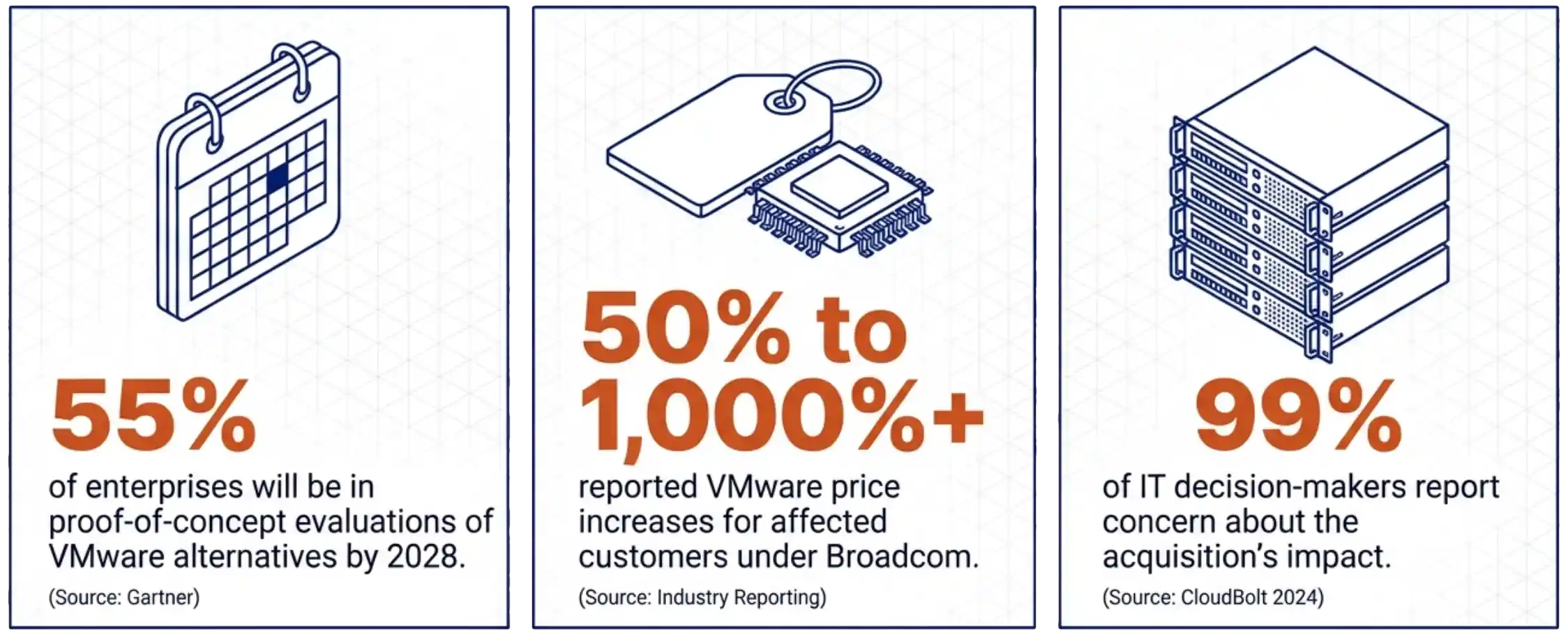
VMware exit data protection — split-hypervisor transition window diagramGartner’s planning data projects that 55 percent of enterprises will be in proof-of-concept evaluations of VMware alternatives by 2028. Industry reporting on VMware price increases under Broadcom shows a range from 50 percent to over 1,000 percent for affected customers. CloudBolt’s 2024 survey found 99 percent of IT decision-makers reporting concern about the acquisition’s impact. These three numbers explain why the migration question is no longer optional for most VMware shops. They do not explain why the backup tier needs to be redesigned alongside it.

The redesign argument comes from operational reality. A team running two hypervisors needs backup tooling that runs against both hypervisors with the same policies, recovery procedures, and retention horizon. Anything less produces parallel backup operations, parallel recovery rehearsals, and parallel staff training. The cost shows up in the transition window, where the team is already managing two infrastructure platforms.

A backup vendor built for heterogeneous environments removes that cost. The same Server, the same policy model, and the same recovery workflow apply to both sides of the migration. The architectural decision is not which backup product is best in isolation. The decision is which backup product survives the transition without forcing a second migration. This shift has been characterized as the chance to rebuild data protection alongside the hypervisor exit, not after it.

“Heterogeneous environments are the norm now, not the exception.” — Paweł Mączka, CTO, Storware. April 2026.

Two Layers, Not One Consolidated Product
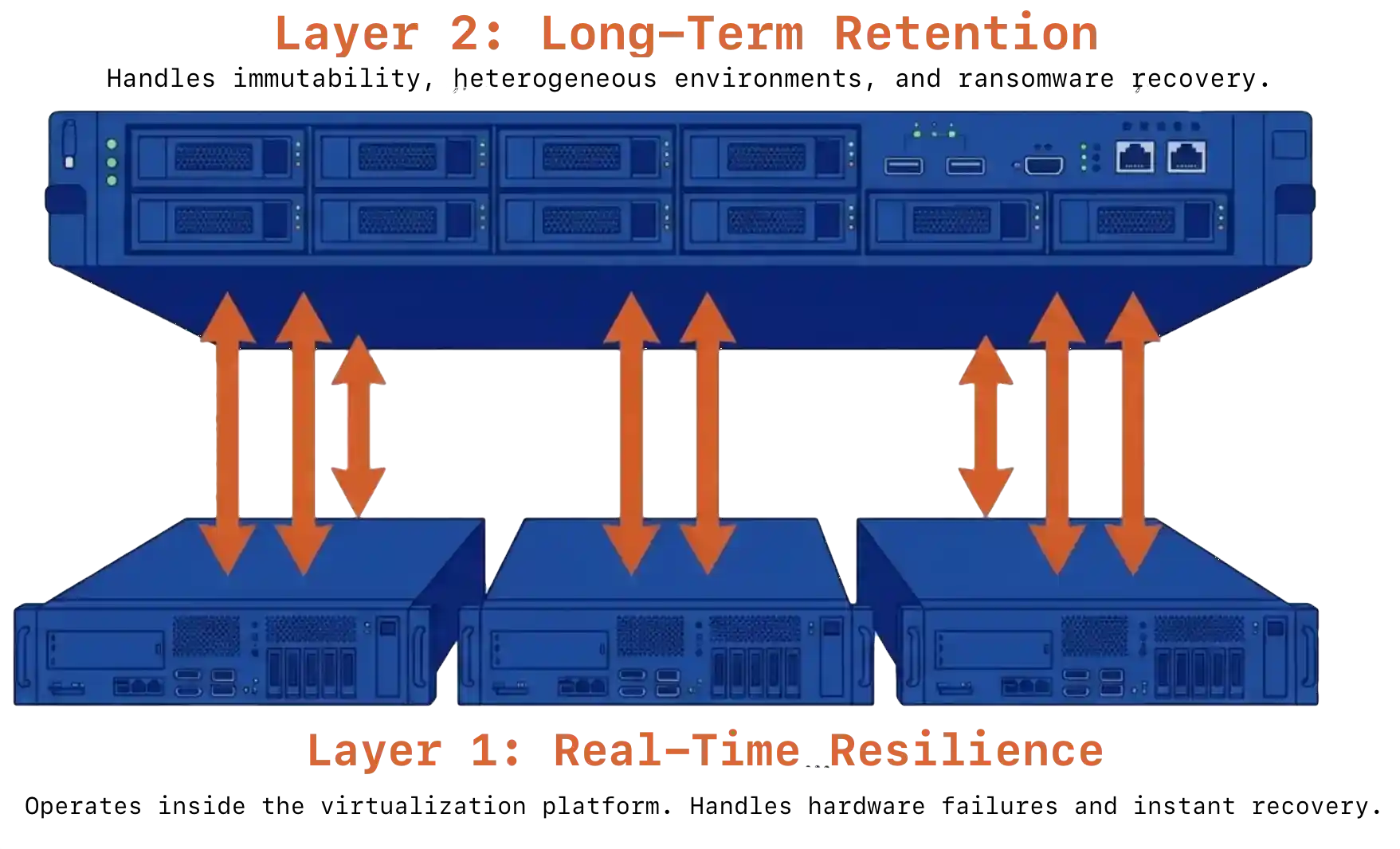
Multi-layer infrastructure data protection model spanning VergeOS and StorwareSingle-product VMware exit data protection fails one of two tests. Infrastructure-only protection lives inside the virtualization platform. It handles hardware failures and operational continuity well, but offers no compliance retention, no air-gapped immutability, and limited defense against ransomware targeting the production cluster itself. Backup-only protection can take minutes to hours to recover after a hardware event and depends entirely on backup scheduling for meaningful protection.

The architecture that survives both modes places independent layers at each level of the stack. Layer one handles real-time resilience. Layer two handles long-term retention and ransomware recovery. The two layers operate independently and reinforce each other.

VergeOS handles layer one. Replication Factors distribute data across cluster nodes as a distributed mirror. ioGuardian sits beside RF and actively serves data during failures rather than only accelerating repair. A production VergeOS cluster running RF2 with ioGuardian survived the failure of four of six servers, with zero downtime and zero data loss. ioClone produces fully independent snapshots of entire instances or specific VMs as read-only objects an attacker cannot modify. Global inline deduplication runs across the cluster, so snapshots and replication do not consume duplicate capacity.

Storware Backup and Recovery handles layer two, and the architectural fit is deliberate. For deeper context on how the platform layer drives recovery readiness, see our companion piece on how VergeOS and the backup tier split the DR job.

Key Terms
Replication Factor (RF)

VergeOS data resilience model. RF2 distributes data across cluster nodes as a distributed mirror. RF3 distributes data as a triple mirror.

ioGuardian

VergeOS technology that actively serves data during cluster failures rather than only accelerating repair. Survived four-of-six node loss with zero downtime in a production customer environment.

ioClone

VergeOS independent snapshot mechanism. Produces full copies of entire instances, virtual data centers, or individual VMs as read-only objects with no parent dependencies.

Universal License

Storware licensing model under which a single agreement covers all supported hypervisors and platforms. Removes the per-platform billing barrier during a hypervisor migration.

V2V Conversion

Virtual-to-virtual migration capability that recovers a workload backed up from one hypervisor onto a different destination hypervisor. Critical during transition windows.

Why Consider Storware as a Layer-Two Partner

Storware is a data protection platform built specifically for the multi-hypervisor world that VMware-exit migrations create. Breadth is the architectural feature. The platform supports VMware, VergeOS, Proxmox, Nutanix AHV, Red Hat Virtualization, OpenStack, oVirt, KubeVirt, and several KVM variants under a single management plane. A team running two hypervisors during a transition window manages one product, one policy model, and one recovery workflow rather than two of each.

The licensing model reinforces the architecture. Storware operates on a universal license that covers all supported platforms under one agreement. Protecting both VMware and VergeOS during the parallel-operation window produces no additional license fee. The transition becomes a budgeted operational state rather than a billing event.

The integration with VergeOS is direct and documented. The Storware Server holds metadata, exposes a RESTful API, and manages policies. The Storware Node deploys as a VM inside the VergeOS cluster or as an external system with network access. Backup jobs use VergeOS ioClone snapshots as the source, read through an NFSv4 share served by a VergeOS NAS service, and apply changed block tracking so incremental jobs transfer only changed data. Synthetic forever-incremental support consolidates the backup chain at the destination, removing the need for periodic full re-runs against production. Supported destinations include NFS, SMB, S3 and Azure Blob object storage, Dell PowerProtect Data Domain via DD Boost, and tape.

Cross-hypervisor recovery is the capability that pays off the design. Storware supports V2V conversion across several platform pairs, including VMware-to-OpenStack and several KVM-based combinations. A workload protected on VMware can be recovered onto VergeOS as a planned migration step rather than as an emergency procedure. An architect builds a parallel VergeOS cluster on existing hardware, recovers protected VMware VMs onto that cluster through Storware, and validates the recovery before committing to migration. The data path during this kind of staged recovery is the same one used in production, so the operation is rehearsed, not improvised.

The Ransomware Layer Is the Real Test

Ransomware reshaped what backup means. The numbers explain why the architecture has to change.
96%
of ransomware attacks target backup repositories (Veeam 2024)
94%
independent targeting rate confirmed by Sophos (2024)
35%
of orgs expecting hours-long recovery actually achieve it (Backblaze 2024)

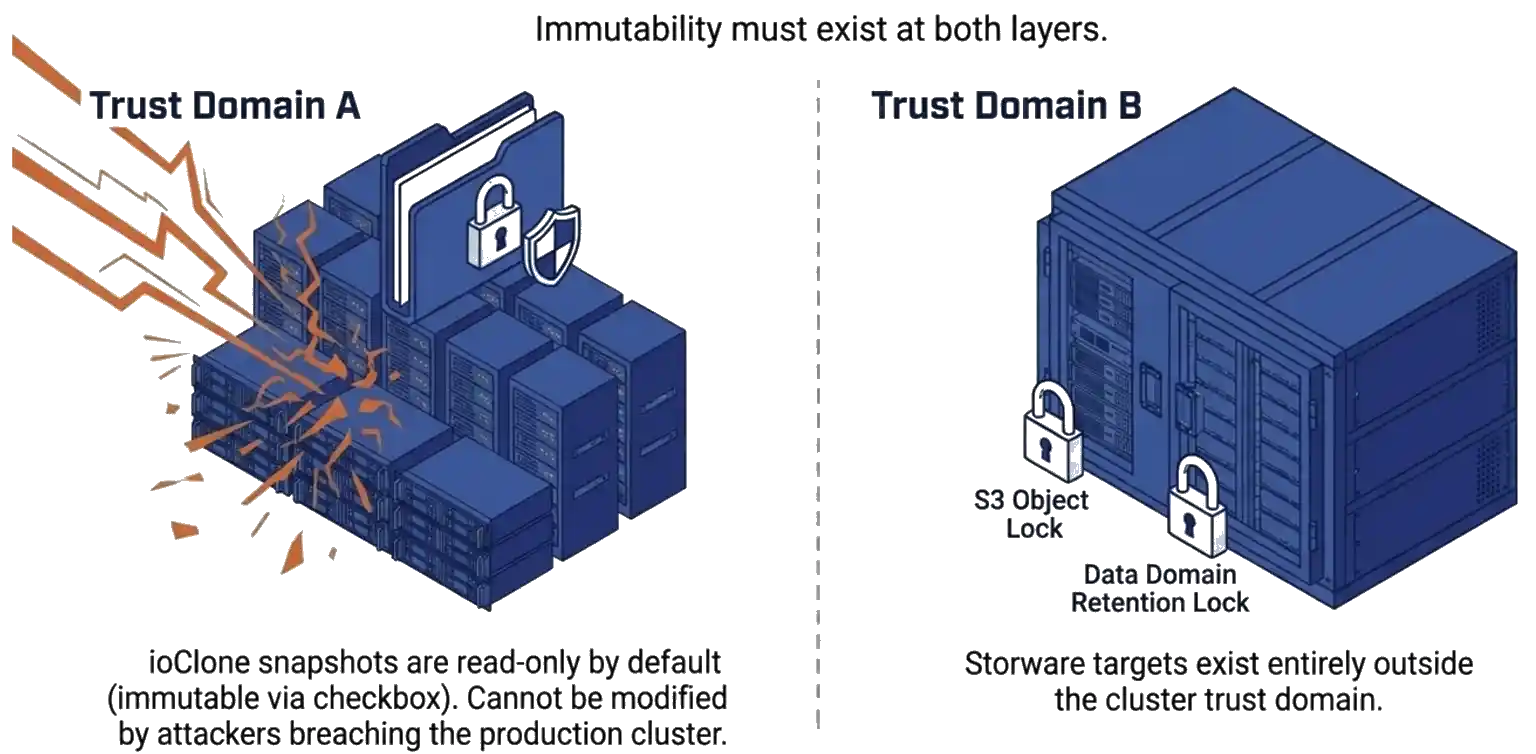
Two-layer immutability defense for VMware exit data protectionThe numbers point to a single architectural answer. A backup that lives in the same trust domain as production has been compromised by definition once an attacker reaches the production system. Immutability has to exist at both layers. ioClone snapshots inside VergeOS are read-only by default and can be set to immutable by checking a box. As a result, they cannot be modified by an attacker who reaches the production cluster. Storware adds immutable storage targets, such as S3 Object Lock and Data Domain Retention Lock, outside the cluster trust domain. Recovery from in-cluster snapshots is near-instant. Recovery from the Storware tier is slower but provides the long-term retention horizon for compliance and forensic analysis.

Practical implementation is straightforward. Use ioClone snapshots for short-window recovery, typically 30 minutes to 30 days. Use Storware backups with immutable destinations for the long-term horizon, typically a year or longer, depending on compliance requirements. Test both monthly. The 25-point gap in Backblaze’s data between expected and actual recovery times is directly attributable to how often teams rehearse.

Who Owns Which Layer

 VergeOS (Layer 1)Storware (Layer 2)
Hardware failure resiliencePrimary—
In-cluster snapshot protectionPrimary—
Long-term retention—Primary
Cross-hypervisor recoverySupportsPrimary
Air-gapped immutable storage—Primary
Ransomware-resistant snapshotsPrimarySupports
Universal multi-platform licensing—Primary

The VMware Exit Data Protection Decision

VMware exit data protection in 2026 is no longer a single-product decision. The infrastructure stack is being rebuilt under transition pressure. The data protection tier needs to span source and destination platforms during that transition. The cost of getting either layer wrong is measured in budget cycles. The architecture that survives places independent protection at each level and treats the transition window as a planned operational state.

For architects evaluating this design, the practical next step is a paired proof-of-concept on existing hardware. Stand up a small VergeOS cluster, deploy a Storware Server and Node against it, protect a VMware VM, and recover it onto VergeOS through Storware. A week with the running system communicates more than any document.

The full white paper, Resilience Without Lock-In, walks through the complete two-layer architecture, the Storware reference implementation against VergeOS 4.13 and higher, sizing recommendations for the NAS service, cross-hypervisor recovery scenarios, and the role-by-role comparison of which product owns which layer. Read the white paper →

Frequently Asked Questions
Why does the backup tier need to be redesigned during a VMware exit?
A VMware exit produces a months-long transition window where production data lives on two hypervisors at once. A backup tier that only knows how to talk to one of them creates a second migration project on top of the first. Heterogeneous backup tooling lets one product, one policy model, and one recovery workflow span both sides of the move.
What is the two-layer protection model?
Layer one handles real-time resilience against hardware failure and operational error through the infrastructure platform itself. Layer two handles long-term retention, granular recovery, and ransomware defense through an independent backup product. The two layers operate independently and reinforce each other against different failure modes.
Why is Storware a fit as the layer-two partner for VergeOS?
Storware supports VMware, VergeOS, Proxmox, Nutanix AHV, Red Hat Virtualization, OpenStack, oVirt, KubeVirt, and several KVM variants under one universal license. That breadth means a transition team manages one backup product across both hypervisors with no additional license fee during the parallel-operation window.
How does the architecture defend against ransomware?
Immutability sits at both layers. ioClone snapshots inside VergeOS are read-only objects an attacker cannot modify. Storware adds immutable storage targets such as S3 Object Lock and Data Domain Retention Lock outside the cluster trust domain. In-cluster recovery is near-instant. Storware-tier recovery is slower but provides the long-term retention horizon for compliance and forensic analysis.
What is cross-hypervisor recovery and why does it matter?
Cross-hypervisor recovery uses V2V conversion to recover a workload backed up from one hypervisor onto a different destination hypervisor. A workload protected on VMware can be recovered onto VergeOS as a planned migration step rather than as an emergency procedure, letting an architect validate the recovery before committing to migration.

Filed Under: Protection Tagged With: dataprotection, IT infrastructure, ransomware, storware-webinar-campaign

855-855-8300

Get Started

  • Versions
  • Request Tour

VergeIO For

  • VMware Alternative
  • SAN Replacement
  • Solving Infrastructure Modernization Challenges
  • Artificial Intelligence
  • Hyperconverged
  • Server Room
  • Secure Research Computing

Product

  • Benefits
  • Documents
  • Architecture Overview
  • Use Cases
  • Videos

Company

  • About VergeIO
  • Blog
  • Technical Documentation
  • Legal

© 2026 VergeIO. All Rights Reserved.