• Skip to main content
  • Architecture
    • Overview
      Learn about VergeOS’ unique unfied architecture that integrates virtualization, storage, networking, AI, backup and DR into a single data center operating system
    • Infrastructure Wide Deduplication
      VergeOS transforms deduplication from a storage-only commodity into a native, infrastructure-wide capability that spans storage, virtualization, and networking, eliminating hidden resource taxes
    • VergeFS
      VergeFS is a distributed, high-performance global file system integrated into VergeOS, unifying storage across nodes, tiers, and workloads while eliminating the need for external SANs
    • VergeFabric
      VergeFabric is VergeOS’s integrated virtual networking layer, delivering high-speed, low-latency communication across nodes while eliminating the complexity of traditional network configurations.
    • Infrastructure Automation
      VergeOS integrates Packer, Terraform, and Ansible to deliver an end-to-end automation pipeline that eliminates infrastructure drift and enables predictable, scalable deployments.
    • VergeIQ
      Unlock secure, on-premises generative AI—natively integrated into VergeOS. With VergeIQ, your enterprise gains private AI capabilities without the complexity, cloud dependency, or token-based pricing.
  • Features
    • Virtual Data Centers
      A VergeOS Virtual Data Center (VDC) is a fully isolated, self-contained environment within a single VergeOS instance that includes its own compute, storage, networking, and management controls
    • High Availability
      VergeOS provides a unified, easy-to-manage infrastructure that ensures continuous high availability through automated failover, storage efficiency, clone-like snapshots, and simplified disaster recovery
    • ioClone
      ioClone utilizes global inline deduplication and a blockchain-inspired file system within VergeFS to create instant, independent, space-efficient, and immutable snapshots of individual VMs, volumes, or entire virtual data centers.
    • ioReplicate
      ioReplicate is a unified disaster-recovery solution that enables simple, cost-efficient DR testing and failover via three‑click recovery of entire Virtual Data Centers—including VMs, networking, and storage.
    • ioFortify
      ioFortify creates immutable, restorable VDC checkpoints and provides proactive ransomware detection with instant alerts for rapid recovery and response.
    • ioMigrate
      ioMigrate enables large-scale VMware migrations, automating the rehosting of hundreds of VMs (including networking settings) in seconds with minimal downtime by seamlessly transitioning entire VMware environments onto existing hardware stacks.
    • ioProtect
      ioProtect offers near-real-time replication of VMware VMs—including data, network, and compute configurations—to a remote disaster‑recovery site on existing hardware, slashing DR costs by over 60% while supporting seamless failover and testing in an efficient, turnkey VergeOS Infrastructure.
    • ioOptimize
      ioOptimize leverages AI and machine learning to seamlessly integrate new and old hardware and automatically migrate workloads from aging or failing servers.
    • ioGuardian
      ioGuardian is VergeIO’s built-in data protection and recovery capability, providing near-continuous backup and rapid VM recovery during multiple simultaneous drive or server failures.
  • IT Initiatives
    • VMware Alternative
      VergeOS offers seamless migration from VMware, enhancing performance and scalability by consolidating virtualization, storage, and networking into a single, efficient platform.
    • Hyperconverged Alternative
      VergeIO’s page introduces ultraconverged infrastructure (UCI) via VergeOS, which overcomes HCI limitations by supporting external storage, scaling compute and storage independently, using existing hardware, simplifying provisioning, boosting resiliency, and cutting licensing costs.
    • SAN Replacement / Storage Refresh
      VergeIO’s storage by replacing aging SAN/NAS systems within its ultraconverged infrastructure, enhancing security, scalability, and affordability.
    • Infrastructure Modernization
      Legacy infrastructure is fragmented, complex, and costly, built from disconnected components. VergeOS unifies virtualization, storage, networking, data protection, and AI into one platform, simplifying operations and reducing expenses.
    • Virtual Desktop Infrastructure (VDI)
      VergeOS for VDI delivers a faster, more affordable, and easier-to-manage alternative to traditional VDI setups—offering organizations the ability to scale securely with reduced overhead
    • Secure Research Computing
      VergeIO's Secure Research Computing solution combines speed, isolation, compliance, scalability, and resilience in a cohesive platform. It’s ideal for institutions needing segmented, compliant compute environments that are easy to deploy, manage, and recover.
    • Venues, Remote Offices, and Edge
      VergeOS delivers resiliency and centralized management across Edge, ROBO, and Venue environments. With one platform, IT can keep remote sites independent while managing them all from a single pane of glass.
  • Blog
      • Are All-Flash Arrays a Budget Liability?All-flash array cost in 2026 has fundamentally changed. AI-driven NAND and DRAM demand has pushed enterprise SSD pricing up 472 percent year over year — and closed-media platforms leave buyers with no sourcing alternatives. The architecture underneath your storage layer now determines how much of that inflation you absorb, and how much you can avoid.
      • Now Is the Worst Time to Buy VMware ServersBroadcom's per-core subscriptions drove 300–500% VMware cost increases. Now server hardware has compounded the problem — DDR5 prices up 2×, enterprise SSD up 257%. Renewing VMware and buying servers simultaneously means paying peak prices on both. VergeOS eliminates all three costs on hardware you already own.
      • VMware Alternative DR: How VergeOS and Veeam Split the JobRansomware encrypts 400 VMs at 2 a.m. VMware alternatives that don't solve the backup question leave you exposed. VergeOS and Veeam split that job — platform recovery in seconds, granular retention for weeks.
    • View All Posts
  • Resources
    • Become a Partner
      Get repeatable sales and a platform built to simplify your customers’ infrastructure.
    • Technology Partners
      Learn about our technology and service partners who deliver VergeOS-powered solutions for cloud, VDI, and modern IT workloads.
    • White Papers
      Explore VergeIO’s white papers for practical insights on modernizing infrastructure. Each paper is written for IT pros who value clarity, performance, and ROI.
    • In The News
      See how VergeIO is making headlines as the leading VMware alternative. Industry analysts, press, and partners highlight our impact on modern infrastructure.
    • Press Releases
      Get the latest VergeOS press releases for news on product updates, customer wins, and strategic partnerships.
    • Case Studies
      See how organizations like yours replaced VMware, cut costs, and simplified IT with VergeOS. Real results, real environments—no fluff.
    • Webinars
      Explore VergeIO’s on-demand webinars to get straight-to-the-point demos and real-world infrastructure insights.
    • Documents
      Get quick, no-nonsense overviews of VergeOS capabilities with our datasheets—covering features, benefits, and technical specs in one place.
    • Videos
      Watch VergeIO videos for fast, focused walkthroughs of VergeOS features, customer success, and VMware migration strategies.
    • Technical Documentation
      Access in-depth VergeOS technical guides, configuration details, and step-by-step instructions for IT pros.
  • How to Buy
    • Schedule a Demo
      Seeing is believing, set up a call with one of our technical architects and see VergeOS in action.
    • Versions
      Discover VergeOS’s streamlined pricing and flexible deployment options—whether you bring your own hardware, choose a certified appliance, or run it on bare metal in the cloud.
    • Test Drive – No Hardware Required
      Explore VergeOS with VergeIO’s hands-on labs and gain real-world experience in VMware migration and data center resiliency—no hardware required
  • Company
    • About VergeIO
      Learn who we are, what drives us, and why IT leaders trust VergeIO to modernize and simplify infrastructure.
    • Support
      Get fast, expert help from VergeIO’s support team—focused on keeping your infrastructure running smoothly.
    • Careers
      Join VergeIO and help reshape the future of IT infrastructure. Explore open roles and growth opportunities.
  • 855-855-8300
  • Contact
  • Search
  • 855-855-8300
  • Contact
  • Search
  • Architecture
    • Overview
    • VergeFS
    • VergeFabric
    • Infrastructure Automation
    • VergeIQ
  • Features
    • Virtual Data Centers
    • High Availability
    • ioClone
    • ioReplicate
    • ioFortify
    • ioMigrate
    • ioProtect
    • ioOptimize
    • ioGuardian
  • IT Initiatives
    • VMware Alternative
    • Hyperconverged Alternative
    • SAN Replacement / Storage Refresh
    • Infrastructure Modernization
    • Virtual Desktop Infrastructure (VDI)
    • Secure Research Computing
    • Venues, Remote Offices, and Edge
  • Blog
  • Resources
    • Become a Partner
    • Technology Partners
    • White Papers
    • In The News
    • Press Releases
    • Case Studies
    • Webinars
    • Documents
    • Videos
    • Technical Documentation
  • How to Buy
    • Schedule a Demo
    • Versions
    • Test Drive – No Hardware Required
  • Company
    • About VergeIO
    • Support
    • Careers
×
  • Architecture
    • Overview
    • VergeFS
    • VergeFabric
    • Infrastructure Automation
    • VergeIQ
  • Features
    • Virtual Data Centers
    • High Availability
    • ioClone
    • ioReplicate
    • ioFortify
    • ioMigrate
    • ioProtect
    • ioOptimize
    • ioGuardian
  • IT Initiatives
    • VMware Alternative
    • Hyperconverged Alternative
    • SAN Replacement / Storage Refresh
    • Infrastructure Modernization
    • Virtual Desktop Infrastructure (VDI)
    • Secure Research Computing
    • Venues, Remote Offices, and Edge
  • Blog
  • Resources
    • Become a Partner
    • Technology Partners
    • White Papers
    • In The News
    • Press Releases
    • Case Studies
    • Webinars
    • Documents
    • Videos
    • Technical Documentation
  • How to Buy
    • Schedule a Demo
    • Versions
    • Test Drive – No Hardware Required
  • Company
    • About VergeIO
    • Support
    • Careers

the-new-economics-of-vmware-exit

April 27, 2026 by George Crump

All-flash array cost in 2026 has fundamentally changed. Flash storage won on merit — the performance case was real, the reliability case was real, and the total cost math worked as long as NAND prices followed their decade-long downward trajectory. That trajectory ended in 2025. The 2026 flash market looks structurally different, and organizations building or expanding all-flash infrastructure are discovering that the platform architecture underneath their storage layer determines how much of that inflation they absorb — and how much they can avoid.

The signal came on April 23, 2026, when Everpure (Pure Storage) CEO Charles Giancarlo published an open letter to customers disclosing a cumulative average price increase of approximately 70 percent since January. Input costs for the semiconductor components Everpure depends on have surged between 300 and 900 percent since mid-2025, driven by AI-fueled NAND and DRAM demand. The math in the letter is accurate. The architecture it reveals is the conversation infrastructure leaders need to have.

70%
Everpure cumulative customer price increase since January 2026
472%
Enterprise SSD price increase Q2 2025 to Q1 2026
300–900%
Input cost surge for enterprise flash components since mid-2025
Key Takeaways
All-flash array cost in 2026 is up 472% year over year for enterprise SSDs — Everpure’s open letter disclosed a 70 percent customer price increase driven by 300–900 percent input cost surges, a direct consequence of closed-media architecture.
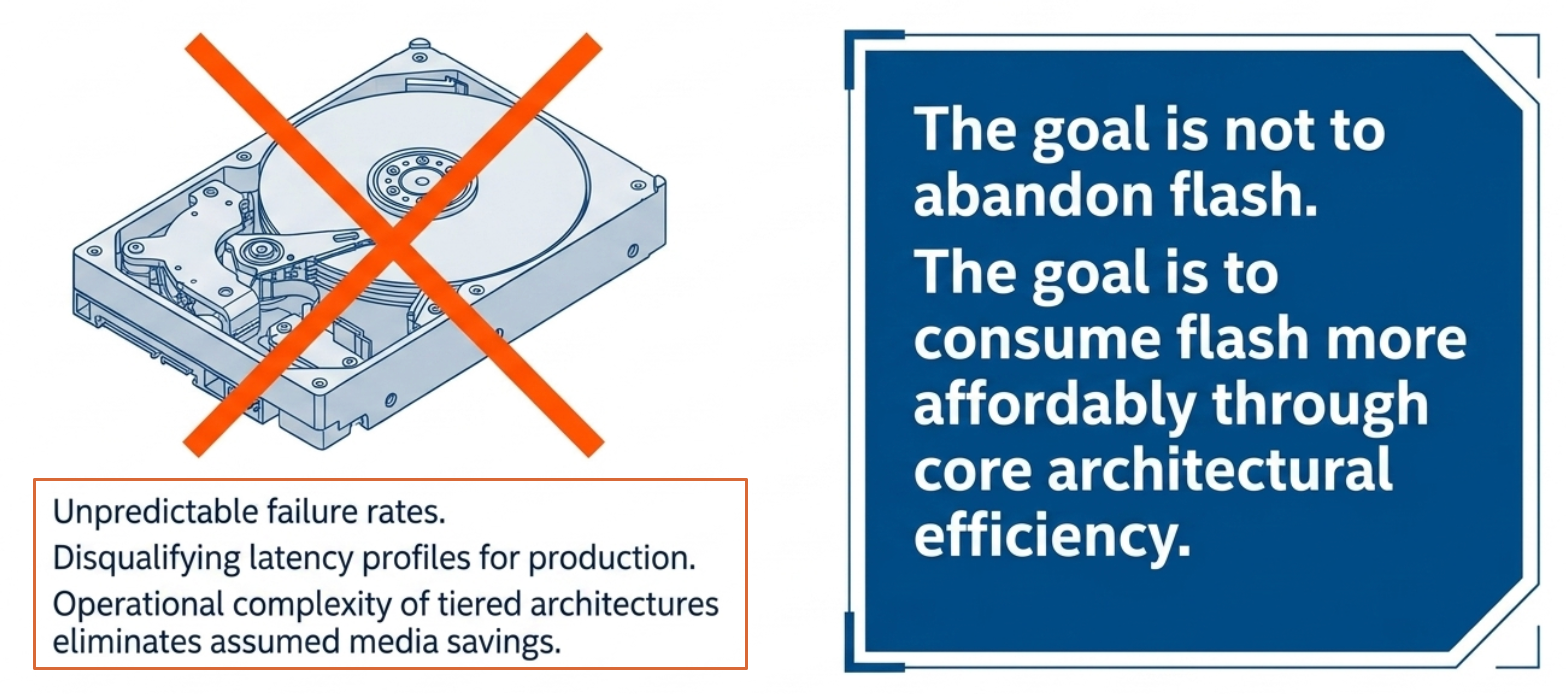
The high cost of flash does not make hard drives a compelling answer. HDDs fail unpredictably and carry latency profiles that disqualify them from most production workloads. The goal is to make flash more affordable, not to abandon it.
VergeOS runs on commodity NVMe from any manufacturer, eliminating single-vendor flash pricing dependency and enabling open-market sourcing on every capacity expansion.
VergeFS handles power-loss protection and data integrity natively in software, removing the enterprise SSD hardware requirement and making consumer-grade flash a safe production option under the ioGuardian protection model.
VergeOS’s always-on global deduplication reduces raw flash requirements by up to 66 percent — a dollar value that scales directly with flash prices, making it worth considerably more in 2026 than in prior years.

The Answer Is Not Hard Drives

all-flash array cost 2026 flash price inflationBefore addressing what organizations should do, it is worth being direct about what they should not do. Rising all-flash array cost in 2026 does not make hard drives a compelling alternative. HDDs fail unpredictably, carry latency profiles that disqualify them from most production workloads, and the operational complexity of managing a tiered architecture dependent on spinning media eliminates whatever savings the lower media cost implies. There is a reason IT moved to all-flash in the first place. The goal is not to abandon flash — it is to consume flash more affordably. Three architectural decisions determine whether that is possible.

Deduplication Has to Be a Core Function, Not a Feature

The most direct lever for reducing flash consumption is deduplication, and most storage platforms treat it wrong. Enterprise storage arrays and hyperconverged platforms typically implement deduplication as an optional, per-volume process — frequently recommended off by default in production because it runs as a background job competing with live I/O. The result is that organizations carry substantially more raw flash capacity than their effective data footprint requires, compounding the all-flash array cost problem further.
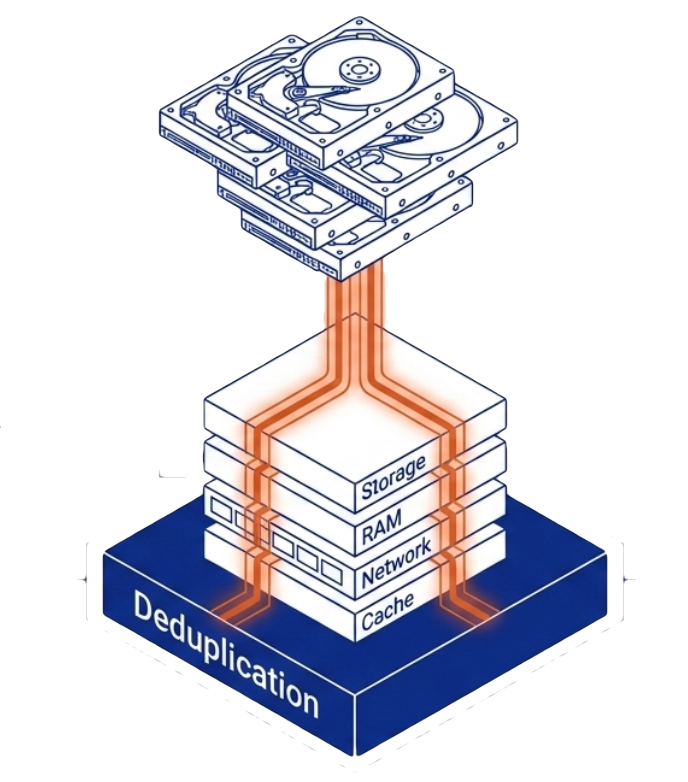
VergeOS integrated deduplication reduces all-flash array cost 2026VergeOS takes a fundamentally different approach. Deduplication is not a feature that runs on stored data after the fact. It is built directly into the VergeOS operating system and runs permanently across the entire environment — cache, network, RAM, and storage — as a core function. A single copy of any block exists in the cluster regardless of how many virtual machines reference it, and that deduplication applies from the moment data is written rather than as a background cleanup pass.

At current enterprise SSD pricing of $100 per terabyte and rising, a continuous 3:1 deduplication ratio running across the full storage pool reduces the raw flash required by 66 percent. The dollar value of that efficiency scales directly with flash prices, which means VergeOS deduplication is worth considerably more in 2026 than it was when NAND cost $20 per terabyte.

Off-the-Shelf NVMe Breaks the Closed-Media Trap
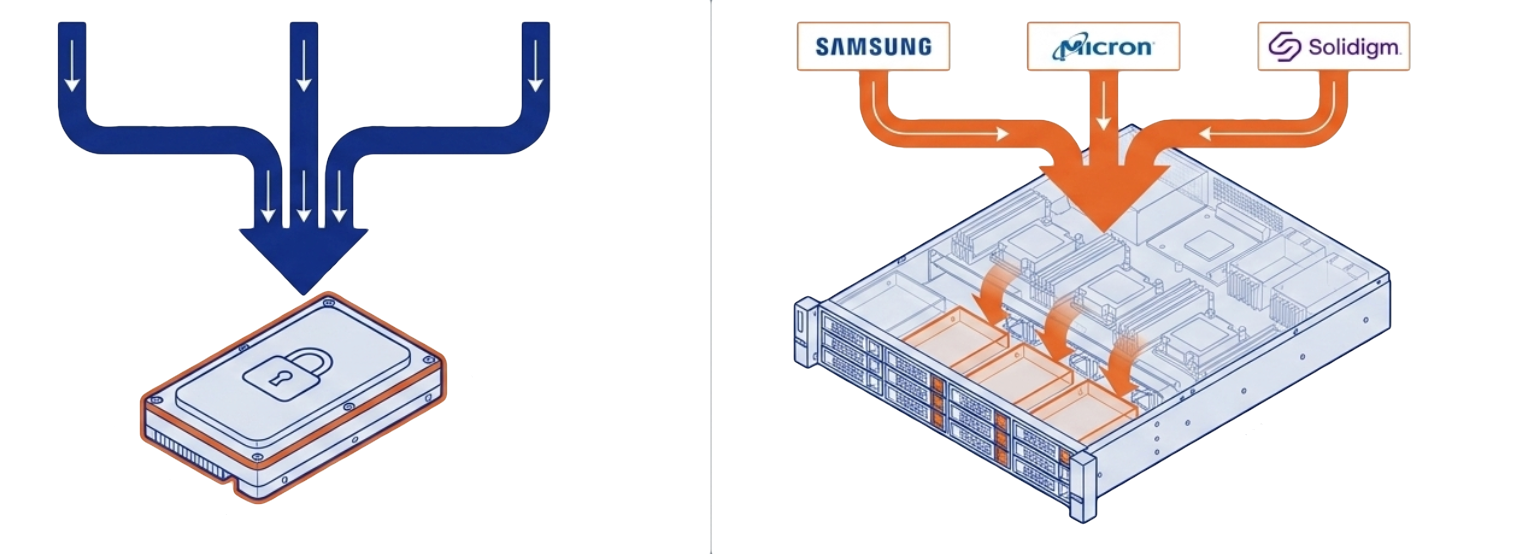
VergeOS multi-source NVMe sourcing vs closed-media single vendorEverpure’s FlashArray and FlashBlade platforms accept only DirectFlash Modules — a proprietary media format that Everpure itself manufactures. Customers cannot source capacity from any other vendor. When component costs surge 300 to 900 percent, a storage platform that accepts media from only one manufacturer has no alternative sourcing path and no way to manage all-flash array cost exposure. The closed architecture that delivered engineering elegance in a declining-price market becomes a one-way pricing funnel when supply inverts.

An organization expanding storage capacity on VergeOS can run a three-way quote across Samsung, Micron, and Solidigm, take the lowest number, and install those drives in servers it already owns. That sourcing flexibility directly controls all-flash array cost on every capacity expansion — and it compounds in value as component markets remain volatile.

VergeOS also consumes the NVMe drives already present in servers the customer owns. An organization consolidating off VMware or retiring a legacy cluster can repurpose its existing flash investment rather than buying new capacity at 2026 pricing — an approach that has been characterized as a path to eliminating future storage refreshes entirely. The hardware ambush trapping VMware exit candidates is most acute for platforms that require both a hypervisor migration and a storage hardware refresh simultaneously. VergeOS eliminates both requirements.

Commodity SSDs — Safely

The most aggressive version of the all-flash affordability argument goes beyond standard enterprise NVMe to consumer-grade SSDs — and this is viable, but the word “safely” carries real meaning. Understanding why requires a brief detour into what enterprise SSDs actually provide and what VergeOS replaces.

Most enterprise SSDs include full power-loss protection: onboard capacitors or supercapacitors let the drive flush its DRAM write cache to NAND if power is cut, preventing in-flight writes from being lost or corrupting metadata. Enterprise SSDs also use stronger ECC and data-path protection to guard against bit errors and silent data corruption — critical for databases and storage arrays that depend on media integrity as a primary reliability mechanism.

Consumer-grade drives typically omit or reduce these protections. On a storage platform that relies on the drive itself to guarantee data integrity and write durability, using consumer SSDs is a genuine risk. VergeOS is not that platform. VergeFS — the VergeOS file system — handles power-loss protection, write durability, and data integrity natively at the software layer. VergeOS does not depend on drive-level PLP capacitors or hardware ECC to protect writes. Those guarantees are enforced by the file system and the cluster protection model, not by the media.

TruthInIT Webinar · April 30
The New Economics of VMware Exit

Mike Matchett and George Crump unpack the hardware ambush, the flash supply squeeze, and the exit math that actually works in 2026. Live Q&A included.

Register Now →

The ioGuardian architecture adds a second layer of confidence. Every drive in the cluster is treated as a potentially failing device. RF2 data protection maintains two copies across the cluster with active service capability — validated in production environments where multiple nodes failed simultaneously and workloads continued serving with zero downtime and zero data loss.

VergeOS telemetry monitors wear across every drive continuously. That same capability caught one customer’s refurbished drives showing 80 percent wear against a certified 15 percent rating — enabling a full vendor refund before any failure occurred. When VergeFS provides power-loss protection in software and ioGuardian provides cluster-level redundancy regardless of drive quality, the case for paying the enterprise SSD premium weakens considerably.

All-Flash Array Cost 2026: Why Architecture Is the Deciding Factor

 Closed-Media PlatformVergeOS
Flash Media SourceProprietary modules only — no alternativesAny NVMe or SATA from any manufacturer
Deduplication ModelOptional, per-volume, off by default in productionAlways-on, built into OS, runs across full environment
Power-Loss ProtectionDrive-level hardware capacitors requiredVergeFS software layer — no hardware dependency
Consumer-grade SSDsNot supportedSupported safely via VergeFS + ioGuardian
Existing Drive ReuseNot possibleDrives from retiring servers repurposed as cluster capacity
Sourcing FlexibilitySingle vendor, single price pointOpen market on every expansion

The 2026 supply environment has made concrete something that was always structurally true: the storage platform decision is also a sourcing decision that locks in for the life of the deployment. Choosing a platform that requires proprietary media, treats deduplication as an optional background job, and depends on enterprise-grade hardware for data integrity means accepting the full weight of current all-flash array cost inflation with no alternatives.

VergeOS eliminates all three constraints simultaneously. Deduplication runs as a permanent core function, reducing effective flash requirements from the ground up. Any commodity NVMe drive from any manufacturer is a valid capacity source, giving procurement teams a live market to shop on every expansion. And VergeFS handles power-loss protection, write integrity, and data-path protection natively — removing the enterprise SSD hardware dependency and making consumer-grade flash a safe and legitimate choice under the right configuration. In a market where a closed-module vendor just disclosed 70 percent customer price increases driven by 300 to 900 percent input cost surges, the economic value of that architecture is no longer theoretical. The Everpure letter quantified it.

Key Terms
DirectFlash Module (DFM)

Everpure’s proprietary flash media format. FlashArray and FlashBlade accept only DFMs manufactured by Everpure — no third-party drives, eliminating all alternative sourcing when component prices rise.

Power-Loss Protection (PLP)

A hardware feature on enterprise SSDs: onboard capacitors that flush the drive’s DRAM write cache to NAND if power is cut. VergeFS replicates this guarantee in software, removing the hardware dependency entirely.

VergeFS

The VergeOS file system. Handles power-loss protection, write durability, ECC, and data integrity natively in software, enabling VergeOS to safely consume consumer-grade SSDs without relying on drive-level hardware protections.

ioGuardian

VergeOS’s active cluster protection model. Treats every drive as a potentially failing device and maintains active service capability through redundancy, allowing the cluster to continue serving data when nodes fail.

RF2

VergeOS’s two-copy data protection model. Maintains two independent copies across the cluster, providing redundancy that operates independently of individual drive quality or health.

Frequently Asked Questions
Why are all-flash array prices increasing so dramatically in 2026?
AI infrastructure demand has consumed available NAND and DRAM supply. Input costs for enterprise flash components have surged 300 to 900 percent since mid-2025. Vendors dependent on proprietary flash media have no alternative sourcing path and are passing those increases to customers.
What makes closed-media architectures especially vulnerable to flash price inflation?
Closed-media platforms manufacture their own proprietary flash modules and accept no drives from any other vendor. When component costs spike, customers cannot source from Samsung, Micron, Solidigm, or the secondary market. They pay whatever the vendor charges with no leverage and no alternative.
How does VergeOS safely use consumer-grade SSDs?
VergeFS handles power-loss protection, write durability, and data integrity natively in software. VergeOS does not depend on drive-level capacitors or hardware ECC. Combined with ioGuardian cluster protection, consumer-grade NVMe drives become a defensible production capacity option.
What is VergeFS power-loss protection?
VergeFS replicates the PLP guarantee at the file system layer in software. Any NVMe drive — including consumer-grade models without onboard capacitors — operates safely under VergeFS protection, with no dependency on drive hardware.
Can VergeOS reuse existing flash drives from retiring servers?
Yes. VergeOS accepts any NVMe or SATA drive from any manufacturer. An organization retiring VMware or Nutanix infrastructure can repurpose that installed flash as capacity in a new VergeOS cluster, avoiding new purchases at 2026 pricing entirely.

Filed Under: Storage Tagged With: the-new-economics-of-vmware-exit

855-855-8300

Get Started

  • Versions
  • Request Tour

VergeIO For

  • VMware Alternative
  • SAN Replacement
  • Solving Infrastructure Modernization Challenges
  • Artificial Intelligence
  • Hyperconverged
  • Server Room
  • Secure Research Computing

Product

  • Benefits
  • Documents
  • Architecture Overview
  • Use Cases
  • Videos

Company

  • About VergeIO
  • Blog
  • Technical Documentation
  • Legal

© 2026 VergeIO. All Rights Reserved.