Saratoga Casino Holdings inherited mirrored Pure Storage arrays, Cisco UCS blades, and VMware from a partnership that wound down. The Pure Storage alternative it chose runs on servers the company picked itself.
A Pure Storage alternative rarely starts as a storage project. Most infrastructure arrives inherited. Someone else chose the blades, the array, and the hypervisor, and the team paying the bill had no vote. A business partner mandated a standard, a reseller shaped the quote around the gear it stocked, or an administrator who left three years ago set a direction that still governs every refresh. The equipment runs fine. The decision behind it belongs to someone else, and the invoice arrives anyway.
Scott Bartgis knows the pattern in detail. As Corporate Director of IT at Saratoga Casino Holdings, he supports four casinos across four states with one corporate team. Years ago a partner bought into the business and standardized the properties on Cisco UCS blades, mirrored Pure Storage arrays, Cisco fabrics, and VMware. That partner funded the buildout and managed the relationship. About two years later, the partnership wound down, and Scott’s team inherited the full environment along with every operating cost attached to it.
Key Takeaways
- Inherited infrastructure sets the budget for years. A partner picked Saratoga’s Cisco UCS, Pure Storage, and VMware stack, then handed back the operating cost.
- Three costs arrived in one budget year: aging servers, a post-Broadcom renewal, and roughly $50,000 a year in array maintenance.
- Small-footprint HCI fit the 10 TB property and fell short at 30 to 40 TB. Nutanix priced close enough to VMware to sit in the same bucket.
- The VergeOS design came in at almost half the Scale Computing quote with more compute, RAM, and capacity.
- The Pure Storage alternative held its performance. Scott chose CXTEC® equal2new® nodes and took cost out of the budget.
Renewal Season Turns an Inheritance Into a Bill
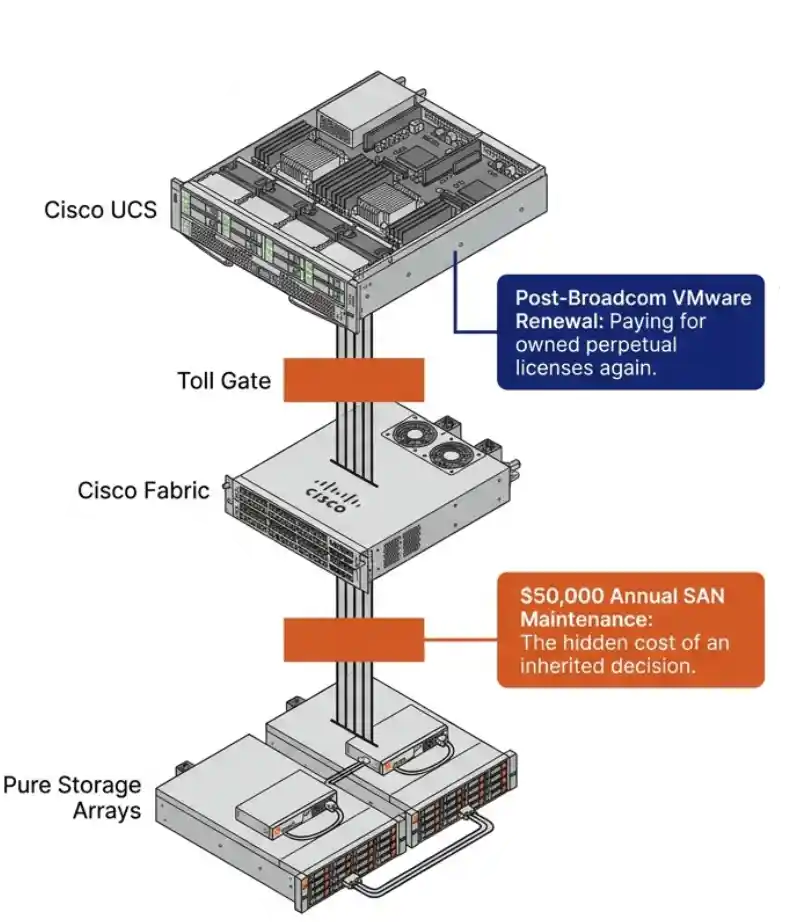
An inherited stack stays invisible until a contract comes up for renewal. Then the choices someone else made start showing up as line items with your name on them.
For Saratoga, three of those items arrived in the same budget year. Server hardware across the group had aged past the point of comfort. The post-Broadcom VMware renewal asked Scott to surrender perpetual licenses he already owned, pay for them again, and layer maintenance on top. Maintenance on the two mirrored Pure Storage arrays ran about $50,000 a year on its own, the quiet third cost that rarely appears in a migration business case.
That storage line deserves more attention than it gets. Teams model the hypervisor renewal and the server refresh with care, then treat array support as a fixed cost of doing business. Ask for the annual maintenance figure on your SAN, then set it beside the price of a platform that pools internal SSDs across the hosts instead. In accounts running an aging array, that one comparison reframes the entire budget conversation.
The Alternatives Had Their Own Problems
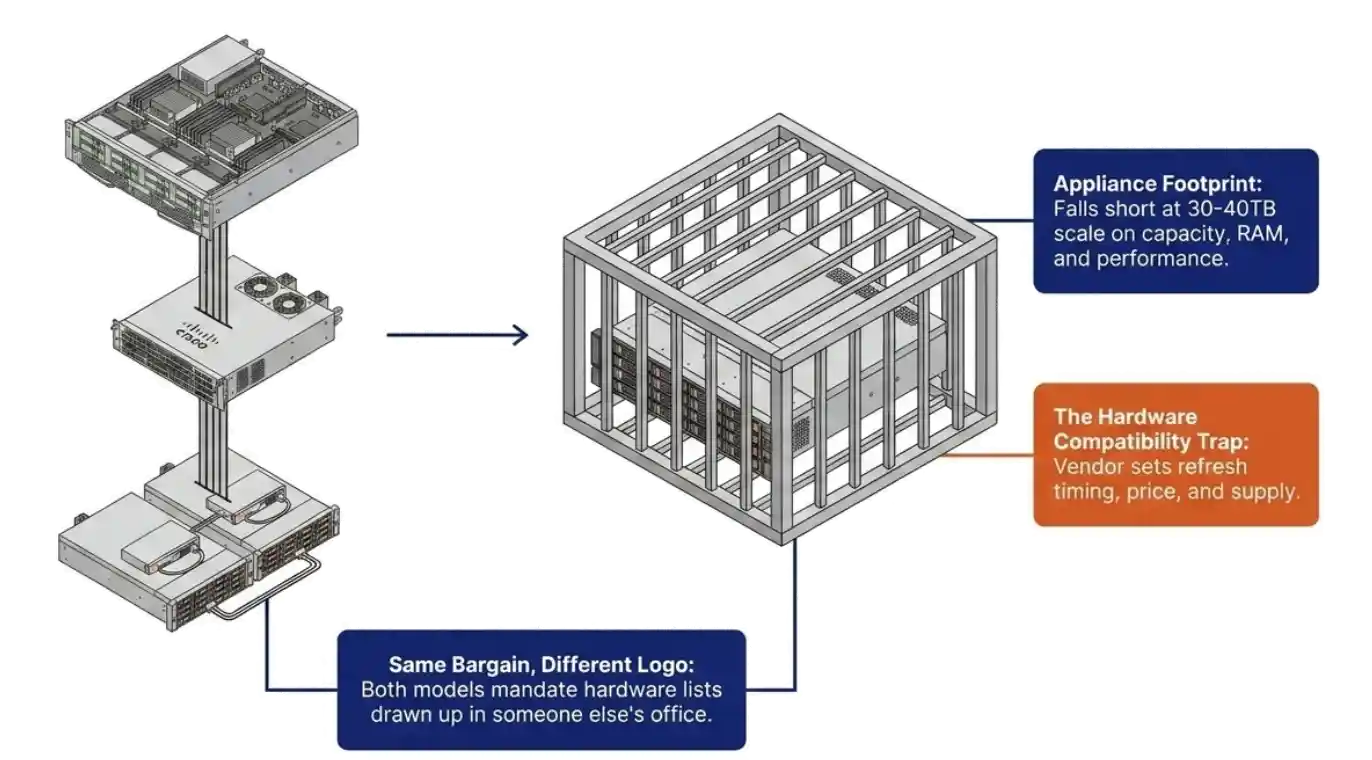
Small-footprint hyperconverged appliances fit the Mississippi property at 10 terabytes. Saratoga sits at 30 to 40 terabytes, and the appliance model fell short in terms of number of nodes supported, total storage capacity, RAM capacity, resiliency, and performance. He considered a more scalable solution like Nutanix, but it was priced so close to VMware that he grouped the two in the same bucket on cost and complexity.
Each vendor asked him to accept a hardware list drawn up in someone else’s office, which is the same bargain his former partner made for him a decade earlier under a different logo. The same trap shows up on the legacy HCI side, where a refresh concentrates in a single chassis and the exit paths run through the narrow set of options a VxRail owner has left.
Hardware choice looks like a procurement preference until you trace what it controls. The compatibility list sets refresh timing, refresh price, and supply availability for years. A buyer restricted to one vendor’s systems waits in that queue at that price, and a buyer running standard x86 servers picks the supplier, the generation, and the delivery date.
Key Terms
Taking the Decision Back
CXTEC, a hardware partner Saratoga trusted since 2016, asked for two days to architect an alternative around VergeOS before Scott placed his order. The design came in at almost half the price of the Scale Computing quote, well under Nutanix, and included more compute, more RAM, and more storage capacity than either.
VergeOS combines virtualization, storage, and networking in a single code base and installs on standard x86 servers, including the hosts already in the rack. Licensing runs per host, so a dense server takes one license rather than a per-core bill that grows with every socket. Collapsing three tiers into one system also removes the array and the fabric, and the maintenance contract leaves with them.
The array bill goes deeper than the maintenance line. An external array charges for redundancy packed inside one box: two storage controllers, a purpose-built chassis, specialized power supplies, and the fabric that connects it to the servers. Saratoga bought that hardware twice and mirrored it. A Pure Storage alternative built on VergeOS pools server-class SSDs inside the hosts and spreads redundancy across nodes, so the money that once bought controllers and enclosures buys capacity instead.
Scott proved the platform himself before committing anything larger. He loaded VergeOS onto a micro PC the company uses as a desktop workstation, a single node with 16 gigabytes of RAM and a terabyte of SSD, then tested installation, performance, instant recovery, and the hardware-agnostic claim. It performed as promised. His administrators reached the same verdict he did.
Then he chose the hardware. Scott selected CXTEC equal2new® systems, the program he already trusted for switches and servers at other properties. VergeIO and CXTEC engineers sized the cluster against his target capacity and his existing VM inventory, picked the nodes, and delivered four servers within a couple of weeks. Buying new added $50,000 to $60,000 for the same result.
Comparison: A Pure Storage Alternative vs. the Inherited Three-Tier Stack
| Inherited three-tier stack | VergeOS on equal2new® | |
|---|---|---|
| Who picks the hardware | Vendor HCL or a mandated standard | The buyer, sized with VergeIO and CXTEC engineers |
| Licensing model | Per core, with perpetual licenses surrendered at renewal | Per host, regardless of core count |
| Storage tier | External array, dual controllers, dedicated chassis and fabric | Server-class SSDs pooled across the hosts |
| Annual array maintenance | About $50,000 at Saratoga, doubled by mirroring | Removed with the array |
| Adding capacity | Array expansion in the vendor’s increments | Add a node, spread the workload wider |
| Retired equipment | Depreciating assets left in the rack | Trade-in credit through CXTEC® |
The Pure Storage Alternative a Year Later
The performance question decides every Pure Storage alternative, and Saratoga was retiring one of the faster all-flash arrays on the market. Scott keeps the same database replicated on both platforms and compares them by feel, the sixth sense an engineer earns over twenty years. His verdict: “If you blindfolded me, I wouldn’t be able to tell.”
Growth works differently now. Adding capacity means adding a node and spreading the workload wider across the cluster, rather than pricing an array expansion in the vendor’s increments.
Own Your Stack Again
An inherited stack costs money every year, and the fix starts with one decision the buyer makes rather than accepts. Scott put Scale Computing, VergeOS, and Nutanix in side-by-side columns for his board, chose his own nodes, held the performance of the array he retired, and took cost out of the budget. He summed it up in one line. “It is no different other than my checkbook has a little more money in it.”
Read the full Saratoga Casino Holdings case study, or hear Scott tell it himself on August 13 at 1:00 PM ET in our live session, How Saratoga Casino Left VMware, Cisco UCS, and Pure Storage Behind.
Frequently Asked Questions
Can VergeOS run on the servers we already own?
How much did Saratoga remove from its budget?
Is refurbished hardware reliable enough for production?
How does a Pure Storage alternative perform against the array it replaces?
What happens to the hardware we retire?
Next Steps
The customer story, the joint announcement, the combined solution details, and the live session are one click away.