• Skip to main content
  • Architecture
    • Overview
      Learn about VergeOS’ unique unfied architecture that integrates virtualization, storage, networking, AI, backup and DR into a single data center operating system
    • Infrastructure Wide Deduplication
      VergeOS transforms deduplication from a storage-only commodity into a native, infrastructure-wide capability that spans storage, virtualization, and networking, eliminating hidden resource taxes
    • VergeFS
      VergeFS is a distributed, high-performance global file system integrated into VergeOS, unifying storage across nodes, tiers, and workloads while eliminating the need for external SANs
    • VergeFabric
      VergeFabric is VergeOS’s integrated virtual networking layer, delivering high-speed, low-latency communication across nodes while eliminating the complexity of traditional network configurations.
    • VergeIQ
      Unlock secure, on-premises generative AI—natively integrated into VergeOS. With VergeIQ, your enterprise gains private AI capabilities without the complexity, cloud dependency, or token-based pricing.
  • Features
    • Virtual Data Centers
      A VergeOS Virtual Data Center (VDC) is a fully isolated, self-contained environment within a single VergeOS instance that includes its own compute, storage, networking, and management controls
    • High Availability
      VergeOS provides a unified, easy-to-manage infrastructure that ensures continuous high availability through automated failover, storage efficiency, clone-like snapshots, and simplified disaster recovery
    • ioClone
      ioClone utilizes global inline deduplication and a blockchain-inspired file system within VergeFS to create instant, independent, space-efficient, and immutable snapshots of individual VMs, volumes, or entire virtual data centers.
    • ioReplicate
      ioReplicate is a unified disaster-recovery solution that enables simple, cost-efficient DR testing and failover via three‑click recovery of entire Virtual Data Centers—including VMs, networking, and storage.
    • ioFortify
      ioFortify creates immutable, restorable VDC checkpoints and provides proactive ransomware detection with instant alerts for rapid recovery and response.
    • ioMigrate
      ioMigrate enables large-scale VMware migrations, automating the rehosting of hundreds of VMs (including networking settings) in seconds with minimal downtime by seamlessly transitioning entire VMware environments onto existing hardware stacks.
    • ioProtect
      ioProtect offers near-real-time replication of VMware VMs—including data, network, and compute configurations—to a remote disaster‑recovery site on existing hardware, slashing DR costs by over 60% while supporting seamless failover and testing in an efficient, turnkey VergeOS Infrastructure.
    • ioOptimize
      ioOptimize leverages AI and machine learning to seamlessly integrate new and old hardware and automatically migrate workloads from aging or failing servers.
  • IT Initiatives
    • VMware Alternative
      VergeOS offers seamless migration from VMware, enhancing performance and scalability by consolidating virtualization, storage, and networking into a single, efficient platform.
    • Hyperconverged Alternative
      VergeIO’s page introduces ultraconverged infrastructure (UCI) via VergeOS, which overcomes HCI limitations by supporting external storage, scaling compute and storage independently, using existing hardware, simplifying provisioning, boosting resiliency, and cutting licensing costs.
    • SAN Replacement / Storage Refresh
      VergeIO’s storage by replacing aging SAN/NAS systems within its ultraconverged infrastructure, enhancing security, scalability, and affordability.
    • Infrastructure Modernization
      Legacy infrastructure is fragmented, complex, and costly, built from disconnected components. VergeOS unifies virtualization, storage, networking, data protection, and AI into one platform, simplifying operations and reducing expenses.
    • Virtual Desktop Infrastructure (VDI)
      VergeOS for VDI delivers a faster, more affordable, and easier-to-manage alternative to traditional VDI setups—offering organizations the ability to scale securely with reduced overhead
    • Secure Research Computing
      Verge.io’s Secure Research Computing solution combines speed, isolation, compliance, scalability, and resilience in a cohesive platform. It’s ideal for institutions needing segmented, compliant compute environments that are easy to deploy, manage, and recover.
    • Venues, Remote Offices, and Edge
      VergeOS delivers resiliency and centralized management across Edge, ROBO, and Venue environments. With one platform, IT can keep remote sites independent while managing them all from a single pane of glass.
  • Blog
      • The Proxmox Storage TaxHere is a clean 35-word excerpt: Excerpt (35 words): Proxmox’s zero licensing cost hides a growing storage tax created by ZFS, Ceph, and external arrays. Capacity waste, expertise demands, and operational overhead increase costs. VergeOS removes these taxes through global deduplication and unified architecture.
      • Comparing Proxmox to VergeOSComparing Proxmox to VergeOS highlights how platform architecture shapes the success of a VMware replacement strategy. Proxmox assembles independent components that require manual alignment, while VergeOS delivers a unified Infrastructure Operating System. This article explains how these differences influence mobility, availability, scaling, and long-term operational stability.
      • The Servers-As-Cattle ModelThe servers-as-cattle model keeps hardware in service until it reaches the end of its usable life, not the end of a vendor refresh cycle. VergeOS makes this possible by running mixed servers from different generations and suppliers inside the same instance, lowering costs and breaking dependence on rigid compatibility lists.
    • View All Posts
  • Resources
    • Become a Partner
      Get repeatable sales and a platform built to simplify your customers’ infrastructure.
    • Technology Partners
      Learn about our technology and service partners who deliver VergeOS-powered solutions for cloud, VDI, and modern IT workloads.
    • White Papers
      Explore VergeIO’s white papers for practical insights on modernizing infrastructure. Each paper is written for IT pros who value clarity, performance, and ROI.
    • In The News
      See how VergeIO is making headlines as the leading VMware alternative. Industry analysts, press, and partners highlight our impact on modern infrastructure.
    • Press Releases
      Get the latest VergeOS press releases for news on product updates, customer wins, and strategic partnerships.
    • Case Studies
      See how organizations like yours replaced VMware, cut costs, and simplified IT with VergeOS. Real results, real environments—no fluff.
    • Webinars
      Explore VergeIO’s on-demand webinars to get straight-to-the-point demos and real-world infrastructure insights.
    • Documents
      Get quick, no-nonsense overviews of VergeOS capabilities with our datasheets—covering features, benefits, and technical specs in one place.
    • Videos
      Watch VergeIO videos for fast, focused walkthroughs of VergeOS features, customer success, and VMware migration strategies.
    • Technical Documentation
      Access in-depth VergeOS technical guides, configuration details, and step-by-step instructions for IT pros.
  • How to Buy
    • Schedule a Demo
      Seeing is beleiving, set up a call with one of our technical architects and see VergeOS in action.
    • Versions
      Discover VergeOS’s streamlined pricing and flexible deployment options—whether you bring your own hardware, choose a certified appliance, or run it on bare metal in the cloud.
    • Test Drive – No Hardware Required
      Explore VergeOS with VergeIO’s hands-on labs and gain real-world experience in VMware migration and data center resiliency—no hardware required
  • Company
    • About VergeIO
      Learn who we are, what drives us, and why IT leaders trust VergeIO to modernize and simplify infrastructure.
    • Support
      Get fast, expert help from VergeIO’s support team—focused on keeping your infrastructure running smoothly.
    • Careers
      Join VergeIO and help reshape the future of IT infrastructure. Explore open roles and growth opportunities.
  • 855-855-8300
  • Contact
  • Search
  • 855-855-8300
  • Contact
  • Search
  • Architecture
    • Overview
    • VergeFS
    • VergeFabric
    • VergeIQ
  • Features
    • Virtual Data Centers
    • High Availability
    • ioClone
    • ioReplicate
    • ioFortify
    • ioMigrate
    • ioProtect
    • ioOptimize
  • IT Initiatives
    • VMware Alternative
    • Hyperconverged Alternative
    • SAN Replacement / Storage Refresh
    • Infrastructure Modernization
    • Virtual Desktop Infrastructure (VDI)
    • Secure Research Computing
    • Venues, Remote Offices, and Edge
  • Blog
  • Resources
    • Become a Partner
    • Technology Partners
    • White Papers
    • In The News
    • Press Releases
    • Case Studies
    • Webinars
    • Documents
    • Videos
    • Technical Documentation
  • How to Buy
    • Schedule a Demo
    • Versions
    • Test Drive – No Hardware Required
  • Company
    • About VergeIO
    • Support
    • Careers
×
  • Architecture
    • Overview
    • VergeFS
    • VergeFabric
    • VergeIQ
  • Features
    • Virtual Data Centers
    • High Availability
    • ioClone
    • ioReplicate
    • ioFortify
    • ioMigrate
    • ioProtect
    • ioOptimize
  • IT Initiatives
    • VMware Alternative
    • Hyperconverged Alternative
    • SAN Replacement / Storage Refresh
    • Infrastructure Modernization
    • Virtual Desktop Infrastructure (VDI)
    • Secure Research Computing
    • Venues, Remote Offices, and Edge
  • Blog
  • Resources
    • Become a Partner
    • Technology Partners
    • White Papers
    • In The News
    • Press Releases
    • Case Studies
    • Webinars
    • Documents
    • Videos
    • Technical Documentation
  • How to Buy
    • Schedule a Demo
    • Versions
    • Test Drive – No Hardware Required
  • Company
    • About VergeIO
    • Support
    • Careers

Proxmox

December 3, 2025 by George Crump

the Proxmox storage tax vs not tax with VergeOS

Organizations evaluating Proxmox as a VMware alternative expect zero licensing costs, but they will also experience the Proxmox storage tax. This tax manifests itself in operational overhead, capacity inefficiency, and architectural compromises that extract payment in different ways. Proxmox offers ZFS for node-local storage and Ceph for distributed storage, each levying its own tax. A third option, external all-flash arrays, reintroduces the siloed infrastructure that drove organizations away from VMware in the first place.

Key Terms (Click to Expand)

Storage Tax: Hidden costs in operational overhead, capacity inefficiency, and architectural complexity that offset zero licensing fees in Proxmox deployments.

Per-Node Deduplication: Data reduction that operates independently on each server, missing duplicate data across multiple nodes in a cluster.

Global Deduplication: Data reduction that identifies and eliminates duplicate blocks across all nodes and workloads in an infrastructure.

SRE-Level Expertise: Site Reliability Engineering knowledge required to deploy and manage complex distributed systems like Ceph.

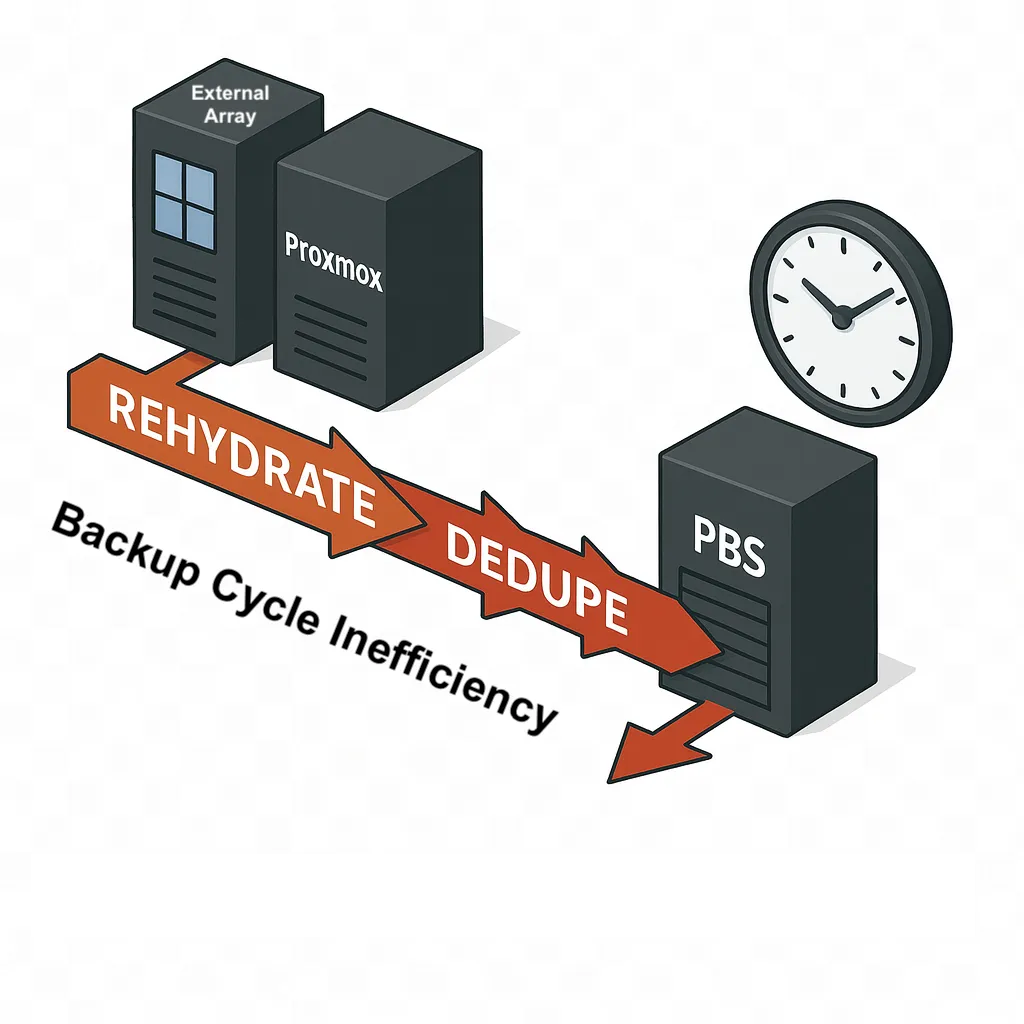
Rehydration Cycle: The process of expanding deduplicated data to full size for transmission, then re-deduplicating at the destination, consuming bandwidth and extending backup windows.

Infrastructure Operating System: A platform that unifies compute, storage, networking, and protection into a single codebase with shared metadata, eliminating coordination between independent subsystems.
The ZFS Storage Tax

ZFS provides strong integrity features with checksumming, compression, and flexible RAID configurations. However, ZFS operates as a node-local construct—each Proxmox node maintains its own independent pool. The first tax arrives immediately: VMs cannot migrate freely because storage doesn’t follow the workload. Proxmox addresses this through asynchronous replication, but it introduces RPO windows during which data can be lost if the source node fails.

the Proxmox storage tax with ZFS

This capacity tax compounds the problem. Most deployments disable ZFS’s mature deduplication due to substantial RAM and CPU overhead. When enabled, deduplication operates per-node only—the same Windows image deployed across five nodes consumes five times the storage. In many-to-one DR scenarios, ten production nodes replicating to a single DR target could require ten times the logical capacity because each stream arrives independently. Organizations pay the storage tax at both production and DR sites.

Eliminating the ZFS Tax: VergeFS provides a global storage model spanning every node in the cluster. VMs move freely because every node sees the same metadata, block references, and deduplication catalog. Global inline deduplication covers every block across every workload without per-node RAM overhead. That Windows image used across twenty VMs consumes the space of a single image. DR targets receive unique deduplicated blocks—no duplicate tax at the DR site.

The Ceph Storage Tax
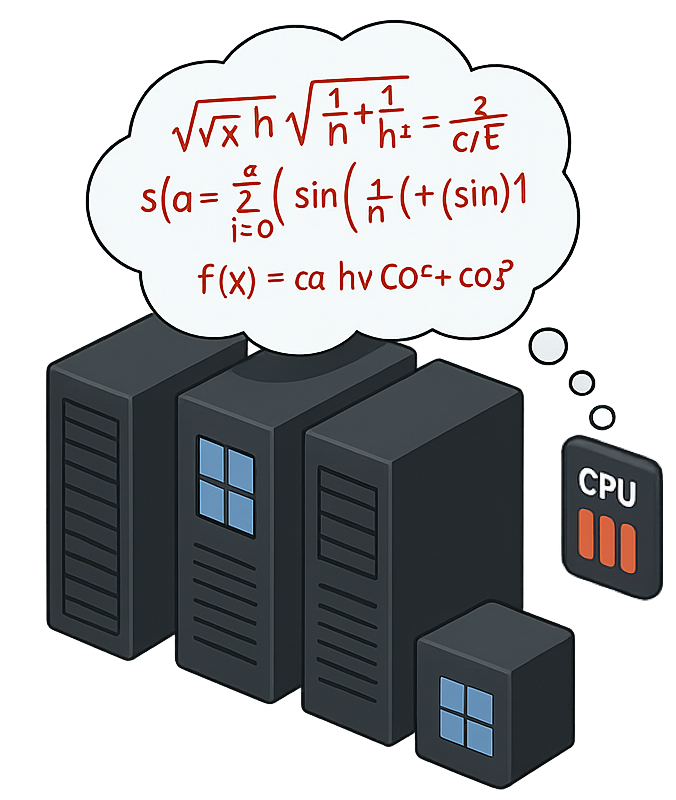
Ceph takes the opposite approach, providing distributed object storage that eliminates VM mobility problems. The tax here is expertise. Ceph demands SRE-level knowledge—the same discipline Google developed for hyperscale operations. Deployment requires understanding placement groups, CRUSH maps, and OSD management. Each client maintains a CRUSH map and performs placement calculations for every I/O operation, consuming CPU cycles that scale with cluster complexity. This is the compute tax—resources diverted from production workloads to storage overhead.

Ceph also levies a capacity tax. Production-ready deduplication doesn’t exist for VM workloads. Organizations accept inflated storage costs or implement separate deduplication at backup layers—paying for another product to solve a problem the platform should handle. Ceph’s redundancy models compound the burden—replicated pools require 3x raw storage for 1x usable capacity.

Live Webinar

Eliminating the Ceph Tax: VergeOS delivers shared storage and VM mobility without Ceph’s expertise tax. There are no CRUSH maps to configure, no placement groups to tune, no OSD management overhead—storage scales linearly as nodes are added, with the platform automatically distributing data. No SRE team required. No compute cycles lost to placement calculations.

The External Array Storage Tax

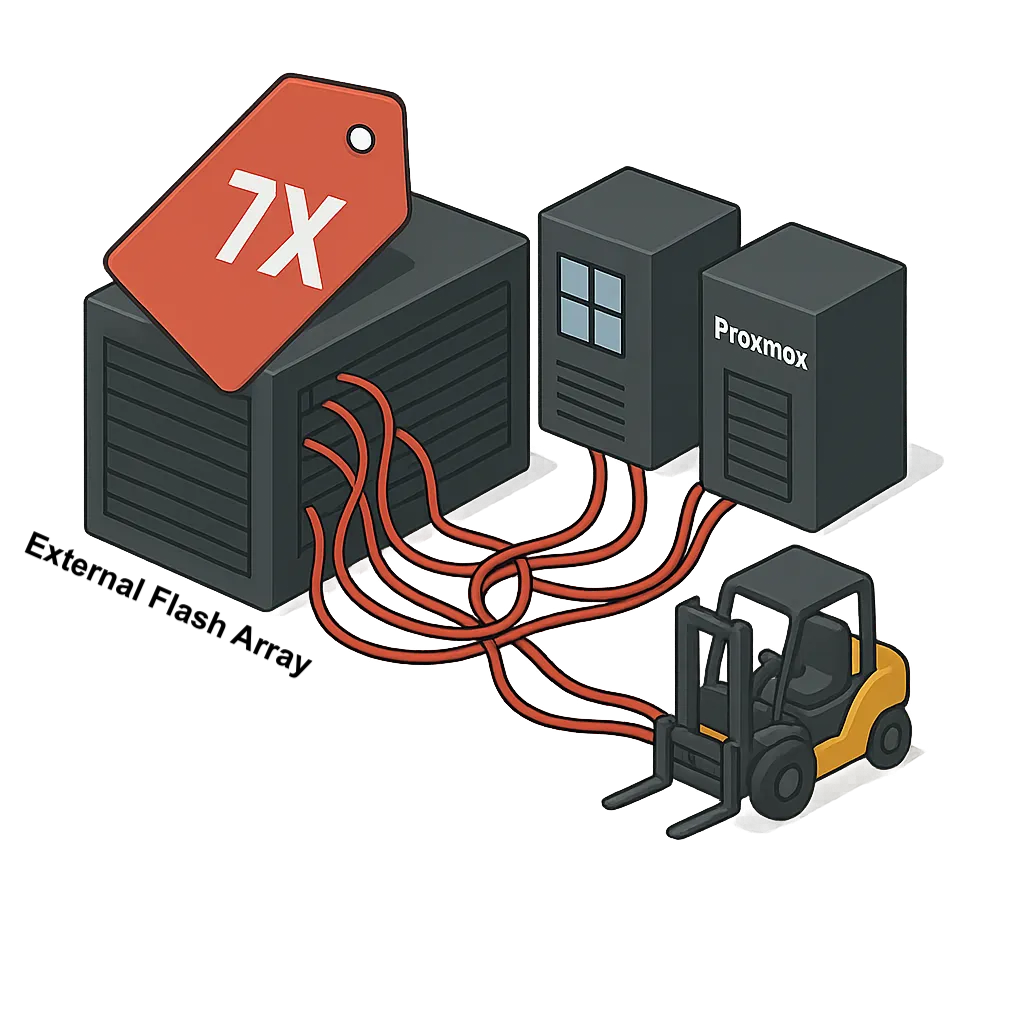
Some organizations consider connecting Proxmox to external all-flash arrays. This path levies the most visible tax: premium controller pricing with excessive storage media markups—7X or more. Organizations pay not just for capacity but for proprietary hardware that could be replaced with commodity alternatives.
eliminate the Proxmox storage tax

The operational tax follows. Storage professionals comfortable with VMware’s vCenter face a learning curve with Proxmox’s Linux-centric management while still managing a separate array console. Scaling demands forklift upgrades rather than incremental growth—a capital expenditure tax that arrives every few years. Storage I/O traverses additional network hops, imposing a latency tax that integrated architectures avoid.

The dedicated-array approach essentially recreates the VMware-era architecture—expensive, siloed, and operationally fragmented—while eliminating the cost advantage that attracted organizations to Proxmox.

Eliminating the Array Tax: VergeOS removes the need for external arrays. Storage integrates directly into the Infrastructure Operating System, eliminating premium controller costs and proprietary markup. Organizations leverage commodity servers and standard storage media while achieving better efficiency through global deduplication than dedicated arrays deliver at their premium prices. Like arrays, VergeOS scales compute and storage independently with storage-only and compute-only nodes—but without vendor lock-in or forklift upgrades.

Storage ApproachStrengthsLimitations / “Tax”How VergeOS Eliminates the Tax
ZFS (Node-Local)Strong integrity, snapshots, and flexible RAIDPer-node dedupe, limited VM mobility, DR multiplies capacityGlobal storage, global dedupe, shared metadata, cluster-wide mobility
Ceph (Distributed)Shared storage, high resilienceRequires SRE expertise, no production dedupe, high CPU cost, 3x replication overheadShared storage without Ceph complexity, plus inline global dedupe
External Flash ArraysMature features, consistent performance7X+ media markup, vendor lock-in, forklift upgrades, added latencyCommodity hardware, integrated storage, no external array dependency
VergeFS (Integrated)Global dedupe, shared metadata, mobility, built-in protectionN/AUnifies compute, storage, and protection

The Data Protection Tax

Regardless of storage path, Proxmox requires Proxmox Backup Server or a third-party alternative for comprehensive data protection—another product to license, deploy, and manage. When production storage uses deduplication, data must be rehydrated to full size before transmission to PBS, which then re-deduplicates. This dedupe-rehydrate-dedupe cycle imposes a bandwidth tax, extends backup windows, and complicates recovery operations. Large environments pay the ultimate tax: recovery times measured in hours or days.

Eliminating the Protection Tax: VergeOS addresses data protection through integrated snapshots, ioReplicate, and ioFortify—eliminating rehydration cycles. Creating a snapshot is a metadata operation that completes in seconds regardless of data volume. Snapshots become independent, space-efficient, immutable clones. Recovery from ransomware involves advancing metadata to a known-good point—an operation that completes in seconds even for 100TB or 100PB environments—no separate backup product required.

The DR Tax

eliminate the Proxmox storage tax

Cross-site resilience with Proxmox requires different approaches depending on the storage backend, each extracting its own tax. ZFS environments combine asynchronous replication with backup-based DR through PBS. Ceph offers RBD mirroring or stretch clusters—each with distinct complexity taxes. External arrays introduce their own DR mechanisms requiring matching arrays at both locations, doubling hardware investment.

Organizations pay the coordination tax: aligning array-level replication with Proxmox VM configurations, ensuring replicated volumes match VM definitions, and spanning multiple management interfaces during failover.

Eliminating the DR Tax: Disaster recovery follows a single architectural pattern in VergeOS. Administrators create a Virtual Data Center at the DR location. ioReplicate sends deduplicated block changes to that VDC. VM configurations, networking rules, storage references, and protection policies remain consistent because they operate within the same Infrastructure Operating System. No coordination tax. No matching hardware tax. DR becomes an extension of the platform.

DR readiness is more crucial than choosing a VMware alternative hypervisor. If disaster recovery isn’t possible, the hypervisor you initially chose becomes irrelevant. Most hypervisors fall short of VMware’s DR capabilities, but VergeOS surpasses them by offering better DR features, reducing costs, and simplifying recovery management.

Key Takeaways

  • Proxmox’s zero licensing cost conceals significant storage taxes in operational overhead and capacity inefficiency.
  • ZFS per node deduplication multiplies storage requirements across clusters and DR sites.
  • Ceph demands SRE level expertise, creating ongoing operational costs most organizations underestimate.
  • External arrays reintroduce VMware era issues including premium pricing, vendor lock in, and siloed architecture.
  • VergeOS eliminates these taxes through global deduplication, unified architecture, and integrated data protection.
What is the Proxmox storage tax?

The Proxmox storage tax refers to hidden operational costs, capacity inefficiencies, and architectural compromises that offset Proxmox’s zero licensing fee. These include per-node deduplication limitations with ZFS, SRE-level expertise requirements with Ceph, and premium hardware costs with external arrays.

Does ZFS deduplication work across Proxmox nodes?

No. ZFS deduplication operates per-node only. The same data on five different nodes consumes five times the storage. This limitation extends to DR scenarios where many-to-one replication multiplies capacity requirements.

Why does Ceph require SRE-level expertise?

Ceph requires knowledge of distributed systems for deployment, tuning, and troubleshooting. Understanding placement groups, CRUSH maps, and OSD management requires skills beyond traditional storage administration, increasing operational costs.

Can external arrays eliminate Proxmox storage limitations?

External arrays solve some problems but introduce others: 7X+ storage media markups, vendor lock-in, forklift upgrade cycles, and the same siloed architecture organizations wanted to escape from VMware.

How does VergeOS eliminate the Proxmox storage tax?

VergeOS provides global inline deduplication without per-node overhead, shared storage without Ceph complexity, and integrated data protection without separate backup products—all within a unified Infrastructure Operating System.
Stop Paying the Storage Tax

Proxmox’s zero licensing cost conceals taxes that arrive throughout the infrastructure lifecycle: capacity taxes from missing or per-node deduplication, expertise taxes from Ceph’s complexity, hardware taxes from external arrays, bandwidth taxes from rehydration cycles, and coordination taxes from multi-vendor DR.

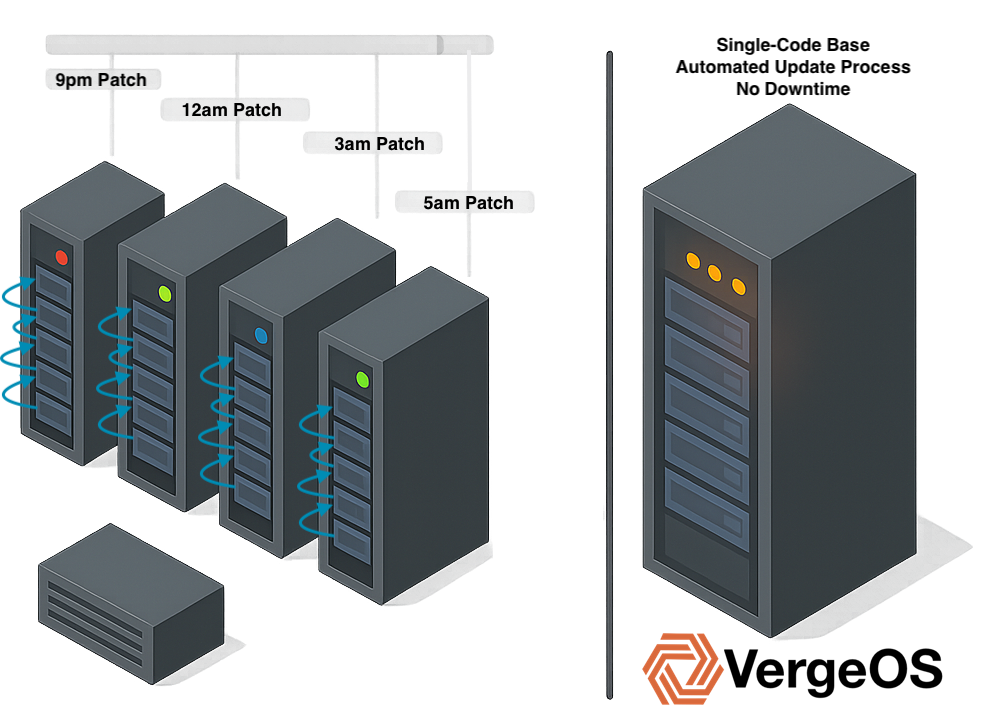
VergeOS eliminates these taxes through a fundamentally different approach—an Infrastructure Operating System that unifies compute, storage, networking, and data protection into a single codebase. One update cycle. One management interface. One support team. No hidden taxes.

Storage is only one part of the infrastructure conversation when comparing Proxmox to VergeOS. Read our blog Comparing Proxmox to VergeOS to dive deeper into other important differences.

For production enterprise workloads, the Proxmox storage tax alone justifies evaluating an Infrastructure Operating System that eliminates these costs by design.

Filed Under: Storage Tagged With: Alternative, KVM, Proxmox, VMware

December 2, 2025 by George Crump

When IT professionals start comparing Proxmox to VergeOS, they often assume the decision centers on choosing a new hypervisor to replace VMware. The real decision is determining if virtualization, networking, availability, and data protection can function as a single system. A platform succeeds only when these elements move together.

Proxmox feels familiar to teams with strong Linux experience, giving the sense that a hypervisor swap offers a clean transition. That impression changes once teams evaluate how Proxmox connects compute, networking, storage, and protection. Each part operates independently, and administrators must keep those parts aligned.

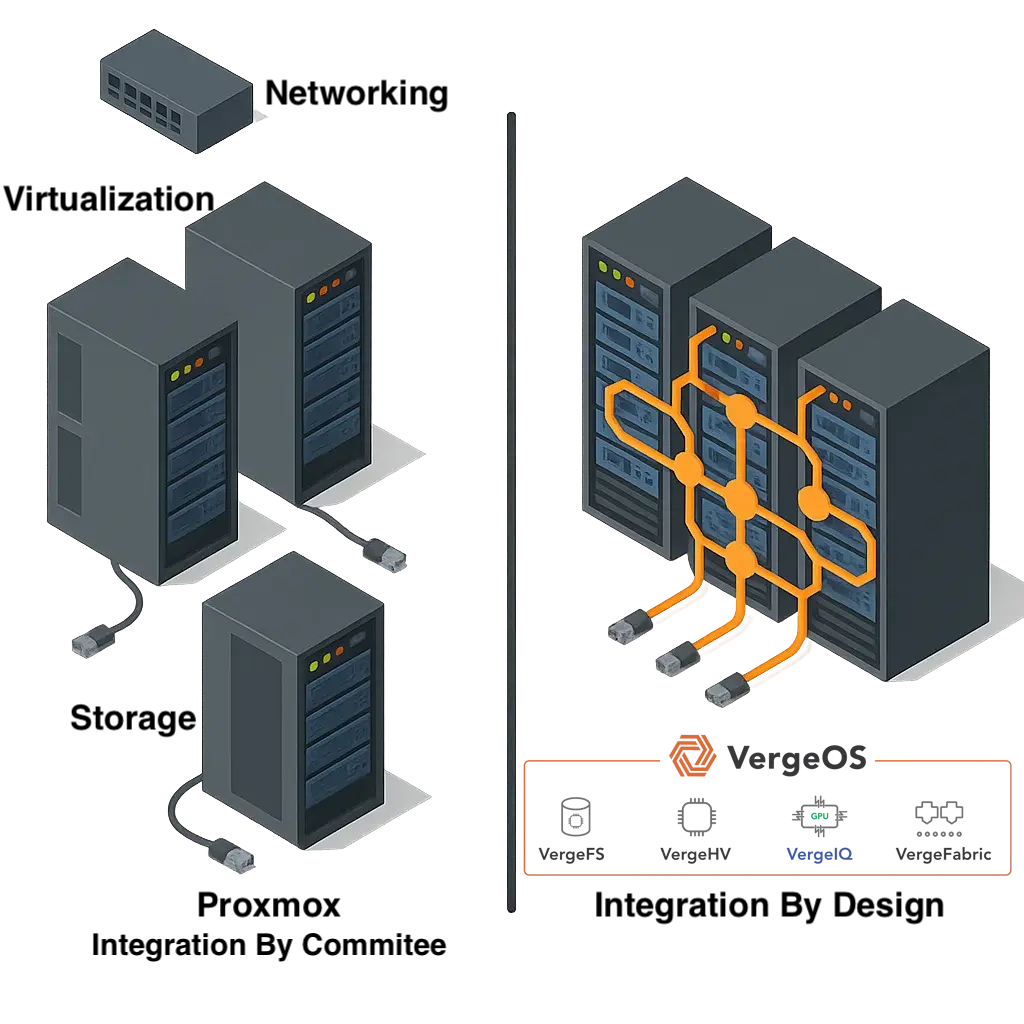
VergeOS takes a different path by treating the hypervisor as a service inside an Infrastructure Operating System. Compute, storage, networking, mobility, and protection follow the same architectural rules across all nodes. Each service draws from the same metadata structure, eliminating the coordination work that modular platforms impose on the operator. Teams gain a predictable environment for migrations, failovers, and growth because the platform manages these functions as one system.

This distinction frames the rest of the comparison. A platform built from independent subsystems introduces drift, coordination work, and rising complexity as clusters grow. A platform that unifies core functions creates a consistent environment for mobility, networking, and recovery. The contrast becomes more apparent as teams examine how Proxmox and VergeOS behave under load, during failures, and during cluster expansion.

Comparing Proxmox to VergeOS: Architectures

A Modular Assembly of Independent Components

comparing Proxmox to VergeOS

Proxmox assembles its platform from separate elements. KVM supplies compute. Linux provides the operating base. ZFS, Ceph, or an external array can supply storage. Networking depends on Linux bridges, VLAN constructs, or Open vSwitch. Backup requires Proxmox Backup Server (PBS) or a third-party tool. Each component behaves well alone. None forms a unified architecture. While the Proxmox GUI attempts to hide the independence of these components, administrators must align these pieces before the environment can produce predictable results.

Networking as a Separate System

Networking highlights this pattern. Each Proxmox node implements Linux networking constructs for packet forwarding. Bridges, bonds, and VLAN definitions require manual configuration. Each option introduces its own behaviors and its own failure characteristics. When teams want consistent mobility, they must maintain identical configurations across nodes. Drift appears quickly because each node evolves with its own configuration history.

Storage Fragmentation Across the Cluster

Storage follows the same structure. ZFS delivers node-local storage. Ceph delivers distributed storage. External arrays centralize storage. Each model uses different tuning guidelines, scaling behaviors, and recovery patterns. Proxmox does not unify these components across the cluster. Administrators test combinations, confirm compatibility, and correct issues as nodes evolve. Flexibility increases, but so does the integration burden. We dive deeper into the challenges of storage in our white paper “Understanding the Proxmox Storage Challenges”, available exclusively to attendees of our upcoming webinar, “VergeOS or Proxmox, A Closer Look at VMware Successors.”

Protection and Availability in Separate Domains

Availability and protection follow the same split. The Proxmox HA manager operates independently from storage. PBS handles protection separately. Each follows different rules for recovery, retention, and consistency. Coordinating these functions becomes the operator’s responsibility. Proxmox delivers the parts. The user builds the system.

VergeOS Takes a Different Path

VergeOS embeds the hypervisor within an Infrastructure Operating System that integrates compute, storage, networking, protection, and availability. Each component behaves consistently because it belongs to the same architecture. Configuration applies across nodes. Updates follow one lifecycle. Configuration Drift does not accumulate. The integration work that Proxmox places on the operator becomes part of the VergeOS platform and is not a concern for IT administrators. Watch our CTO, Greg Campbell, dive deep into the VergeOS architecture in this LightBoard video.

Comparing Proxmox to VergeOS: Operational Models

Independent Lifecycles Create Complexity

Proxmox places significant operational responsibility on the administrator. Each subsystem updates independently and carries its own risks. ZFS and Ceph follow separate release cycles. Linux introduces kernel changes that influence device behavior. PBS adds another update stream. Administrators test combinations before deployment—the platform functions, but only when the operator maintains alignment across all layers.

Troubleshooting Requires Multi-Domain Expertise

Troubleshooting follows the same pattern. A performance issue might originate in ZFS, Ceph, networking, KVM, or PBS. Logs live in different places. Metrics flow through various tools. Expertise in one area does not always translate to another. Resolution time increases because the architecture introduces many potential fault paths.

VergeOS Delivers Operational Simplicity

VergeOS presents one operational model. Storage, networking, protection, and compute share the same metadata pool and control plane. Engineers run one update process. Troubleshooting follows one diagnostic path. The system understands where data lives, how networks map to workloads, and how protection applies. Far fewer unknowns exist. The environment behaves as a single platform rather than several connected parts.

Comparing Proxmox to VergeOS: Mobility, Resilience, and HA Behavior

Mobility Depends on Storage Choices in Proxmox

Mobility and availability expose architectural gaps quickly. Proxmox mobility depends on storage design. ZFS ties storage to one node. Ceph distributes storage but introduces requirements for cluster health and OSD stability. Replication intervals influence the likelihood of data loss. Failover timing depends on subsystem alignment. Administrators must coordinate most of these variables manually.

VergeOS Delivers Mobility Through Unified Metadata

VergeOS uses a single metadata pool that applies across the cluster. VM mobility becomes a function of reading shared metadata rather than coordinating separate systems. Availability improves because recovery follows one architecture that understands where data lives and how networks connect. Movement, placement, and recovery follow one consistent model. Even deduplication has an advantage over AFA-based deduplication since everything, virtualization, networking, AI, and storage are now deduplication aware.

Comparing Proxmox to VergeOS: Scaling the Platform

Growth Exposes Architectural Differences

Scaling introduces variation in Proxmox quickly. New nodes bring their own pools, network settings, and state. ZFS pools differ. Ceph rebalances. VLAN definitions drift. Each addition increases the coordination work required to maintain stability.

VergeOS Delivers Predictably Across Mixed Hardware

VergeOS grows by extending one architecture. New nodes access the same metadata, rules, and operational model. Mixed hardware joins the cluster easily. Customers often comment on how quickly they can expand VergeOS environments. Many describe it as the fastest expansion experience they have ever seen in a production environment.

Conclusion

The architectural difference between Proxmox and VergeOS shapes every operational outcome. Proxmox provides a modular platform that rewards teams with deep expertise across multiple domains. VergeOS delivers a unified Infrastructure Operating System that holds those domains together and dramatically simplifies IT operations.

Filed Under: Virtualization Tagged With: Alternative, KVM, Proxmox, VMware

855-855-8300

Get Started

  • Versions
  • Request Tour

VergeIO For

  • VMware Alternative
  • SAN Replacement
  • Solving Infrastructure Modernization Challenges
  • Artificial Intelligence
  • Hyperconverged
  • Server Room
  • Secure Research Computing

Product

  • Benefits
  • Documents
  • Architecture Overview
  • Use Cases
  • Videos

Company

  • About VergeIO
  • Blog
  • Technical Documentation
  • Legal

© 2025 Verge.io. All Rights Reserved.