• Skip to main content
  • Architecture
    • Overview
      Learn about VergeOS’ unique unfied architecture that integrates virtualization, storage, networking, AI, backup and DR into a single data center operating system
    • Infrastructure Wide Deduplication
      VergeOS transforms deduplication from a storage-only commodity into a native, infrastructure-wide capability that spans storage, virtualization, and networking, eliminating hidden resource taxes
    • VergeFS
      VergeFS is a distributed, high-performance global file system integrated into VergeOS, unifying storage across nodes, tiers, and workloads while eliminating the need for external SANs
    • VergeFabric
      VergeFabric is VergeOS’s integrated virtual networking layer, delivering high-speed, low-latency communication across nodes while eliminating the complexity of traditional network configurations.
    • Infrastructure Automation
      VergeOS integrates Packer, Terraform, and Ansible to deliver an end-to-end automation pipeline that eliminates infrastructure drift and enables predictable, scalable deployments.
    • VergeIQ
      Unlock secure, on-premises generative AI—natively integrated into VergeOS. With VergeIQ, your enterprise gains private AI capabilities without the complexity, cloud dependency, or token-based pricing.
  • Features
    • Virtual Data Centers
      A VergeOS Virtual Data Center (VDC) is a fully isolated, self-contained environment within a single VergeOS instance that includes its own compute, storage, networking, and management controls
    • High Availability
      VergeOS provides a unified, easy-to-manage infrastructure that ensures continuous high availability through automated failover, storage efficiency, clone-like snapshots, and simplified disaster recovery
    • ioClone
      ioClone utilizes global inline deduplication and a blockchain-inspired file system within VergeFS to create instant, independent, space-efficient, and immutable snapshots of individual VMs, volumes, or entire virtual data centers.
    • ioReplicate
      ioReplicate is a unified disaster-recovery solution that enables simple, cost-efficient DR testing and failover via three‑click recovery of entire Virtual Data Centers—including VMs, networking, and storage.
    • ioFortify
      ioFortify creates immutable, restorable VDC checkpoints and provides proactive ransomware detection with instant alerts for rapid recovery and response.
    • ioMigrate
      ioMigrate enables large-scale VMware migrations, automating the rehosting of hundreds of VMs (including networking settings) in seconds with minimal downtime by seamlessly transitioning entire VMware environments onto existing hardware stacks.
    • ioProtect
      ioProtect offers near-real-time replication of VMware VMs—including data, network, and compute configurations—to a remote disaster‑recovery site on existing hardware, slashing DR costs by over 60% while supporting seamless failover and testing in an efficient, turnkey VergeOS Infrastructure.
    • ioOptimize
      ioOptimize leverages AI and machine learning to seamlessly integrate new and old hardware and automatically migrate workloads from aging or failing servers.
    • ioGuardian
      ioGuardian is VergeIO’s built-in data protection and recovery capability, providing near-continuous backup and rapid VM recovery during multiple simultaneous drive or server failures.
  • IT Initiatives
    • VMware Alternative
      VergeOS offers seamless migration from VMware, enhancing performance and scalability by consolidating virtualization, storage, and networking into a single, efficient platform.
    • Hyperconverged Alternative
      VergeIO’s page introduces ultraconverged infrastructure (UCI) via VergeOS, which overcomes HCI limitations by supporting external storage, scaling compute and storage independently, using existing hardware, simplifying provisioning, boosting resiliency, and cutting licensing costs.
    • SAN Replacement / Storage Refresh
      VergeIO’s storage by replacing aging SAN/NAS systems within its ultraconverged infrastructure, enhancing security, scalability, and affordability.
    • Infrastructure Modernization
      Legacy infrastructure is fragmented, complex, and costly, built from disconnected components. VergeOS unifies virtualization, storage, networking, data protection, and AI into one platform, simplifying operations and reducing expenses.
    • Virtual Desktop Infrastructure (VDI)
      VergeOS for VDI delivers a faster, more affordable, and easier-to-manage alternative to traditional VDI setups—offering organizations the ability to scale securely with reduced overhead
    • Secure Research Computing
      VergeIO's Secure Research Computing solution combines speed, isolation, compliance, scalability, and resilience in a cohesive platform. It’s ideal for institutions needing segmented, compliant compute environments that are easy to deploy, manage, and recover.
    • Venues, Remote Offices, and Edge
      VergeOS delivers resiliency and centralized management across Edge, ROBO, and Venue environments. With one platform, IT can keep remote sites independent while managing them all from a single pane of glass.
  • Blog
      • From Zero to RAG in a GPU Virtual WorkstationNVIDIA's RAG Application Toolkit turns a GPU virtual workstation into an AI development environment. VergeOS makes the infrastructure invisible.
      • GPU Infrastructure Without the ComplexityGPU infrastructure doesn't have to require GPU specialists. VergeOS delivers point-and-click MIG configuration, automated driver management, and NVIDIA joint support — so standard IT teams can run visual compute and AI development workloads on the infrastructure they already own.
      • Data Availability is Critical During the Memory SupercycleRising RAM and flash prices force organizations onto aging and refurbished hardware. Data availability determines whether those hardware failures are routine events or business-stopping emergencies. VergeOS delivers layered protection from the drive level through node-level redundancy to cross-site replication, all on the hardware you already own.
    • View All Posts
  • Resources
    • Become a Partner
      Get repeatable sales and a platform built to simplify your customers’ infrastructure.
    • Technology Partners
      Learn about our technology and service partners who deliver VergeOS-powered solutions for cloud, VDI, and modern IT workloads.
    • White Papers
      Explore VergeIO’s white papers for practical insights on modernizing infrastructure. Each paper is written for IT pros who value clarity, performance, and ROI.
    • In The News
      See how VergeIO is making headlines as the leading VMware alternative. Industry analysts, press, and partners highlight our impact on modern infrastructure.
    • Press Releases
      Get the latest VergeOS press releases for news on product updates, customer wins, and strategic partnerships.
    • Case Studies
      See how organizations like yours replaced VMware, cut costs, and simplified IT with VergeOS. Real results, real environments—no fluff.
    • Webinars
      Explore VergeIO’s on-demand webinars to get straight-to-the-point demos and real-world infrastructure insights.
    • Documents
      Get quick, no-nonsense overviews of VergeOS capabilities with our datasheets—covering features, benefits, and technical specs in one place.
    • Videos
      Watch VergeIO videos for fast, focused walkthroughs of VergeOS features, customer success, and VMware migration strategies.
    • Technical Documentation
      Access in-depth VergeOS technical guides, configuration details, and step-by-step instructions for IT pros.
  • How to Buy
    • Schedule a Demo
      Seeing is believing, set up a call with one of our technical architects and see VergeOS in action.
    • Versions
      Discover VergeOS’s streamlined pricing and flexible deployment options—whether you bring your own hardware, choose a certified appliance, or run it on bare metal in the cloud.
    • Test Drive – No Hardware Required
      Explore VergeOS with VergeIO’s hands-on labs and gain real-world experience in VMware migration and data center resiliency—no hardware required
  • Company
    • About VergeIO
      Learn who we are, what drives us, and why IT leaders trust VergeIO to modernize and simplify infrastructure.
    • Support
      Get fast, expert help from VergeIO’s support team—focused on keeping your infrastructure running smoothly.
    • Careers
      Join VergeIO and help reshape the future of IT infrastructure. Explore open roles and growth opportunities.
  • 855-855-8300
  • Contact
  • Search
  • 855-855-8300
  • Contact
  • Search
  • Architecture
    • Overview
    • VergeFS
    • VergeFabric
    • Infrastructure Automation
    • VergeIQ
  • Features
    • Virtual Data Centers
    • High Availability
    • ioClone
    • ioReplicate
    • ioFortify
    • ioMigrate
    • ioProtect
    • ioOptimize
    • ioGuardian
  • IT Initiatives
    • VMware Alternative
    • Hyperconverged Alternative
    • SAN Replacement / Storage Refresh
    • Infrastructure Modernization
    • Virtual Desktop Infrastructure (VDI)
    • Secure Research Computing
    • Venues, Remote Offices, and Edge
  • Blog
  • Resources
    • Become a Partner
    • Technology Partners
    • White Papers
    • In The News
    • Press Releases
    • Case Studies
    • Webinars
    • Documents
    • Videos
    • Technical Documentation
  • How to Buy
    • Schedule a Demo
    • Versions
    • Test Drive – No Hardware Required
  • Company
    • About VergeIO
    • Support
    • Careers
×
  • Architecture
    • Overview
    • VergeFS
    • VergeFabric
    • Infrastructure Automation
    • VergeIQ
  • Features
    • Virtual Data Centers
    • High Availability
    • ioClone
    • ioReplicate
    • ioFortify
    • ioMigrate
    • ioProtect
    • ioOptimize
    • ioGuardian
  • IT Initiatives
    • VMware Alternative
    • Hyperconverged Alternative
    • SAN Replacement / Storage Refresh
    • Infrastructure Modernization
    • Virtual Desktop Infrastructure (VDI)
    • Secure Research Computing
    • Venues, Remote Offices, and Edge
  • Blog
  • Resources
    • Become a Partner
    • Technology Partners
    • White Papers
    • In The News
    • Press Releases
    • Case Studies
    • Webinars
    • Documents
    • Videos
    • Technical Documentation
  • How to Buy
    • Schedule a Demo
    • Versions
    • Test Drive – No Hardware Required
  • Company
    • About VergeIO
    • Support
    • Careers

NVIDIA - VergeOS AI Workstation Campaign

April 9, 2026 by George Crump

NVIDIA built the AI toolkit. VergeOS makes the infrastructure disappear.
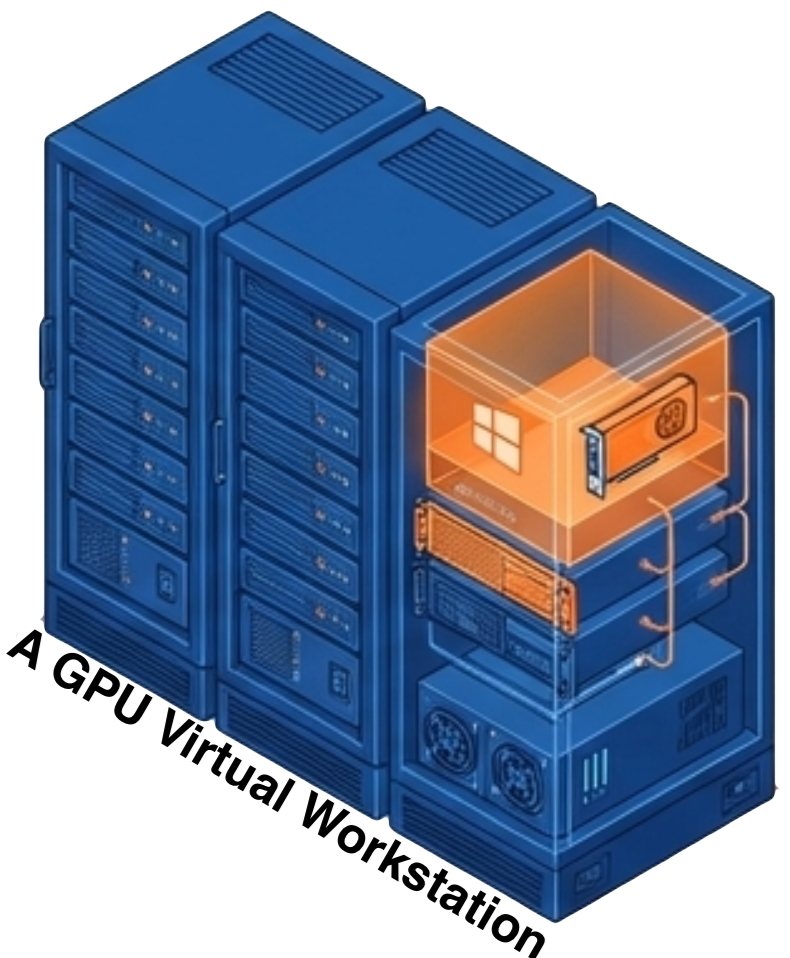
A GPU Virtual Workstation

Every AI project hits the same inflection point. Someone identifies a use case worth building. The engineering team wants to connect an LLM to internal documentation, simulation results, product specifications, or design archives so domain experts can query their own data in natural language. The concept is retrieval-augmented generation, and the ideal place to build it is a GPU virtual workstation. The use case is sound. Then someone asks the question that stalls the project: where is the infrastructure to run it?

A growing number of organizations are standardizing on GPU virtual workstations. Not cloud endpoints with metered GPU hours. Not shared notebook environments where teams compete for resources every morning. The model is a self-contained virtual machine with dedicated GPU resources, running on infrastructure the IT team already manages. NVIDIA’s AI Virtual Workstation toolkit initiative makes this practical. VergeOS makes the infrastructure underneath it invisible.

Key Takeaways
  • NVIDIA’s RAG Application Toolkit provides a repeatable, guided path from blank VM to working retrieval-augmented generation application inside a GPU virtual workstation.
  • RAG applications running in VMs inherit full infrastructure discipline: snapshots, replication, cloning, and disaster recovery that physical workstation deployments lack.
  • VergeOS compresses GPU provisioning, driver deployment, vGPU profile assignment, and MIG partitioning into a point-and-click workflow that requires no GPU specialist.
  • NVIDIA introduced VergeOS as a supported vGPU platform, establishing joint support paths so both vendors stand behind the deployment.
  • The RTX Pro 6000 Blackwell Server Edition supports up to four MIG-isolated RAG environments from a single GPU, and the RTX 4500 fits 16 cards in a 4U chassis for density-first deployments.
  • Organizations that build the GPU infrastructure layer once deploy every subsequent NVIDIA AI toolkit as an application project rather than an infrastructure project.

The Toolkit Changes What “Getting Started” Means

NVIDIA launched the AI vWS toolkit program approximately a year ago. The observation behind it was straightforward. Current-generation data center and workstation GPUs, including Blackwell-architecture cards, now have the memory capacity and bandwidth to run GPU-accelerated inference and development inside virtual machines. Quantization advances at the framework and hardware level expand what fits inside a single vGPU allocation. The missing piece was never hardware. It was a guided path from blank VM to working application.

The RAG Application Toolkit is the most popular entry point. It walks an engineering or data science team through the complete GPU virtual workstation deployment: VM provisioning, NVIDIA AI Workbench configuration, vector database deployment, LLM loading, and a functional chat interface that queries organizational data. The minimum VM footprint is modest at 8 vCPUs, 32 GB of system memory, 120 GB of storage, and a vGPU allocation.
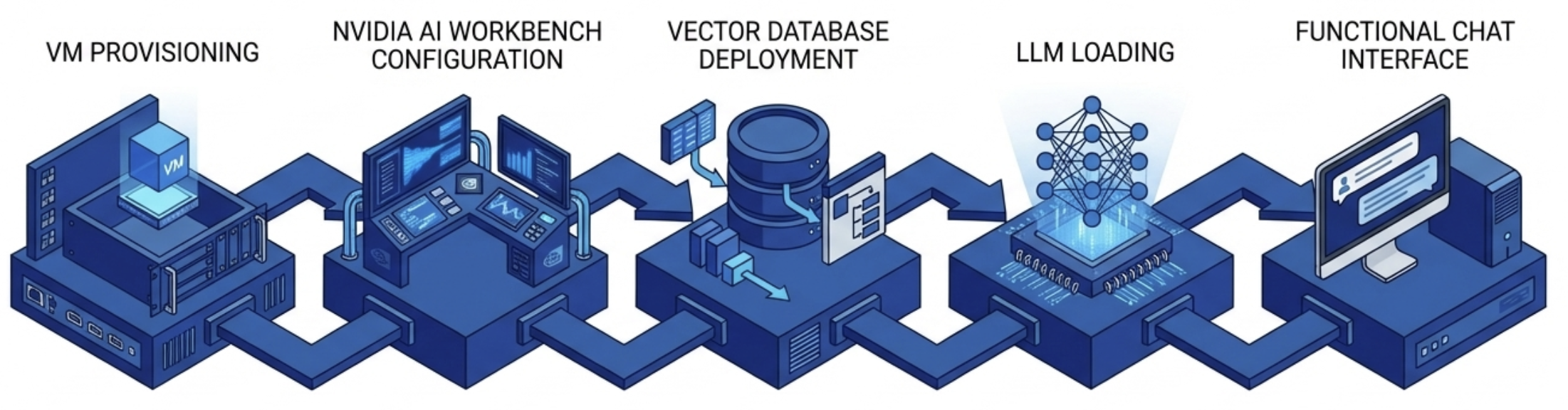
NVIDIA RAG Application Toolkit for GPU Virtual Workstation

No single component here is new. Vector databases, embedding models, and LLM inference are all well-understood technologies. The significance is that NVIDIA has assembled them into a repeatable recipe that runs inside a virtual workstation. That is the same kind of environment IT teams already know how to provision, snapshot, replicate, and recover. That last point matters more than most AI conversations acknowledge.

Key Terms
Retrieval-Augmented Generation (RAG)
An architecture that connects a large language model to external data sources through a vector database, allowing the LLM to answer questions using organizational data it was not trained on.
NVIDIA AI Virtual Workstation (AI vWS) Toolkit
A collection of guided deployment workflows from NVIDIA that walk teams through standing up AI applications inside GPU-accelerated virtual machines, including RAG, agentic RAG, fine-tuning, and video search.
NVIDIA vGPU
A software layer that allows multiple virtual machines to share a single physical GPU, with each VM receiving dedicated memory and a full NVIDIA driver stack. Requires a separate software license from an NVIDIA-authorized partner.
MIG (Multi-Instance GPU)
Hardware-level GPU partitioning that divides a single GPU into isolated instances with dedicated compute engines, memory, and bandwidth. Isolation is enforced in silicon, not software.
NVIDIA AI Sizing Advisor
A free, wizard-driven tool from NVIDIA that recommends GPU configurations for specific AI workloads and includes a smoke test to validate the recommendation before deployment.
FP4 (4-bit Floating Point)
A low-precision numerical format supported by fifth-generation Tensor Cores in Blackwell GPUs. Increases inference throughput by processing more operations per cycle at reduced precision.

AI Development Needs Infrastructure Discipline

The gap between a working AI prototype and a production-ready deployment is almost entirely an infrastructure problem. Data scientists build remarkable things in notebooks and local environments. Then someone needs to make it recoverable, reproducible, and manageable at the organizational level.
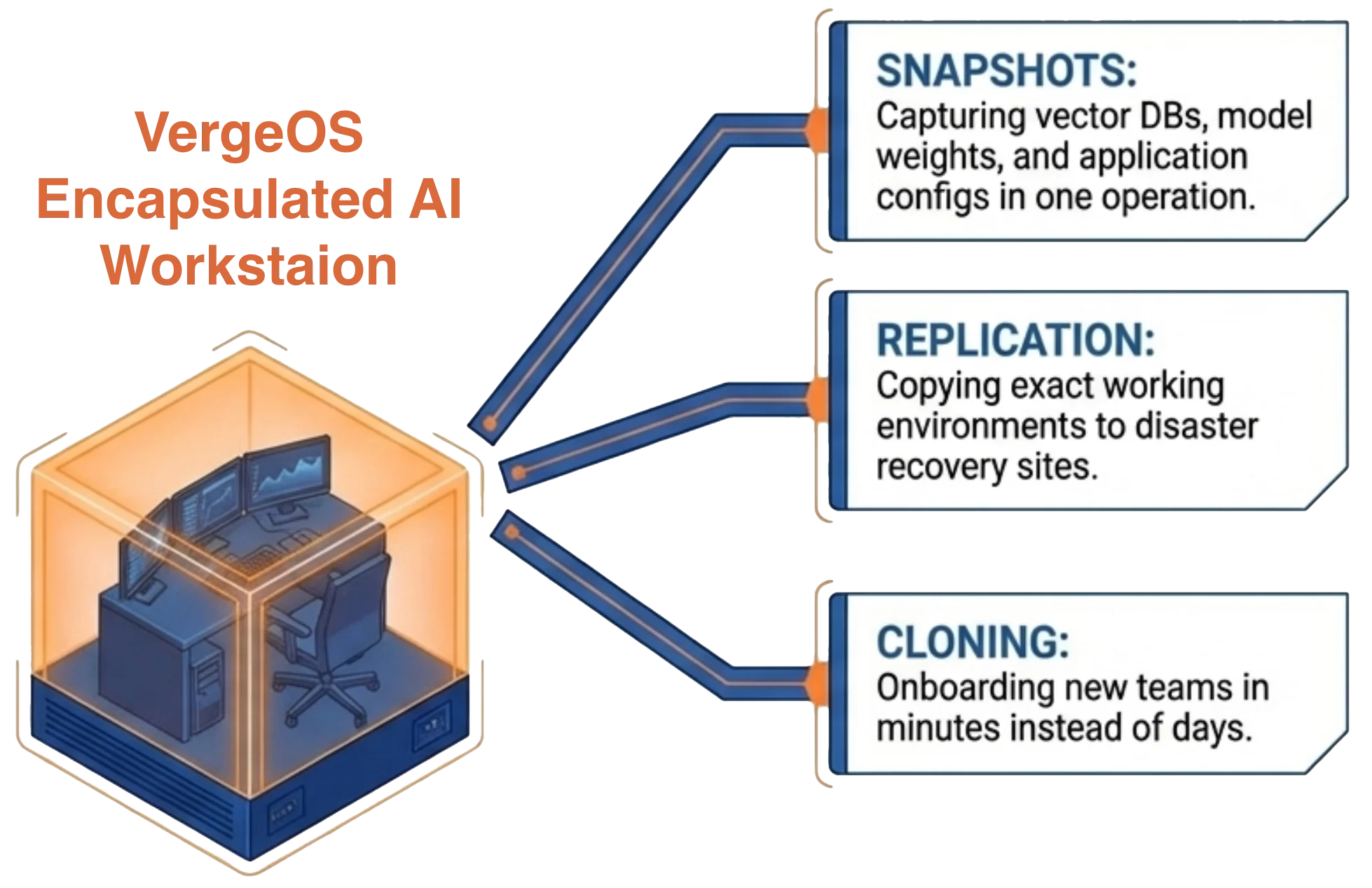
VergeOS Encapsulated GPU Virtual Workstation

A RAG application running on a developer’s physical workstation has no backup strategy. It has no replication path. If the hardware fails, the environment gets rebuilt manually. If a second team needs the same configuration, someone walks through the entire installation process again.

A RAG application running inside a GPU virtual workstation inherits every infrastructure capability the platform provides. Snapshots capture the entire environment, the vector database, the model weights, the application configuration, in a single operation. Replication copies the working environment to a disaster recovery site. Cloning the VM gives a new team member the same configuration in minutes instead of days.

This is not a theoretical distinction. It is the difference between an AI initiative that lives on one person’s machine and one that operates as organizational infrastructure.

The GPU Virtual Workstation Platform Matters

NVIDIA’s toolkit assumes a functioning GPU virtual workstation exists. It does not prescribe how that workstation gets provisioned, how GPU resources get allocated, or how the driver stack gets managed. Those are platform responsibilities.
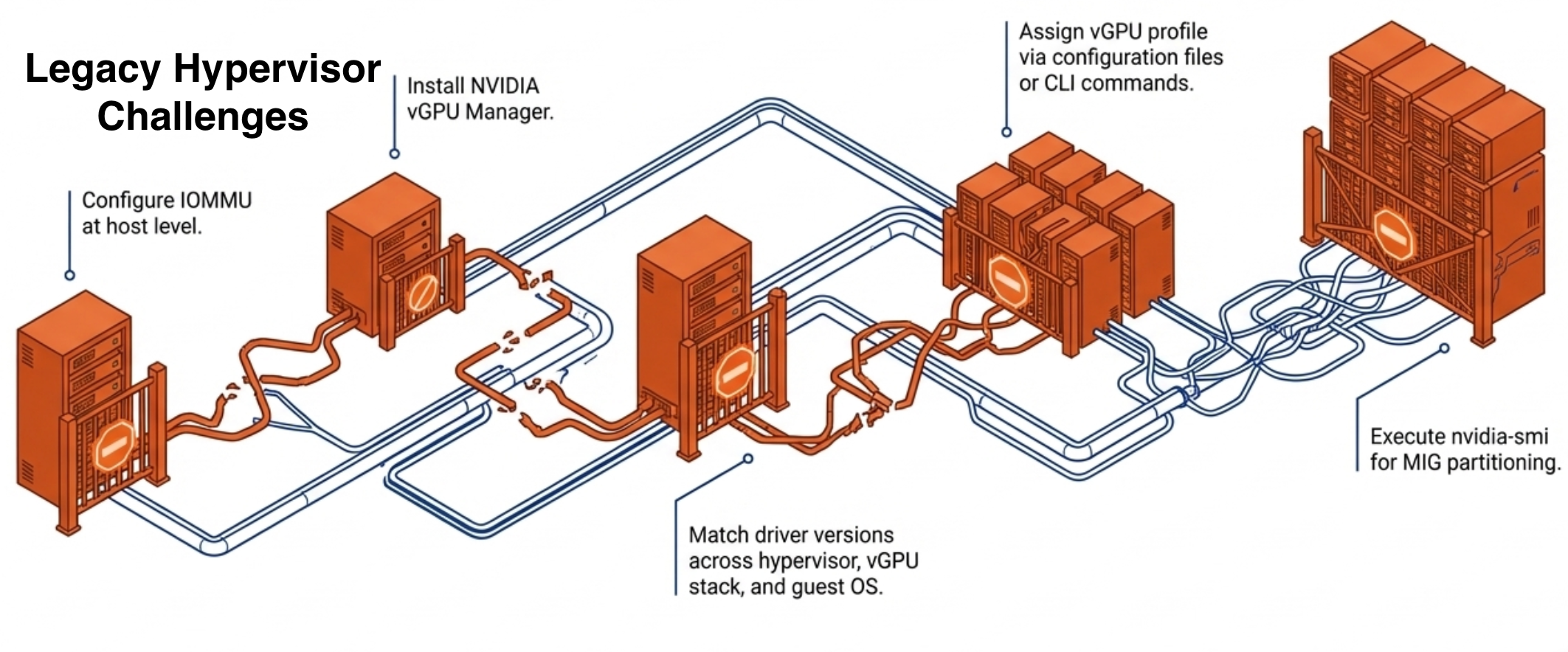
Legacy Hypervisor Challenges with GPU Virtual Workstation Deployment

On many hypervisors, standing up a GPU virtual workstation still involves a long sequence of manual steps. Configure IOMMU at the host level. Install the NVIDIA vGPU Manager. Match driver versions across the hypervisor, the vGPU software stack, and the guest OS. Assign a vGPU profile through configuration files or CLI commands.

Some platforms have improved parts of this experience, but most still treat GPU management as a separate discipline from core infrastructure operations. MIG partitioning, splitting a high-end GPU into hardware-isolated instances so multiple team members can work at the same time, still requires nvidia-smi CLI expertise on most platforms.
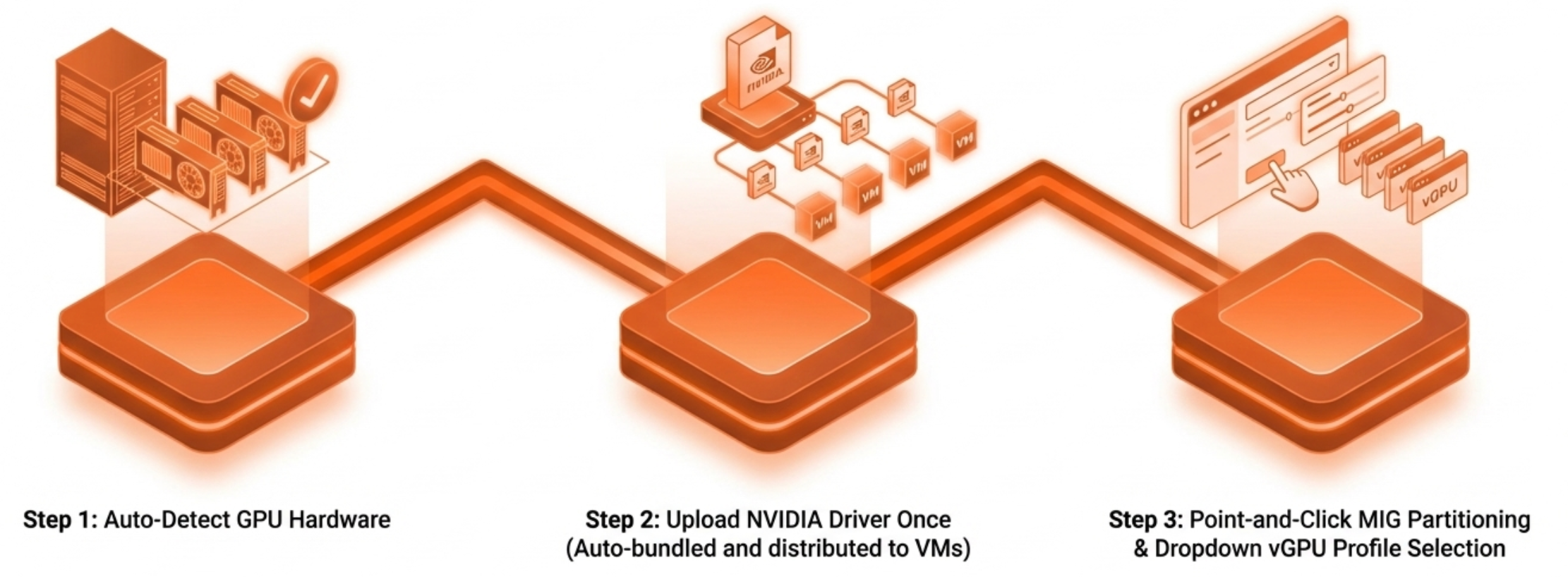
VergeOS GPU Virtual Workstation Provisioning Method

VergeOS compresses that entire sequence into a workflow an IT generalist completes without specialized GPU knowledge. The platform detects GPU hardware automatically. IT teams obtain drivers directly from NVIDIA, available to customers with valid NVIDIA vGPU software licenses, and upload them once. VergeOS bundles and distributes them to VMs automatically at assignment. vGPU profiles are selected from a dropdown. MIG partitioning is point-and-click. The GPU virtual workstation that the RAG toolkit assumes is ready in minutes, not days.

The operational contrast sharpens at scale. One RAG workstation is a project. Ten RAG workstations across three engineering teams, each with isolated GPU resources, snapshot schedules, and DR replication, is an infrastructure operation. VergeOS treats it as one. GPU workloads are managed through the same interface as compute, storage, and networking. No separate management plane. No GPU specialist on call. NVIDIA introduced VergeOS as a supported vGPU platform, and both vendors stand behind the deployment when issues arise.

Right-Sizing the GPU Virtual Workstation

The RAG toolkit’s minimum GPU virtual workstation requirement of 32 GB system memory and a capable vGPU allocation aligns well with the hardware VergeOS has validated. Teams deploying multiple RAG environments from a single card have a strong option in the RTX Pro 6000 Blackwell Server Edition. MIG partitioning on that card provides up to four hardware-isolated instances, each with dedicated memory and compute, from a single GPU. Four data science teams get four isolated RAG environments from one card.

Organizations that prioritize density have another option in the RTX 4500 Blackwell Server Edition. That card fits up to 16 units in a 4U server chassis at 165 watts per card. Each card carries 32 GB of GDDR7 memory and fifth-generation Tensor Cores with FP4 inference support. That combination handles RAG workloads with headroom for larger models and document collections as the use case matures.

NVIDIA’s AI Sizing Advisor helps teams determine the right GPU virtual workstation configuration before a single VM is provisioned. It is a free, wizard-driven tool, not a chatbot, that recommends configurations based on specific workload parameters and includes a smoke test to validate the recommendation.

The Pattern, Not Just the Project
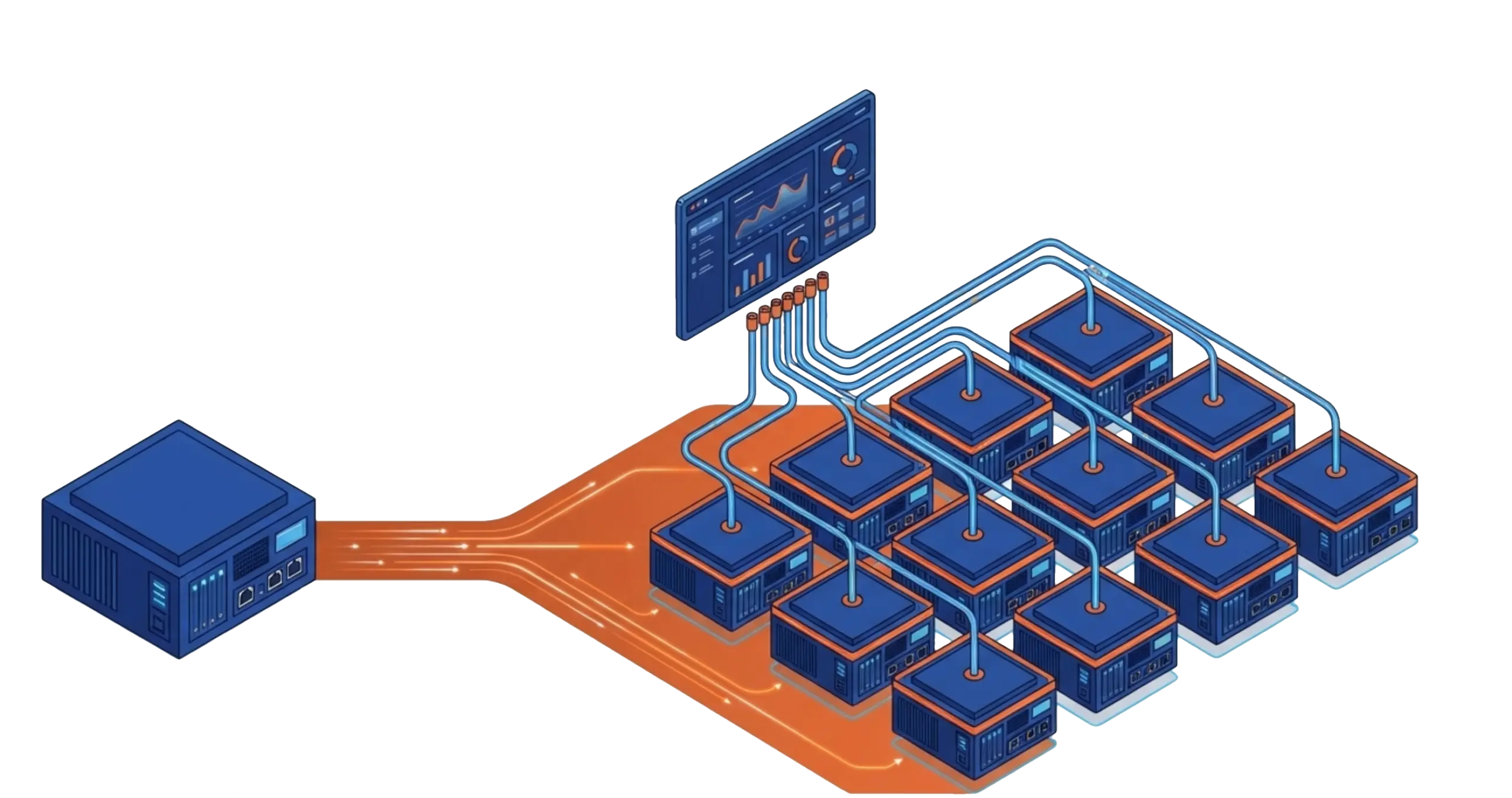
Dedicated GPU Workstation to vGPU

The RAG toolkit is the most visible entry point, but it represents a broader pattern. NVIDIA’s toolkit portfolio also includes Agentic RAG for multi-step retrieval workflows, a fine-tuning toolkit for model customization, and a video search and summarization toolkit arriving this year. Each follows the same model: a guided deployment path that assumes a GPU virtual workstation exists.

Organizations that build the infrastructure layer once, GPU provisioning, driver management, MIG configuration, snapshot and recovery workflows, deploy every subsequent toolkit as an application project rather than an infrastructure project. The same infrastructure that already runs engineering VDI, simulation workloads, and scientific visualization extends to AI development without a second management stack. The platform investment compounds.

VergeOS is designed for exactly this pattern. The same infrastructure that runs your first RAG workstation runs your tenth, your fine-tuning environment, and your inference endpoints. One interface. The same operational workflows. No need to expand the team that manages it.

The AI toolkit is ready. The question is whether your infrastructure is ready to run it as an organizational capability rather than a one-off experiment. Watch the GPU Virtualization Without the Complexity on-demand webinar for a live demonstration of all three GPU modes in the VergeOS interface. Download the GPU Virtualization Without the Complexity white paper for a full technical breakdown of GPU modes, driver management, and deployment scenarios.

Take a Test Drive Today — No hardware required.

Explore the full platform details on the Abstracted GPU Infrastructure page.

Frequently Asked Questions
What is the NVIDIA RAG Application Toolkit and what does it include?
The RAG Application Toolkit is a guided deployment workflow from NVIDIA that walks teams through building a retrieval-augmented generation application inside a GPU virtual workstation. It covers VM provisioning, NVIDIA AI Workbench installation, vector database configuration, LLM deployment (Llama 3 8B is the recommended starting model), and a chat interface for querying organizational data. The minimum VM requirement is 8 vCPUs, 32 GB system memory, 120 GB storage, and a vGPU allocation.
Do we need GPU specialists on staff to deploy RAG workloads on VergeOS?
No. VergeOS manages driver deployment, MIG configuration, vGPU profile assignment, and GPU monitoring through the same interface IT teams already use for compute, storage, and networking. The platform abstracts GPU complexity so an IT generalist who has never managed a GPU can deploy and operate vGPU workloads from day one.
How does running RAG in a virtual workstation compare to running it on a physical developer machine?
A RAG application in a VM inherits full infrastructure capabilities: snapshots capture the entire environment in one operation, replication copies it to a DR site, and cloning gives a new team member the identical configuration in minutes. A physical workstation has none of these. If the hardware fails, the environment is rebuilt manually. If a second team needs the same configuration, someone repeats the entire installation process.
Which NVIDIA GPUs are validated for RAG workloads on VergeOS?
VergeOS 26.1.3 has validated vGPU operation on the A100, A30, A40, and L40 series data center GPUs. MIG vGPU functionality has been validated on the RTX Pro 6000 Blackwell Server Edition, which supports up to four hardware-isolated instances from a single card. The RTX 4500 Blackwell Server Edition provides a density option at up to 16 cards per 4U chassis. NVIDIA vGPU software licenses are required and are available through NVIDIA-authorized partners.
Can multiple teams share a single GPU for separate RAG environments?
Yes. MIG partitioning on the RTX Pro 6000 Blackwell Server Edition divides a single GPU into up to four hardware-isolated instances, each with dedicated compute engines, memory, and bandwidth. Each instance operates as an independent GPU from the application’s perspective. Four teams get four isolated RAG environments from one card with no contention between them.
What other AI toolkits run on this same infrastructure?
NVIDIA’s AI vWS toolkit portfolio includes Agentic RAG for multi-step retrieval workflows, a fine-tuning toolkit for model customization, a PDF-to-podcast converter, and a video search and summarization toolkit. Each follows the same deployment model: a guided path that assumes a GPU virtual workstation exists. Organizations that build the infrastructure layer once deploy every subsequent toolkit as an application project.
What does NVIDIA’s supported platform designation mean for support escalation?
NVIDIA introduced VergeOS as a supported vGPU platform. That designation means the configuration has been tested against NVIDIA’s technical requirements. When GPU issues arise in production, both NVIDIA and VergeIO engineering teams collaborate on resolution. No finger-pointing between vendors. No gaps in support coverage.

Filed Under: AI Tagged With: AI, Enterprise AI, GPU, NVIDIA - VergeOS AI Workstation Campaign, vGPU

855-855-8300

Get Started

  • Versions
  • Request Tour

VergeIO For

  • VMware Alternative
  • SAN Replacement
  • Solving Infrastructure Modernization Challenges
  • Artificial Intelligence
  • Hyperconverged
  • Server Room
  • Secure Research Computing

Product

  • Benefits
  • Documents
  • Architecture Overview
  • Use Cases
  • Videos

Company

  • About VergeIO
  • Blog
  • Technical Documentation
  • Legal

© 2026 VergeIO. All Rights Reserved.