Snapshots Are the First Restore Point
VergeOS snapshots are a native capability of the platform. They are included with VergeOS and operate independently of ioGuardian. The two share the same code base and the same global inline deduplication engine, which is why they behave consistently, but they remain separate products with separate roles.
Recovery follows a hierarchy. The first restore point is always the VergeOS snapshot, and it applies any time the underlying drives still operate. Snapshots hold immutable point-in-time copies on the same deduplicated storage as production data, so recovery from a deleted file, a corrupted database, or a ransomware event finishes in seconds. Nothing crosses the network, and no backup appliance takes part in the operation.
- Drives operational. VergeOS snapshots. Roll back to a snapshot using the platform capability already included with VergeOS. Recovery completes in seconds against local deduplicated storage, and the virtual machines never stop.
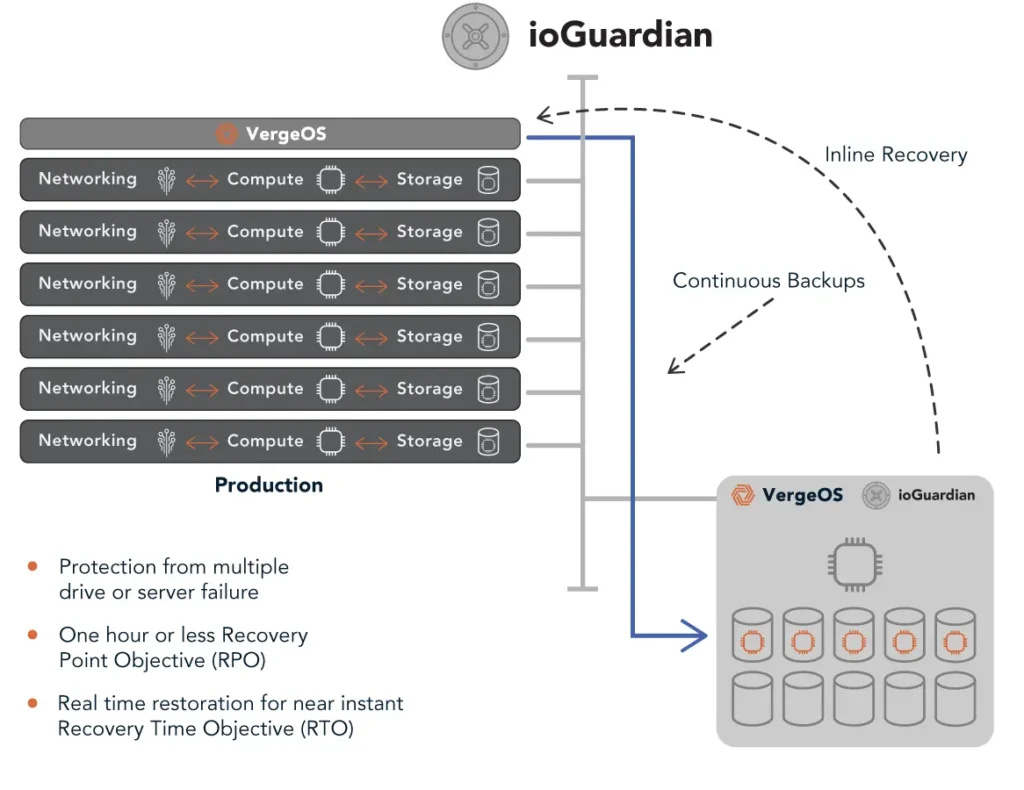
- Drives failed. ioGuardian. The separately licensed ioGuardian server delivers the missing data segments inline to the running virtual machines and rebuilds the data onto replacement drives in the background.
The two cover different failure domains. Administrators recover from VergeOS snapshots for logical failures and turn to ioGuardian for physical media failures, and both paths keep production workloads running on the primary cluster. Instant recovery products collapse these cases into one slow answer, sending every restore through a backup appliance even when the production drives remain intact.
| Feature | Real-Time RecoveryVergeOS snapshots, plus ioGuardian for drive failure | Instant Recovery |
|---|---|---|
| First Restore Point | VergeOS snapshots, a native platform capability separate from ioGuardian, used any time the drives still operate. Rollback runs against local deduplicated storage and finishes in seconds. ioGuardian covers the drive failure case | The backup copy on the appliance, even when the production drives remain intact |
| Recovery Time Objective (RTO) | Near-instant, with VMs continuing operations seamlessly | May require downtime for VMs to restart on a backup appliance, leading to operational delays |
| Recovery Point Objective (RPO) | Can be less than an hour, depending on snapshot frequency | Typically ranges from four to eight hours, leading to potential data loss |
| Data Recovery Process | VergeOS snapshot rollback when the drives are healthy. ioGuardian inline delivery of missing data segments to VMs when they are not. No downtime in either case | VMs crash on the production server and manually restart on the backup appliance, potentially corrupting data and degrading performance |
| IT Intervention | Minimal to none, with automated processes for data delivery and restoration | Requires manual intervention for recovery and restoring VMs to the production environment |
| Performance Impact | VMs continue to operate from the primary instance, maintaining performance | Running VMs on the backup appliance may result in suboptimal performance |
| Storage Efficiency | One global inline deduplication engine serves both snapshots and ioGuardian, reducing the data footprint with no second copy and no re-hydration | Dependent on the backup appliance’s capabilities, which may not offer deduplication. Transfer from deduplicated primary storage to deduplicated secondary storage requires re-hydration |
| Cost | Snapshots are included with VergeOS at no additional cost. Only the ioGuardian server requires separate licensing | Additional costs for backup appliance and software licenses |
| Automatic Data Rebuilding | Automatically rebuilds data on new drives post-failure, simplifying restoration | Does not aid in restoring new drives; requires manual and complete restoration of volumes |
| Flexibility | Supports frequent snapshots based on customer needs, allowing for tighter RPO and RTO | Backup frequency and restoration capabilities may be limited by the appliance and software |