Planning a storage refresh in 2026 means confronting a cost structure that looks nothing like it did two years ago. The cost of dedicated storage was already hard to justify before the flash and memory supercycle hit. The licensing, the proprietary flash, the maintenance contracts, the dedicated controllers that require their own teams to manage — the math never added up the way vendors claimed it did. We covered the baseline problem in The High Cost of Dedicated Storage. In 2026, that baseline problem has a multiplier on it.
Key Takeaways
- DRAM prices are up 171% year-over-year through 2027 — storage array controller memory has followed, and vendors are passing every dollar of that increase forward.
- Enterprise storage controllers require hundreds of gigabytes of RAM per controller just to run storage functions like deduplication, compression, tiering, and caching. None of that memory serves workloads.
- Proprietary enterprise flash is increasingly unavailable at expected prices and lead times. Supply chain constraints hit certified media harder than commodity SSDs because production runs are smaller and certification cycles are longer.
- Reducing protection levels to save on flash costs is the wrong move. The value of your data has not gone down because storage prices went up.
- VMware licensing changes compound the problem by landing in the same budget cycle as a storage refresh, creating a combined infrastructure bill many organizations were not prepared for.
- VergeOS runs the full stack — hypervisor, storage, and networking — at 2–3% memory overhead per node with no dedicated storage controllers and no proprietary flash requirements.
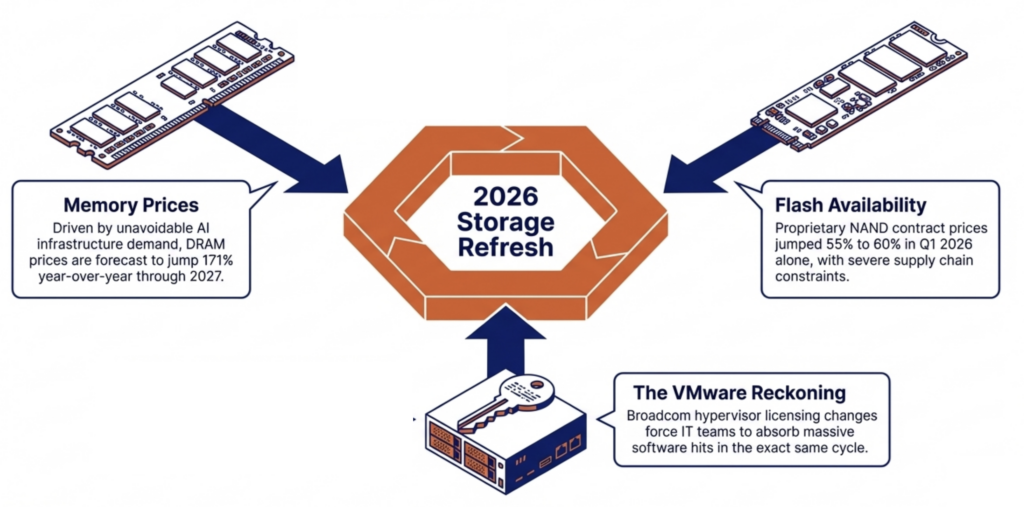
Three forces that did not exist at the same intensity two years ago are now hitting storage refresh decisions simultaneously: memory prices, flash availability, and the VMware licensing reckoning. Any one of them would force a difficult conversation. All three at once make a traditional storage refresh one of the most expensive infrastructure decisions for IT teams this year.
Key Terms
- Storage Refresh — The process of replacing aging storage hardware — arrays, controllers, and media — with new equipment. In 2026, this process is significantly more expensive due to DRAM and NAND flash price increases.
- DRAM (Dynamic Random Access Memory) — The primary system memory used by servers and storage controllers. Enterprise array controllers require hundreds of gigabytes of DRAM to run storage functions like deduplication, compression, and caching.
- NAND Flash — The semiconductor storage technology used in SSDs. Contract prices jumped 55–60% in Q1 2026, driven by AI infrastructure demand that has constrained global supply.
- Proprietary Flash — Certified storage media required by enterprise array vendors. Manufactured in smaller production runs than commodity SSDs, making supply chain disruptions more severe and price increases steeper.
- N+2 Protection — A data availability level that sustains two simultaneous device failures without data loss. Stepping down to N+1 to save on flash capacity trades long-term resilience for short-term budget relief.
- Flash and Memory Supercycle — The current period of elevated and constrained DRAM and NAND flash pricing driven by AI infrastructure demand. Analysts forecast supply constraints extending through 2027 and beyond.
- Private Cloud Operating System — A software platform that unifies hypervisor, storage, and networking into a single stack running on commodity x86 hardware. VergeOS runs the full stack at 2–3% memory overhead per node with no dedicated storage controllers required.
Storage Arrays Are Memory Hogs
Enterprise storage controllers do not run on air. Deduplication, compression, tiering, caching, and RAID management all execute in RAM. High-end array controllers routinely require hundreds of gigabytes of memory per controller to handle these functions at production scale. That memory exists entirely to serve the storage system itself — none of it runs workloads, VMs, or appears in any application performance metric.
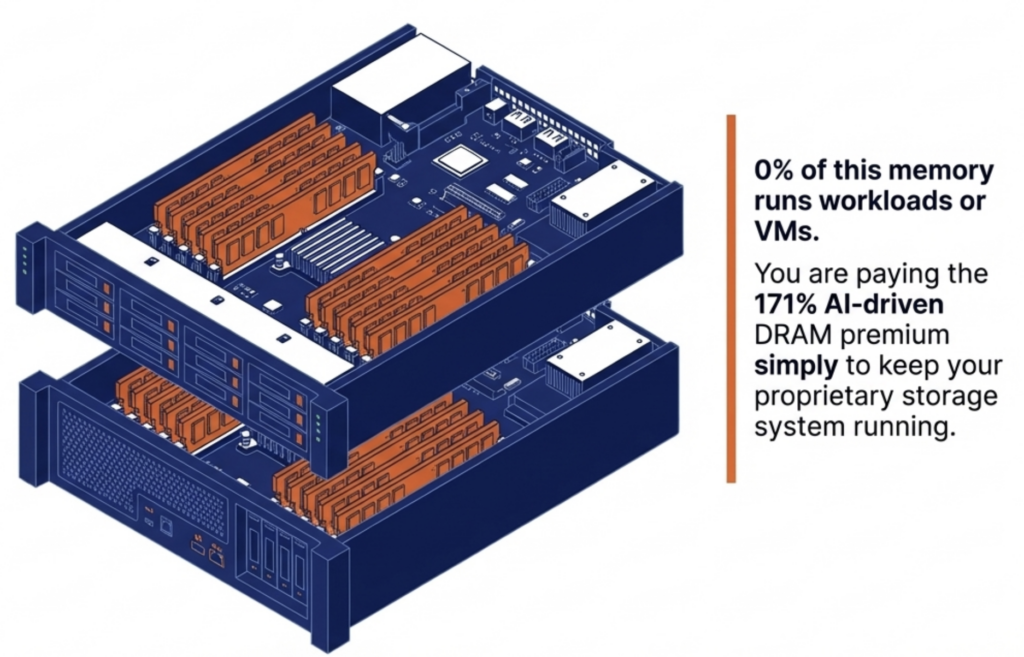
When DRAM prices were stable, this was a footnote in a procurement spreadsheet. DRAM prices are not stable. They are up 171% year-over-year through 2027, according to current market forecasts, driven by AI infrastructure demand that enterprise IT cannot negotiate away. Storage vendors face the same supply constraints as everyone else. They are paying more for controller memory and passing that cost forward. The list price for a storage refresh today reflects a DRAM market that looks nothing like the one your last refresh was based on.
Proprietary Flash: Why Storage Refresh Costs Keep Climbing
Enterprise storage arrays require certified, proprietary flash media. The certification process exists for legitimate reasons — compatibility testing, firmware validation, performance guarantees. It also creates a closed market where vendors set prices independent of commodity flash trends.
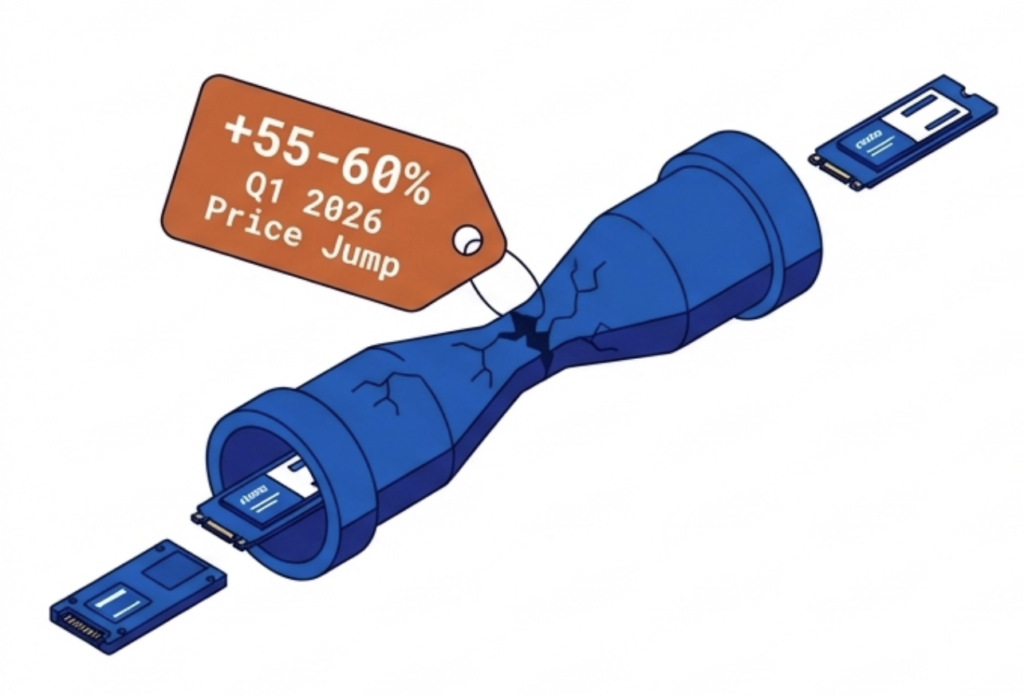
NAND flash contract prices jumped 55 to 60% in Q1 2026. Consumer and data center SSDs have both seen significant price increases. Enterprise array flash has increased further, and in many configurations, it has simply become unavailable at the quantities and timelines IT teams expected. Supply chain constraints might hit commodity flash, but they hit proprietary enterprise flash harder because production runs are smaller and certification cycles are longer. Organizations planning a storage refresh in Q1 2026 are discovering that the hardware they specified six months ago no longer ships on the same timeline or at the same price.
Under this pressure, the instinct for some IT teams is to reduce protection levels — stepping down from N+2 to N+1 to cut capacity costs. That instinct is wrong, and the reasons why are worth understanding before making a decision that trades long-term resilience for short-term budget relief. The value of your data has not gone down because flash prices went up.
VMware Licensing Changes the Total Cost Equation
Organizations evaluating a storage refresh are often doing so within the same budget cycle as they consider absorbing Broadcom’s VMware licensing changes. The two costs used to be separate line items evaluated in separate cycles. In 2026, many IT teams are considering a combined infrastructure bill that includes a storage refresh, a VMware licensing increase, and ongoing hardware cost inflation from the supercycle. The math on continuing the status quo has broken down for a significant portion of the installed base.
A Different Architecture, A Different Storage Refresh Cost
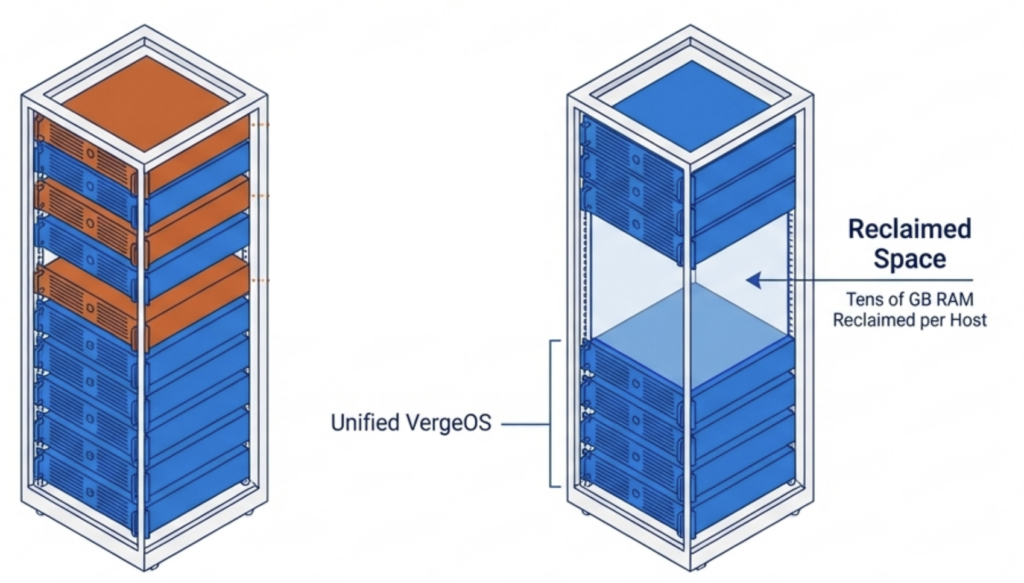
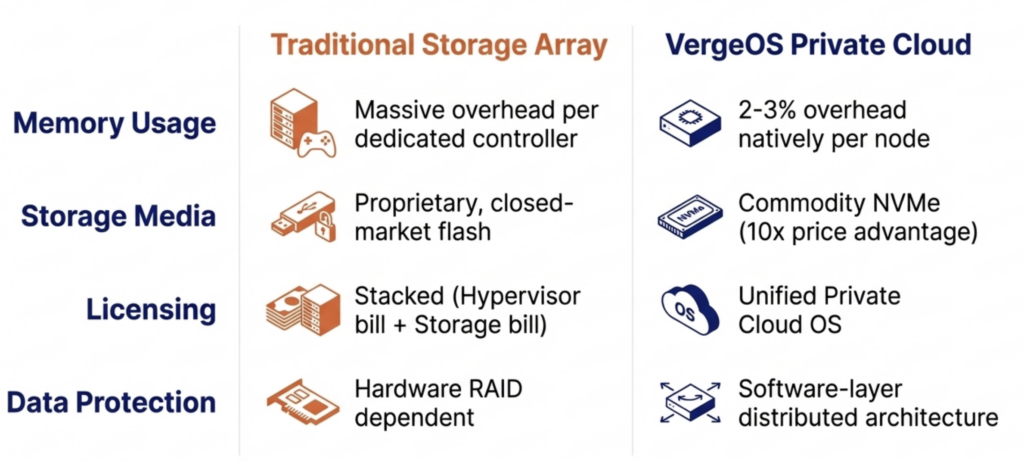
A Private Cloud Operating System like VergeOS approaches this problem from a fundamentally different position. The entire VergeOS stack — hypervisor, storage, and networking — runs at 2 to 3% memory overhead per node. There are no dedicated storage controllers, no separate storage network, and no proprietary flash requirements.
VergeOS safely leverages commodity SSDs, including consumer-grade and even refurbished drives, through its distributed architecture. The platform handles data protection and availability at the software layer, not through hardware RAID controllers that require proprietary media to function. For a detailed look at the architecture and the economics behind it, Architecting for the Flash and Memory Supercycle is available on demand.
The result is a cost structure that does not track with the supercycle the same way a dedicated storage array does. No controller memory markup. No proprietary flash sourcing problem. No separate storage licensing on top of hypervisor licensing. The same servers running the same workloads carry the storage function natively, without the dedicated hardware that is currently the most expensive and hardest-to-source component in a traditional refresh cycle.
The cost of a storage refresh in 2026 is not just higher. For many organizations, it is the wrong question entirely.
Frequently Asked Questions
- Why are storage array costs rising faster than commodity hardware in 2026? Enterprise arrays rely on certified proprietary flash media and controller DRAM, both sourced in smaller volumes than commodity components. That makes them more vulnerable to supply chain disruptions and more expensive when constraints hit. DRAM prices are up 171% year-over-year, and those costs flow directly into array pricing.
- Can I use commodity SSDs instead of certified enterprise flash? Not in a traditional enterprise array — those systems require certified media and will reject uncertified drives. Platforms like VergeOS are built differently. The distributed software layer handles data protection and availability, allowing commodity and even refurbished SSDs to be used safely in production.
- Should I reduce data protection levels to lower my storage refresh cost? No. The value of your data has not declined because flash prices increased. Stepping from N+2 to N+1 extends the rebuild window during a drive failure, increasing both the risk of data loss and the performance impact on production workloads. The right response to rising storage costs is a more efficient architecture, not less protection.
- How does VergeOS avoid dedicated storage controller costs? VergeOS integrates storage natively into the same nodes running the hypervisor and networking stack, with only 2–3% total memory overhead for the entire platform. There are no separate storage controllers, no separate storage network, and no proprietary flash requirements. The distributed architecture provides N+2 data availability using commodity SSDs on standard x86 hardware.
- What is the Flash and Memory Supercycle? The Flash and Memory Supercycle is the current period of elevated and constrained DRAM and NAND flash pricing driven primarily by AI infrastructure demand. DRAM prices are projected to rise 171% year-over-year through 2027. NAND flash contract prices jumped 55–60% in Q1 2026 alone. Analysts forecast supply constraints extending through 2027 and potentially beyond.
- Does this apply to hyperconverged infrastructure as well as dedicated arrays? Yes. HCI platforms that fold storage software into compute nodes carry their own memory overhead for storage services — often 20–30% of total host memory before any VM runs. That overhead has a real dollar cost at supercycle DRAM prices, whether storage lives in a dedicated array or in HCI storage software running on every node.