Data sovereignty for US companies matters as much as it does for European companies, if not more. Most of the sovereignty conversation centers on Europe, where GDPR, NIS2 and DORA have turned control of data into regulation, and many US IT leaders treat it as somebody else’s problem. Set the legal questions aside for a moment. Good IT governance says the organization’s data assets should be accessible only to the people and processes the organization chooses. That principle applies to a manufacturer in Ohio as much as it does to a bank in Frankfurt.
Now fold the legal aspect back in. The same laws that compel a US provider to turn over a European organization’s data, wherever in Europe that data physically sits, certainly apply to US companies whose data is housed in a US provider’s data center inside the United States. A European company at least has its own government and courts in the conversation. A US company whose data sits with a US provider has neither a border nor a treaty between its data and the request.
Key Takeaways
- The laws that let US authorities reach European data held by US providers reach US companies’ cloud data even more directly, often through orders the company never sees.
- Keeping data in the public cloud makes sovereignty expensive. It requires encryption at rest, in flight and in use, plus networking and access controls the organization has to build and audit on someone else’s platform.
- Data center inflation is pushing cloud rates up, so on-premises infrastructure that keeps servers and storage in service for ten years or more, run by one infrastructure operating system, lowers cost and simplifies sovereignty at the same time.
Who Decides When Your Data Is Turned Over?
The decision on whether, and to what extent, an organization complies with a legal demand to turn over data should be a business decision the organization makes on its own. A cloud provider should not make that decision for it. The provider faces no repercussions for turning over the data, and it can face penalties for refusing. Under the Stored Communications Act, which the CLOUD Act amended in 2018 to reach data stored overseas, US authorities can serve a warrant or subpoena directly on the provider. A court can also attach a nondisclosure order that bars the provider from telling the customer the request exists. The company that owns the data can learn about it months later, or never.
When the data sits on infrastructure the company owns, the demand comes to the company. Its general counsel reads it, its outside counsel decides whether to challenge the scope, and a judge hears that argument before anything leaves the building. At a minimum, a secure data sovereignty strategy delays data turnover until the company has a chance to argue against it in court.
More Reasons US Companies Need a Sovereignty Strategy
Legal demands are the clearest case, and they are one of several.
US regulation is catching up with Europe on its own terms. Privacy laws in California, Virginia, Colorado, Texas and a growing list of other states put obligations on how companies collect, store and share personal data. Healthcare organizations answer to HIPAA, defense contractors to CMMC and ITAR, and police agencies to CJIS. The Department of Justice’s bulk sensitive data rule, in effect since 2025, restricts access to certain categories of Americans’ personal data by countries of concern, and proving compliance starts with knowing exactly who can reach that data. Each of these is easier to satisfy when the organization controls the infrastructure end to end.
US companies also sell into Europe. A US manufacturer or software company with European customers inherits those customers’ sovereignty requirements through contracts and procurement questionnaires. “Who can compel access to our data?” now shows up in RFPs, and “our cloud provider” is a weak answer.
Then there is the kill switch. A provider can suspend an account over a billing dispute, a terms-of-service flag or a government order, and the workloads stop with it. Encryption keeps the data private. It does nothing to keep applications running.
AI raises the stakes further. Prompts, retrieval data and fine-tuning sets hold the organization’s most sensitive information, from customer records to product designs. Sending that data to a model hosted on someone else’s infrastructure extends every exposure above to the company’s intellectual property.
Implementing a US Data Sovereignty Strategy
What makes implementing a data sovereignty strategy so complex is the use of the hyperscale cloud providers. Their advantages are obvious: low upfront cost, rapid deployment and quick scale. They also make obtaining complete data sovereignty very complex. Data has to be encrypted everywhere, in flight, at rest and even during processing. Encrypting data in use requires processors with confidential computing features such as AMD SEV-SNP and Intel TDX, instance types that expose them, and attestation services that prove the protection is working. Implementing this level of wide-spectrum encryption is difficult and expensive, and confirming that every workload stays continuously in that encrypted state is time-consuming work for a small IT team.
Networking and Access Complications
The network is where many cloud sovereignty plans come apart. Every workload sits on a virtual network the provider designs, operates and can see into. Keeping traffic off the public internet means buying private interconnects into each region, building private endpoints for every managed service the applications touch, and writing egress rules that catch data headed somewhere it should not go. Many managed services replicate across regions or call out to global endpoints by default, so IT has to find and override each one. Egress fees then charge the organization to move its own data back out.
Access is harder still. Identity and access management in a hyperscaler is powerful and dense, with thousands of permission types spread across dozens of accounts and projects. One overly broad role or forgotten service account exposes the data the sovereignty plan was built to protect. Above the customer’s own controls sits the provider’s operations staff. Some services let the customer approve support access, and others give the customer no view into it at all. Proving to an auditor who can reach a given dataset becomes a project of its own, and the answer changes every time the provider ships a new feature.
The Cost of Staying
Add to the challenges of maintaining data sovereignty in the public cloud the cost of long-term cloud usage. That low upfront cost compounds over time into an expensive long-term commitment. Add to that the impact of data center inflation. Memory and flash prices climbed sharply in 2026 as AI build-outs absorbed supply, and the trend points to servers becoming increasingly more expensive. Cloud providers buy from the same suppliers, so they will have to raise their rates.
The same trend favors ownership. An organization that invests in on-premises hardware, and runs an infrastructure operating system that keeps that hardware in service for ten years, can dramatically reduce costs compared to staying in the cloud.
On-Premises Simplifies Data Sovereignty for US Companies
Establishing an on-premises strategy simplifies the path to data sovereignty. All of your data is behind your four walls, physical or virtual. You are in complete control of data access and delivery. You control data protection, along with where and in what state those backups are stored. You control the network, what is allowed in and what is allowed out. Legal demands come to you, and your counsel decides how to respond.
With the infrastructure in-house, the encryption burden drops back to at-rest and in-flight encryption, with keys the organization holds itself. The untrusted provider administrator beneath the workload is gone, and so is the case for buying new processors just for confidential computing.
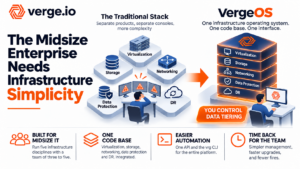
The key is to simplify infrastructure management so the physical cost savings and the specific security measures deployed are easy to implement, operate and maintain. The software part of on-premises infrastructure has always been the weak spot, and it is what makes the cloud so appealing. A legacy stack of separate virtualization, storage, networking and backup products, each with its own console, update cycle and vendor connection, gives a small IT team more to run and gives an auditor more to check.
How VergeIO Simplifies Data Sovereignty
VergeIO delivers an infrastructure operating system, VergeOS, that lets you exit VMware, simplify data sovereignty and fight hardware inflation. VergeOS runs virtualization, storage, networking and data protection in a single code base, managed from one interface inside your own data center. Storage encryption at rest uses AES-256, with keys held on USB drives in the controller nodes or entered as a password at power-up, and replication to a DR site travels encrypted by default. Virtual Data Centers (VDCs) separate workload groups on shared hardware, each with its own resources, network and administrators. With an air-gap license, VergeOS runs with no outbound connection to VergeIO at all.
VergeOS also runs on a wide range of existing x86 servers, including mixed generations in the same environment, so customers run servers and storage for ten years or more. Formica extended the life of its nodes to 15 years. The result is lower infrastructure cost and far less time spent managing infrastructure, which is what makes on-premises sovereignty practical for a midsize IT team.
Comparing the Two Paths
| Sovereignty requirement | US hyperscaler | On-premises with VergeOS |
|---|---|---|
| Who receives a legal demand | The provider, sometimes under a nondisclosure order | Your company and your counsel |
| Encryption | At rest, in flight and in use, with customer-held keys | At rest and in flight, keys in your building |
| Network control | Private interconnects, private endpoints and egress rules per region | Your network and your rules |
| Access | Provider IAM plus provider operations staff | Your administrators |
| Kill switch | Account suspension or a provider order stops workloads | Runs fully disconnected |
| Cost trend | Rates rise with data center inflation | Hardware in service for ten years or more |
Data Sovereignty Is a US Issue
US companies have as much reason to control their data as any company in Europe. The governance case stands on its own, US law reaches cloud-hosted data directly, and the cost of meeting sovereignty inside a hyperscaler keeps climbing. Bringing workloads home puts the organization back in charge of its data, its network and its legal decisions, as long as the infrastructure software is simple enough for a small team to run.
For many organizations the first step is the one they are already taking with their VMware alternative evaluation, a moment we have described as why cloud repatriation is critical post-VMware exit. Learn more about data sovereignty with VergeOS, and join Omdia’s Simon Robinson and VergeIO on November 19 for a live webinar on data sovereignty without the complexity or cost.
Key Terms
Frequently Asked Questions
Does data sovereignty apply to US companies?
Does the CLOUD Act apply to data stored inside the United States?
Can a company challenge a demand for its data?
Do I need confidential computing processors on-premises?
Yes. Good governance calls for the organization to control who can reach its data, and US law gives authorities a direct path to data held by US cloud providers. State privacy laws, sector rules and European customer contracts add requirements on top.
Data a US provider stores in the US was already reachable under the Stored Communications Act. The CLOUD Act extended that reach to data stored overseas. Either way, the demand goes to the provider holding the data.
When the company holds its own data, the demand comes to the company, and it can work with counsel to challenge the scope before producing anything. When a provider holds the data, the provider responds, sometimes without telling the customer.
For most organizations, no. On infrastructure you control, the untrusted host administrator is gone, and at-rest and in-flight encryption meet most requirements on the servers you already own.