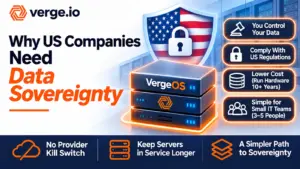
Simplifying data sovereignty starts with a question most sovereignty plans skip, which is whether the workloads should stay in the public cloud at all. The European Union has spent years turning sovereignty into regulation through GDPR, NIS2, DORA and the EU Data Act, and businesses in the US and around the world should pay attention to that process and learn from it. Data sovereignty requires more than understanding the location of your data. It also requires knowing who has access to that data, which jurisdiction’s laws govern it, and who or what can turn off access to it.
What makes data sovereignty so complex is that most recommendations assume the organization will keep using public cloud resources. The reasoning is that the historic advantages of the cloud outweigh the complexity that sovereignty adds to its continued use. That assumption deserves a hard look. When IT tests it, much of the complexity goes away.
Key Takeaways
- Keeping workloads in the public cloud forces an encrypt-everywhere design that covers data at rest, in flight and in use, and encrypting data in use requires processors with confidential computing features like AMD SEV-SNP and Intel TDX.
- On-premises infrastructure keeps data, applications and networks behind the organization’s own walls, which removes most jurisdiction concerns and lets at-rest and in-flight encryption meet most security requirements.
- VergeOS builds in encryption, secure nested multitenancy and fully disconnected operation, and it answers the cloud’s traditional advantages with simpler management, longer server life and per-server licensing.
Is the Cloud Still Worth It?
Achieving data sovereignty when your workloads are in the cloud is incredibly complex. Start with data location. Most providers let customers pin data to a region, but location is a weak foundation for a sovereignty plan. Providers replicate data for resilience, run support and telemetry through global operations, and answer to the laws of the country where they are headquartered. The US CLOUD Act, for example, reaches data held by companies under US jurisdiction wherever that data is stored. The safe assumption is that some of your data will end up outside your preferred jurisdiction. Jurisdiction becomes the standard you plan around.
If you assume data will be outside your jurisdiction, then you need to encrypt it. Encryption at rest on the provider’s storage is the starting point, and every network path the data crosses needs encryption in flight. The hardest requirement is encrypting data in use, in memory, where the provider’s own administrators and hypervisor sit beneath your workload. Encrypting data in use requires processors with these capabilities, like AMD SEV-SNP and Intel TDX, along with instance types that expose them and attestation services that prove the protection is working.
The keys add another layer. Whoever holds the encryption keys can be compelled to hand them over, so the organization has to generate, store and manage its own keys outside the provider’s key service. Each of these layers costs money, adds work for a small IT team and creates one more component that can fail. None of it changes the fact that the infrastructure belongs to someone else.
The On-Premises Advantage
The advantage of running on-premises is that it eliminates most of the concern. If the data is always behind your four walls, either physically or virtually on infrastructure you control, the need to encrypt everything drops substantially. The untrusted administrator beneath the workload is gone, and so is the case for buying new processors just for confidential computing features. Most organizations can meet their data security needs with at-rest and in-flight encryption at the primary site and at-rest encryption at a DR site. The servers already in the rack stay in service, and the keys stay in the building.
Both of these encryption methods are built into VergeOS. Customers can choose to encrypt the storage layer at rest with AES-256 when they install the system, with the keys stored on USB drives in the controller nodes or entered as a password at power-up. In-flight encryption is the default for off-site data transfers, so snapshots replicated to a DR site through a site sync travel encrypted with AES-256.
VergeOS is infrastructure software for building your own on-premises private cloud, and that design removes the concern over jurisdiction. Data, applications and networks are always behind your walls, protected by your security measures and managed by your staff under your country’s laws.
Key Terms
Sovereignty by Workload With Virtual Data Centers
Workloads answer to different rules. A plant-floor system or an HR database needs to stay inside one operational jurisdictional boundary. A customer portal or a partner integration needs to reach across it. Most organizations solve that by building separate environments, each with its own hardware and its own management overhead.
VergeOS’ secure, nested multitenancy handles both on the same hardware. Its Virtual Data Centers (VDCs) let organizations set up secure tenants, each with its own compute, storage, networking and administrators. A tenant for applications that cross jurisdictional boundaries runs on the same servers as tenants for workloads that must stay inside the boundary, and the infrastructure operating system enforces the separation between them. VDCs can also nest inside one another, so a business unit or an in-country operation can manage its own slice of the environment without seeing anyone else’s. IT runs one environment, and each workload group follows the rules that apply to it.
The Kill Switch Test
The final test is the kill switch test. What happens if the provider is ordered to turn off access to the data center itself, or to your account? Encryption keeps the data from being read. It does nothing to keep the workloads running. Short of moving all workloads to a regional provider, passing this test requires the ability to move operations out of the cloud provider at a moment’s notice. That means a second environment the organization controls, with current copies of data and applications, ready to take over. At that point the organization is already paying for an on-premises environment, and running production there is the simpler choice.
The kill switch applies to on-premises software too. Many infrastructure products check in with the vendor to validate licenses, run their management console from the vendor’s cloud or stream telemetry back home. Each of those connections is a switch someone outside the organization can flip.
VergeOS allows organizations to run in a totally disconnected state. Management runs inside the organization’s own data center, and an air-gap license removes the need for license check-ins. Updates can be installed through a temporary connection or from an update ISO brought in on removable media and uploaded locally. VergeIO has multiple organizations running in this design today and provides them world-class support and service.
Addressing the Cloud Advantages
We opened with the statement that many cloud providers still argue the legacy advantages of the cloud make it worthwhile to keep using their services, even with the complexities that data sovereignty introduces. Those advantages include the removal of physical infrastructure management, no need to buy or integrate new hardware as the organization grows, and the elimination of the physical data center itself. Each one has an answer.
Simpler Infrastructure Management
VergeOS unifies all the major infrastructure software, including virtualization, storage, networking and data protection, into a single code base where each operates as a function of an infrastructure operating system. That approach greatly simplifies infrastructure management, with one interface, one update cycle and one vendor to call. “We used to bounce between dozens of vCenter consoles. Now everything is centralized,” says Jason Sova, Architect for Enterprise Infrastructure at Topgolf.
Expansion follows the same pattern. InterBel Telephone, where a single person runs all of IT, built its VergeOS lab in under two hours and added nodes in fifteen minutes. CenterGrid tested several platforms, including so-called turnkey solutions, and found adding new nodes to VergeOS the most straightforward process of any product it tested. The new server joins the existing compute and storage pools, and there is no separate array or storage network to reconfigure.
Fewer Hardware Purchases
The unified operating system approach also provides greater hardware abstraction, so customers can run VergeOS on their existing hardware and keep the flexibility to integrate other hardware brands in the future. “Others told me to buy new, but I had good servers with life left,” says Ryan Conte, CIO of Pfeiffer University, which moved its existing HP and Dell servers to VergeOS and avoided a $100,000 to $200,000 refresh.
Formica repurposed its existing hardware, added components and extended its lifespan to 15 years, with nodes that will stay in service until 2034. Brian Bazzell, IT Director for the City of Saint Peters, puts it this way: “With VergeIO, we could extend the life of our existing hardware while reducing licensing costs.”
The unified code is also more efficient than separate applications “integrated” by a management GUI. VergeOS is less than 400,000 lines of code, compared to the rumored millions of lines of code in the typical infrastructure stack. That efficiency puts more workloads on each server, so server expansion happens less often. With memory and flash prices climbing, every extra year of service from a server is budget the organization keeps.
Topgolf’s venue deployments are moving from six-node clusters with 35TB of storage capacity to three-node VergeOS clusters with 5TB. “VergeOS is smart enough to run efficiently on three, and that means real savings,” says Scott Forehand, Topgolf’s Manager of Global Infrastructure. At Alinsco Insurance, CIO Darrin Kirby reports that the company’s older hardware “quite frankly runs faster with VergeOS than it did with VMware.”
A Smaller Data Center Footprint
Lastly, VergeIO’s licensing structure reduces data center expansion pressure. VergeOS is licensed per physical server, not by CPU, core, amount of memory or storage, and that structure rewards denser servers. A quad-socket server with plenty of drive bays costs the same to license as a smaller two-socket server, so IT can pack more compute and more storage into each rack unit without paying more for the software. NETdepot, a hosting provider, uses per-server licensing to run dense quad-processor servers “that reduce power, cooling and data center floor space.”
Per-core and per-capacity licensing push in the opposite direction. Every socket, core and terabyte added raises the software bill, which steers IT toward smaller servers and more of them. Denser servers that stay in service longer let the existing data center, or a modest colocation footprint, absorb years of growth.
Comparing the Two Paths
| Sovereignty requirement | Staying in the public cloud | On-premises with VergeOS |
|---|---|---|
| Jurisdiction | Provider’s home country laws apply | Your laws, your facility, your staff |
| Encryption at rest | Required, with customer-held keys | AES-256, keys on USB in your controller nodes |
| Encryption in flight | Required on every path | Default for site syncs to your DR site |
| Encryption in use | Requires SEV-SNP or TDX instances and attestation | Untrusted host administrator is gone |
| Kill switch | Provider can be ordered to cut access | Runs fully disconnected |
| Workload separation | Separate accounts, regions or providers | Nested VDCs on shared hardware |
| Growth | Rent more instances | Per-server licensing rewards dense, long-lived servers |
Simplifying Data Sovereignty With One Infrastructure Operating System
Staying in the cloud makes sovereignty complex. The organization signs up for encryption at every layer, new processors, its own key management, and a standby environment to survive the kill switch. Bringing workloads on-premises removes most of that work, as long as the infrastructure is simple enough for a three-to-five-person IT team to run. That is the case for a single infrastructure operating system. Fewer layers mean fewer things to secure, fewer things to staff and fewer places for a sovereignty audit to look.
For many organizations the first step is the same one they are already taking with their VMware alternative evaluation, a moment that has been characterized as why cloud repatriation is critical post-VMware exit. The platform that replaces VMware can also be the platform that makes sovereignty simple. Learn more about data sovereignty with VergeOS, and join Omdia’s Simon Robinson and VergeIO on November 19 for a live webinar on data sovereignty without the complexity or cost.
Frequently Asked Questions
Is data residency enough to meet sovereignty requirements?
Do I need new processors with confidential computing to achieve data sovereignty?
Can VergeOS run with no internet connection?
How does VergeOS handle workloads with different sovereignty rules?
No. Residency puts the data inside a country’s borders. Sovereignty also requires control over who operates the infrastructure and who can be compelled to hand over the data or the keys.
Only if the data runs on infrastructure you don’t control. On-premises, the untrusted host administrator is gone, and at-rest and in-flight encryption meet most requirements on the servers you already own.
Yes. VergeOS runs in a fully disconnected state with an air-gap license. Updates are installed through a temporary connection or from an update ISO uploaded locally.
Nested Virtual Data Centers separate workload groups on the same hardware, each with its own resources, administrators and policies.