Before we look at the value of an integrated VMware alternative, IT needs to realize that what vendors claim as integration isn’t always integration. The pseudo-integrated solutions don’t deliver the same return on investment (ROI) nor do they reduce total cost of ownership (TCO) in the way a true integrated solution does.
Key Takeaways
- Three architectures hide behind the word integrated, and each carries different cost, performance, and operational consequences.
- A hypervisor swap lowers the license bill and leaves three-tier complexity and cost in place.
- HCI removes the storage array but keeps separate software stacks, and almost none ship in-house network software.
- UltraConverged infrastructure builds every service into one code base, which reclaims hardware, simplifies operations, and lowers TCO.
Nearly every VMware alternative on the market claims to be integrated. Look closer, and three very different architectures hide behind that single word. Each one carries its own consequences for cost, performance, resiliency, scalability, and day-to-day operational load. Choosing among them is the real decision an IT team makes when it exits VMware, even when the conversation never names it directly.
The stakes are higher now than during earlier platform shifts. Memory prices remain high, flash costs keep climbing under AI-driven demand, and no budget can absorb an architecture that burns resources to keep layers of software talking to one another. When hardware is expensive, efficiency stops being a talking point and becomes the deciding factor.
Key Terms
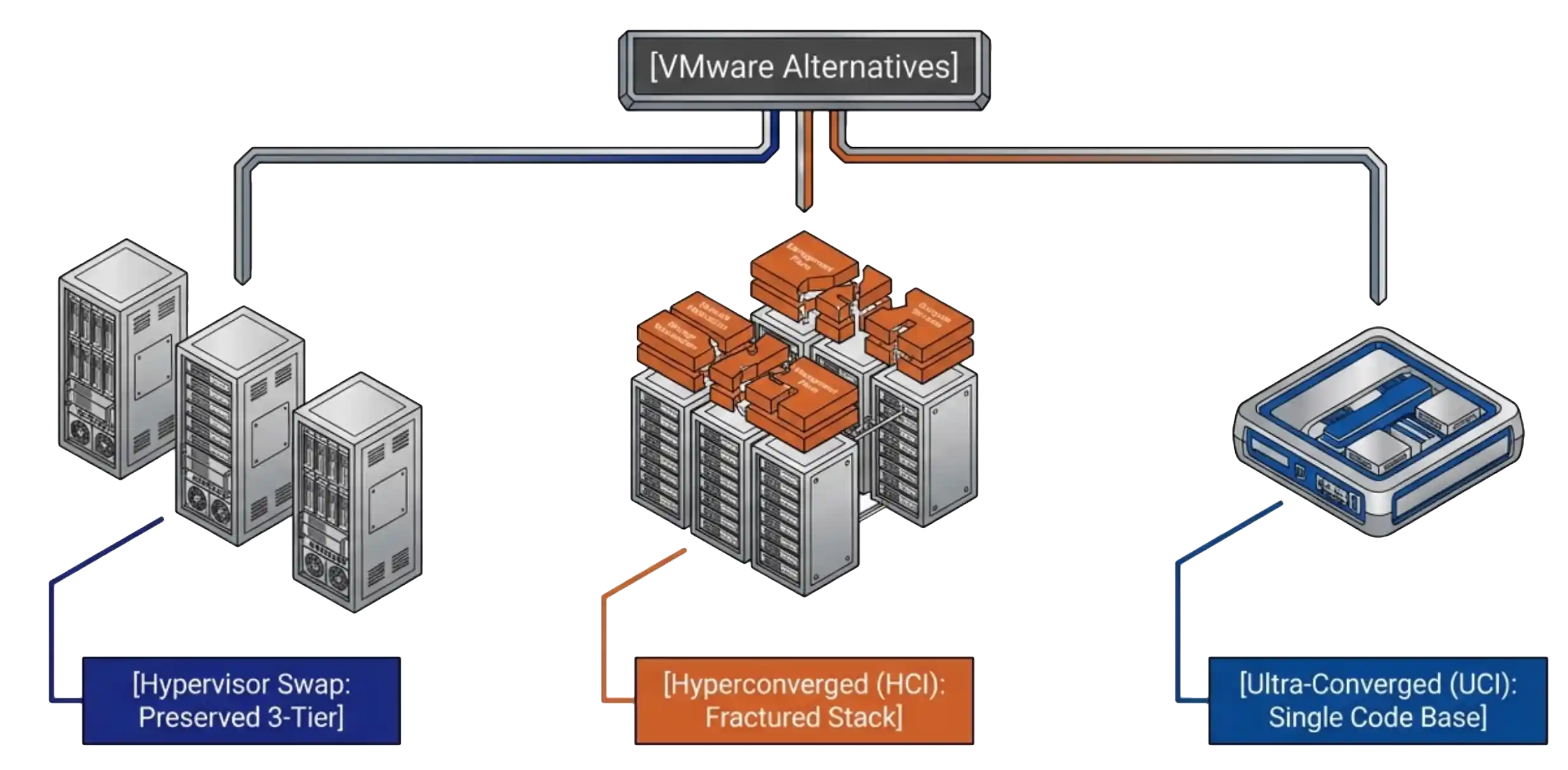
Three roads lead out of VMware. Only one removes the complexity instead of moving it.
The Hypervisor Swap
The simplest path away from VMware is to replace ESXi with another hypervisor while leaving the surrounding three-tier architecture untouched. Servers stay separate from storage. Networking remains a collection of independent systems, and backup, disaster recovery, security, and management each continue to run as their own products. The appeal is obvious. Migration disruption stays low, and existing operational habits carry forward with little retraining.
The problem is that everything else carries forward, too. The complexity, the cost, and the operational burden that defined the environment before the migration all survive the swap intact. In many cases the economics get worse. Rising server prices and persistent pressure on memory and flash make a portfolio of separate silos more expensive to maintain each quarter, and each component still has to be bought, upgraded, licensed, protected, and managed on its own schedule. For an organization that wanted real simplification, a hypervisor swap never delivers the value of an integrated VMware alternative, offering little beyond a smaller licensing bill.
Hyperconverged Infrastructure
Hyperconverged infrastructure earned its reputation for a reason. HCI collapsed the external storage array into the server layer, so storage services run as software on each node next to the virtualization layer. Compute, storage, and networking start to look like one system from the operator’s chair, and for many teams that was a genuine step forward.

Look under the management console and the picture changes. Most hyperconverged platforms are a set of separate software modules wired together. The hypervisor is one code base, storage is another, and management becomes a third layer that presents them through a shared interface. The integration is administrative rather than architectural. Administrators see one dashboard, and several independent software stacks keep running underneath it.
Networking exposes the seams most clearly. Almost no HCI vendor ships network software it developed in house. Most still lean on proprietary networking hardware, an irony for an architecture that set out to move infrastructure into software, and the rest bolt on a third-party software-defined networking product. VMware NSX is the exception. It is genuine in-house network software, yet it arrives as a separate module that carries a steep additional price.

That structure creates real costs. Each service claims its own CPU and memory, data often has to cross software boundaries before it reaches an application, and feature releases have to be coordinated across multiple code bases. Troubleshooting turns into tracing a request through several components built by different teams. When performance demands climb, capacity grows fast, or a workload like AI lands on the cluster, HCI’s insistence that storage and compute scale together starts to waste money. Teams respond by bolting on dedicated silos again, which quietly rebuilds a modern version of the three-tier design they were trying to escape.
The lasting presence of three-tier infrastructure is not proof that HCI failed. It is a sign that most organizations were never shown the value of an integrated VMware alternative, only a better-looking dashboard.
UltraConverged Infrastructure
UltraConverged infrastructure is where the value of an integrated VMware alternative shows up, and it starts from a different premise. Rather than gather multiple products under a shared management framework, UCI builds the infrastructure services into one code base. Virtualization, storage, networking, availability, security, automation and management ship as components of a single software architecture instead of separate products stitched together after the fact. VergeOS is built this way, and that one design choice drives everything that follows.
The distinction sounds academic until you trace its effects. Services share one code foundation, so no independent stacks fight each other for resources. Communication between services happens inside the platform rather than across external modules and network hops. Engineering refines features across the whole architecture instead of negotiating handoffs between product teams. The platform runs with less overhead, consumes fewer resources, and behaves predictably, the result of being designed as one system rather than assembled from several.

The deeper payoff is system-wide design. Storage services understand virtualization requirements. Networking services understand storage requirements, and availability services act with direct knowledge of both. The infrastructure operates as a single system rather than a federation of integrated products, and that difference shows up in every performance and resiliency decision the platform makes.
Deduplication shows how that single design ripples past storage. In a multi-product stack, deduplication is a storage feature, and its benefit stops at the array. In a single code base, that same deduplication map is visible to every service. The network transports only unique data, so replication and migration traffic shrink to the blocks that have changed. The RAM cache holds only unique data, so a fixed amount of memory caches far more of the working set. One feature, written once, makes storage, networking, and memory all do more with the same hardware.
Why a Single Code Base Delivers the Value of an Integrated VMware Alternative
The advantages of one code base grow more valuable as infrastructure demands keep rising. They land in four areas that senior IT buyers feel directly.
Resource consumption comes first. Multi-layered architectures force every software stack to carry its own memory footprint, processing load, and operational overhead. A single-code-base design strips out most of that duplication and frees a larger share of system resources to run applications instead of plumbing.
Operations comes next. When infrastructure services share one architecture, administrators spend less time refereeing interactions between products and more time managing outcomes. Fewer software boundaries mean faster troubleshooting and fewer finger-pointing exercises between vendors.
Innovation follows. New capabilities reach the entire platform at once, without waiting on multiple teams to align their roadmaps. Features arrive as platform improvements rather than integration projects that a customer has to validate.
Economics ties the first three together. Memory and flash stay constrained by what has been characterized as a Memory and Flash Supercycle, so every gigabyte an infrastructure layer wastes is a gigabyte an application cannot use. Every storage resource spent propping up software is capacity a workload never sees. An architecture that minimizes its own overhead turns that discipline into a direct and measurable cost advantage.
The Value and ROI of an Integrated VMware Alternative
The value of an integrated VMware alternative starts with hardware that does more with less. Every hyperconverged node runs a storage controller in software, and that controller reserves memory and CPU on each node before a single application starts. Reservations of 24 to 64 GB of RAM per node are common, so a 16-node cluster can surrender 384 GB to more than 1 TB of memory to storage overhead alone. A single-code-base platform folds storage into the same kernel that runs the virtual machines, and that reclaimed memory goes back to workloads. At current DRAM prices, recovering a terabyte of RAM across a cluster is real money returned to the budget.

Node (host) count tells the same story. When the architecture stops spending capacity on duplicate software stacks, the same workloads fit on fewer servers. Customers consolidating from three-tier or HCI environments routinely land their workloads on 20 to 40 percent fewer nodes. Fewer nodes mean lower hardware spend, lower power and cooling draw, less rack space, and fewer hypervisor and storage licenses to renew every year.
Total cost of ownership is where the three approaches separate most clearly. The hypervisor swap trims one line on the invoice and leaves the rest of the cost structure standing. HCI removes the array and keeps paying for layered software. UltraConverged infrastructure collapses the stack into one license and one support contract, and the savings compound across the life of the environment.
| Cost Driver | Hypervisor Swap | Hyperconverged (HCI) | UltraConverged (UCI) |
|---|---|---|---|
| Hardware efficiency | Three-tier waste unchanged | Controller VMs reserve RAM and CPU on every node | Storage runs in-kernel, overhead reclaimed for workloads |
| Software licensing | New hypervisor plus the existing stack | Hypervisor, storage, network, and management licensed separately | One license covers every service |
| Support contracts | One per silo | Several, often split by module | One contract, one vendor |
| Scaling model | Add silos independently | Compute and storage scale together, often wastefully | Compute and storage scale independently inside one system |
| Operational load | Full pre-migration burden remains | Hardware silos gone, software silos persist | Coordination work largely removed |
Operational cost follows the same pattern. A team running separate storage, networking, backup, and disaster recovery products carries separate upgrade cycles, separate support contracts, and separate troubleshooting paths. Each of those is staff time that never touches a business outcome. Folding the services into one platform removes whole categories of coordination work, and the recovered hours land where they belong, on projects that move the business forward. One platform also means one vendor to call, which ends the cross-vendor finger-pointing that stretches a simple outage into a multi-day investigation.
The math behind these returns is not complicated. It comes from refusing to pay for the same function three times. A hypervisor swap relocates complexity and bills you for the privilege. Real integration removes it. The most important number behind the value of an integrated VMware alternative is not the per-core license. It is the share of the hardware you bought that actually runs your applications, and that number is set by the code itself.
See how a single code base changes the math in your environment.