VergeOS adds CSI driver, Cloud Controller Manager, Cluster Autoscaler, and Rancher node driver — letting VMware shops running Kubernetes retire vSphere licensing, distribution licensing, and overlay storage in a single platform decision.
ANN ARBOR, Mich. — May 12, 2026 — VergeIO, the Private Cloud Operating System company, today announced general availability of Kubernetes support in VergeOS. The release adds a CSI storage driver, Cloud Controller Manager, Cluster Autoscaler, and Rancher node driver with UI extension, all distributed as Helm charts from the verge-io repository on GitHub. Together, the components let VMware customers running Kubernetes collapse three separate licensing taxes — vSphere, a Kubernetes distribution, and overlay storage — into a single platform.
VMware shops running Kubernetes today pay three separate vendors to do one job. They pay Broadcom for vSphere licensing to host cluster nodes. They pay a Kubernetes distribution tax — Tanzu, OpenShift, or Rancher Prime. Many pay a third tax for overlay storage like Longhorn or Portworx because vSphere storage policies do not extend cleanly into Kubernetes without commercial Tanzu add-ons. VergeOS now handles all three layers natively. Rancher remains the management plane customers already use. Workloads move on the customer’s timeline.
Support, Not a Distribution
VergeIO is not introducing a Kubernetes distribution. The support layer assumes customers already run a distribution they trust — RKE2, K3s, vanilla upstream, or a vendor distribution — and provides the platform underneath. Four components ship in this release:
- CSI Driver — delegates storage operations directly to the VergeOS API, so persistent volumes participate in the full VergeFS feature set including inline deduplication, multi-tier placement, and integrated snapshots.
- Cloud Controller Manager — integrates VergeOS VMs as first-class Kubernetes nodes, automatically populating provider IDs, instance metadata, and IP addresses, with native VNet-based LoadBalancer services on the near term roadmap.
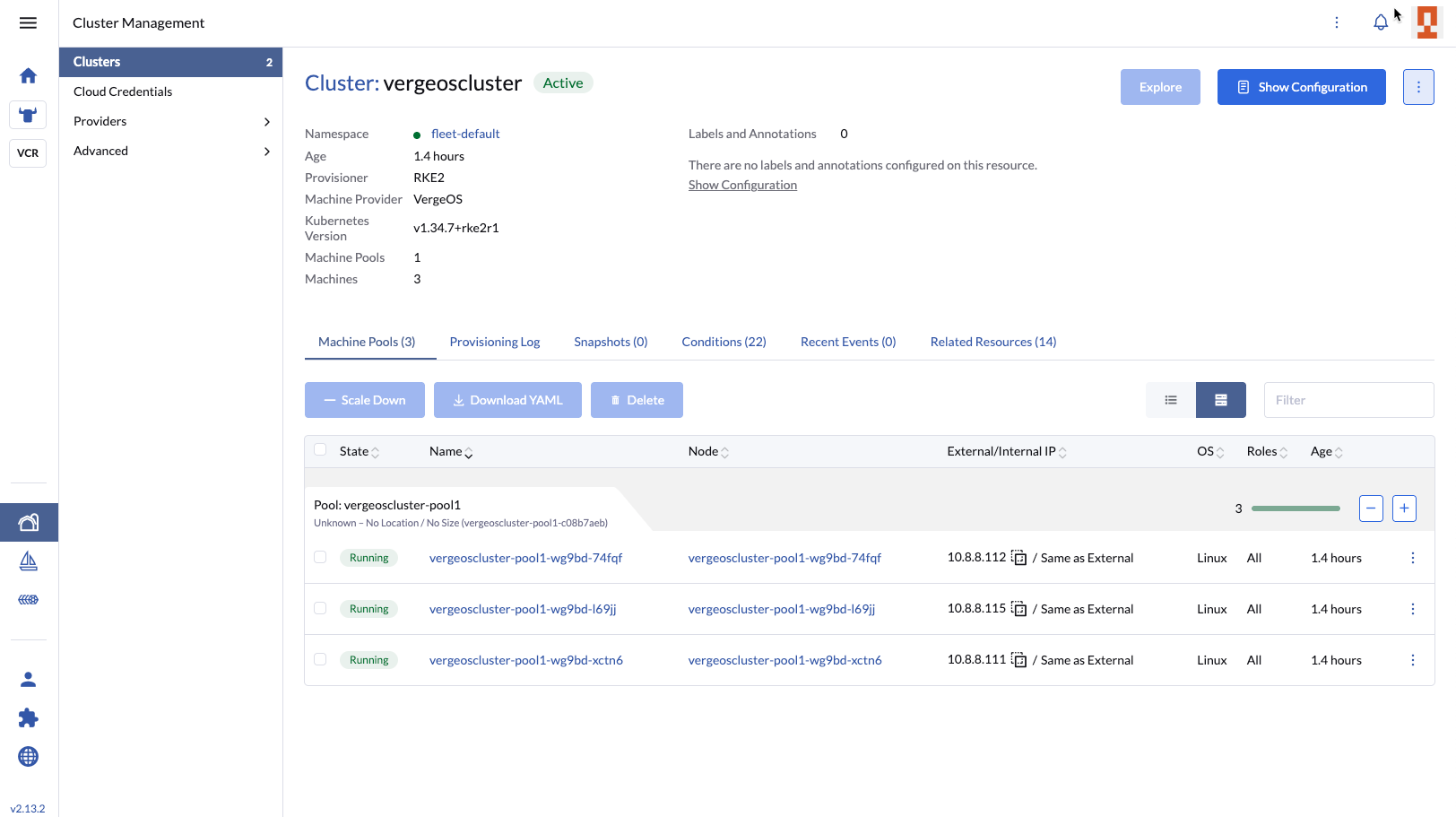
- Rancher Node Driver — provisions, manages, and autoscales Kubernetes clusters on VergeOS through Rancher. The Docker Machine driver clones VM templates, injects SSH keys via cloud-init, configures CPU and memory, attaches networks, and powers on. Node pools scale up and down automatically based on pending pod resource requests, executed against VergeOS compute capacity.
- Rancher UI Extension — surfaces VergeOS-specific cloud credential and machine configuration forms inside the Rancher UI. Operators get the same provisioning experience for VergeOS clusters as for vSphere, with no context switch and no separate tool.
Customers shouldn’t have to rebuild their applications to leave VMware — and once they leave, they shouldn’t be locked in again. With Rancher on VergeOS, the workloads move, and they stay portable.
Validated in Production
NGAMING, the group that brings together Türkiye’s leading brands in the digital entertainment and gaming sector — including NESINE, Atyarisi.com, and Liderform — served as the design partner during the development process. The Nesine engineering team worked in close collaboration with VergeIO during the MVP phase to successfully validate the CSI Driver, Cloud Controller Manager, and Rancher Node Driver against real production workloads. Nesine has approved the Kubernetes support layer for use in its production environment.
Three Customer Situations
Kubernetes support in VergeOS addresses three distinct VMware-customer situations.
Rancher Inside vSphere
Customers running Rancher to manage Kubernetes clusters inside vSphere can keep their Rancher control plane unchanged and replace the substrate underneath. Application teams see no change in their day-to-day Kubernetes operations. Platform teams see the vSphere renewal disappear.
Tanzu Kubernetes Grid Customers
Customers running Tanzu Kubernetes Grid facing Broadcom roadmap uncertainty and bundled licensing pressure can run new clusters on VergeOS while existing TKG clusters continue to operate. Rancher manages both for the duration of the migration. Workloads move on the customer’s timeline — stateless services first, stateful workloads after the new platform validates under real load.
Bare-Metal Kubernetes
Customers running Kubernetes directly on bare metal can add hypervisor benefits — live migration, integrated DR, and a shared snapshot model — without changing their Kubernetes operations workflow. RKE2 and K3s clusters provisioned on VergeOS gain VM-level isolation and unified storage policy across containerized and traditional workloads.
Go Deeper
The full architectural argument, technical overview, live demonstration, and complete research collection live behind four destinations:
Availability
Generally Available Now
All four components are generally available now and downloadable as Helm charts from the verge-io repository on GitHub.
About VergeIO
VergeIO is the Private Cloud Operating System company, headquartered in Ann Arbor, Michigan. Its platform, VergeOS, collapses virtualization, storage, networking, and data protection into a single integrated software stack running on commodity hardware. VergeOS is a leading VMware alternative, recognized by DCIG as a Top 5 VMware Alternative across both the SME and SLED categories. The company has grown annual recurring revenue more than 80 percent year over year and serves enterprise, public sector, and service provider customers worldwide. Learn more at www.verge.io.
Media Contact
Judy Smith
JPR Communications for VergeIO
[email protected]
818-522-9673