Organizations leaving VMware face a question that stalls more migrations than any technical challenge: will our backup tools still work? VergeOS answers that question at the architecture level. VergeOS 26.1.2 implements the oVirt API natively — the same interface that enterprise backup platforms like Veeam are already built to support. Exit VMware. Keep your backup tools. No custom integration, no replacement vendors, no renegotiated contracts.
Key Takeaways
The oVirt Standard: Why Backup Tools Already Support VergeOS
The oVirt API is the established interface for KVM-based virtualization environments. Major backup vendors adopted this standard as the path to supporting modern hypervisor platforms, building their products against a single, common interface rather than maintaining separate integrations for each platform. The result is a broad ecosystem of compatible tools that organizations can bring to any oVirt-compatible environment.
VergeOS 26.1.2 implements this interface natively within the platform. No custom development is required on either side. Backup platforms connect to VergeOS through the same driver they already use for KVM environments, authenticate, and operate at full production scale. Both sides work as designed.
Key Terms
The standard management interface for KVM-based virtualization environments. Major backup vendors implemented oVirt drivers to support KVM platforms, creating a shared compatibility layer across the KVM ecosystem.
A Linux kernel virtualization module that serves as the hypervisor foundation for VergeOS and other open-source virtualization platforms. oVirt was built specifically to manage KVM environments.
A software component within enterprise backup platforms such as Veeam that enables communication with oVirt-compatible hypervisors. The driver handles VM discovery, snapshot management, and data transfer without platform-specific customization.
A VergeOS construct that encapsulates a complete, isolated environment including compute, storage, and networking. VergeOS can protect and recover an entire VDC as a single unit, independent of workload-level backup tools.
The current market condition of simultaneous DRAM (171% projected YoY through 2027) and NAND flash (55–60% in Q1 2026) price increases, combined with extended server lead times. Organizations replacing hardware during this period face significantly elevated acquisition costs.
The data protection architecture where VergeOS handles infrastructure-level availability (disk, node, site failures) and enterprise backup platforms handle granular protection (file-level restore, application-aware backup, long-term retention). Both layers operate independently and simultaneously.
The Operational Impact of Exiting VMware with Backup Intact
The most persistent barrier to exiting VMware is not infrastructure complexity. It is the prospect of replacing data protection infrastructure that IT teams have built their recovery strategies around. VergeOS removes that barrier at the architecture level. Organizations connect their existing backup platforms to VergeOS, discover workloads, and apply current protection policies without change. Backup workflows, retention strategies, and recovery procedures carry forward intact.
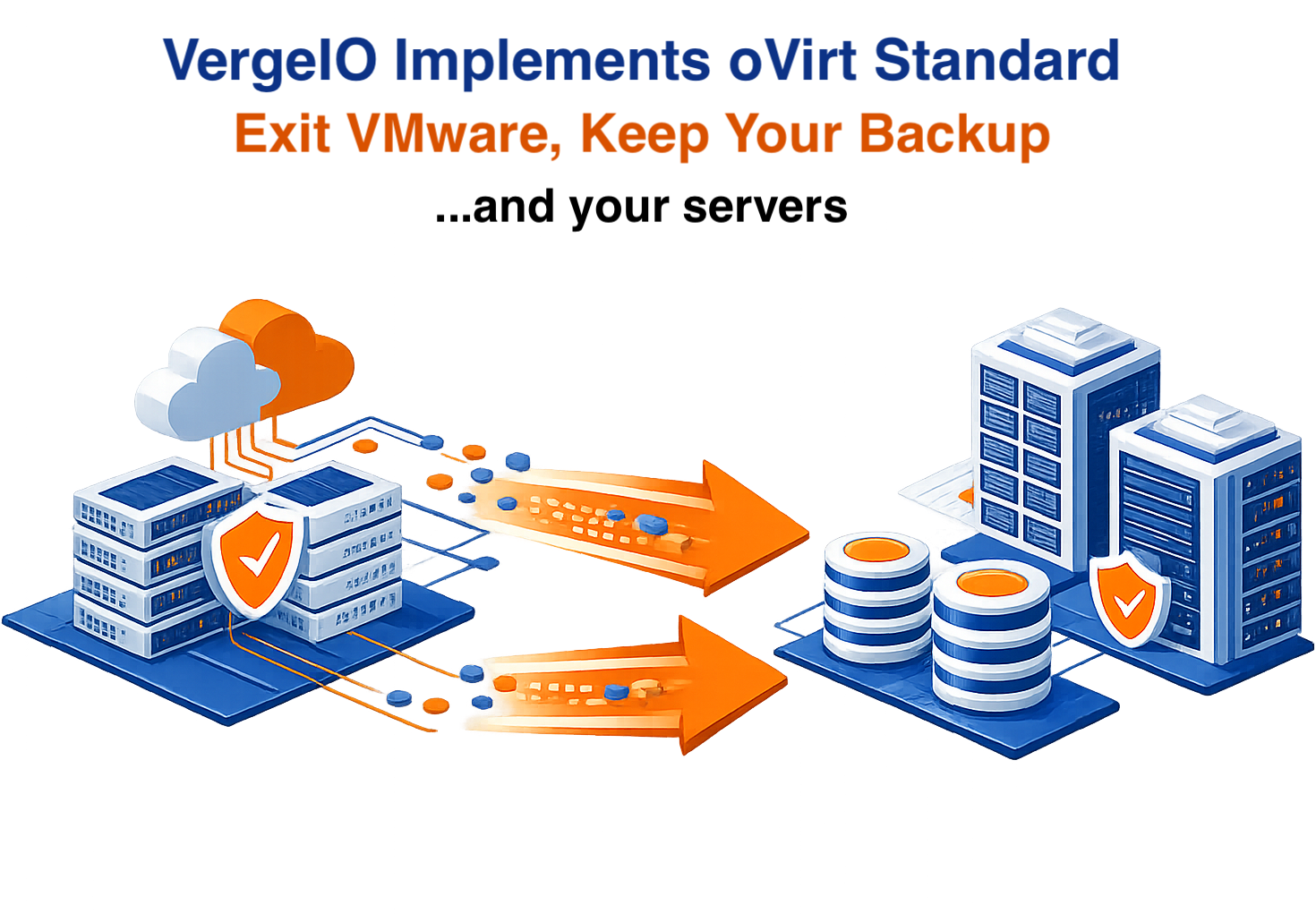 Veeam is a leading example of this in practice. Veeam’s oVirt driver connects to VergeOS 26.1.2 with no modifications and no custom code. The integration deploys in under an hour and runs at full production scale from day one. For any organization running Veeam as its backup standard, VergeOS is immediately compatible.
Migration projects no longer stall on backup readiness. The question shifts from “How do we handle backup after we exit VMware?” to “When do we want to move?”
Keep Your Existing Servers Through the Memory and Storage Price Supercycle
DRAM prices are projected to increase 171% year-over-year through 2027. NAND flash contract prices jumped 55–60% in Q1 2026 alone. Server lead times have extended to months in some categories as memory and flash shortages ripple through the supply chain. DDR4 production is winding down while DDR5 pricing reflects AI infrastructure demand that enterprise IT cannot negotiate away. This has been characterized as a Memory and Flash Supercycle that will reshape enterprise infrastructure economics for years.
Organizations that commit to staying on VMware are committing to a hardware refresh cycle at the worst possible time. Broadcom’s licensing changes frequently require hardware that meets updated specifications, pushing organizations toward new server purchases precisely when server costs are at a cycle peak.
VergeOS runs on the hardware you already own. Exiting VMware through VergeOS means organizations migrate workloads without replacing infrastructure. The same servers that run VMware today run VergeOS tomorrow — with the same backup tools, through the same oVirt-compatible interface, on the same physical hardware.
VergeOS also reduces the RAM footprint for the same workload count. The platform’s global inline deduplication extends across memory as well as storage, reducing the physical RAM your infrastructure requires. Organizations running DDR4 hardware that might otherwise require DDR5 upgrades to sustain workload density on VMware can maintain and increase density on VergeOS without new memory purchases — a direct operational response to the supercycle.
A Two-Layer Protection Model
VergeOS and oVirt-compatible backup platforms divide data protection responsibilities cleanly. VergeOS operates at the infrastructure layer, maintaining continuous data availability and supporting recovery at the scale of entire Virtual Data Centers. Failures at the disk, node, or site level are absorbed within the platform. Backup platforms handle the granular layer — file-level restore, application-aware protection, and long-term retention. Each system operates within its intended role.
Availability
Native oVirt API compatibility is available today in VergeOS 26.1.2 and later. Organizations ready to exit VMware connect their existing backup platforms through the standard oVirt interface and begin protecting workloads immediately.
A live demonstration with Veeam is scheduled for April 15, 2026, at 1:00 PM ET. Register for the webinar.