• Skip to main content
  • Architecture
    • Overview
      Learn about VergeOS’ unique unfied architecture that integrates virtualization, storage, networking, AI, backup and DR into a single data center operating system
    • Infrastructure Wide Deduplication
      VergeOS transforms deduplication from a storage-only commodity into a native, infrastructure-wide capability that spans storage, virtualization, and networking, eliminating hidden resource taxes
    • VergeFS
      VergeFS is a distributed, high-performance global file system integrated into VergeOS, unifying storage across nodes, tiers, and workloads while eliminating the need for external SANs
    • VergeFabric
      VergeFabric is VergeOS’s integrated virtual networking layer, delivering high-speed, low-latency communication across nodes while eliminating the complexity of traditional network configurations.
    • Infrastructure Automation
      VergeOS integrates Packer, Terraform, and Ansible to deliver an end-to-end automation pipeline that eliminates infrastructure drift and enables predictable, scalable deployments.
    • VergeIQ
      Unlock secure, on-premises generative AI—natively integrated into VergeOS. With VergeIQ, your enterprise gains private AI capabilities without the complexity, cloud dependency, or token-based pricing.
  • Features
    • Virtual Data Centers
      A VergeOS Virtual Data Center (VDC) is a fully isolated, self-contained environment within a single VergeOS instance that includes its own compute, storage, networking, and management controls
    • High Availability
      VergeOS provides a unified, easy-to-manage infrastructure that ensures continuous high availability through automated failover, storage efficiency, clone-like snapshots, and simplified disaster recovery
    • ioClone
      ioClone utilizes global inline deduplication and a blockchain-inspired file system within VergeFS to create instant, independent, space-efficient, and immutable snapshots of individual VMs, volumes, or entire virtual data centers.
    • ioReplicate
      ioReplicate is a unified disaster-recovery solution that enables simple, cost-efficient DR testing and failover via three‑click recovery of entire Virtual Data Centers—including VMs, networking, and storage.
    • ioFortify
      ioFortify creates immutable, restorable VDC checkpoints and provides proactive ransomware detection with instant alerts for rapid recovery and response.
    • ioMigrate
      ioMigrate enables large-scale VMware migrations, automating the rehosting of hundreds of VMs (including networking settings) in seconds with minimal downtime by seamlessly transitioning entire VMware environments onto existing hardware stacks.
    • ioProtect
      ioProtect offers near-real-time replication of VMware VMs—including data, network, and compute configurations—to a remote disaster‑recovery site on existing hardware, slashing DR costs by over 60% while supporting seamless failover and testing in an efficient, turnkey VergeOS Infrastructure.
    • ioOptimize
      ioOptimize leverages AI and machine learning to seamlessly integrate new and old hardware and automatically migrate workloads from aging or failing servers.
    • ioGuardian
      ioGuardian is VergeIO’s built-in data protection and recovery capability, providing near-continuous backup and rapid VM recovery during multiple simultaneous drive or server failures.
  • IT Initiatives
    • VMware Alternative
      VergeOS offers seamless migration from VMware, enhancing performance and scalability by consolidating virtualization, storage, and networking into a single, efficient platform.
    • Hyperconverged Alternative
      VergeIO’s page introduces ultraconverged infrastructure (UCI) via VergeOS, which overcomes HCI limitations by supporting external storage, scaling compute and storage independently, using existing hardware, simplifying provisioning, boosting resiliency, and cutting licensing costs.
    • SAN Replacement / Storage Refresh
      VergeIO’s storage by replacing aging SAN/NAS systems within its ultraconverged infrastructure, enhancing security, scalability, and affordability.
    • Infrastructure Modernization
      Legacy infrastructure is fragmented, complex, and costly, built from disconnected components. VergeOS unifies virtualization, storage, networking, data protection, and AI into one platform, simplifying operations and reducing expenses.
    • Virtual Desktop Infrastructure (VDI)
      VergeOS for VDI delivers a faster, more affordable, and easier-to-manage alternative to traditional VDI setups—offering organizations the ability to scale securely with reduced overhead
    • Secure Research Computing
      VergeIO's Secure Research Computing solution combines speed, isolation, compliance, scalability, and resilience in a cohesive platform. It’s ideal for institutions needing segmented, compliant compute environments that are easy to deploy, manage, and recover.
    • Venues, Remote Offices, and Edge
      VergeOS delivers resiliency and centralized management across Edge, ROBO, and Venue environments. With one platform, IT can keep remote sites independent while managing them all from a single pane of glass.
  • Blog
      • GPU Infrastructure Without the ComplexityGPU infrastructure doesn't have to require GPU specialists. VergeOS delivers point-and-click MIG configuration, automated driver management, and NVIDIA joint support — so standard IT teams can run visual compute and AI development workloads on the infrastructure they already own.
      • Data Availability is Critical During the Memory SupercycleRising RAM and flash prices force organizations onto aging and refurbished hardware. Data availability determines whether those hardware failures are routine events or business-stopping emergencies. VergeOS delivers layered protection from the drive level through node-level redundancy to cross-site replication, all on the hardware you already own.
      • Will Hard Drives Save Us From the Flash and RAM Supercycle?DRAM is up 171%. Flash jumped 55–60%. Will hard drives solve the flash and memory supercycle? The short answer is no — and here's what actually does.
    • View All Posts
  • Resources
    • Become a Partner
      Get repeatable sales and a platform built to simplify your customers’ infrastructure.
    • Technology Partners
      Learn about our technology and service partners who deliver VergeOS-powered solutions for cloud, VDI, and modern IT workloads.
    • White Papers
      Explore VergeIO’s white papers for practical insights on modernizing infrastructure. Each paper is written for IT pros who value clarity, performance, and ROI.
    • In The News
      See how VergeIO is making headlines as the leading VMware alternative. Industry analysts, press, and partners highlight our impact on modern infrastructure.
    • Press Releases
      Get the latest VergeOS press releases for news on product updates, customer wins, and strategic partnerships.
    • Case Studies
      See how organizations like yours replaced VMware, cut costs, and simplified IT with VergeOS. Real results, real environments—no fluff.
    • Webinars
      Explore VergeIO’s on-demand webinars to get straight-to-the-point demos and real-world infrastructure insights.
    • Documents
      Get quick, no-nonsense overviews of VergeOS capabilities with our datasheets—covering features, benefits, and technical specs in one place.
    • Videos
      Watch VergeIO videos for fast, focused walkthroughs of VergeOS features, customer success, and VMware migration strategies.
    • Technical Documentation
      Access in-depth VergeOS technical guides, configuration details, and step-by-step instructions for IT pros.
  • How to Buy
    • Schedule a Demo
      Seeing is believing, set up a call with one of our technical architects and see VergeOS in action.
    • Versions
      Discover VergeOS’s streamlined pricing and flexible deployment options—whether you bring your own hardware, choose a certified appliance, or run it on bare metal in the cloud.
    • Test Drive – No Hardware Required
      Explore VergeOS with VergeIO’s hands-on labs and gain real-world experience in VMware migration and data center resiliency—no hardware required
  • Company
    • About VergeIO
      Learn who we are, what drives us, and why IT leaders trust VergeIO to modernize and simplify infrastructure.
    • Support
      Get fast, expert help from VergeIO’s support team—focused on keeping your infrastructure running smoothly.
    • Careers
      Join VergeIO and help reshape the future of IT infrastructure. Explore open roles and growth opportunities.
  • 855-855-8300
  • Contact
  • Search
  • 855-855-8300
  • Contact
  • Search
  • Architecture
    • Overview
    • VergeFS
    • VergeFabric
    • Infrastructure Automation
    • VergeIQ
  • Features
    • Virtual Data Centers
    • High Availability
    • ioClone
    • ioReplicate
    • ioFortify
    • ioMigrate
    • ioProtect
    • ioOptimize
    • ioGuardian
  • IT Initiatives
    • VMware Alternative
    • Hyperconverged Alternative
    • SAN Replacement / Storage Refresh
    • Infrastructure Modernization
    • Virtual Desktop Infrastructure (VDI)
    • Secure Research Computing
    • Venues, Remote Offices, and Edge
  • Blog
  • Resources
    • Become a Partner
    • Technology Partners
    • White Papers
    • In The News
    • Press Releases
    • Case Studies
    • Webinars
    • Documents
    • Videos
    • Technical Documentation
  • How to Buy
    • Schedule a Demo
    • Versions
    • Test Drive – No Hardware Required
  • Company
    • About VergeIO
    • Support
    • Careers
×
  • Architecture
    • Overview
    • VergeFS
    • VergeFabric
    • Infrastructure Automation
    • VergeIQ
  • Features
    • Virtual Data Centers
    • High Availability
    • ioClone
    • ioReplicate
    • ioFortify
    • ioMigrate
    • ioProtect
    • ioOptimize
    • ioGuardian
  • IT Initiatives
    • VMware Alternative
    • Hyperconverged Alternative
    • SAN Replacement / Storage Refresh
    • Infrastructure Modernization
    • Virtual Desktop Infrastructure (VDI)
    • Secure Research Computing
    • Venues, Remote Offices, and Edge
  • Blog
  • Resources
    • Become a Partner
    • Technology Partners
    • White Papers
    • In The News
    • Press Releases
    • Case Studies
    • Webinars
    • Documents
    • Videos
    • Technical Documentation
  • How to Buy
    • Schedule a Demo
    • Versions
    • Test Drive – No Hardware Required
  • Company
    • About VergeIO
    • Support
    • Careers

vGPU

March 30, 2026 by George Crump

NVIDIA vGPU — VergeOS 26.1.3

GPU acceleration without the operational overhead

Every enterprise wants AI capabilities. Most organizations have proprietary data they do not, or legally cannot, send to cloud providers. Visual compute and AI development infrastructure keeps sensitive data on-premises while delivering the GPU acceleration that machine learning workloads demand. The challenge has never been the hardware — NVIDIA GPUs are widely available, and most organizations already own servers capable of running them. The challenge is operations.

Key Takeaways
  • Visual compute and AI development infrastructure keeps sensitive data on-premises while delivering GPU-accelerated performance without cloud dependency.
  • VergeOS eliminates the specialized expertise barrier by managing GPU resources through the same interface used for compute, storage, and networking.
  • NVIDIA introduced VergeOS as a supported vGPU platform, establishing joint support paths so both vendors stand behind your deployment.
  • MIG configuration in VergeOS is a point-and-click operation — no nvidia-smi, no command-line tools, no GPU specialists required.
  • Five deployment scenarios — VDI, inference, multi-tenant dev, edge AI, and analytics — are all accessible to standard IT teams today.

Visual compute and AI development deployments keep sensitive data on-premises while delivering the GPU acceleration that machine learning workloads demand. GPU infrastructure traditionally requires specialized expertise that most IT teams lack. Who manages the GPUs? What happens when driver updates break compatibility? How do you allocate GPU resources across competing workloads without constant manual intervention? These questions stop projects before they start.

Key Terms
Visual Compute and AI Development Infrastructure
GPU-accelerated computing deployed on-premises for engineering, design, simulation, and AI development workloads, keeping proprietary data inside the organization’s security boundary rather than sending it to public cloud providers.
NVIDIA vGPU
A software layer that enables multiple virtual machines to share a single physical GPU, with each VM receiving dedicated memory and its own full NVIDIA driver stack. Requires a software license from an NVIDIA-authorized partner.
MIG (Multi-Instance GPU)
Hardware-level GPU partitioning available on NVIDIA Ampere and Blackwell architecture GPUs. Divides a single GPU into isolated instances with dedicated compute engines, memory, and bandwidth — enforced in silicon, not software.
VergeOS
The private cloud operating system from VergeIO that unifies compute, storage, networking, and GPU management in a single platform. IT teams manage all infrastructure — including GPUs — through one interface.
NVIDIA Supported vGPU Platform
NVIDIA introduced VergeOS as a supported vGPU platform, meaning VergeOS meets NVIDIA’s technical requirements for enterprise GPU virtualization. Supported platforms receive joint support from both the platform vendor and NVIDIA engineering.
GPU Passthrough
A configuration that assigns an entire physical GPU exclusively to a single virtual machine. Delivers maximum performance but no sharing — one VM per GPU.

Driver management, resource allocation, Multi-Instance GPU configuration, and troubleshooting demand knowledge that sits outside the typical sysadmin skill set. Organizations either hire dedicated GPU specialists, engage expensive consultants, or avoid GPU workloads altogether. VergeOS changes that equation. The partnership with NVIDIA brings vGPU capabilities into the same unified management interface that IT teams already use for compute, storage, and networking. No separate tools. No specialized training. No operational friction.

Multi-Instance GPU: One GPU, Multiple Workloads
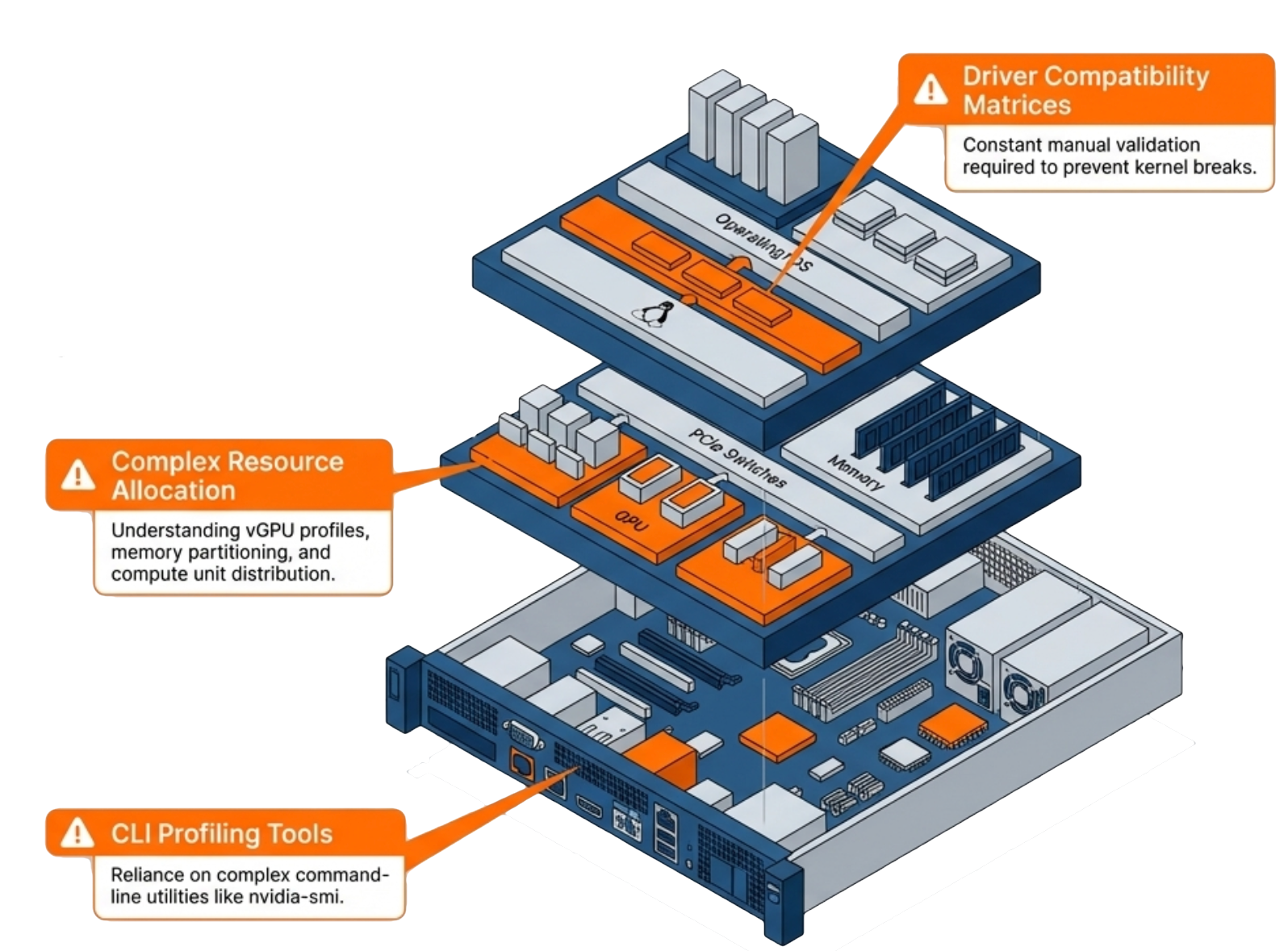
GPU management complexity without VergeOS

Not every workload needs a full GPU. A data scientist running inference tests does not require the same resources as a team training a large model. Traditional GPU allocation forces a choice: dedicate an entire GPU to a single workload or deal with the complexity of manual resource sharing.

NVIDIA Multi-Instance GPU (MIG) solves this problem by partitioning a single physical GPU into multiple isolated instances. Each instance gets dedicated memory and compute resources. Workloads running on separate MIG instances cannot interfere with each other, and each instance behaves like an independent GPU from the application’s perspective.

The catch: MIG configuration traditionally requires command-line expertise and careful planning. IT teams need to understand partition sizes, memory allocation, and how to reconfigure instances as workload requirements change. VergeOS automates MIG configuration through the same interface used for all other infrastructure management. Select the partition profile that matches your workload requirements, and VergeOS handles the rest. When requirements change, reconfigure without touching a command-line tool or GPU management utility.

What It Means That NVIDIA Introduced VergeOS as a Supported vGPU Platform
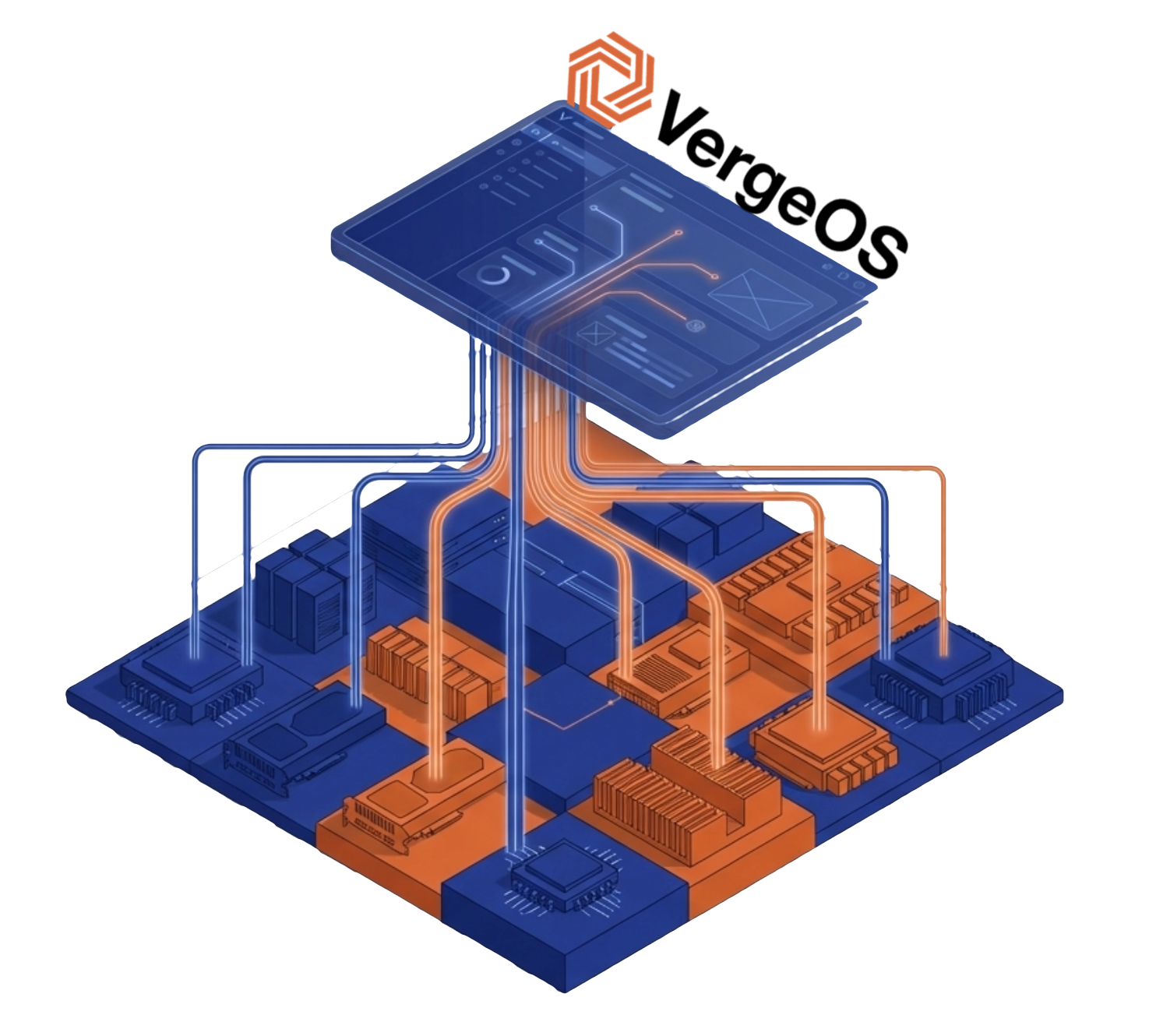
VergeOS unified GPU management interface

NVIDIA introducing VergeOS as a supported vGPU platform matters for one reason: support escalation paths. When something goes wrong with GPU workloads, enterprises need to know both vendors will stand behind the deployment. Joint support means IT teams can deploy vGPU workloads with confidence. If driver issues arise, both VergeOS and NVIDIA engineering teams collaborate on resolution. No finger-pointing. No gaps in coverage.

This designation also signals that NVIDIA’s technical teams have validated VergeOS as an enterprise-ready platform for GPU virtualization. NVIDIA does not introduce platforms lightly. Their enterprise customers expect validated, tested configurations, and NVIDIA’s reputation depends on partner platforms delivering consistent results. For full details on what this means for your deployment, see the official announcement.

Practical Applications for Visual Compute and AI Development

Visual compute and AI development use cases extend well beyond training large language models. Engineering simulation, scientific visualization, and inference workloads all benefit from GPU acceleration without requiring massive GPU clusters. These are five scenarios standard IT teams can deploy today without GPU specialists:

VDI with GPU acceleration gives knowledge workers access to applications that previously required dedicated workstations. Engineering, design, and scientific visualization workloads run from centralized infrastructure while users connect from standard endpoints.

AI inference at the edge processes data locally without sending it to external services. Manufacturing quality control, retail analytics, and healthcare imaging all benefit from on-premises GPU acceleration.

Multi-tenant AI development splits a single high-end GPU across multiple data science teams. Each team gets an isolated MIG instance with guaranteed resources. No contention, no noisy neighbor problems, and no need to purchase separate GPUs for each group.

Development environments for AI teams provide GPU resources on demand without physical hardware allocation. Spin up GPU-enabled VMs when needed and reclaim resources when projects complete.

Database acceleration uses GPUs for analytics workloads, dramatically reducing query times on large datasets. Business intelligence teams get faster insights without specialized database infrastructure.

NVIDIA and VergeOS GPU use cases

Getting Started

Organizations with existing VergeOS deployments can add GPU capabilities to their current infrastructure. Install supported NVIDIA GPUs in your servers, and VergeOS handles the rest — driver management, MIG configuration, resource allocation, and monitoring all from the same interface your team already operates. No separate management plane. No new interfaces to learn.

For organizations evaluating private cloud platforms, the NVIDIA partnership demonstrates the direction VergeOS is headed: an infrastructure layer that makes advanced capabilities accessible to standard IT operations. GPU management today, and whatever comes next tomorrow. The goal is consistent — eliminate the operational complexity that prevents organizations from using the infrastructure they already own. Visual compute and AI development infrastructure should not require specialized GPU staff.

Take a Test Drive Today — No hardware required.

See it live: join the GPU Virtualization Without the Complexity webinar on April 2nd at 1:00 PM ET for a live demonstration of MIG configuration, vGPU profiles, and one-time driver upload in a unified private cloud environment.

Explore the full platform details on the Abstracted GPU Infrastructure page, or read the official announcement.

?Frequently Asked Questions
What makes on-premises GPU infrastructure different from public cloud AI?
On-premises GPU infrastructure keeps all data, model weights, and inference outputs inside the organization’s security boundary. Public cloud AI routes sensitive data through third-party infrastructure, creating compliance risk for regulated industries and organizations with proprietary data. On-premises GPU-accelerated infrastructure delivers the same performance as cloud without the data sovereignty concerns.
Do we need to hire GPU specialists to run VergeOS with NVIDIA vGPU?
No. VergeOS manages driver deployment, MIG configuration, resource allocation, and GPU monitoring through the same interface IT teams already use for compute, storage, and networking. The platform abstracts GPU complexity so sysadmins who have never managed a GPU can deploy and operate vGPU workloads from day one.
What is MIG and why does it matter for multi-tenant AI deployments?
Multi-Instance GPU partitions a single physical GPU into isolated instances at the hardware level. Each instance gets dedicated compute engines, memory, and bandwidth. Because the isolation is enforced in silicon, workloads in one MIG instance cannot affect neighboring instances — no noisy neighbor effects, no contention. For multi-tenant environments, MIG provides the same guarantees as separate physical GPUs at a fraction of the cost.
What NVIDIA GPU hardware is supported with VergeOS today?
Currently validated data center GPUs include the A100, A30, A40, and L40 series in VergeOS 26.1.3. MIG vGPU functionality has been validated on the NVIDIA Blackwell RTX Pro 6000 Server Edition. NVIDIA vGPU software licenses are required for vGPU operation and are available through NVIDIA-authorized partners.
Where can I see VergeOS GPU management in action?
Register for the live webinar on April 2nd at 1:00 PM ET at GPU Virtualization Without the Complexity. The session covers pass-through, vGPU, and MIG configuration in a unified environment with a live demo. An on-demand replay will be available after the event.
What does it mean that NVIDIA introduced VergeOS as a supported vGPU platform?
NVIDIA introduced VergeOS as a supported vGPU platform, meaning VergeOS 26.1.3 appears on NVIDIA’s validated platform list as a supported configuration for enterprise GPU virtualization. When GPU issues arise, both VergeOS and NVIDIA engineering teams collaborate on resolution. IT teams get a clear support escalation path with no gaps between vendors. GPU support is additive — install supported NVIDIA GPUs into existing cluster nodes and VergeOS automatically detects and inventories the hardware.

Filed Under: AI Tagged With: GPU, IT infrastructure, Private AI, vGPU

855-855-8300

Get Started

  • Versions
  • Request Tour

VergeIO For

  • VMware Alternative
  • SAN Replacement
  • Solving Infrastructure Modernization Challenges
  • Artificial Intelligence
  • Hyperconverged
  • Server Room
  • Secure Research Computing

Product

  • Benefits
  • Documents
  • Architecture Overview
  • Use Cases
  • Videos

Company

  • About VergeIO
  • Blog
  • Technical Documentation
  • Legal

© 2026 VergeIO. All Rights Reserved.