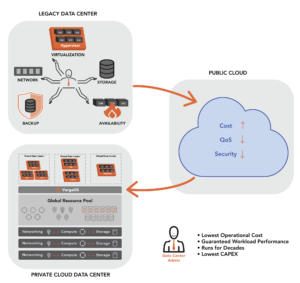
If you are frustrated with VMware’s high prices, exorbitant renewal fees, stalled innovation, and declining support, you may be looking at the Public Cloud as a VMware alternative. Public Cloud providers like Amazon AWS, Microsoft Azure, and Google Cloud have their use cases. Still, as we’ve seen in the recent rash of cloud repatriation moves, the Cloud is not necessarily the ideal solution for all use cases.
The first question is, “Does the Public Cloud meet the requirements of a VMware Alternative?”
Requirements for a VMware Alternative:
- Have a lower upfront cost
- Lower long-term costs
- Provide superior performance and capabilities
- Offer world-class support
This blog will explore how the Public Cloud stands up to these requirements.
The Upfront Costs of the Public Cloud
Upfront costs are an area where most analysts suggest that the Public Cloud has an advantage over VMware and other VMware alternative solutions. But does it? In the VMware alternative use case, you already have the hardware! The bigger question is, can the potential VMware alternative use your hardware? In most cases, the answer is “no” or “not very well,” so in those cases, the Public Cloud has an upfront cost advantage because you only have to pay the first month’s “rent” for the hardware and software you need.
VergeOS is an Ultraconverged Infrastructure that rotates the traditional IT stack (hypervisor, storage, and network) into a linear plane and a single software code base. This integration is essential because it creates a data center operating system that is 50% or more efficient than legacy, fragmented solutions. Unlike traditional Hyperconverged Infrastructure (HCI), VergeOS can run on existing hardware and deliver more capacity and performance. See our HCI to UCI comparison page for more details.
The Long-Term Costs of the Public Cloud
An area where the Public Cloud as a VMware alternative does not fare well is in the long-term cost calculation. The repeated monthly rental of the same infrastructure adds up quickly, which is why we see a rash in Public Cloud departures. The Public Cloud is ideal for short-term projects that you will spin up quickly and then tear down after getting the answers you need or validating a concept. It is not ideal for long-term, relatively static environments that will run for years, even decades.
Most customers we speak to looking for a VMware replacement have been running their VMware infrastructure for five years or more. The servers that support that environment are typically three to five years old. Even if you are very judicious about cloud resource utilization (which most people don’t have the time for), over five years, you will spend significantly more for the cost of renting that compute from the Public Cloud versus owning it outright, especially in the VMware or VMware alternative use case.
VergeIO has a long-term cost advantage over the Public Cloud, VMware, and VMware alternatives, thanks again to the extreme efficiency of VergeOS. Our software allows you to extend the life of IT infrastructure further than you ever thought possible. Many VergeOS customers are running on servers and storage that are over six years old.
The Performance of the Public Cloud
In theory, the performance of the Public Cloud should be an advantage when IT Professionals consider it a VMware alternative. If you need more processing power, rent more processors; if you don’t, deactivate them. This theory may hold if your application is scalable across multiple processors and cores. Most applications are not that threaded, and throwing more processing power at them doesn’t help. Additionally, performance isn’t just about processor performance. In most cases, the bottleneck is either poor application code or storage I/O performance.
Storage performance is an area where the Public Cloud struggles. High performance is costly and often far more challenging to configure. The built-in capabilities of the Public Cloud, especially in terms of storage, are so weak that there are dozens of products from third-party software developers that organizations need to sift through to try to fill the gaps.
VergeIO’s approach directly integrates a complete suite of storage services into VergeOS. Storage is an equal citizen alongside the hypervisor and network capabilities. The storage capabilities of VergeOS are so powerful that many companies begin their VMware Exit Strategy by selecting VergeOS instead of going through yet another SAN replacement.
World Class Support
The quality of support from both VMware and the Public Cloud varies wildly. With VergeIO, all customers, regardless of size, experience high-quality support with quick resolution to your questions. VergeIO also provides customers with a world-class support experience. We know that VergeOS doesn’t live in a vacuum, and we go above and beyond, even helping customers resolve issues with non-VergeOS-related challenges. Quality support is easy to claim but harder to deliver. Take our product for a test drive, experience our support firsthand, or speak with our customers.
How to Start Your VMware Exit
VergeOS is usually 50% less than the price of VMware, and it leverages your existing hardware so you can benefit from those savings almost immediately. Our efficiency will extend the life of your current hardware, further increasing your savings. Finally, the operating system delivers better performance, data protection, and greatly simplified operations.
You can start by scheduling a test drive. Using our Virtual Data Center technology, we create a virtual environment. Within minutes you’ll be up and running without having to deploy hardware.
Your next step might be using VergeOS as a disaster recovery copy of your VMware environment. If you have a few different servers, you can load our software on them and create a complete VMware disaster recovery plan without a substantial financial outlay. This option allows you to take an inexpensive extended use of our solution while adding value to and reducing the cost of your current infrastructure.
While using VergeOS as a VMware DR solution, you might also want to use your VergeOS infrastructure for new workloads. Then when you’re ready, you can use our DR technology to move your VMware environment to VergeOS seamlessly. Again, transition at your pace, knowing we will be there every step of the way.