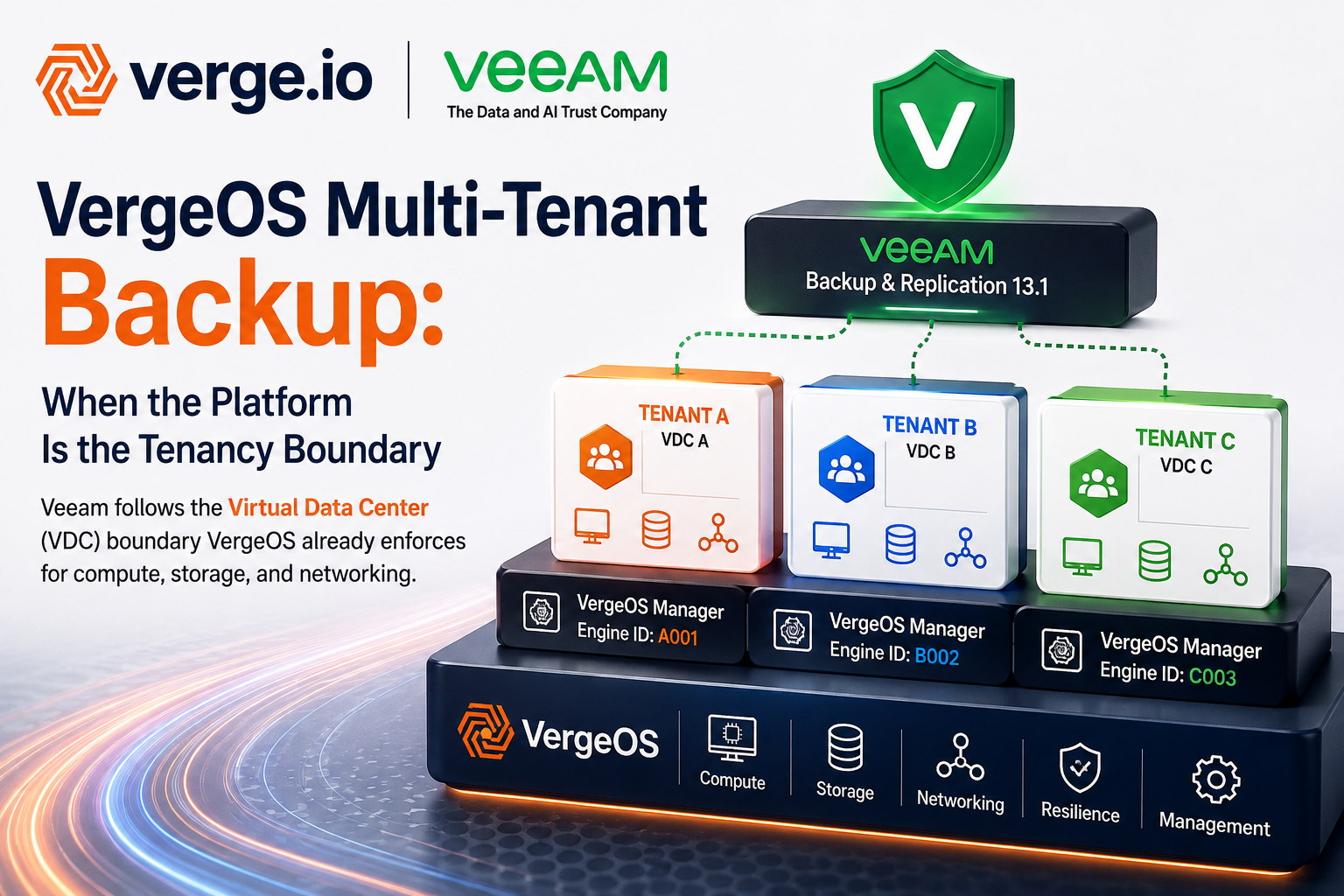
Each VergeOS tenant becomes its own VergeOS Manager and engine ID in Veeam Backup & Replication, so multi-tenant backup follows the Virtual Data Center boundary the platform already enforces.
VergeOS multi-tenant backup follows a boundary the platform already enforces, not one a backup administrator builds on top of it. Most Veeam coverage of the VergeOS integration treats it as a hypervisor story, and multi-tenant behavior gets one line in a feature list near the bottom of the page. The architecture behind that line carries the real argument. Each VergeOS tenant is added to Veeam Backup & Replication as its own VergeOS Manager, with its own engine ID. Jobs, retention, and reporting stay separated per tenant, and that separation follows the Virtual Data Center, the isolation unit VergeOS already enforces for compute, storage, and networking.
Key Takeaways
- VergeOS multi-tenant backup follows the Virtual Data Center boundary the platform enforces for compute, storage, and networking. Veeam inherits that boundary rather than reconstructing it.
- Enterprises carry the same tenancy problem service providers do. Production and development, a subsidiary under its own compliance rules, an acquired company, and a regulated department all need the same separation.
- VergeOS multi-tenant backup means Veeam adds each tenant as its own VergeOS Manager with its own engine ID, so jobs, retention, and reporting stay separated without a backup administrator maintaining the boundary by hand.
The Enterprise Case for Virtual Data Centers
Most readers categorize a Virtual Data Center as a cloud provider feature, and that categorization costs VergeOS an audience that skips past anything with “multi-tenant” in the title. An enterprise runs the same problem under different names. Production and development need real separation, not a naming convention two engineers agreed to follow. A subsidiary carries its own compliance obligations. An acquired company arrives with an infrastructure estate that has to stay intact through an integration that runs two years. Departments charge back their own infrastructure costs, and regulated workloads live under audit scope that cannot spread into the rest of the estate.
Every one of those is a tenancy problem, and enterprises solve it today by buying separate clusters. Separate hardware is the enterprise version of a tenant boundary. It sits idle between peaks, and moving a workload from one cluster to another means a migration project rather than a configuration change. The VDC delivers the same isolation without the second cluster, and the Veeam integration lets the backup design inherit that isolation instead of fighting for it.
The Virtual Data Center as the Isolation Unit
A VDC is a full encapsulation of compute, storage, and networking, the same way a virtual machine encapsulates its own resources, scaled up to data center size. VergeOS describes the result as complete isolation at the infrastructure level, and draws a direct contrast with a VLAN, which segments only the network and operates at the data link layer. A VLAN separates traffic. A VDC separates the infrastructure the traffic runs on.
That distinction carries the whole piece. On most platforms, multi-tenant backup is a discipline the backup administrator imposes on infrastructure that has no idea tenancy exists. Folder hierarchies, job naming conventions, tag policies, and scoped credentials all approximate a boundary the hypervisor never had. The approximation holds until someone edits a job, renames a folder, or reassigns a credential. On VergeOS the boundary already exists at the infrastructure layer before a single backup job gets created, so the backup topology inherits it instead of reconstructing it.
How Veeam Inherits VergeOS Multi-Tenant Backup
Veeam Backup & Replication 13.1 connects directly to that structure. A VergeOS provider system, or an individual tenant inside it, gets added to Veeam under Virtualization Platforms as its own VergeOS Manager, and each one carries its own engine ID. Jobs point at a specific VergeOS Manager, so a job built against one tenant has no path to the VMs living inside another. Retention policies, schedules, and reporting all follow the same separation, tenant by tenant, without a shared job that a backup administrator has to scope by hand.
One deployment step earns a place in this piece rather than a footnote. The provider’s External network has to extend into each tenant Veeam will protect, so Veeam Workers can reach the VMs they back up. It is a real step in a real deployment plan, and a piece that skips it loses credibility with the reader who tries the integration next.
State the division of labor plainly, since getting it backwards inverts the whole argument. VergeOS enforces the tenant boundary, and Veeam inherits it. Veeam reads a structure that already exists and reports against it, tenant by tenant, a smaller job than enforcing isolation and a more reliable one.
| Most Backup Platforms | VergeOS with Veeam | |
|---|---|---|
| What separates tenants | Folder structure, job naming, tag policy, scoped credentials | The Virtual Data Center, enforced at the infrastructure layer |
| Who enforces the boundary | The backup administrator, job by job | The platform, before a backup job exists |
| What happens when a job is misconfigured | The boundary can be crossed | The job has no path across it |
| Where the boundary lives | Inside the backup product | Inside the infrastructure the backup product reads |
What the Design Buys Operationally
VergeOS multi-tenant backup pays off at restore time. A tenant-scoped restore returns exactly what that tenant owns, and nothing from a neighboring tenant surfaces in the recovery, since the VergeOS Manager backing the job never had a path to that data in the first place. An enterprise running production and development as separate VDCs gets the same guarantee a service provider gets for two customers, without asking a backup administrator to police the line between them every time a job changes.
Tenant isolation answers one restore question. Whether the restored VM opens the way the application left it is a separate one, and it turns on application-consistent backup, not on which VDC the job ran against. VergeOS earns that guarantee through the same Veeam Deployment Toolkit mechanism vSphere and Hyper-V already use, and the tenant boundary has no bearing on it either way.
That is the part worth carrying past this article. A tenant boundary built from folders and naming conventions holds until somebody edits a job. A tenant boundary built into the infrastructure has nothing to edit.
Key Terms
See the Tenant Model in a Live Console
Read the full capability set, including the multi-tenant deployment step, in the datasheet: Leave VMware. Keep Veeam.