Architecting continuity through the hypervisor transition.
Critical workloads migrate last. The parallel-operation window runs for months. A backup tool that only speaks to one hypervisor forces a second migration project on top of the first. This session walks the two-layer reference architecture that holds the line.

George Crump
CMO, VergeIO · Host

Paweł Piskorz
Presales Engineer, Storware
A few housekeeping notes.
Polls along the way.
Two quick polls during the session. Anonymous. We use the answers to calibrate where the room actually is on the architecture question.
Q&A is open the whole time.
Drop questions in as they hit you. We answer the technical ones live and the strategic ones at the end. Nothing gets ignored.
The recording goes out.
Every registrant receives the on-demand link within 24 hours. The deck and reference architecture diagrams ship in the same email.
Two perspectives. One architecture.
The infrastructure layer and the data protection layer were built by different teams in different code bases. That separation is the point. Each of us speaks to the layer we own and how the seam between them holds.
George Crump
CMO, VergeIO · Former Founder, Storage Switzerland
George spent fifteen years as an industry analyst writing about storage and virtualization architecture. He covers the infrastructure layer in this session and frames the design problem the transition window actually presents.
Paweł Piskorz
Presales Engineer, Storware
Paweł works with customers running heterogeneous hypervisor estates every day. He drives the demo and walks the integration pipeline that ties the VergeOS native services to the Storware data protection tier.
What is VergeOS, in seven specifics.
For the part of the audience who has not seen the platform before. Software-defined infrastructure that integrates compute, storage, networking, and virtualization into a single kernel. The seven things that matter for this session.
One operating system, not a stack.
Hypervisor, storage, and networking integrated. No separate vendors at the infrastructure tier.
Replication factor 2 or 3.
Data and metadata are striped and replicated across the cluster. Hardware failure does not interrupt service.
Active during failure.
Continues serving data during multi-node failures. Customer proof: zero downtime with four of six servers down.
Independent snapshot objects.
Not redirect-on-write. ioClone produces fully independent objects with no parent VM performance penalty.
Inline, cluster-wide.
Snapshot retention does not consume duplicate capacity. The dedup horizon is the entire cluster.
NFSv4 service, scales horizontally.
Native VergeOS NAS service is what Storware mounts. Backup throughput scales by adding NAS instances.
Hardware is consumed, not negotiated.
Runs on standard x86 servers. Procurement decisions are operational, not platform-compatibility puzzles.
VergeOS handles physical reality at the infrastructure tier. The data protection tier above it is not asked to compensate for hardware failures, drive wear, or node death. That separation is what lets layer two specialize in logical threats and long-term retention.
What is Storware, in seven specifics.
The data protection tier above VergeOS. Built for heterogeneous environments. The seven things that matter for this session.
Separated control and data planes.
Server handles metadata, scheduling, and policy. Nodes handle data movement. The architecture scales each independently.
One license, every supported platform.
Per-host licensing covers VergeOS, VMware, Hyper-V, KVM, Proxmox, OpenShift, and more. No double-taxation during migration.
Changed block tracking, not snapshots.
Storware reads VergeOS via native export. Only changed blocks move. No agents in the guest. No custom plugins required.
Recover across platform boundaries.
Ingest a VMware backup, run V2V conversion, deploy natively onto VergeOS. Recovery and migration use the same data path.
Outside the production trust domain.
S3, Data Domain, immutable NAS, tape. Object lock activates at the storage tier, not the backup application.
Backup chains stay flat.
Backups consolidate at the destination. The backup window does not bloat over time. Restore points stay fast to read.
Fifteen-plus platforms supported.
VMware, VergeOS, Hyper-V, KVM, Proxmox, OpenShift, oVirt, Nutanix, OpenStack, and others. Heterogeneous is the design center.
Storware handles the logical threats and long-term retention that VergeOS is not designed to absorb on its own. Compliance retention, file-browser GUI restore, and storage outside the production trust domain are all native to this tier. The seam between the two layers is the architecture.
The repricing triggered widespread market migration.
Extreme concern.
Of IT decision-makers report extreme concern over hypervisor lock-in.
Price hikes.
Per-workload repricing for equivalent licensing following the Broadcom acquisition.
POC commitment.
Of enterprises will initiate proofs-of-concept for VMware alternatives by 2028. Source: Gartner.
The transition window is not an event.
It is the new operating reality.
Critical workloads migrate last.
Easy workloads move first. The complex, dependency-heavy, business-critical workloads stay on the source hypervisor for months. The hardest data protection problem is the last to land.
Heterogeneous is the norm.
Production data lives on two hypervisors at once during the transition. A backup architecture that assumes a single platform forces a second migration project.
Ransomware targets backup.
96% of attacks now target backup repositories. A backup that lives in the same trust domain as production is compromised by definition. Air-gap is no longer optional.
Why heterogeneous is the design center.
“Heterogeneous environments are the norm now, not the exception.”
— Paweł Mączka · CTO, Storware
- Source and destination hypervisors run in parallel for the duration of the migration, not just the cutover.
- Backup tooling is the seam where the transition window either holds or fails.
- A single-hypervisor backup product creates a billing event for every workload move.
- Cross-hypervisor recovery is the actual test. Recovery to the source platform is not enough.
- The reference architecture must be evaluated under transition conditions, not steady state.
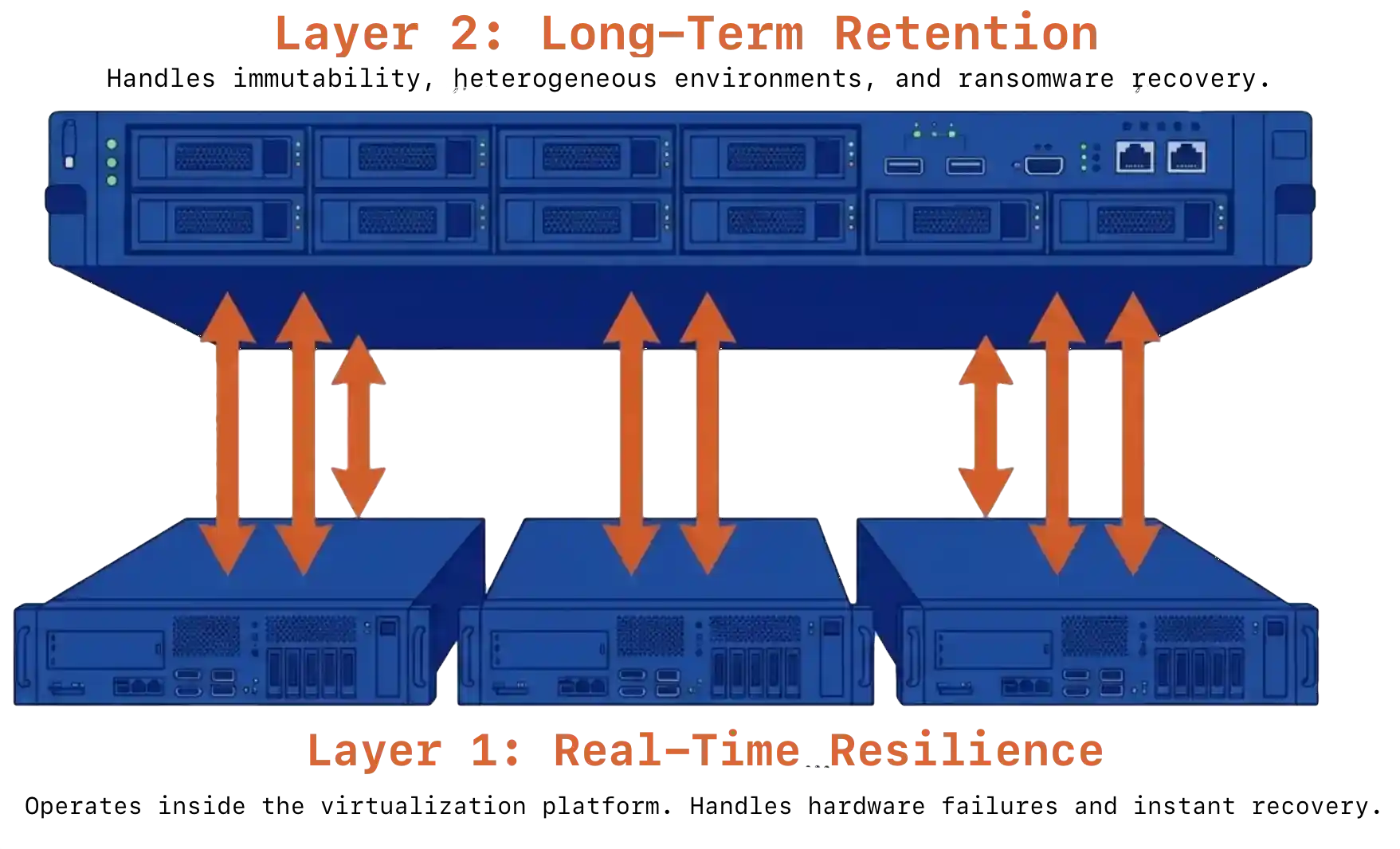
The seam between the layers is the design.
Each layer has a job. The infrastructure tier handles physical reality. The data protection tier handles logical threats and retention. The seam between them is what makes the architecture survive a transition window.
Physical reality.
Software-defined infrastructure. Drives, nodes, networks, and the virtualization layer integrated into a single kernel.
- RF2/RF3 + ioGuardian absorb drive loss and node death without interruption.
- Global deduplication ensures snapshot retention does not consume duplicate capacity.
- ioClone snapshots produce fully independent objects with no parent VM penalty.
- Internal NFSv4 NAS scales horizontally to match Storware Node throughput.
- Hardware events stay invisible to the data protection tier above.
Layer one handles high-frequency physical events instantly.
Logical threats and retention.
Dedicated data protection tier built for heterogeneous environments. Server-and-Node architecture separates metadata from data movement.
- Native CBT integration across VMware, VergeOS, and 13+ other hypervisors.
- Cross-hypervisor V2V ingests VMware backups and deploys natively onto VergeOS.
- Immutable targets — S3, Data Domain, immutable NAS — outside the production trust domain.
- Synthetic forever-incremental consolidates the backup chain at the destination.
- Universal license covers all supported platforms. No double-taxation during migration.
Layer two handles catastrophic logical events with immutable retention.
Four steps. End-to-end. Live.
All of us on camera. One drives, the rest narrate. The data path used during the demo is the exact same path used in production.
Create a production VM in VergeOS.
Stand up a workload on the VergeOS cluster. Allocate compute, storage, and network as native services of the platform. Boot the VM and place a small dataset on it.
- Storage and networking are native to the OS, not external products.
- Provisioning happens in seconds, not a procurement cycle.
- RF2 protection engages automatically. No configuration step.
- The VM is visible to Storware over the internal NAS service immediately.
Capture an ioClone, ship through the integration pipeline.
Snapshot the VM with ioClone. The native VergeOS NFSv4 NAS service exposes the snapshot to the Storware Node. Changed block tracking ensures only incremental data moves.
- ioClone produces an independent object — no parent VM degradation.
- Inline global deduplication kicks in across the cluster.
- Storware Node mounts the NFSv4 share and reads the snapshot directly.
- Synthetic forever-incremental consolidates the chain at the destination.
Land the backup on an immutable target.
Storware writes the backup to an immutable destination outside the production trust domain. Object lock activates. The backup is now invisible to ransomware running inside the VergeOS cluster.
- Targets supported: S3 / object, Data Domain, immutable NAS, tape.
- Object lock is enforced at the storage tier, not the backup application.
- The trust domain boundary is the design point, not a feature.
- Retention policies handle multi-year compliance independently of the cluster.
Recover a VMware VM directly onto VergeOS.
Ingest a VMware backup that Storware was already protecting. Run V2V conversion. Deploy the recovered workload natively onto the VergeOS active cluster. The data path used for staged recovery validation is the exact same path used in production.
- Cross-hypervisor recovery is a function call, not a migration project.
- Storware Conversion Engine handles the V2V translation in flight.
- The recovered VM boots natively on VergeOS. No agent re-installation.
- This is the migration path. The transition window is the same operation.
What we covered, in four numbers.
The next three quarters.
Reference architecture validation.
The two-layer model is documented end-to-end. Customer paired PoCs run against the reference. Joint engineering closes the integration gaps surfaced during evaluation.
Operational scaling proof.
Published throughput numbers for VergeOS NAS instances against Storware Node clusters. Sizing guides shipped. Early enterprise deployments documented.
Migration completions.
The first cohort of customers completes their VMware exit through the two-layer architecture. The transition window is documented as a planned operation, not a recovery story.
Four ways to keep going.
Test drive VergeOS in the lab.
The Ultimate Test Drive. Live, instructor-free hands-on labs running real VergeOS clusters. No download. No install. Immediate access.
The full reference architecture.
Resilience Without Lock-In. The complete two-layer architecture with sizing, integration mechanics, and recovery scenarios. No registration required.
VergeOS and Storware integration.
Joint solution datasheet. Architecture diagrams, supported configurations, integration pipeline, and the recovery scenarios the platform covers.
Custom migration strategy session.
Book twenty minutes with George. Bring your environment. Walk away with a complete, custom migration strategy built for your transition window.
The architecture is best evaluated by running it.
The paired PoC kit is the next step. Stand up a VergeOS cluster on existing x86 hardware. Deploy Storware against it. Ingest a VMware VM and execute a V2V recovery natively onto VergeOS. The data path is the same one production uses.