Storage tiering control belongs to the team running the workload, not to an algorithm guessing at it from a dashboard. Tiering itself was never the flaw in enterprise storage. IT teams have separated hot data from cold data across flash and disk for two decades, and the price gap between flash and hard drives makes that discipline worth more this year than ever. The flaw sits in auto-tiering, the algorithm vendors ask IT to trust with the decision of what moves and when. IT has never trusted it, and giving up that control was never something IT wanted to do. There is a better way.
Key Takeaways
- Automated tiering moves too slowly, works from an incomplete picture of the workload, and struggles most on the return trip, warming data back up to flash once the business needs it again.
- VergeOS puts storage tiering control back with the IT team that already knows the workload, and moves a running VM between tiers, in either direction, with no downtime.
- The same mechanism that puts you in control of tiering also shrinks the flash you have to buy at 2026 prices, and VergeOS licenses by the server so that saving reaches the bill.
The Guess Nobody Asked For
A policy engine cannot know that tax season ends on a specific date. It watches a heat map, applies a threshold, and moves blocks when the pattern crosses that threshold. The workload behind the pattern is quarter-end close one month, a once-a-month batch job the next, or an application the finance team only touches for three weeks a year. The engine treats all three the same way, and it promotes or demotes data on its own schedule, not the schedule the business actually runs on.
Three failures live inside that schedule. The algorithm often takes too long to identify data that has gone cold enough to move, so a block sits on expensive flash for days or weeks past the point it earned the spot. The data set behind the decision is frequently incomplete, built from a sampling window that misses the workload’s real pattern. And when the engine does act, it moves the wrong data at the wrong time, demoting a block the application still needs or promoting one nobody asked for.
The bigger failure sits on the return trip. Moving data down to a cheap tier is the easy direction for most auto-tiering engines. Moving it back up to flash the moment the business needs it again is not. Warm paths back to the fast tier run limited and slow in most implementations, so a demotion that made sense in April turns into a performance problem the following January, when tax season starts back up and the data that matters most is still sitting on a hard drive, waiting for the algorithm to notice.
That mismatch is common. It is built into the design. A policy someone else wrote has no way to know what your calendar looks like this month, in either direction.
Who Actually Knows the Workload
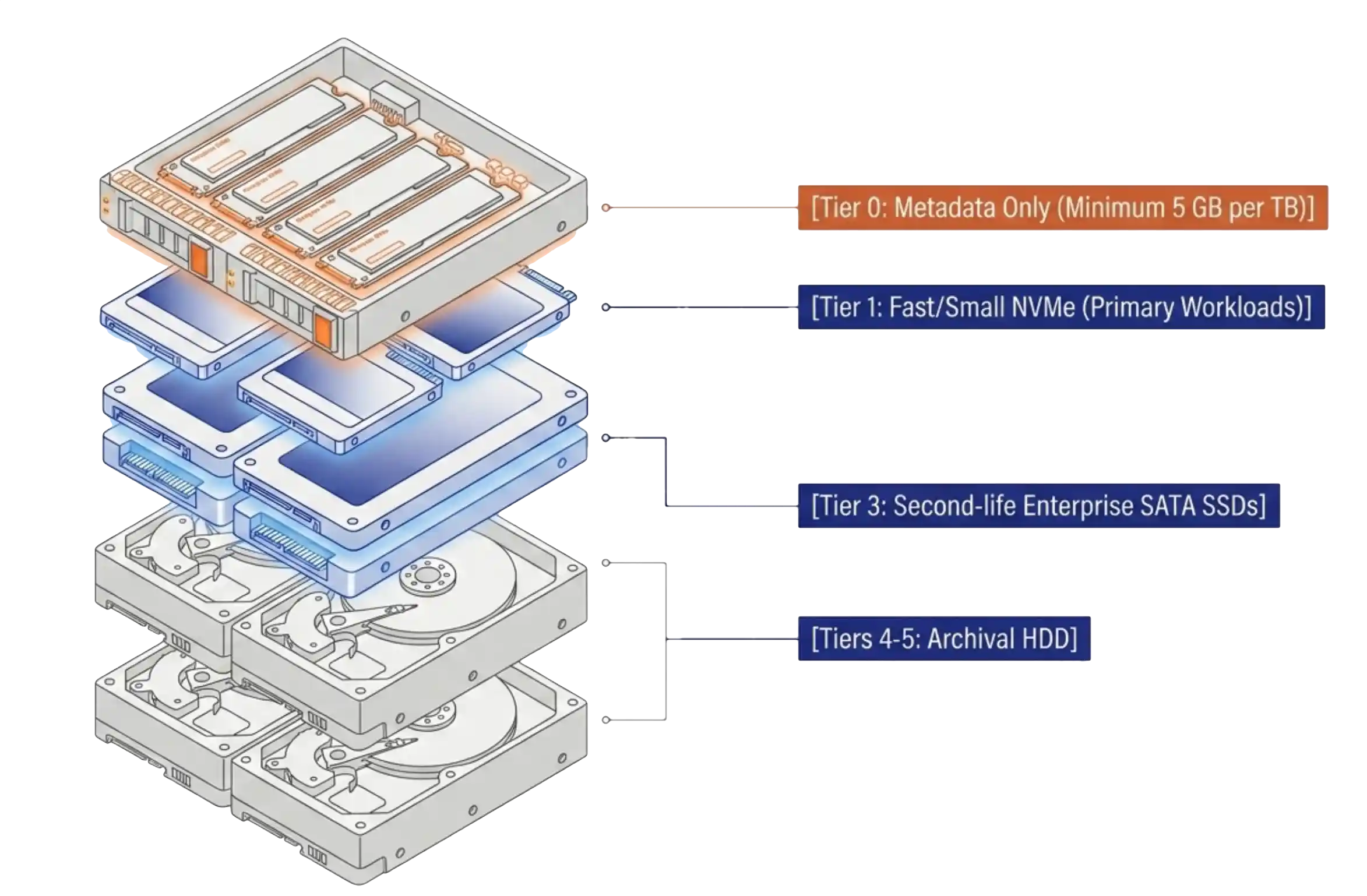
Storage tiering control starts with the person who already knows the answer. The IT professional running the application knows when it goes hot and when it goes cold, without a heat map to tell them. Tax season ends on a date on the calendar, not on an algorithm’s guess, and it starts back up on a date too. A batch job runs on a schedule the operations team set months ago. Nobody in that room needs a prediction. They need the ability to act on what they already know, the moment they know it, in either direction.
VergeOS builds tiering around that fact instead of working around it. A running VM moves between tiers on command, live, and it keeps serving reads and writes the entire time. No reboot, no guest awareness, no maintenance window. VergeOS documentation on the mechanism reports an API acknowledgment in about a second and full block movement completing in the background within seconds, with the VM staying in a running state throughout. The decision comes from the person who owns the workload, and the system carries it out the moment they make it.
The Tax Season Test
Picture an application that runs mostly writes during a specific stretch of the year. It earns its place on the flash tier, and the workload profile on screen shows the write-heavy pattern plainly. Once that stretch ends, the same application turns mostly reads. It no longer needs flash, and the flash it was holding is needed somewhere else.
That is the exact scenario VergeIO walks through live in the TruthInIT session “Can You Afford Your Next Storage Refresh?” David Vincent flips the workload from writes to reads, then migrates the running VM from the flash tier to the hard drive tier, and it keeps serving I/O the entire time. The move takes seconds on screen, and the performance impact stays limited. The RAM cache handles the reads underneath the move.
The same command runs in reverse. That is storage tiering control working in both directions, not just one. When tax season starts back up, the workload moves from the hard drive tier back to flash on that same on-command basis, warmed up the moment the team calls for it, with no policy engine standing between the decision and the move.
The pattern is not exclusive to tax season. A retail chain building for the holiday quarter needs the same flash from November through the January returns window, then has no use for it once that window closes. A law firm that takes on a large case needs the same flash for the length of discovery, and lets it go the moment the matter closes. Every one of these workloads runs on a calendar the IT team already tracks, and storage tiering control means the storage follows that calendar instead of a policy engine’s guess.
Where Storage Tiering Control Meets the Refresh Math
Control over tiering is not just an operational win. It changes what you have to buy on the next refresh. VergeOS deduplicates data across storage, virtualization, and networking with shared metadata, so a block stays deduplicated as it moves through the system instead of getting rehydrated the moment it lands on an array. That lets RAM cache sit directly in the server next to the VM. VergeOS documentation puts the resulting cache hit rate at four to five times what array-side caching delivers. The cache no longer spends space storing the same block many times over.
A smaller working set and a higher cache hit rate both point the same direction. Less flash has to sit in the design to hit the same performance. Flash and memory prices climbed 70 to 95 percent through the first half of 2026, with more increases projected into the third quarter. Every gigabyte of flash a design avoids buying is a gigabyte that never has to be priced again at those numbers on the next refresh.
None of that math holds if the license meter cancels it out. Capacity-priced storage licensing charges for every terabyte purchased, and the meter reads raw capacity, so deduplication and thin provisioning never lower the number on the bill. That mismatch is what turns a converged platform’s hardware advantage back into a dedicated array’s advantage. VergeOS licenses by the server, not the terabyte, so the flash a design avoids buying through storage tiering control and deduplication stays avoided on the license line too.
Key Terms
Auto-Tiering vs. Storage Tiering Control
| Auto-tiering (policy engine) | VergeOS tiering control | |
|---|---|---|
| Who decides | A heuristic reading access patterns | The team running the workload |
| When it moves | Crosses a threshold on its own schedule | The moment the team calls for it |
| Moving back to flash | Limited and slow in most implementations | The same on-command move, run in reverse |
| Downtime during a move | Varies by vendor and array | None, the VM stays running |
| Failure mode | Wrong guess shows up at month-end close | None, nothing gets guessed |
The Bottom Line
Storage tiering control earns its place in a design when the person who understands the workload makes the call. It fails when that call gets handed to a policy engine reading a heat map from the outside, in both directions, down to a cheap tier and back up to flash. VergeOS keeps the decision with the team, moves the data live once they make it, and uses the same deduplication and cache architecture that makes that move fast to shrink what the next refresh has to buy in flash, on a license that charges by the server instead of the terabyte.
Watch David Vincent run this exact scenario live, tax season and beyond, and register to watch the full TruthInIT session on demand. For the engineering detail behind the live tier move itself, read Storage Tiering Without the Capacity Tax.
Frequently Asked Questions
Does automated tiering ever get the prediction right?
Sometimes. A wrong guess costs capacity or performance at the moment the business can least afford either one, and nobody controls when that moment lands.
Why is warming data back up to flash the harder problem?
Most auto-tiering engines build their entire design around demotion. Moving cold data down is the direction the heat map handles. Moving hot data back up on demand, before the algorithm even notices the pattern changed, gets little of that same engineering attention.
How long does a live tier move take in VergeOS?
In documented testing, the system acknowledged the move in about a second, and block movement finished in the background within seconds, with the VM running throughout. The same speed applies whether the move goes down to a cheaper tier or back up to flash.
Does moving data to a colder tier hurt performance?
The RAM cache sits in the server next to the VM and handles the reads, keeping application performance steady even after a move to a slower tier.
What does storage tiering control have to do with my next storage refresh?
Less flash in the design means less exposure to 2026 flash and memory pricing, and a per-server license means that savings is not clawed back on the capacity meter. The same architecture that puts tiering under your control also shrinks what you have to buy at today’s prices.


