All-flash array cost in 2026 has fundamentally changed. Flash storage won on merit — the performance case was real, the reliability case was real, and the total cost math worked as long as NAND prices followed their decade-long downward trajectory. That trajectory ended in 2025. The 2026 flash market looks structurally different, and organizations building or expanding all-flash infrastructure are discovering that the platform architecture underneath their storage layer determines how much of that inflation they absorb — and how much they can avoid.
The signal came on April 23, 2026, when Everpure (Pure Storage) CEO Charles Giancarlo published an open letter to customers disclosing a cumulative average price increase of approximately 70 percent since January. Input costs for the semiconductor components Everpure depends on have surged between 300 and 900 percent since mid-2025, driven by AI-fueled NAND and DRAM demand. The math in the letter is accurate. The architecture it reveals is the conversation infrastructure leaders need to have.
Key Takeaways
The Answer Is Not Hard Drives
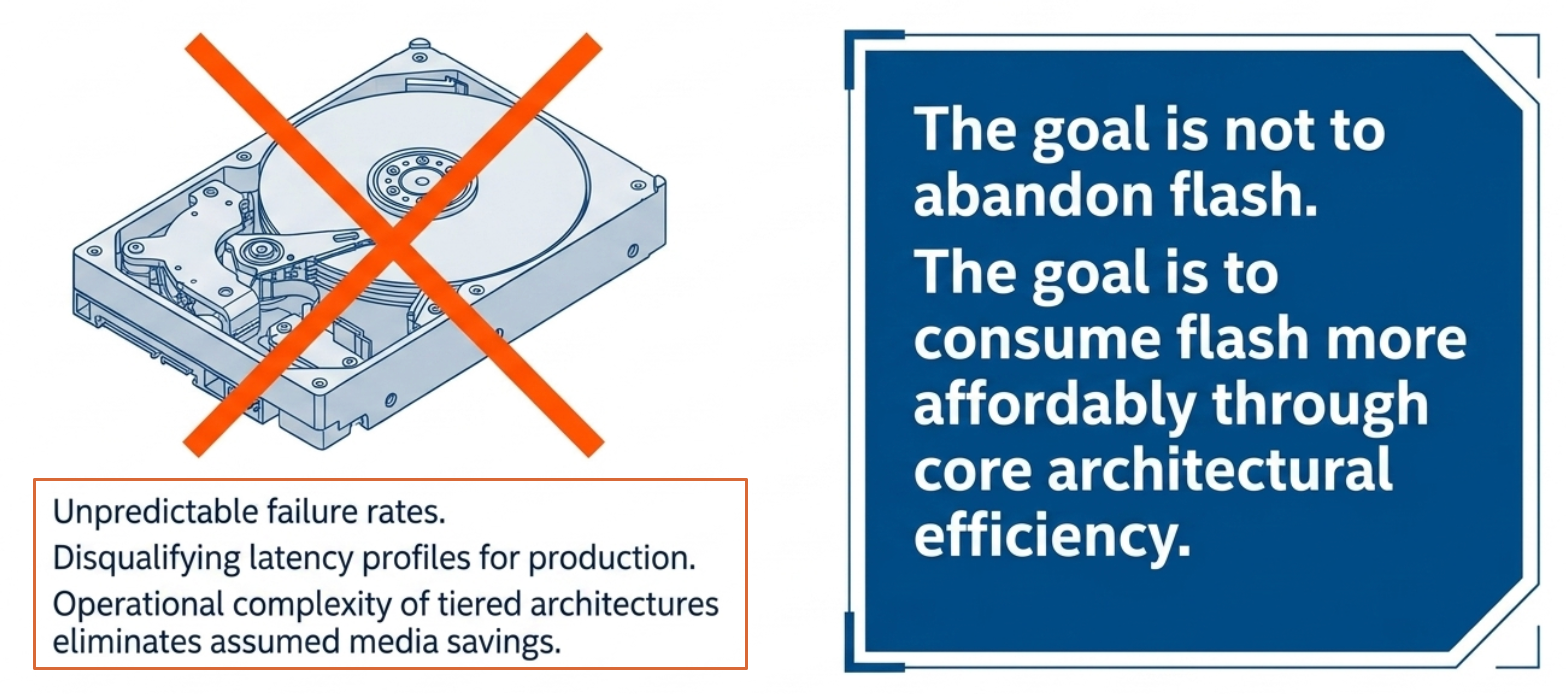 Before addressing what organizations should do, it is worth being direct about what they should not do. Rising all-flash array cost in 2026 does not make hard drives a compelling alternative. HDDs fail unpredictably, carry latency profiles that disqualify them from most production workloads, and the operational complexity of managing a tiered architecture dependent on spinning media eliminates whatever savings the lower media cost implies. There is a reason IT moved to all-flash in the first place. The goal is not to abandon flash — it is to consume flash more affordably. Three architectural decisions determine whether that is possible.
Deduplication Has to Be a Core Function, Not a Feature
The most direct lever for reducing flash consumption is deduplication, and most storage platforms treat it wrong. Enterprise storage arrays and hyperconverged platforms typically implement deduplication as an optional, per-volume process — frequently recommended off by default in production because it runs as a background job competing with live I/O. The result is that organizations carry substantially more raw flash capacity than their effective data footprint requires, compounding the all-flash array cost problem further.
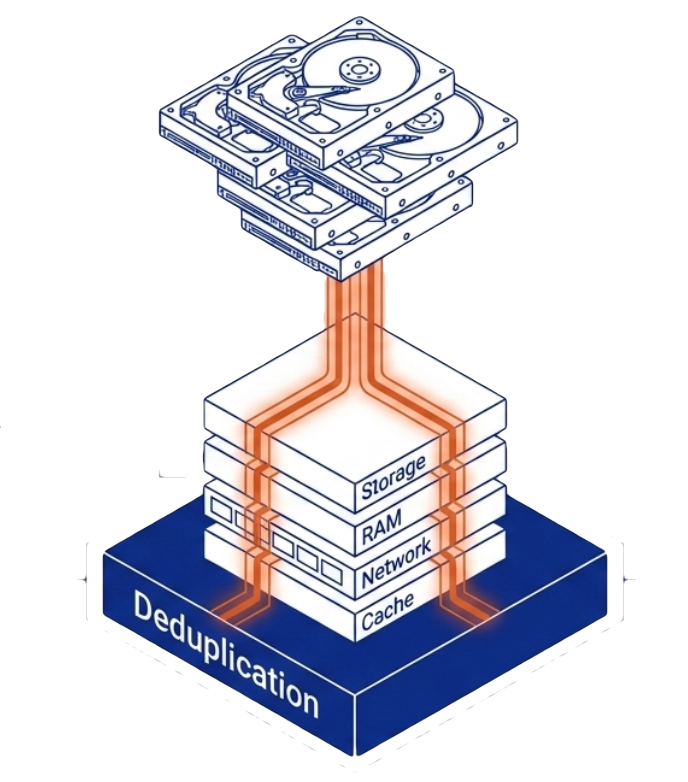 VergeOS takes a fundamentally different approach. Deduplication is not a feature that runs on stored data after the fact. It is built directly into the VergeOS operating system and runs permanently across the entire environment — cache, network, RAM, and storage — as a core function. A single copy of any block exists in the cluster regardless of how many virtual machines reference it, and that deduplication applies from the moment data is written rather than as a background cleanup pass.
At current enterprise SSD pricing of $100 per terabyte and rising, a continuous 3:1 deduplication ratio running across the full storage pool reduces the raw flash required by 66 percent. The dollar value of that efficiency scales directly with flash prices, which means VergeOS deduplication is worth considerably more in 2026 than it was when NAND cost $20 per terabyte.
Off-the-Shelf NVMe Breaks the Closed-Media Trap
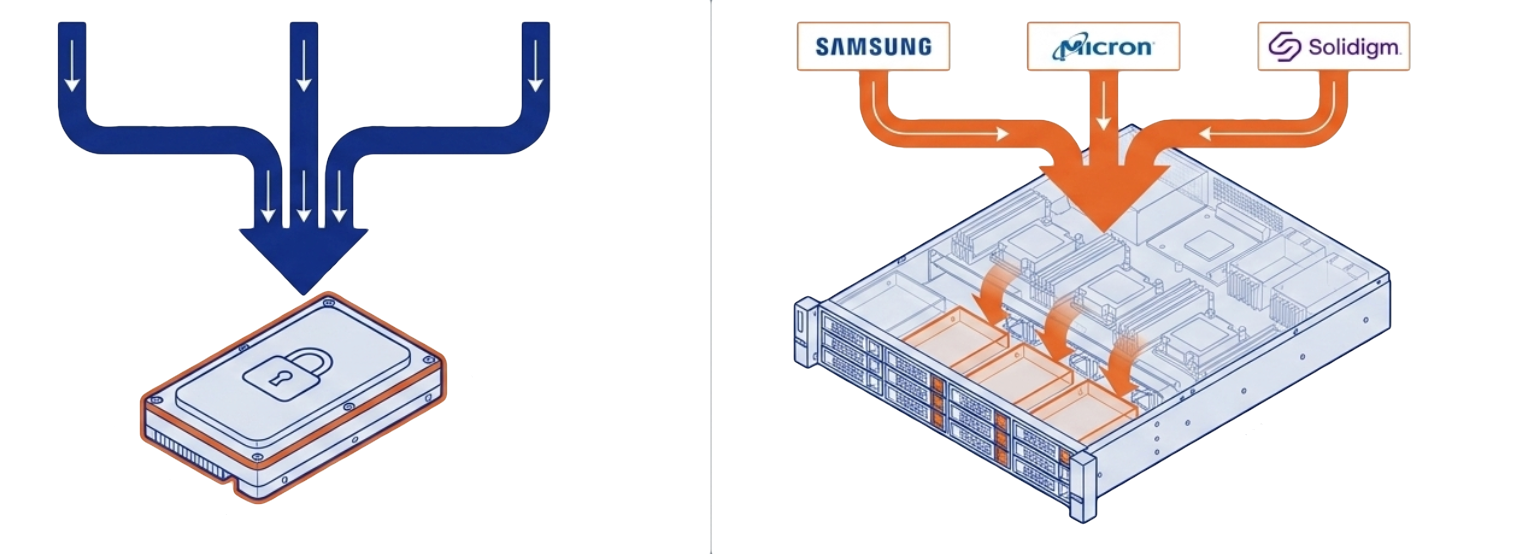 Everpure’s FlashArray and FlashBlade platforms accept only DirectFlash Modules — a proprietary media format that Everpure itself manufactures. Customers cannot source capacity from any other vendor. When component costs surge 300 to 900 percent, a storage platform that accepts media from only one manufacturer has no alternative sourcing path and no way to manage all-flash array cost exposure. The closed architecture that delivered engineering elegance in a declining-price market becomes a one-way pricing funnel when supply inverts.
VergeOS also consumes the NVMe drives already present in servers the customer owns. An organization consolidating off VMware or retiring a legacy cluster can repurpose its existing flash investment rather than buying new capacity at 2026 pricing — an approach that has been characterized as a path to eliminating future storage refreshes entirely. The hardware ambush trapping VMware exit candidates is most acute for platforms that require both a hypervisor migration and a storage hardware refresh simultaneously. VergeOS eliminates both requirements.
Commodity SSDs — Safely
The most aggressive version of the all-flash affordability argument goes beyond standard enterprise NVMe to consumer-grade SSDs — and this is viable, but the word “safely” carries real meaning. Understanding why requires a brief detour into what enterprise SSDs actually provide and what VergeOS replaces.
Most enterprise SSDs include full power-loss protection: onboard capacitors or supercapacitors let the drive flush its DRAM write cache to NAND if power is cut, preventing in-flight writes from being lost or corrupting metadata. Enterprise SSDs also use stronger ECC and data-path protection to guard against bit errors and silent data corruption — critical for databases and storage arrays that depend on media integrity as a primary reliability mechanism.
Consumer-grade drives typically omit or reduce these protections. On a storage platform that relies on the drive itself to guarantee data integrity and write durability, using consumer SSDs is a genuine risk. VergeOS is not that platform. VergeFS — the VergeOS file system — handles power-loss protection, write durability, and data integrity natively at the software layer. VergeOS does not depend on drive-level PLP capacitors or hardware ECC to protect writes. Those guarantees are enforced by the file system and the cluster protection model, not by the media.
Mike Matchett and George Crump unpack the hardware ambush, the flash supply squeeze, and the exit math that actually works in 2026. Live Q&A included.
Register Now →The ioGuardian architecture adds a second layer of confidence. Every drive in the cluster is treated as a potentially failing device. RF2 data protection maintains two copies across the cluster with active service capability — validated in production environments where multiple nodes failed simultaneously and workloads continued serving with zero downtime and zero data loss.
VergeOS telemetry monitors wear across every drive continuously. That same capability caught one customer’s refurbished drives showing 80 percent wear against a certified 15 percent rating — enabling a full vendor refund before any failure occurred. When VergeFS provides power-loss protection in software and ioGuardian provides cluster-level redundancy regardless of drive quality, the case for paying the enterprise SSD premium weakens considerably.
All-Flash Array Cost 2026: Why Architecture Is the Deciding Factor
| Closed-Media Platform | VergeOS | |
|---|---|---|
| Flash Media Source | Proprietary modules only — no alternatives | Any NVMe or SATA from any manufacturer |
| Deduplication Model | Optional, per-volume, off by default in production | Always-on, built into OS, runs across full environment |
| Power-Loss Protection | Drive-level hardware capacitors required | VergeFS software layer — no hardware dependency |
| Consumer-grade SSDs | Not supported | Supported safely via VergeFS + ioGuardian |
| Existing Drive Reuse | Not possible | Drives from retiring servers repurposed as cluster capacity |
| Sourcing Flexibility | Single vendor, single price point | Open market on every expansion |
The 2026 supply environment has made concrete something that was always structurally true: the storage platform decision is also a sourcing decision that locks in for the life of the deployment. Choosing a platform that requires proprietary media, treats deduplication as an optional background job, and depends on enterprise-grade hardware for data integrity means accepting the full weight of current all-flash array cost inflation with no alternatives.
VergeOS eliminates all three constraints simultaneously. Deduplication runs as a permanent core function, reducing effective flash requirements from the ground up. Any commodity NVMe drive from any manufacturer is a valid capacity source, giving procurement teams a live market to shop on every expansion. And VergeFS handles power-loss protection, write integrity, and data-path protection natively — removing the enterprise SSD hardware dependency and making consumer-grade flash a safe and legitimate choice under the right configuration. In a market where a closed-module vendor just disclosed 70 percent customer price increases driven by 300 to 900 percent input cost surges, the economic value of that architecture is no longer theoretical. The Everpure letter quantified it.
Key Terms
Everpure’s proprietary flash media format. FlashArray and FlashBlade accept only DFMs manufactured by Everpure — no third-party drives, eliminating all alternative sourcing when component prices rise.
A hardware feature on enterprise SSDs: onboard capacitors that flush the drive’s DRAM write cache to NAND if power is cut. VergeFS replicates this guarantee in software, removing the hardware dependency entirely.
The VergeOS file system. Handles power-loss protection, write durability, ECC, and data integrity natively in software, enabling VergeOS to safely consume consumer-grade SSDs without relying on drive-level hardware protections.
VergeOS’s active cluster protection model. Treats every drive as a potentially failing device and maintains active service capability through redundancy, allowing the cluster to continue serving data when nodes fail.
VergeOS’s two-copy data protection model. Maintains two independent copies across the cluster, providing redundancy that operates independently of individual drive quality or health.


