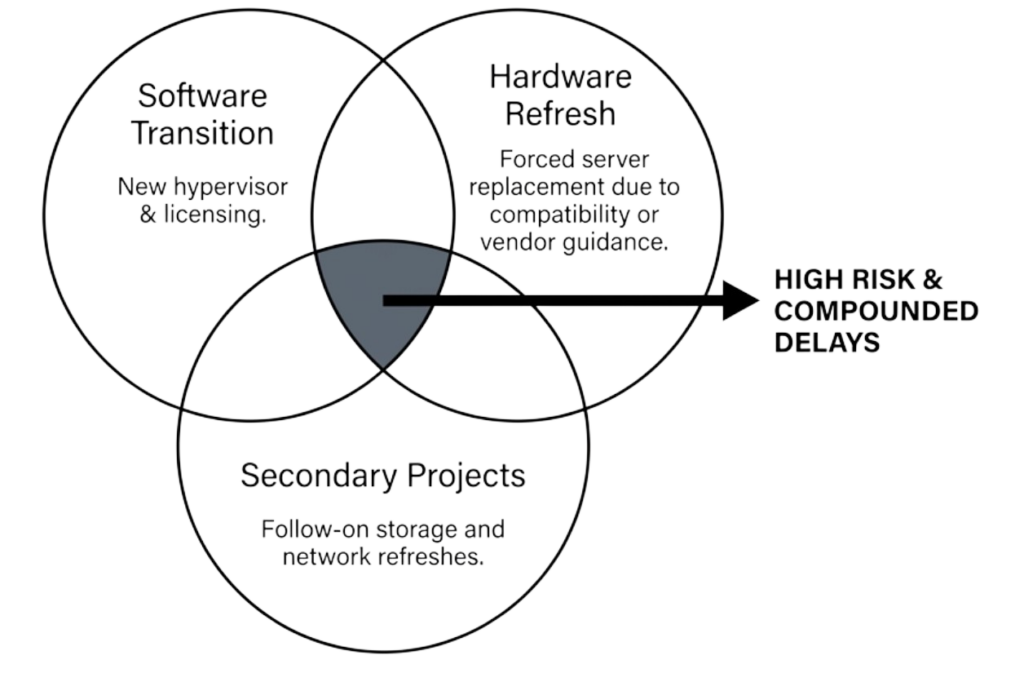
In-place VMware exits keeps existing server hardware in production and separates the software decision from the hardware lifecycle. The problem is that most VMware migration projects come bundled with assumptions that have nothing to do with software. The hypervisor decision triggers a server refresh. The server refresh triggers a storage evaluation. The storage evaluation opens questions about networking. What starts as a licensing response to Broadcom’s changes becomes a multi-quarter capital project with procurement dependencies, extended testing cycles, and compounding risk.
Key Takeaways
- No hardware refresh required: VergeOS allows organizations to exit VMware on existing servers, separating the software decision from the hardware lifecycle.
- Two migration paths: Teams with spare servers complete migration in 2 days to 2 weeks. Teams migrating in place complete in 4 days to 3 weeks.
- 65% licensing cost reduction: VergeOS per-server licensing replaces VMware per-core subscriptions without long-term commitments.
- 80% storage cost reduction: Off-the-shelf NVMe, SATA, or SAS SSDs replace dedicated-array storage at approximately one-seventh the cost.
- 70% delay server refreshes: More than 70% of organizations delay or cancel planned server replacements within the first year after migration.
- Rollback preserved throughout: VMware remains operational until final workloads move. No forced cutover. No global downtime.

It does not have to work this way. VergeOS enables in-place VMware exits on existing servers. The infrastructure upgrade happens through architectural change, not equipment replacement. Hardware refresh decisions return to their natural ROI-based timing. They are no longer compressed into migration windows or driven by vendor compatibility matrices.
📖 Key Terms
- In-Place VMware Exit
- A migration approach that keeps existing server hardware in production, replacing only the hypervisor and infrastructure software layer.
- Infrastructure Operating System
- A unified platform that abstracts compute, storage, and networking into a single operational surface, eliminating the need for separate management tools.
- vSAN
- Virtual storage area network created from off-the-shelf SSDs installed in server drive bays, replacing dedicated storage arrays at a fraction of the cost.
- Hardware Abstraction
- The ability to run infrastructure software across heterogeneous server hardware without compatibility constraints or performance penalties.
- Global Deduplication
- Inline storage efficiency that eliminates duplicate data blocks across all workloads, reducing capacity requirements as workloads migrate.
- Per-Server Licensing
- VergeOS licensing model based on server count rather than core count, without long-term subscription commitments.
The Case for In-Place VMware Exits
Server refresh is the forcing function that inflates the VMware migration scope. Even when storage arrays stay in place, the hypervisor transition typically coincides with server replacement. Compatibility requirements, support matrices, and vendor guidance push organizations toward new hardware during the platform change.
That bundling creates sequencing pressure. IT teams complete a VMware exit and immediately face secondary projects. Storage refresh follows when new servers exhibit different performance characteristics or when existing arrays no longer align with the environment. Network refresh follows when new server platforms introduce different NIC configurations or fabric requirements. Each project carries its own planning cycle, testing effort, and risk profile.
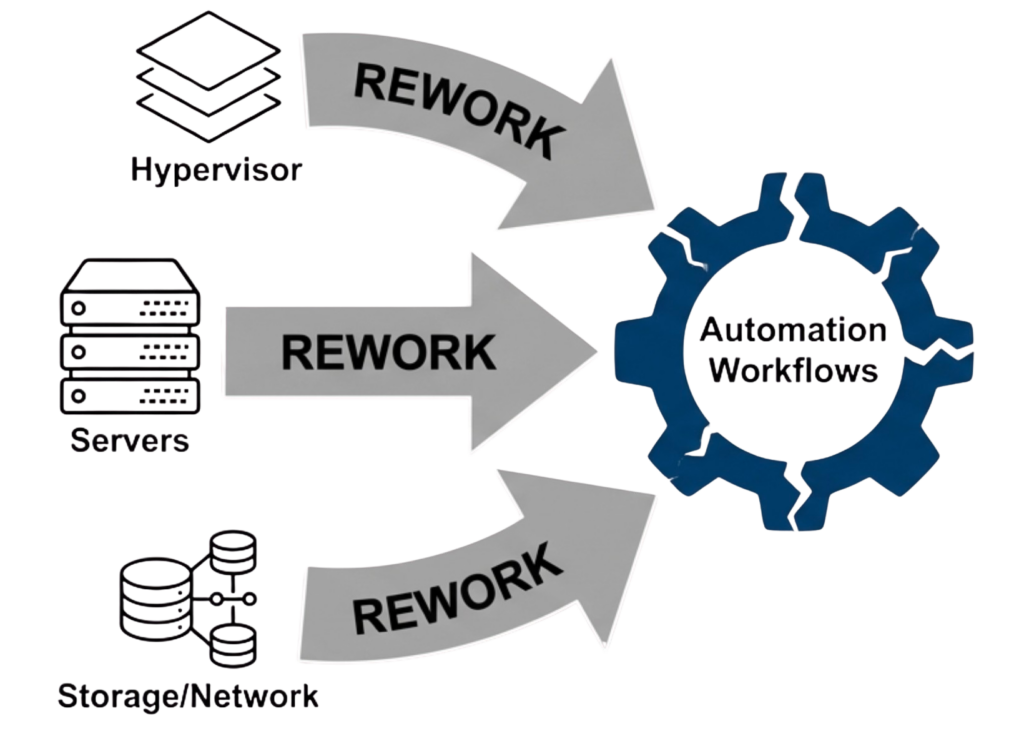
A VMware exit that requires an entirely new set of servers compounds an already fragile automation architecture. Fragmented infrastructure, common in VMware environments, breaks automation, especially during platform transitions. Infrastructure-as-code must be rewritten for the new hypervisor during the VMware exit. If servers change at the same time, automation requires a more extensive rewrite. Templates, drivers, and performance profiles all shift at once. When storage or networking platforms refresh later, automation breaks a third time. The same workflows are repeatedly reworked because they remain tied directly to specific hardware generations.
VergeOS separates that coupling by providing in-place VMware exits. The hypervisor layer changes first, allowing it to keep running production workloads. Often, the unified platform uses these servers more efficiently than VMware did, thereby delaying or eliminating planned server replacements. When additional servers are required, new servers are added gradually, not all at once. Automation is configured once, and thanks to VergeOS’s abstraction, it doesn’t need to be changed when hardware is upgraded, maximizing automation ROI.
Two In-Place Migration Paths
Organizations approach VMware migration from different starting conditions. Some have unused servers or plan to purchase new ones. Others operate at full capacity with no hardware to reallocate. In all scenarios, teams add off-the-shelf NVMe, SATA, or SAS SSDs to existing server drive bays. These drives cost approximately seven times less than dedicated-array storage. A vSAN is created, and migration begins.
When extra servers are available, they become the foundation of the new environment. VergeOS is installed on the spare or new hardware first, and these systems form an initial VergeOS instance running alongside VMware. Workloads migrate incrementally at the virtual machine level. Each VM is moved, validated, and placed into production on VergeOS before the next migration begins. As VMware hosts are freed, they are re-imaged and added to the VergeOS instance. The new environment grows organically as the VMware footprint contracts. These migrations typically complete in two days to two weeks.
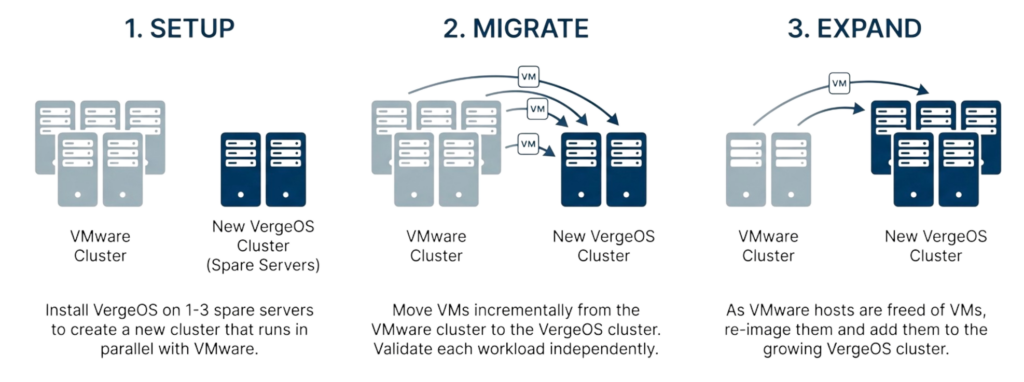
When no extra servers are available, migration occurs entirely in place. Workloads evacuate from a single VMware host to the remaining VMware nodes. That freed host is re-imaged and becomes the first VergeOS node. Workloads then migrate to VergeOS as capacity allows, and additional VMware hosts are converted one at a time. The cluster expands incrementally over a timeline spanning four days to three weeks. No parallel infrastructure is required. No global cutover with extended downtime is necessary.
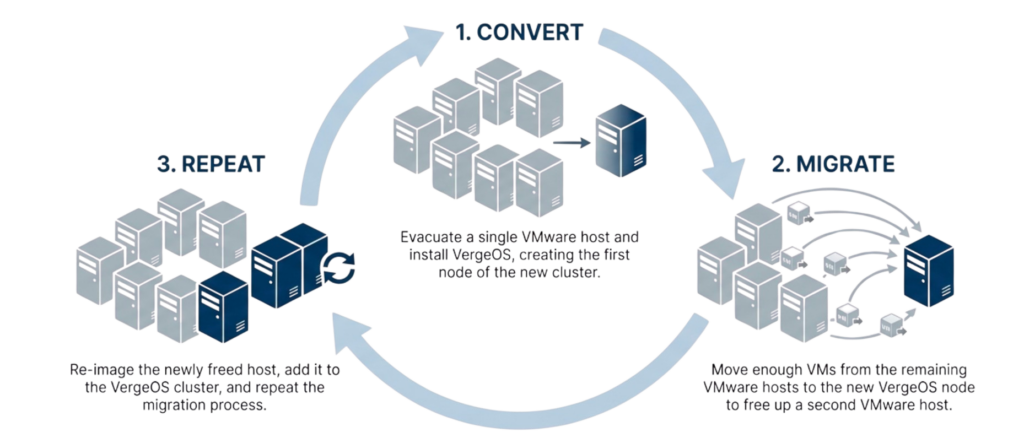
Both paths preserve rollback options throughout. VMware remains operational until the final workloads move. There is no forced decision point until the environment is already stable on VergeOS. The in-place VMware exit remains controlled and reversible at every step.
In-Place Data Handling
Data typically becomes the pacing factor in VMware migrations. Data gravity, protection requirements, and performance concerns push teams toward complex staging designs or third-party migration tools. The anxiety around storage often delays projects or inflates their scope.
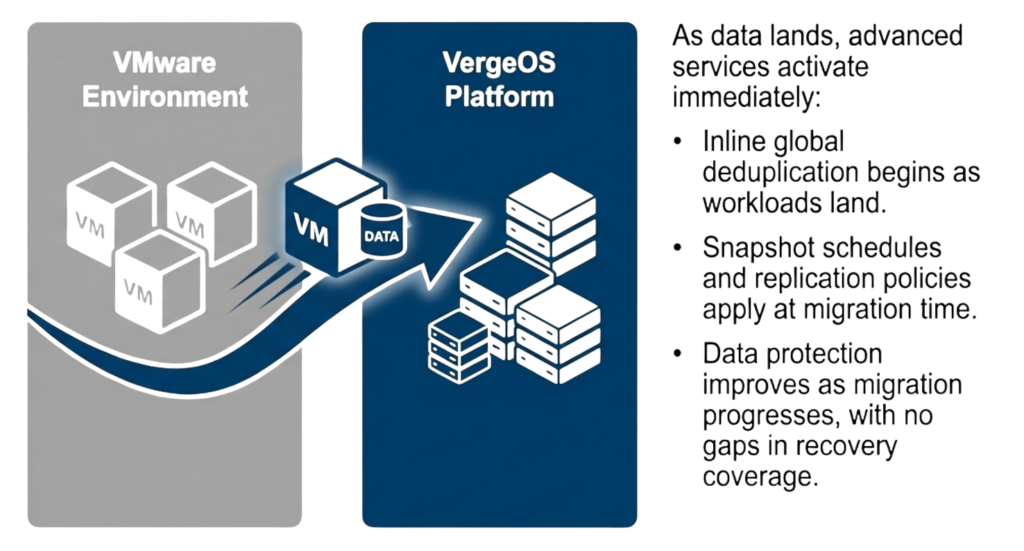
VergeOS removes that pressure. Virtual machine data moves with the VM during migration, whether that data resides on local VMware host storage, a NAS platform, or a dedicated SAN. Data is not copied out, transformed, and re-ingested as a separate process. As each workload arrives, VergeOS storage services absorb it directly into the unified platform.
Data services activate immediately. Inline global deduplication begins as workloads land, and snapshot schedules, replication policies, and protection rules apply at migration time. Data protection improves as the migration progresses rather than being temporarily weakened. Teams migrate incrementally without exposing gaps in recovery coverage.
Licensing During In-Place VMware Exits
VMware and VergeOS operate concurrently during migration. This overlap is intentional and allows workloads to move at an operational pace without forcing an artificial cutover date.
VMware licensing applies only to hosts running VMware workloads. As virtual machines migrate and VMware hosts are freed, those hosts exit the VMware licensing footprint. The licensed core count declines naturally as the environment contracts. Final VMware host conversion can align with subscription renewal dates or contract milestones. Licensing exposure decreases incrementally as progress is made.
Financial risk stays proportional to actual VMware usage. Licensing decisions become part of sequencing and planning rather than an external deadline imposed on the project.
Operations After In-Place Migration
Once migration completes, the operational model simplifies rather than becoming more complex. VergeOS removes entire classes of infrastructure components that previously required independent deployment, monitoring, and lifecycle management.
There are no storage virtual machines to size, patch, or troubleshoot. No network virtual machines are acting as intermediaries between workloads and the physical fabric. External SAN dependencies disappear, and operations consolidate around a single management plane for compute, storage, and networking.
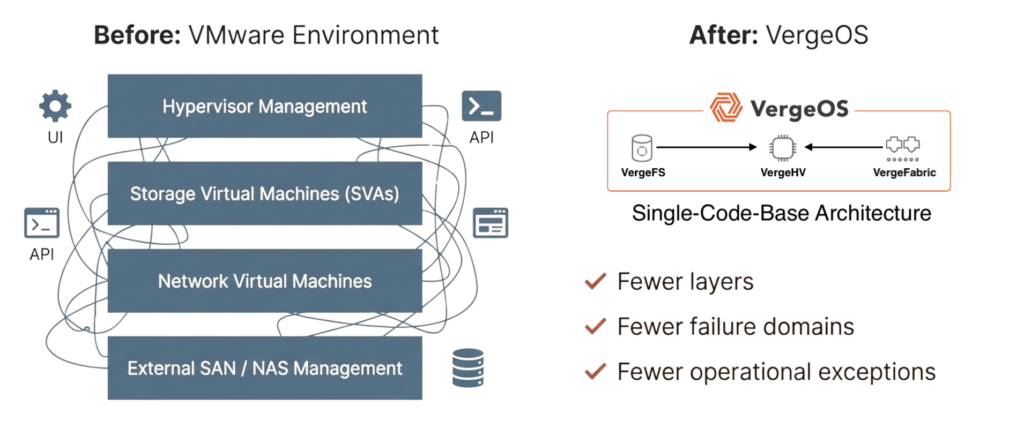
The net effect is fewer layers, fewer failure domains, and fewer operational exceptions. Future changes occur within a stable operational model and do not reintroduce fragmentation over time.
In-Place VMware Exits Measured Results
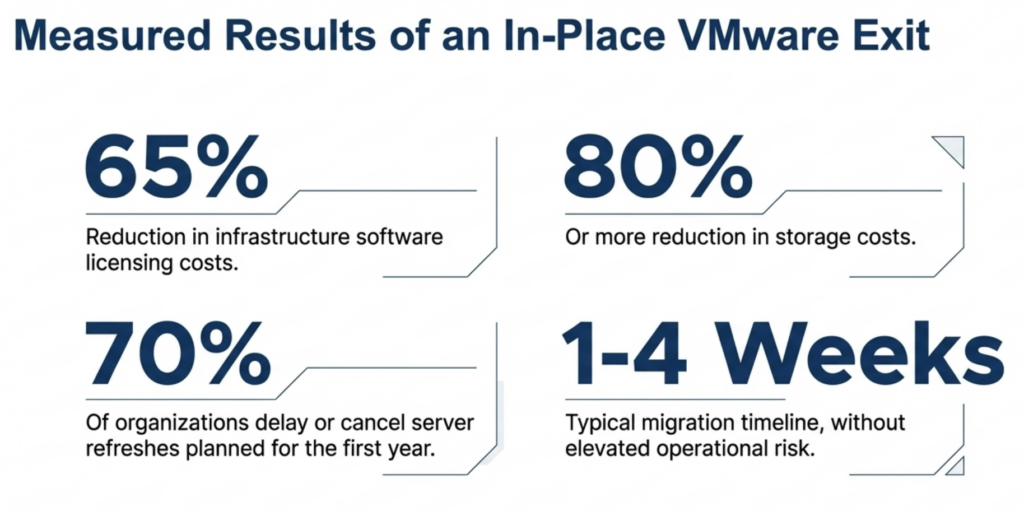
Organizations executing an in-place VMware exit to VergeOS typically see a 65% reduction in infrastructure software licensing costs, and storage costs are reduced by 80% or more. More than 70% of organizations delay or cancel server refreshes originally scheduled for the first year after migration. The hardware they expected to replace continues to perform better than it did under VMware. Migration timelines range from one to four weeks, depending on starting conditions, and teams exit VMware without emergency maintenance windows or elevated operational risk.
Infrastructure modernization becomes incremental. Capacity is added when needed, not when a vendor contract forces the issue. The environment stops feeling transitional and starts behaving like a long-term platform.
The in-place VMware exit becomes a managed milestone, not a crisis event. Change happens deliberately, once, and gives way to a durable operating model that supports incremental growth and long-term planning.
Frequently Asked Questions
Can I migrate from VMware without buying new servers?
Yes. VergeOS delivers an in-place VMware exit that keeps existing server hardware in production. The hypervisor and infrastructure layer change first. Existing servers continue running workloads throughout the transition. More than 70% of organizations delay or cancel planned server refreshes within the first year after migration.
How long does an in-place VMware exit take?
Migration timelines range from one to four weeks depending on starting conditions. Organizations with spare servers typically complete migration in 2 days to 2 weeks. Organizations migrating entirely in place typically complete in 4 days to 3 weeks. No global cutover or extended downtime is required.
What happens to my data during migration?
Virtual machine data moves with the VM during migration, whether that data resides on local VMware host storage, a NAS platform, or a dedicated SAN. Data is not copied out, transformed, and re-ingested as a separate process. VergeOS storage services absorb each workload directly. Inline global deduplication, snapshot schedules, and protection rules apply at migration time.
Do I have to shut down VMware all at once?
No. VMware and VergeOS operate concurrently during migration. Workloads migrate incrementally at the virtual machine level. VMware remains operational until the final workloads move. There is no forced decision point until the environment is already stable on VergeOS. Rollback options are preserved throughout the process.
What cost savings can I expect?
Organizations executing an in-place VMware exit to VergeOS typically see a 65% reduction in infrastructure software licensing costs and storage costs reduced by 80% or more. VergeOS uses per-server licensing without long-term subscription commitments, and off-the-shelf SSDs replace dedicated-array storage at approximately one-seventh the cost.
What if I need to roll back?
Rollback options are preserved throughout the migration. VMware remains fully operational until the final workloads move. Any workload can be paused, reversed, or deferred without affecting the rest of the environment. There is no forced cutover and no global downtime. The in-place VMware exit remains controlled and reversible at every step.
What hardware do I need to add?
Teams add off-the-shelf NVMe, SATA, or SAS SSDs to existing server drive bays. These drives cost approximately seven times less than dedicated-array storage. A vSAN is created from these drives, and migration begins. No new servers are required. VergeOS runs on heterogeneous hardware without compatibility constraints.
Yes. VergeOS delivers an in-place VMware exit that keeps existing server hardware in production. The hypervisor and infrastructure layer change first. Existing servers continue running workloads throughout the transition. More than 70% of organizations delay or cancel planned server refreshes within the first year after migration.
Migration timelines range from one to four weeks, depending on starting conditions. Organizations with spare servers typically complete migration in 2 days to 2 weeks. Organizations migrating entirely in place generally complete in 4 days to 3 weeks. No global cutover or extended downtime is required.
Virtual machine data moves with the VM during migration, whether it resides on the local VMware host storage, a NAS platform, or a dedicated SAN. Data is not copied out, transformed, and re-ingested as a separate process. VergeOS storage services absorb each workload directly. Inline global deduplication, snapshot schedules, and protection rules apply during migration.
No. VMware and VergeOS operate concurrently during migration. Workloads migrate incrementally at the virtual machine level. VMware remains operational until the final workloads move. There is no forced decision point until the environment is already stable on VergeOS. Rollback options are preserved throughout the process.
Organizations executing an in-place VMware exit to VergeOS typically see a 65% reduction in infrastructure software licensing costs and storage costs reduced by 80% or more. VergeOS uses per-server licensing without long-term subscription commitments, and off-the-shelf SSDs replace dedicated-array storage at approximately one-seventh the cost.
Rollback options are preserved throughout the migration. VMware remains fully operational until the final workloads move. Any workload can be paused, reversed, or deferred without affecting the rest of the environment. There is no forced cutover and no global downtime. The in-place VMware exit remains controlled and reversible at every step.
Teams add off-the-shelf NVMe, SATA, or SAS SSDs to existing server drive bays. These drives cost approximately seven times less than dedicated-array storage. A vSAN is created from these drives, and migration begins. No new servers are required. VergeOS runs on heterogeneous hardware without compatibility constraints.