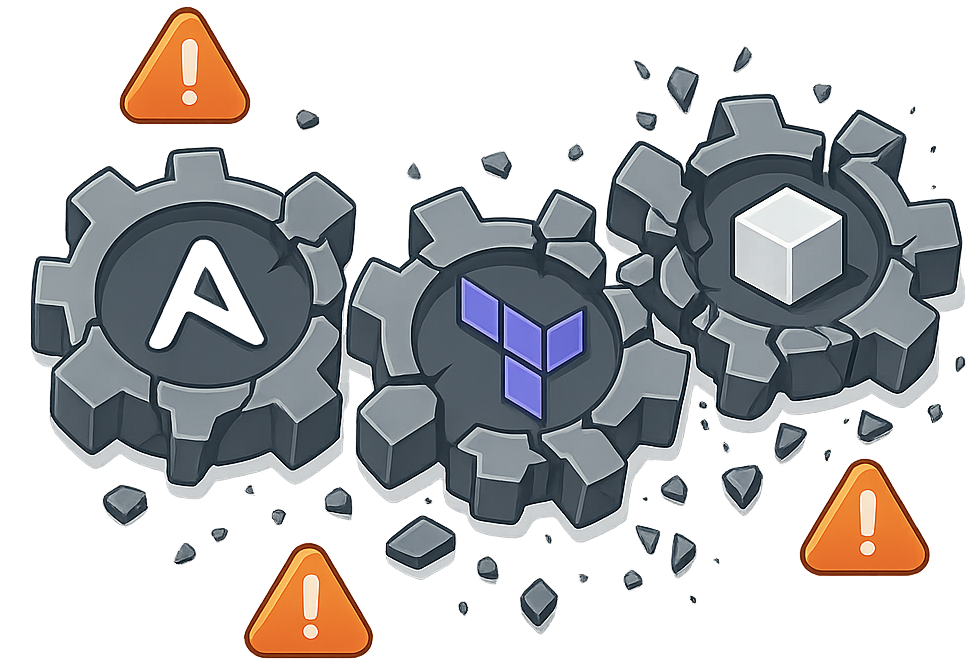
While tools like Packer, Terraform, and Ansible should improve IT efficiency, teams often find that their fragmented infrastructure breaks automation. The pipeline works in the lab. It passes the proof of concept. Then it reaches production, and the exceptions begin, especially at scale. Modules that work in one cluster fail in another. Roles require constant adjustment as hardware changes. Storage paths shift between nodes. Network adapters map differently across generations. The team spends more time maintaining the automation than they spend on manual processes.
Key Terms & Concepts
Fragmented Infrastructure: Traditional virtualization environments composed of independent layers (hypervisor, external storage arrays, network fabrics) that sometimes glued together through a common management interfaces but still exhibit inconsistent behaviors across clusters, making automation complex.
Unified Infrastructure: An infrastructure operating system that integrates virtualization, storage, networking, and AI into a single codebase with one API, eliminating architectural fragmentation.
Infrastructure Automation: The practice of using code-based tools (Packer, Terraform, Ansible) to build, provision, and configure infrastructure in a repeatable, predictable manner.
Packer: HashiCorp tool for creating machine images as code, enabling version-controlled golden images that work consistently across environments.
Terraform: HashiCorp tool for infrastructure as code, allowing teams to define and provision infrastructure resources through declarative configuration files.
Ansible: Configuration management tool that enforces desired system states through repeatable roles, eliminating configuration drift.
Composable Infrastructure: Infrastructure that can be assembled, disassembled, and reassembled programmatically to meet changing workload requirements without manual intervention.
Golden Image: A standardized, version-controlled base image that serves as the foundation for all VM deployments, ensuring consistency across the environment.
Hardware Abstraction: The process of separating infrastructure services from physical hardware, allowing the underlying components to change without impacting automation workflows.
API Abstraction: Presenting infrastructure services through a single, consistent API rather than multiple vendor-specific interfaces, simplifying automation integration.
Configuration Drift: The gradual divergence of system configurations from their intended state, typically caused by manual changes or inconsistent automation practices.
Infrastructure as Code (IaC): The practice of managing and provisioning infrastructure through machine-readable definition files rather than manual configuration.
Multi-Cluster Operations: Managing multiple infrastructure clusters with consistent automation definitions, ensuring identical behavior across production, DR, and development environments.
They rely on hardware to provide the services, as a result, each new hardware component or hardware change threatens to break the automation workflow. The tools are not the problem. The substrate beneath them is the issue. Traditional virtualization stacks depend on independent components that behave inconsistently. Automation tools inherit this fragmentation. The automation pipeline devolves into a collection of workarounds rather than functioning as a reliable system.
VergeOS changes this pattern by treating virtualization, storage, networking, and AI as software services rather than hardware constructs. Packer, Terraform, and Ansible communicate via a single API rather than separate interfaces for each physical device. VergeOS abstracts the hardware completely. The VergeOS Automation Workflow simplifies because the substrate behaves consistently regardless of the underlying components. Teams gain a foundation that supports automation rather than resisting it.
The Anatomy of Fragmented Infrastructure
Traditional virtualization environments operate as three independent layers. The hypervisor manages compute. External storage arrays handle data. Network fabrics control connectivity. Each component brings its own management interface, firmware update cycle, and operational behavior, which is why fragmented infrastructure breaks automation. The layers coordinate through APIs that vary by vendor and model. This creates a fragmented infrastructure where no single control plane governs the entire stack.
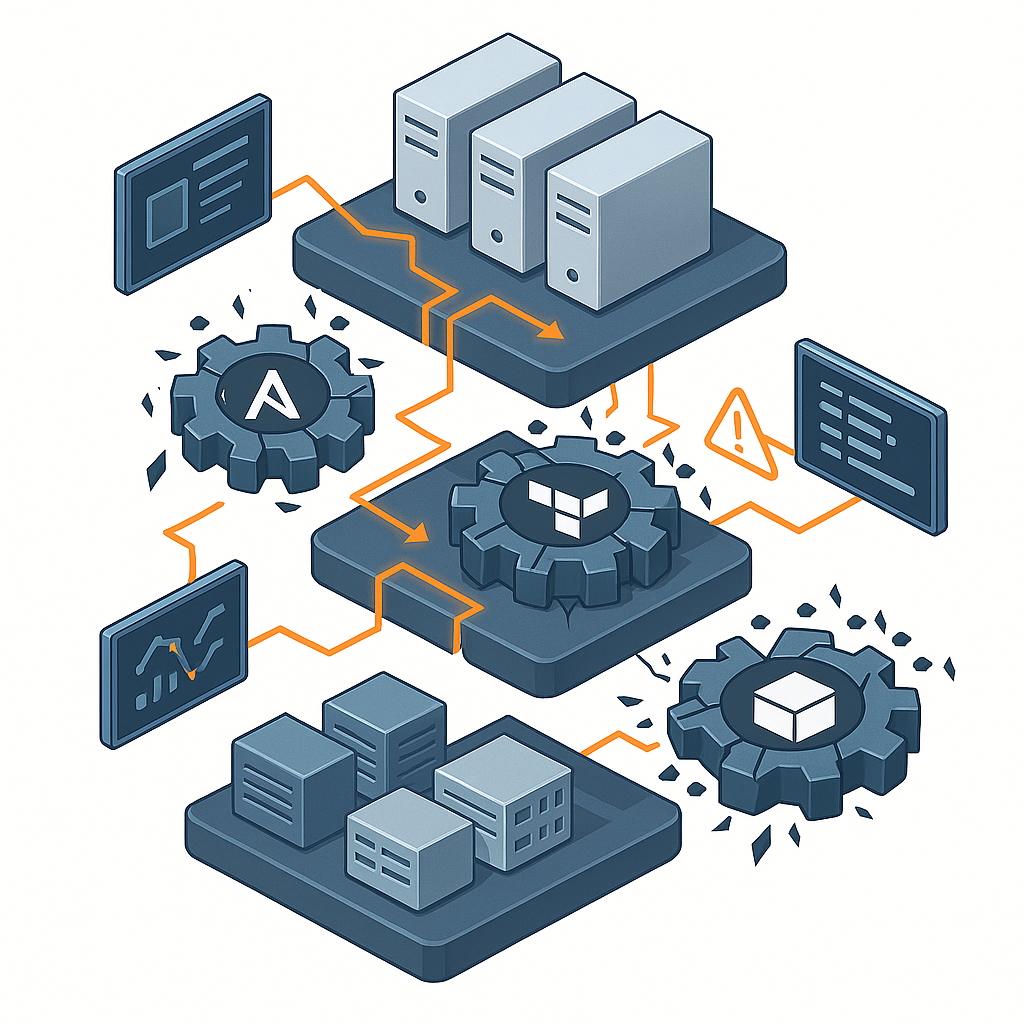
Storage fragmentation appears first. Arrays from different vendors expose different feature sets. Storage behavior varies by array model:
- Feature sets differ across vendors and generations
- Management interfaces expose incompatible APIs
- Device mappings shift as hardware evolves
One model supports provisioning through a REST API. Another requires CLI commands. A third uses proprietary management software. Path behavior changes between storage generations. A VM that moves from one host to another may encounter different device mappings. LUN masking rules vary across arrays. Terraform modules that define storage must account for these differences. The automation layer absorbs complexity that originates in the hardware.
Packer faces similar challenges during image creation. A golden image built for one storage backend requires different guest tools than an image built for another. Device drivers that work with one array model fail with the next generation. Boot order assumptions break when storage presentation changes. Teams maintain multiple image variants for different clusters rather than a single standardized template—the image pipeline fragments along with the infrastructure. What should be a single source of truth becomes a collection of hardware-specific builds.
Network fragmentation follows the same pattern. Distributed virtual switches operate differently across hardware generations. Network behavior becomes inconsistent when:
- Distributed switches differ across fabrics
- Adapter models shift teaming and ordering
- VLAN constructs behave differently across clusters
NIC teaming configurations shift when adapter models change. VLAN constructs that work on one fabric fail on another. Network adapter ordering becomes unpredictable when servers refresh. A VM provisioned on older hardware uses eth0 for management. The same automation, when run on newer hardware, assigns eth0 to a different function. Ansible roles are filled with conditional logic to handle these variations.
How Fragmented Infrastructure Moves into the Code
Fragmented infrastructure breaks automation by moving into the very code that organizations are hoping to leverage to increase efficiency.
Packer templates grow complex as they account for storage and network variations. A single template becomes multiple build definitions. One handles images for SAN storage. Another targets NAS environments. A third addresses direct-attached storage. Provisioner blocks include conditional logic to install different guest tools based on the target cluster. Boot configuration steps vary depending on the storage presentation method. The template that should produce one golden image instead produces a library of hardware-specific artifacts. Image versioning becomes difficult because each variant follows its own path.
Terraform modules grow conditional branches to handle array-specific storage parameters. One block defines volumes for vendor A. Another block handles vendor B. A third addresses the legacy array that refuses retirement. The module that should describe infrastructure intent becomes a collection of hardware-specific exceptions.
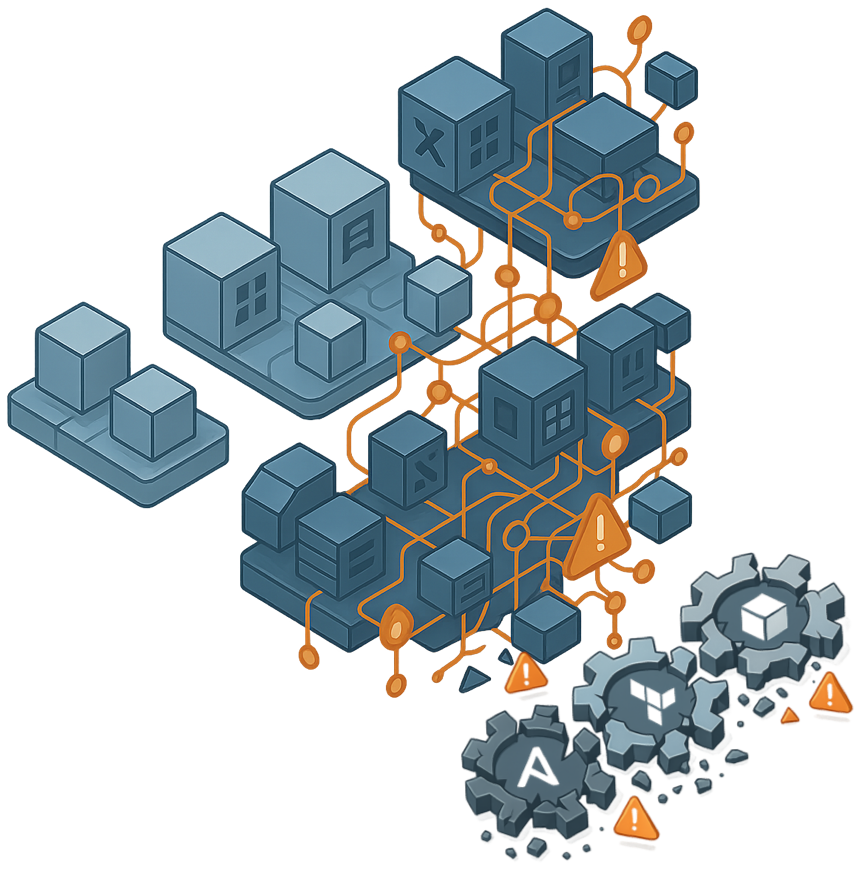
Ansible roles follow the same pattern. A role that configures network interfaces needs separate logic for each adapter type. One task handles Intel NICs. Another addresses Broadcom. A third manages Mellanox. The role includes detection logic that identifies which hardware is present before applying the configuration. What should be a straightforward state declaration becomes a hardware inventory exercise. The role grows longer with each new server generation.
Teams write these exceptions because they have no choice. The underlying platform forces complexity upward. Terraform cannot abstract over storage differences at the physical layer. Ansible cannot enforce consistent network behavior when adapters behave differently. Packer cannot build universal images when each cluster requires platform-specific components. The automation code reflects the fragmentation it operates on.
Multi-cluster environments suffer most. A module set that works in the primary data center fails in the DR site because the storage differs. Teams maintain separate branches of automation code for each location. They duplicate effort. They introduce drift between environments that should be identical. The fragmentation that should have been solved by automation instead multiplies across the organization. The pipeline accumulates complexity rather than removing it.
How Unification Fixes Fragmented Infrastructure Automation
A unified infrastructure operating system removes the variables that break automation. VergeOS integrates virtualization, storage, networking, and AI into a single codebase. The platform provides a single API to automation tools rather than separate interfaces for each hardware component. Storage behavior remains consistent across all nodes. Network constructs follow identical patterns across all clusters. The substrate eliminates fragmentation at the architectural level.
A unified infrastructure OS improves automation by:
- presenting one API across all nodes and clusters
- enforcing consistent storage and network behavior
- removing hardware dependencies from automation code
This works because VergeOS abstracts services from the hardware rather than depending on hardware to provide them. Hardware can change or differ without requiring changes to infrastructure automation code. A cluster with three-year-old servers operates identically to a cluster with new hardware. Automation modules reference storage services, not storage arrays. They define network services, not physical switches. The underlying hardware becomes irrelevant to the automation layer.
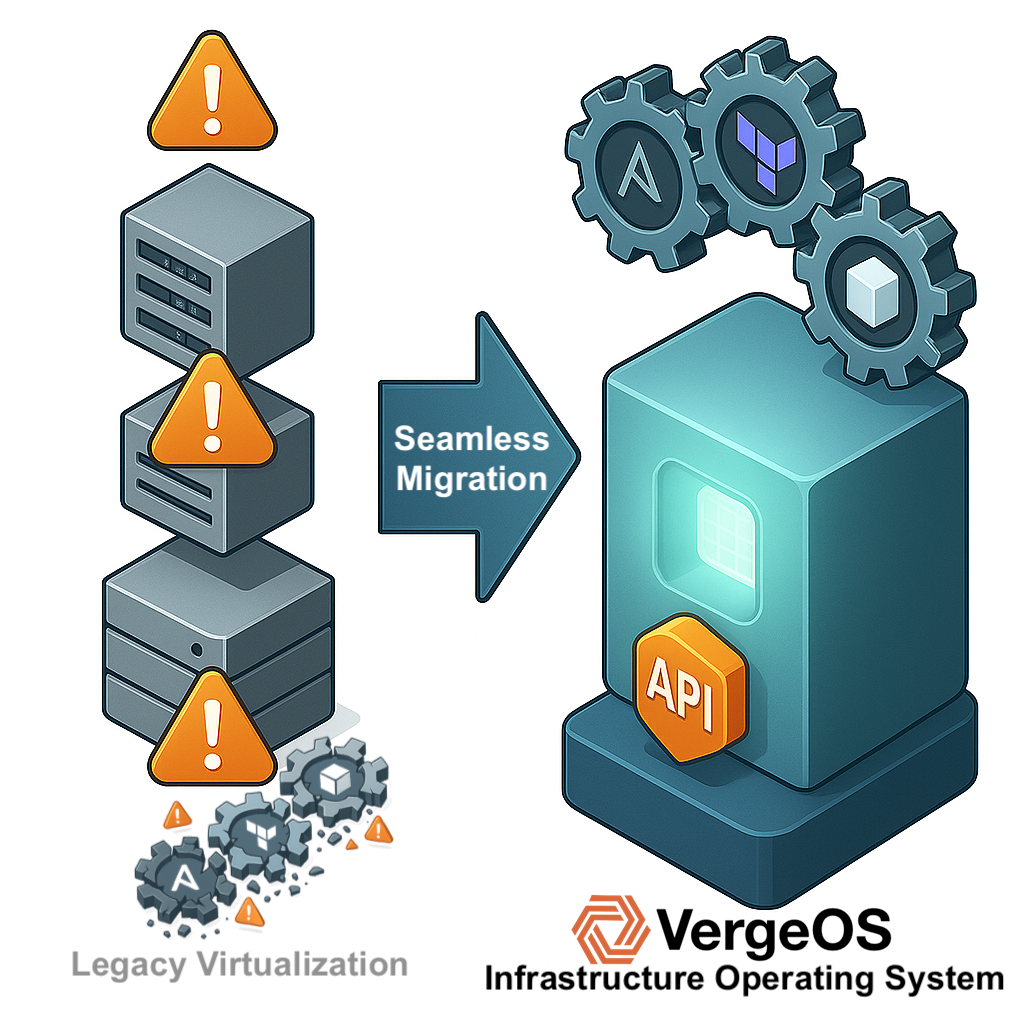
The abstraction delivers another benefit. When VergeOS upgrades and offers new or improved services, all existing hardware gains those capabilities immediately. When VergeOS delivered immutable snapshots, every storage node in every cluster could provide them instantly. Teams did not need to buy new arrays or wait for vendor firmware updates. The feature rolled out across the entire environment via a software update. Traditional stacks cannot deliver this. New capabilities remain locked to new hardware purchases because the hardware provides the services.
Packer builds a single golden image that works across all environments. Teams no longer maintain hardware-specific variants. The image includes standard guest tools that function consistently because the platform abstracts storage and network differences. Boot behavior remains predictable. Device mappings stay constant. The image pipeline becomes what it should be: a single source of truth for all deployments.
Terraform modules drop the conditional logic. A storage definition describes capacity and performance requirements without referencing vendor-specific parameters. Network definitions create VLANs and subnets without accounting for fabric variations. VM specifications remain stable across hardware generations. The module that defines infrastructure in cluster A works identically in cluster B and in the DR site. Teams write infrastructure code that describes intent rather than navigating hardware exceptions.
Ansible roles simplify in the same way. Configuration tasks no longer require hardware detection. Network interface names remain consistent. Storage paths do not shift. Application deployments follow the same steps across all clusters. The role expresses the desired state without conditional branches. Teams maintain a single set of roles rather than location-specific versions. Private AI infrastructure uses the same automation pipeline as traditional workloads because VergeOS treats AI as another software service rather than a separate hardware stack.
Unified Infrastructure Enables Predictable Automation
The operational benefits become clear when teams move from fragmented infrastructure to a unified platform. DR sites mirror production perfectly because the platform behaves identically across locations. Terraform modules deploy the same way in both environments. Ansible roles apply a consistent configuration. Failover tests succeed because the automation produces the same results across sites.
Hardware refresh cycles no longer break automation pipelines. New servers join clusters without requiring module updates or role modifications. The automation code remains stable across hardware generations. Teams retire equipment and deploy replacements as part of routine maintenance rather than as part of infrastructure redesign projects.
Recovery from failure becomes faster and more reliable. A cluster damaged by a hardware failure can be rebuilt from Terraform definitions. Storage, networks, and VMs return to their pre-failure configuration. Administrators follow the automation pipeline rather than documentation that drifted from reality. The environment reaches operational state in hours instead of days.
Teams spend their time improving automation rather than maintaining it. They add capabilities. They refine processes. They integrate new services. The pipeline evolves through intentional development rather than emergency repairs. Administrative overhead declines as the environment grows because the infrastructure no longer introduces variables that require human intervention.
Infrastructure Architecture Determines Automation Success
| Aspect | Fragmented Infrastructure | Unified Infrastructure (VergeOS) |
|---|---|---|
| Packer Image Creation | Multiple hardware-specific variants. Different drivers per storage backend. | No conditionals needed—same modules across all environments. |
| Terraform Modules | Conditional branches for each vendor. Separate logic per cluster. | Hardware changes are invisible to automation. No code updates needed. |
| Ansible Roles | Hardware detection in every role. Different tasks per NIC type. | No hardware detection required. Consistent interfaces everywhere. |
| API Complexity | Three separate APIs with different authentication. | Single API for all infrastructure services. |
| Hardware Changes | Every refresh breaks automation. New models require code updates. | Hardware changes are invisible to automation—no code updates needed. |
| Multi-Cluster Operations | Separate automation branches per location. DR drifts from production. | Identical automation across all sites. DR mirrors production perfectly. |
| Feature Deployment | New capabilities require hardware purchases. Features locked to specific models. | New features appear across all hardware instantly via software updates. |
| Operational Overhead | Teams maintain exceptions. Time spent on repairs. | Single golden image works everywhere—standard tools across all nodes. |
Conclusion
Automation tools are only as reliable as the platform beneath them—fragmented infrastructure forces complexity into every layer of the pipeline. Unified infrastructure removes that complexity at the source. Organizations that move to platforms like VergeOS gain automation that scales predictably. The tools work as intended because the foundation supports them. The pipeline delivers consistency rather than collecting exceptions. Infrastructure automation succeeds when the substrate enables it.
Key Takeaways
Fragmented infrastructure breaks automation by forcing hardware complexity into every layer of the automation pipeline, creating brittle code filled with conditional logic and vendor-specific exceptions.
Traditional virtualization stacks rely on hardware to provide services, meaning each storage array, network fabric, and hypervisor generation introduces variables that automation tools must navigate.
Packer, Terraform, and Ansible inherit fragmentation from the substrate. Image templates require multiple variants, Terraform modules grow conditional branches, and Ansible roles fill with hardware detection logic.
Unified infrastructure operating systems abstract services from hardware, allowing clusters with different hardware generations to behave identically from the automation layer’s perspective.
A single API replaces multiple vendor-specific interfaces, dramatically simplifying automation integration and eliminating the need for platform-specific conditionals in code.
Hardware changes become invisible to automation workflows. Teams add new servers, retire old equipment, and refresh clusters without updating Terraform modules, Ansible roles, or Packer images.
Software updates deliver new capabilities to all existing hardware instantly, rather than locking features to new hardware purchases as traditional stacks do.
Multi-cluster and DR environments maintain perfect alignment because the same automation definitions produce identical results regardless of location or underlying hardware.
Automation tools are only as reliable as the platform beneath them. Fragmented infrastructure forces complexity into pipelines. Unified infrastructure removes that complexity at the source.
Organizations gain automation that scales predictably when they move to platforms like VergeOS that eliminate architectural fragmentation and provide a consistent substrate for infrastructure as code.
Frequently Asked Questions
What causes infrastructure automation to fail at scale?
Automation fails when the underlying infrastructure behaves inconsistently. Traditional virtualization stacks rely on external storage arrays, network fabrics, and hypervisor hosts that each operate independently. When hardware changes or varies across clusters, automation code must account for these differences through conditional logic and exceptions. The complexity accumulates until teams spend more time maintaining automation than they spent on manual processes.
Can Packer, Terraform, and Ansible work on fragmented infrastructure?
These tools function on fragmented infrastructure, but they inherit the complexity. Packer requires multiple image variants for different storage backends. Terraform modules need conditional branches for vendor-specific parameters. Ansible roles fill with hardware detection logic. The tools work, but the automation becomes brittle and difficult to maintain across environments.
How does unified infrastructure differ from hyperconverged infrastructure?
Hyperconverged infrastructure bundles compute, storage, and networking into appliances but often still relies on separate management layers and external components. Unified infrastructure like VergeOS integrates all services into a single codebase with one API. Hardware abstraction happens at the operating system level rather than through appliance bundling. This creates a consistent substrate for automation rather than just packaging components together.
Will my existing Terraform modules and Ansible roles work with VergeOS?
VergeOS provides Terraform providers and Ansible modules specifically designed for the platform. Existing automation logic can be adapted, and in most cases simplified, because the platform eliminates the conditional branches and hardware-specific exceptions required on fragmented infrastructure. Teams typically find their automation code becomes cleaner and shorter during migration.
What happens to automation when I refresh hardware?
On fragmented infrastructure, hardware refresh often breaks automation because new models expose different APIs, storage paths, or network behaviors. On unified infrastructure like VergeOS, hardware changes are invisible to the automation layer. New servers join clusters without requiring updates to Terraform modules, Ansible roles, or Packer images. The abstraction layer handles hardware variations automatically.
How does this approach handle multi-cluster or multi-region deployments?
Unified infrastructure enables identical automation across all locations. The same Terraform modules deploy infrastructure in production, DR sites, and remote clusters. Ansible roles apply consistent configuration everywhere. Packer images work across all environments. Teams maintain one set of automation definitions rather than location-specific branches.
Can I automate private AI infrastructure the same way as traditional workloads?
On unified infrastructure, AI workloads use the same automation pipeline as traditional applications. VergeOS treats AI as a software service rather than requiring a separate hardware stack. Teams apply the same Terraform modules, Ansible roles, and Packer images to AI infrastructure. This eliminates the need for duplicate automation pipelines and separate operational procedures.
What is the ROI of moving from fragmented to unified infrastructure?
Organizations reduce time spent maintaining automation exceptions and troubleshooting hardware-induced drift. Hardware refresh cycles no longer require automation redesign. Multi-cluster operations become simpler because environments behave identically. Administrative overhead declines as scale increases rather than growing proportionally. Teams shift focus from reactive maintenance to planned improvements.
How long does it take to migrate automation to a unified platform?
Migration time depends on environment complexity, but teams typically start with a single layer. Packer images migrate first, followed by Terraform modules, then Ansible roles. The incremental approach allows teams to build confidence without disrupting current operations. Modern AI tools accelerate the process by generating initial templates and modules that teams refine.
Does this approach work for organizations leaving VMware?
Organizations exiting VMware gain both a new platform and a cleaner operational model. VergeOS eliminates the fragmented architecture that complicated VMware automation. Teams define target infrastructure in Terraform, pre-build images with Packer, and deploy configuration through Ansible. The migration provides an opportunity to establish disciplined automation practices from the start rather than replicating legacy complexity.
Automation fails when the underlying infrastructure behaves inconsistently. Traditional virtualization stacks rely on external storage arrays, network fabrics, and hypervisor hosts that each operate independently. When hardware changes or varies across clusters, automation code must account for these differences through conditional logic and exceptions. The complexity accumulates until teams spend more time maintaining automation than they spent on manual processes.
These tools function on fragmented infrastructure, but they inherit the complexity. Packer requires multiple image variants for different storage backends. Terraform modules need conditional branches for vendor-specific parameters. Ansible roles fill with hardware detection logic. The tools work, but the automation becomes brittle and difficult to maintain across environments.
Hyperconverged infrastructure bundles compute, storage, and networking into appliances but often still relies on separate management layers and external components. Unified infrastructure like VergeOS integrates all services into a single codebase with one API. Hardware abstraction happens at the operating system level rather than through appliance bundling. This creates a consistent substrate for automation rather than just packaging components together.
VergeOS provides Terraform providers and Ansible modules specifically designed for the platform. Existing automation logic can be adapted and, in most cases, simplified because the platform eliminates the conditional branches and hardware-specific exceptions required by fragmented infrastructure. Teams typically find that their automation code becomes cleaner and shorter during migration.
In a fragmented infrastructure, hardware refreshes often break automation because new models expose different APIs, storage paths, or network behaviors. On a unified infrastructure like VergeOS, hardware changes are invisible to the automation layer. New servers join clusters without requiring updates to Terraform modules, Ansible roles, or Packer images. The abstraction layer automatically handles hardware variations.
Unified infrastructure enables identical automation across all locations. The same Terraform modules deploy infrastructure in production, DR sites, and remote clusters. Ansible roles apply consistent configuration everywhere. Packer images work across all environments. Teams maintain one set of automation definitions rather than location-specific branches.
On a unified infrastructure, AI workloads use the same automation pipeline as traditional applications. VergeOS treats AI as a software service rather than requiring a separate hardware stack. Teams apply the same Terraform modules, Ansible roles, and Packer images to AI infrastructure. This eliminates the need for duplicate automation pipelines and separate operational procedures.
Organizations reduce time spent maintaining automation exceptions and troubleshooting hardware-induced drift. Hardware refresh cycles no longer require redesign of the automation. Multi-cluster operations become simpler because environments behave identically. Administrative overhead declines as scale increases rather than growing proportionally. Teams shift focus from reactive maintenance to planned improvements.
Migration time depends on environmental complexity, but teams typically start with a single layer. Packer images migrate first, followed by Terraform modules, then Ansible roles. The incremental approach allows teams to build confidence without disrupting current operations. Modern AI tools accelerate the process by generating initial templates and modules that teams refine.
Organizations exiting VMware gain both a new platform and a cleaner operational model. VergeOS eliminates the fragmented architecture that complicates VMware automation. Teams define target infrastructure in Terraform, build pre-built images with Packer, and deploy configurations with Ansible. The migration provides an opportunity to establish disciplined automation practices from the start rather than replicating legacy complexity.