When IT professionals start comparing Proxmox to VergeOS, they often assume the decision centers on choosing a new hypervisor to replace VMware. The real decision is determining if virtualization, networking, availability, and data protection can function as a single system. A platform succeeds only when these elements move together.
Proxmox feels familiar to teams with strong Linux experience, giving the sense that a hypervisor swap offers a clean transition. That impression changes once teams evaluate how Proxmox connects compute, networking, storage, and protection. Each part operates independently, and administrators must keep those parts aligned.
VergeOS takes a different path by treating the hypervisor as a service inside an Infrastructure Operating System. Compute, storage, networking, mobility, and protection follow the same architectural rules across all nodes. Each service draws from the same metadata structure, eliminating the coordination work that modular platforms impose on the operator. Teams gain a predictable environment for migrations, failovers, and growth because the platform manages these functions as one system.
This distinction frames the rest of the comparison. A platform built from independent subsystems introduces drift, coordination work, and rising complexity as clusters grow. A platform that unifies core functions creates a consistent environment for mobility, networking, and recovery. The contrast becomes more apparent as teams examine how Proxmox and VergeOS behave under load, during failures, and during cluster expansion.
Comparing Proxmox to VergeOS: Architectures
A Modular Assembly of Independent Components
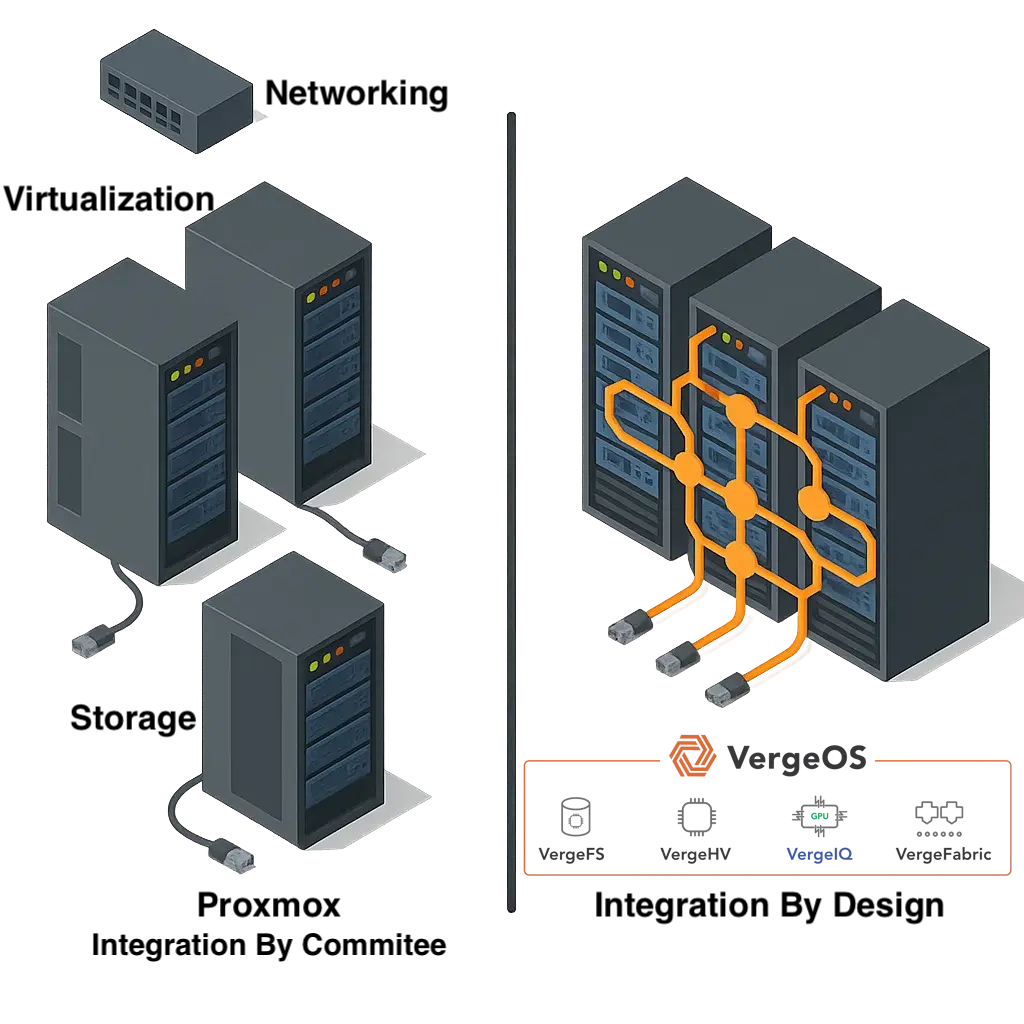
Proxmox assembles its platform from separate elements. KVM supplies compute. Linux provides the operating base. ZFS, Ceph, or an external array can supply storage. Networking depends on Linux bridges, VLAN constructs, or Open vSwitch. Backup requires Proxmox Backup Server (PBS) or a third-party tool. Each component behaves well alone. None forms a unified architecture. While the Proxmox GUI attempts to hide the independence of these components, administrators must align these pieces before the environment can produce predictable results.
Networking as a Separate System
Networking highlights this pattern. Each Proxmox node implements Linux networking constructs for packet forwarding. Bridges, bonds, and VLAN definitions require manual configuration. Each option introduces its own behaviors and its own failure characteristics. When teams want consistent mobility, they must maintain identical configurations across nodes. Drift appears quickly because each node evolves with its own configuration history.
Storage Fragmentation Across the Cluster
Storage follows the same structure. ZFS delivers node-local storage. Ceph delivers distributed storage. External arrays centralize storage. Each model uses different tuning guidelines, scaling behaviors, and recovery patterns. Proxmox does not unify these components across the cluster. Administrators test combinations, confirm compatibility, and correct issues as nodes evolve. Flexibility increases, but so does the integration burden. We dive deeper into the challenges of storage in our white paper “Understanding the Proxmox Storage Challenges”, available exclusively to attendees of our upcoming webinar, “VergeOS or Proxmox, A Closer Look at VMware Successors.”
Protection and Availability in Separate Domains
Availability and protection follow the same split. The Proxmox HA manager operates independently from storage. PBS handles protection separately. Each follows different rules for recovery, retention, and consistency. Coordinating these functions becomes the operator’s responsibility. Proxmox delivers the parts. The user builds the system.
VergeOS Takes a Different Path
VergeOS embeds the hypervisor within an Infrastructure Operating System that integrates compute, storage, networking, protection, and availability. Each component behaves consistently because it belongs to the same architecture. Configuration applies across nodes. Updates follow one lifecycle. Configuration Drift does not accumulate. The integration work that Proxmox places on the operator becomes part of the VergeOS platform and is not a concern for IT administrators. Watch our CTO, Greg Campbell, dive deep into the VergeOS architecture in this LightBoard video.
Comparing Proxmox to VergeOS: Operational Models
Independent Lifecycles Create Complexity
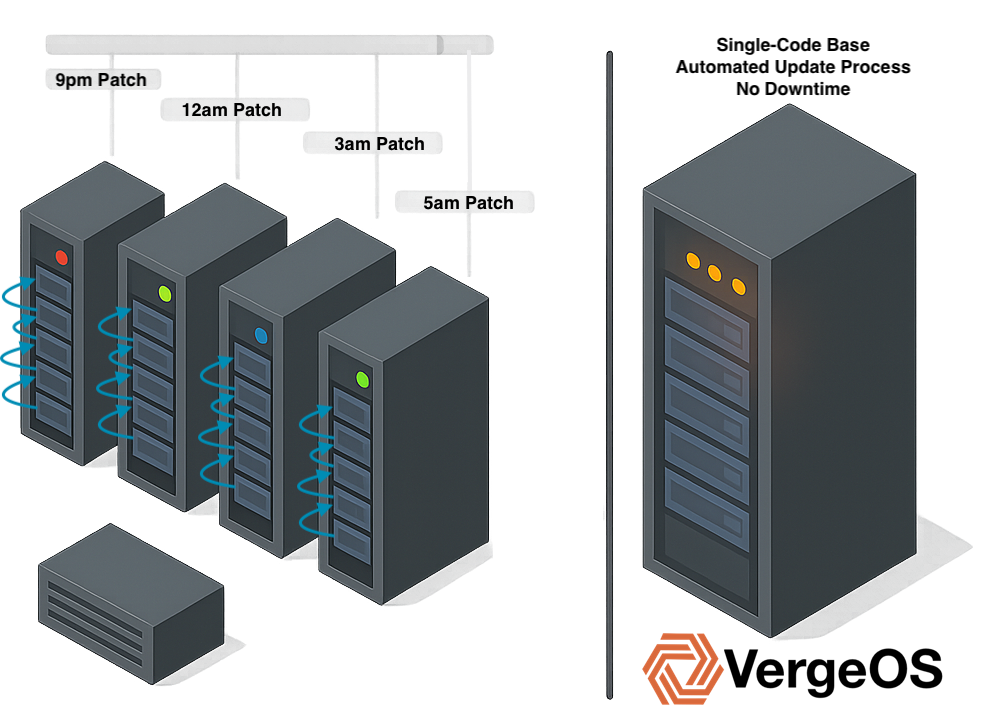
Proxmox places significant operational responsibility on the administrator. Each subsystem updates independently and carries its own risks. ZFS and Ceph follow separate release cycles. Linux introduces kernel changes that influence device behavior. PBS adds another update stream. Administrators test combinations before deployment—the platform functions, but only when the operator maintains alignment across all layers.
Troubleshooting Requires Multi-Domain Expertise
Troubleshooting follows the same pattern. A performance issue might originate in ZFS, Ceph, networking, KVM, or PBS. Logs live in different places. Metrics flow through various tools. Expertise in one area does not always translate to another. Resolution time increases because the architecture introduces many potential fault paths.
VergeOS Delivers Operational Simplicity
VergeOS presents one operational model. Storage, networking, protection, and compute share the same metadata pool and control plane. Engineers run one update process. Troubleshooting follows one diagnostic path. The system understands where data lives, how networks map to workloads, and how protection applies. Far fewer unknowns exist. The environment behaves as a single platform rather than several connected parts.
Comparing Proxmox to VergeOS: Mobility, Resilience, and HA Behavior
Mobility Depends on Storage Choices in Proxmox
Mobility and availability expose architectural gaps quickly. Proxmox mobility depends on storage design. ZFS ties storage to one node. Ceph distributes storage but introduces requirements for cluster health and OSD stability. Replication intervals influence the likelihood of data loss. Failover timing depends on subsystem alignment. Administrators must coordinate most of these variables manually.
VergeOS Delivers Mobility Through Unified Metadata
VergeOS uses a single metadata pool that applies across the cluster. VM mobility becomes a function of reading shared metadata rather than coordinating separate systems. Availability improves because recovery follows one architecture that understands where data lives and how networks connect. Movement, placement, and recovery follow one consistent model. Even deduplication has an advantage over AFA-based deduplication since everything, virtualization, networking, AI, and storage are now deduplication aware.
Comparing Proxmox to VergeOS: Scaling the Platform
Growth Exposes Architectural Differences
Scaling introduces variation in Proxmox quickly. New nodes bring their own pools, network settings, and state. ZFS pools differ. Ceph rebalances. VLAN definitions drift. Each addition increases the coordination work required to maintain stability.
VergeOS Delivers Predictably Across Mixed Hardware
VergeOS grows by extending one architecture. New nodes access the same metadata, rules, and operational model. Mixed hardware joins the cluster easily. Customers often comment on how quickly they can expand VergeOS environments. Many describe it as the fastest expansion experience they have ever seen in a production environment.
Conclusion
The architectural difference between Proxmox and VergeOS shapes every operational outcome. Proxmox provides a modular platform that rewards teams with deep expertise across multiple domains. VergeOS delivers a unified Infrastructure Operating System that holds those domains together and dramatically simplifies IT operations.


