Organizations evaluating Proxmox as a VMware alternative expect zero licensing costs, but they will also experience the Proxmox storage tax. This tax manifests itself in operational overhead, capacity inefficiency, and architectural compromises that extract payment in different ways. Proxmox offers ZFS for node-local storage and Ceph for distributed storage, each levying its own tax. A third option, external all-flash arrays, reintroduces the siloed infrastructure that drove organizations away from VMware in the first place.
Key Terms (Click to Expand)
Storage Tax: Hidden costs in operational overhead, capacity inefficiency, and architectural complexity that offset zero licensing fees in Proxmox deployments.
Per-Node Deduplication: Data reduction that operates independently on each server, missing duplicate data across multiple nodes in a cluster.
Global Deduplication: Data reduction that identifies and eliminates duplicate blocks across all nodes and workloads in an infrastructure.
SRE-Level Expertise: Site Reliability Engineering knowledge required to deploy and manage complex distributed systems like Ceph.
Rehydration Cycle: The process of expanding deduplicated data to full size for transmission, then re-deduplicating at the destination, consuming bandwidth and extending backup windows.
Infrastructure Operating System: A platform that unifies compute, storage, networking, and protection into a single codebase with shared metadata, eliminating coordination between independent subsystems.

The ZFS Storage Tax
ZFS provides strong integrity features with checksumming, compression, and flexible RAID configurations. However, ZFS operates as a node-local construct—each Proxmox node maintains its own independent pool. The first tax arrives immediately: VMs cannot migrate freely because storage doesn’t follow the workload. Proxmox addresses this through asynchronous replication, but it introduces RPO windows during which data can be lost if the source node fails.
This capacity tax compounds the problem. Most deployments disable ZFS’s mature deduplication due to substantial RAM and CPU overhead. When enabled, deduplication operates per-node only—the same Windows image deployed across five nodes consumes five times the storage. In many-to-one DR scenarios, ten production nodes replicating to a single DR target could require ten times the logical capacity because each stream arrives independently. Organizations pay the storage tax at both production and DR sites.
Eliminating the ZFS Tax: VergeFS provides a global storage model spanning every node in the cluster. VMs move freely because every node sees the same metadata, block references, and deduplication catalog. Global inline deduplication covers every block across every workload without per-node RAM overhead. That Windows image used across twenty VMs consumes the space of a single image. DR targets receive unique deduplicated blocks—no duplicate tax at the DR site.
The Ceph Storage Tax
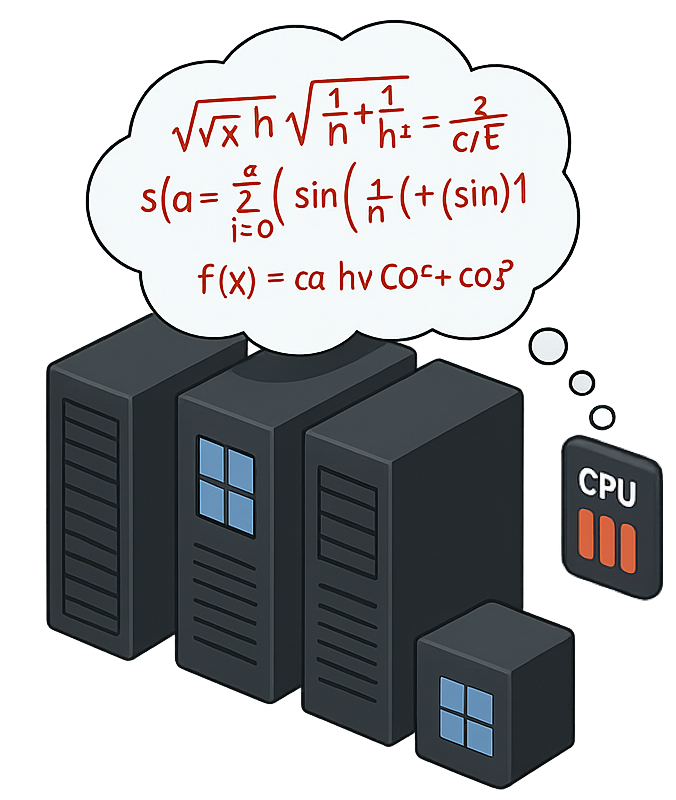
Ceph takes the opposite approach, providing distributed object storage that eliminates VM mobility problems. The tax here is expertise. Ceph demands SRE-level knowledge—the same discipline Google developed for hyperscale operations. Deployment requires understanding placement groups, CRUSH maps, and OSD management. Each client maintains a CRUSH map and performs placement calculations for every I/O operation, consuming CPU cycles that scale with cluster complexity. This is the compute tax—resources diverted from production workloads to storage overhead.
Ceph also levies a capacity tax. Production-ready deduplication doesn’t exist for VM workloads. Organizations accept inflated storage costs or implement separate deduplication at backup layers—paying for another product to solve a problem the platform should handle. Ceph’s redundancy models compound the burden—replicated pools require 3x raw storage for 1x usable capacity.
Eliminating the Ceph Tax: VergeOS delivers shared storage and VM mobility without Ceph’s expertise tax. There are no CRUSH maps to configure, no placement groups to tune, no OSD management overhead—storage scales linearly as nodes are added, with the platform automatically distributing data. No SRE team required. No compute cycles lost to placement calculations.
The External Array Storage Tax
Some organizations consider connecting Proxmox to external all-flash arrays. This path levies the most visible tax: premium controller pricing with excessive storage media markups—7X or more. Organizations pay not just for capacity but for proprietary hardware that could be replaced with commodity alternatives.
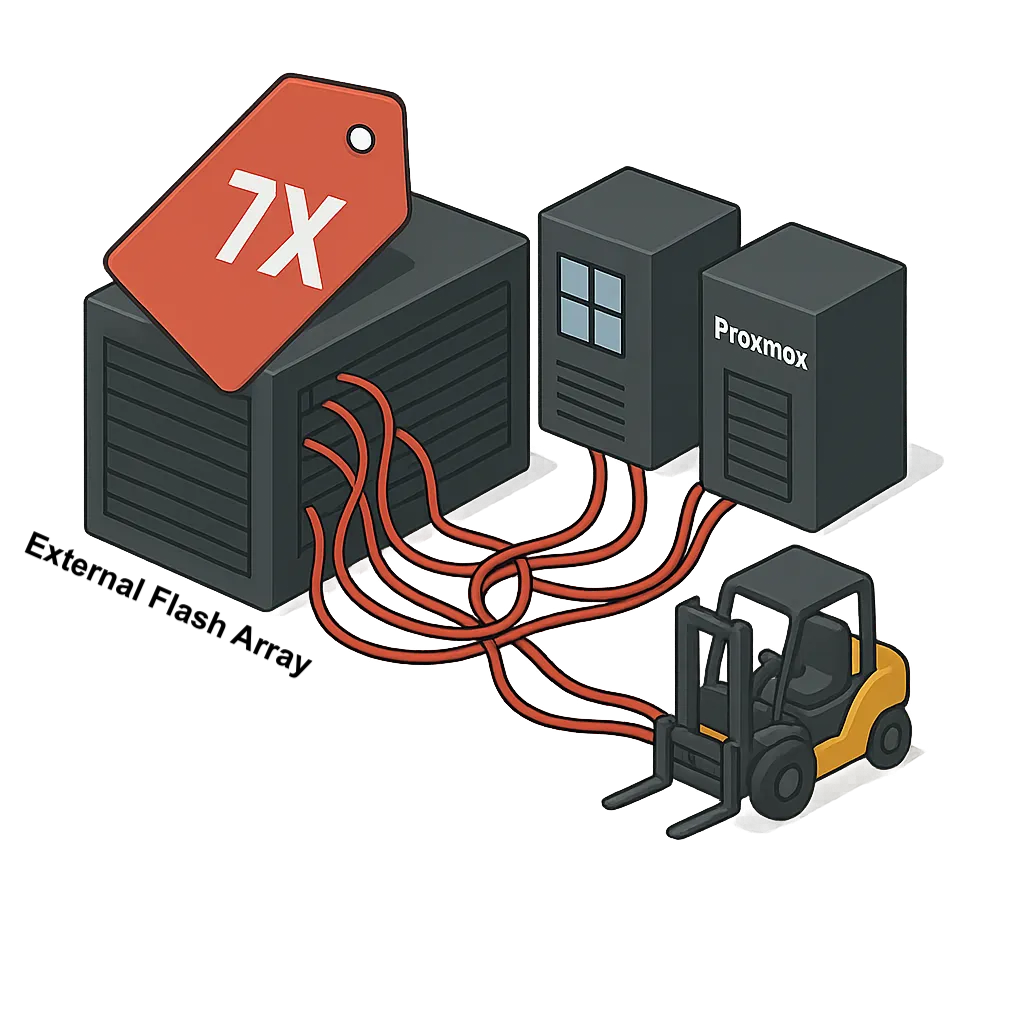
The operational tax follows. Storage professionals comfortable with VMware’s vCenter face a learning curve with Proxmox’s Linux-centric management while still managing a separate array console. Scaling demands forklift upgrades rather than incremental growth—a capital expenditure tax that arrives every few years. Storage I/O traverses additional network hops, imposing a latency tax that integrated architectures avoid.
The dedicated-array approach essentially recreates the VMware-era architecture—expensive, siloed, and operationally fragmented—while eliminating the cost advantage that attracted organizations to Proxmox.
Eliminating the Array Tax: VergeOS removes the need for external arrays. Storage integrates directly into the Infrastructure Operating System, eliminating premium controller costs and proprietary markup. Organizations leverage commodity servers and standard storage media while achieving better efficiency through global deduplication than dedicated arrays deliver at their premium prices. Like arrays, VergeOS scales compute and storage independently with storage-only and compute-only nodes—but without vendor lock-in or forklift upgrades.
| Storage Approach | Strengths | Limitations / “Tax” | How VergeOS Eliminates the Tax |
|---|---|---|---|
| ZFS (Node-Local) | Strong integrity, snapshots, and flexible RAID | Per-node dedupe, limited VM mobility, DR multiplies capacity | Global storage, global dedupe, shared metadata, cluster-wide mobility |
| Ceph (Distributed) | Shared storage, high resilience | Requires SRE expertise, no production dedupe, high CPU cost, 3x replication overhead | Shared storage without Ceph complexity, plus inline global dedupe |
| External Flash Arrays | Mature features, consistent performance | 7X+ media markup, vendor lock-in, forklift upgrades, added latency | Commodity hardware, integrated storage, no external array dependency |
| VergeFS (Integrated) | Global dedupe, shared metadata, mobility, built-in protection | N/A | Unifies compute, storage, and protection |
The Data Protection Tax
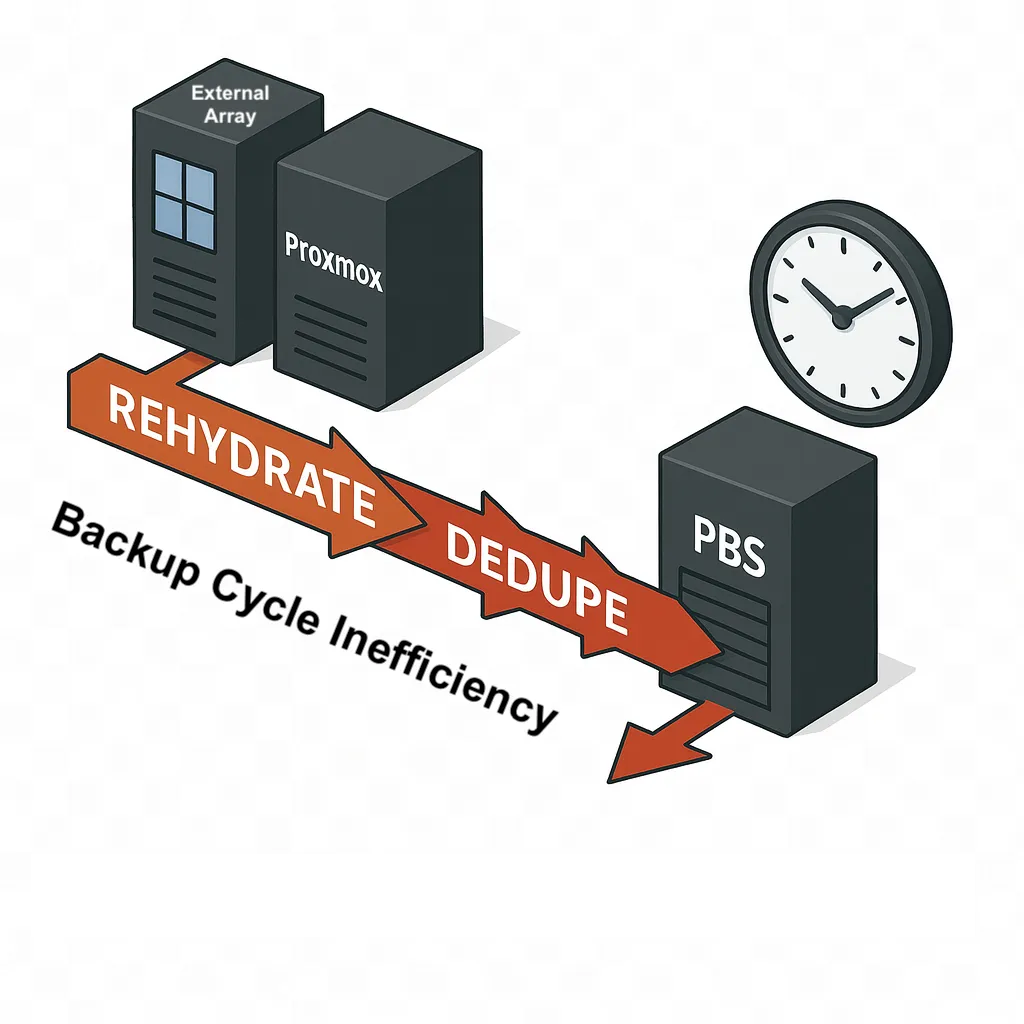
Regardless of storage path, Proxmox requires Proxmox Backup Server or a third-party alternative for comprehensive data protection—another product to license, deploy, and manage. When production storage uses deduplication, data must be rehydrated to full size before transmission to PBS, which then re-deduplicates. This dedupe-rehydrate-dedupe cycle imposes a bandwidth tax, extends backup windows, and complicates recovery operations. Large environments pay the ultimate tax: recovery times measured in hours or days.
Eliminating the Protection Tax: VergeOS addresses data protection through integrated snapshots, ioReplicate, and ioFortify—eliminating rehydration cycles. Creating a snapshot is a metadata operation that completes in seconds regardless of data volume. Snapshots become independent, space-efficient, immutable clones. Recovery from ransomware involves advancing metadata to a known-good point—an operation that completes in seconds even for 100TB or 100PB environments—no separate backup product required.
The DR Tax

Cross-site resilience with Proxmox requires different approaches depending on the storage backend, each extracting its own tax. ZFS environments combine asynchronous replication with backup-based DR through PBS. Ceph offers RBD mirroring or stretch clusters—each with distinct complexity taxes. External arrays introduce their own DR mechanisms requiring matching arrays at both locations, doubling hardware investment.
Organizations pay the coordination tax: aligning array-level replication with Proxmox VM configurations, ensuring replicated volumes match VM definitions, and spanning multiple management interfaces during failover.
Eliminating the DR Tax: Disaster recovery follows a single architectural pattern in VergeOS. Administrators create a Virtual Data Center at the DR location. ioReplicate sends deduplicated block changes to that VDC. VM configurations, networking rules, storage references, and protection policies remain consistent because they operate within the same Infrastructure Operating System. No coordination tax. No matching hardware tax. DR becomes an extension of the platform.
DR readiness is more crucial than choosing a VMware alternative hypervisor. If disaster recovery isn’t possible, the hypervisor you initially chose becomes irrelevant. Most hypervisors fall short of VMware’s DR capabilities, but VergeOS surpasses them by offering better DR features, reducing costs, and simplifying recovery management.
Key Takeaways
- Proxmox’s zero licensing cost conceals significant storage taxes in operational overhead and capacity inefficiency.
- ZFS per node deduplication multiplies storage requirements across clusters and DR sites.
- Ceph demands SRE level expertise, creating ongoing operational costs most organizations underestimate.
- External arrays reintroduce VMware era issues including premium pricing, vendor lock in, and siloed architecture.
- VergeOS eliminates these taxes through global deduplication, unified architecture, and integrated data protection.
Stop Paying the Storage Tax
Proxmox’s zero licensing cost conceals taxes that arrive throughout the infrastructure lifecycle: capacity taxes from missing or per-node deduplication, expertise taxes from Ceph’s complexity, hardware taxes from external arrays, bandwidth taxes from rehydration cycles, and coordination taxes from multi-vendor DR.
VergeOS eliminates these taxes through a fundamentally different approach—an Infrastructure Operating System that unifies compute, storage, networking, and data protection into a single codebase. One update cycle. One management interface. One support team. No hidden taxes.
Storage is only one part of the infrastructure conversation when comparing Proxmox to VergeOS. Read our blog Comparing Proxmox to VergeOS to dive deeper into other important differences.
For production enterprise workloads, the Proxmox storage tax alone justifies evaluating an Infrastructure Operating System that eliminates these costs by design.
Frequently Asked Questions About Proxmox Storage Costs
What is the Proxmox storage tax?
The Proxmox storage tax refers to hidden operational costs, capacity inefficiencies, and architectural compromises that offset Proxmox’s zero licensing fee. These include per node deduplication limitations with ZFS, SRE level expertise requirements with Ceph, and premium hardware costs with external arrays.
Does ZFS deduplication work across Proxmox nodes?
No. ZFS deduplication operates per node only. The same data on five different nodes consumes five times the storage. This limitation extends to disaster recovery scenarios where many to one replication multiplies capacity requirements.
Why does Ceph require SRE level expertise?
Ceph demands distributed systems knowledge for deployment, tuning, and troubleshooting. Understanding placement groups, CRUSH maps, and OSD management requires skills beyond traditional storage administration, increasing operational costs.
Can external arrays eliminate Proxmox storage limitations?
External arrays solve some problems but introduce others, including high storage media markups, vendor lock in, forklift upgrade cycles, and the same siloed architecture organizations wanted to escape when leaving VMware.
How does VergeOS eliminate the Proxmox storage tax?
VergeOS provides global inline deduplication without per node overhead, shared storage without Ceph complexity, and integrated data protection without separate backup products, all within a unified Infrastructure Operating System.
The Proxmox storage tax refers to hidden operational costs, capacity inefficiencies, and architectural compromises that offset Proxmox’s zero licensing fee. These include per-node deduplication limitations with ZFS, SRE-level expertise requirements with Ceph, and premium hardware costs with external arrays.
No. ZFS deduplication operates per-node only. The same data on five different nodes consumes five times the storage. This limitation extends to DR scenarios where many-to-one replication multiplies capacity requirements.
Ceph requires knowledge of distributed systems for deployment, tuning, and troubleshooting. Understanding placement groups, CRUSH maps, and OSD management requires skills beyond traditional storage administration, increasing operational costs.
External arrays solve some problems but introduce others: 7X+ storage media markups, vendor lock-in, forklift upgrade cycles, and the same siloed architecture organizations wanted to escape from VMware.
VergeOS provides global inline deduplication without per-node overhead, shared storage without Ceph complexity, and integrated data protection without separate backup products—all within a unified Infrastructure Operating System.