Instant recovery earned its place in the data protection stack. Veeam and other backup vendors built it to restart a workload fast when the production platform is unavailable, and it remains the right answer for that failure. Customers running VergeOS asked for a companion capability, one that shrinks recovery point objectives (RPO) and recovery time objectives (RTO) when the failure never leaves the platform. VergeOS’ ioGuardian answers with real-time, inline recovery, an instant recovery upgrade for failures inside the platform.
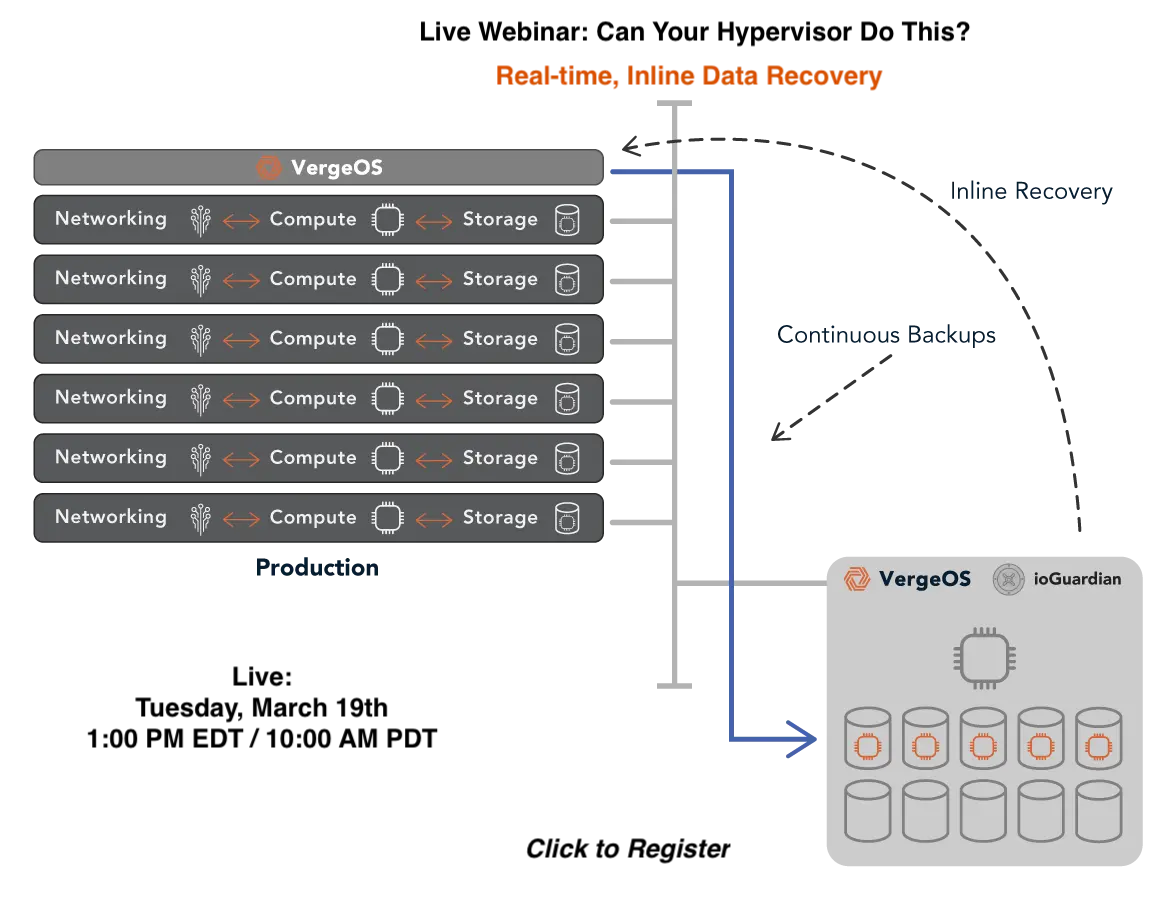
The distinction matters because the two techniques answer different questions. Instant recovery asks how fast a workload can come back somewhere else. Inline recovery asks whether the workload has to go down at all. A VergeOS environment running both covers the full range of failures, from a pair of dead drives in one node through a site loss that takes the whole instance offline.
Key Takeaways
- Instant recovery and inline recovery answer different failures. Veeam Instant Recovery restarts a workload somewhere else. ioGuardian keeps the workload running where it already is.
- ioGuardian delivers missing data segments to running VMs in real time, holding RTO at zero with an RPO measured in minutes, with no VM restart and no later move back to production.
- The ioGuardian target runs on repurposed hardware and holds a third copy of data outside the production instance, with global inline deduplication limiting the capacity it consumes.
- After failed drives are replaced, the ioGuardian server rebuilds only the missing segments, with no volume-level restore and no RAID rebuild.
- ioGuardian is included in VergeOS. The only added cost is licensing the server it runs on.
Understanding Real-time Recovery with ioGuardian
ioGuardian for VergeOS is data protection built into the VergeOS code base. Rather than moving a copy of the workload to another platform, it repairs the read path in place, keeping data available even when the hardware protections underneath run out of room during multiple drive or node failures. Instant recovery answers that same event by restarting the VM on a backup appliance. ioGuardian answers it by delivering the missing data segments to virtual machines (VMs) inline, so the workload keeps running.
One of ioGuardian’s key benefits is its ability to tighten RPOs and RTOs. It achieves this through VergeOS snapshots, which run as frequently as the customer needs, pairing regular point-in-time protection with inline recovery. The combination delivers real-time recovery of missing data segments, so VMs keep running while the repair happens behind them. These capabilities are included in VergeOS at no additional charge other than licensing the server used for ioGuardian.
Setting Up Real-time Recovery
The setup for ioGuardian involves configuring a dedicated server as the ioGuardian target, which can be an older, repurposed server or storage system capable of running VergeOS. It runs outside the production instance and represents a third copy of data beyond the protections built-in to the production VergeOS instance.
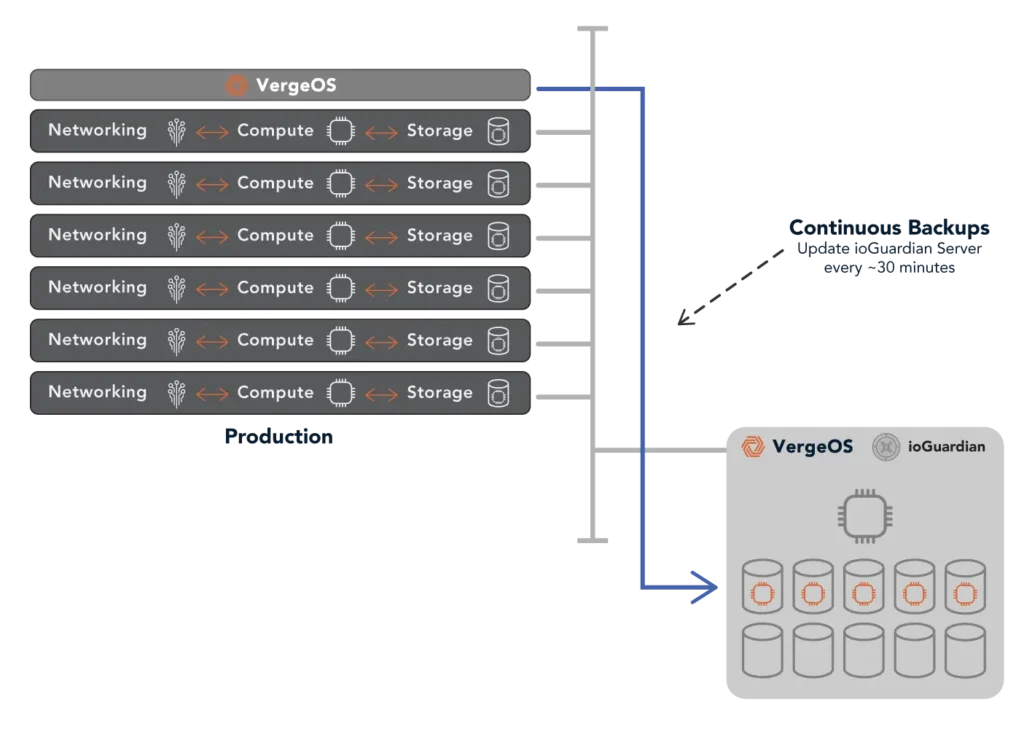
Since it is also running VergeOS, it also provides global inline deduplication, so the storage capacity needed for the ioGuardian server is optimized, allowing for reduced data transfer and footprint. Additionally, placing an ioGuardian server on-premises and at a remote location can enhance data recovery efforts by providing access to data blocks from multiple sources if needed.
Key Terms
Comparing Instant Recovery to Real-time Recovery
Several rapid recovery technologies have reached the market over the past decade, and instant recovery is the most widely deployed of them. Veeam Instant Recovery re-instantiates a VM on a backup appliance in minutes. That is exactly what you want when the production platform is down, when the hypervisor itself is the problem, or when the workload has to land on hardware different from where it started. Portability is the point of the technique, and no in-platform capability substitutes for it.
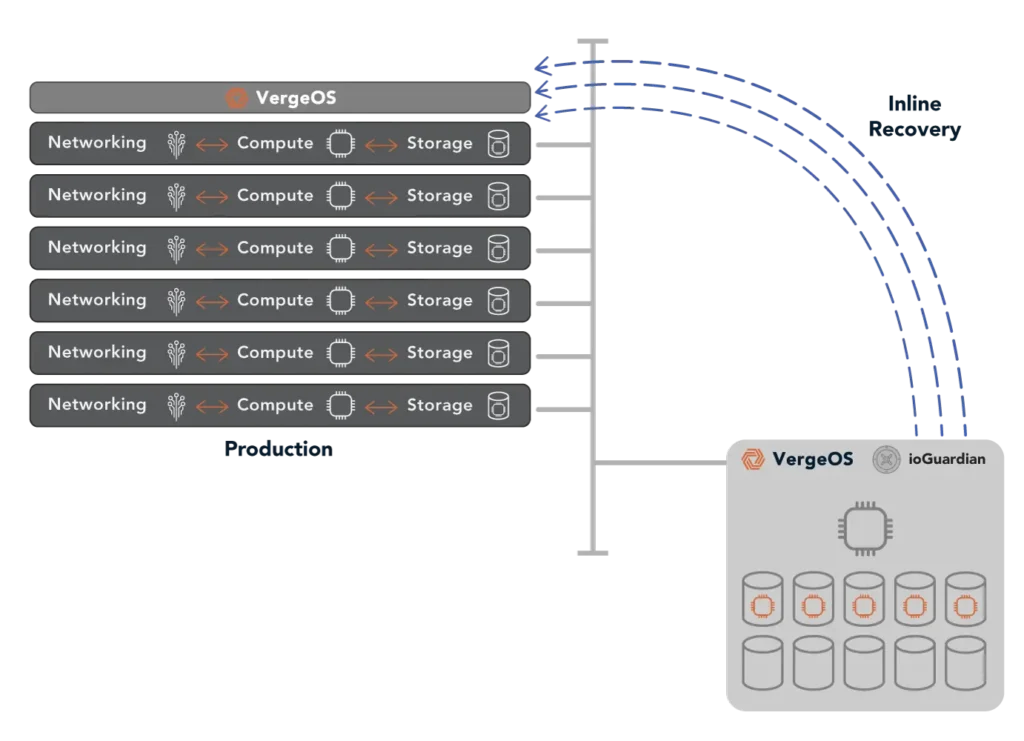
Recovery on a backup appliance is a deliberate handoff. IT decides which workloads come up, in what order, and on which appliance, then schedules the move back to production. That control carries real value in a site outage or a ransomware event, where judgment about what to restore matters more than raw speed. It answers a different question than riding through two failed drives inside a single production node.
The two approaches also part ways after the hardware is fixed. A backup product restores full volumes to the replaced drives, which is correct behavior for software that sits outside the platform and cannot see its layout. VergeOS sits inside the platform and knows precisely which segments are missing, so it repairs only those.
ioGuardian handles the in-platform case with no VM restart at all. It supplies the missing data segments in real time, holding RTO at zero with an RPO measured in minutes, and the VMs keep running on production hardware the entire time. Nothing has to move back afterward. When the failed drives are replaced, the ioGuardian server rebuilds the data on them automatically, with no volume-level restore and no RAID rebuild.
Conclusion
The right way to read this comparison is as a division of labor. Veeam Instant Recovery is how a VergeOS workload comes back when it has to come back somewhere else. VergeOS snapshots and ioGuardian are how a VergeOS workload stays up when the failure is inside the platform. Running both produces recovery that is instant in the cases that happen most often and portable in the cases where portability is the only option. ioGuardian is included in VergeOS, so the second layer costs nothing beyond the server it runs on.
To learn more, register for our upcoming webinar, “Can Your Hypervisor Do This? Real-Time and Inline Data Recovery” We spotlight VergeOS’s ioGuardian capabilities, challenging the status quo of hypervisor functionality. Learn what it would take and how much it would cost for other hypervisors to deliver similar capabilities. We will also demonstrate live how ioGuardian delivers missing data segments to virtual machines (VMs), maintaining continuous operations even during multiple simultaneous hardware failures.


