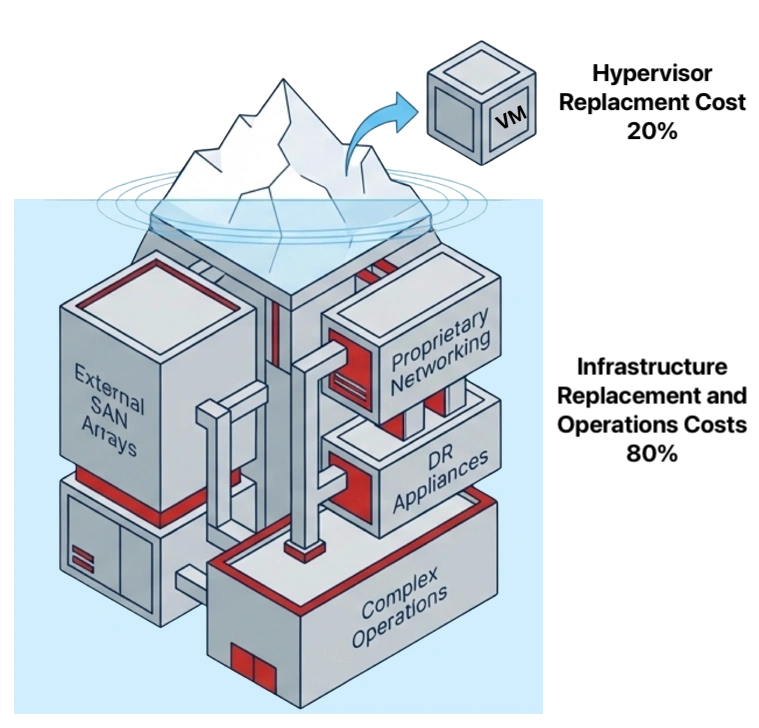
As organizations evaluate VMware alternatives, most focus on finding a replacement hypervisor, when they may be better served by selecting a Private Cloud OS. The hypervisor-only focus means you are swapping VMware for Hyper-V, Proxmox, or Nutanix AHV. However, the issue is not what you swap, but what you keep: the high cost of external all-flash arrays, proprietary network switches and appliances, brittle data and disaster recovery processes, complex operational models, and infrastructure costs spiraling out of control.
Simply swapping the hypervisor only solves one problem. It does not solve the broader infrastructure problem that is costing you 5X more than hypervisor licensing.
Key Takeaways
- Hypervisor swaps solve one problem: Replacing VMware with another hypervisor preserves expensive storage arrays, proprietary networking, brittle backup processes, and complex operational models that cost 5X more than hypervisor licensing.
- Private cloud virtualizes the entire data center: Compute, storage, networking, and data protection all become software-defined resources managed as one system rather than separate products.
- VMware never delivered a true private cloud: ESXi, vSAN, and NSX remained separate products with distinct lifecycles, management interfaces, failure domains, and licensing fees.
- Two private cloud models exist: Orchestration coordinates separate products through automation; a Private Cloud OS treats all infrastructure functions as native capabilities of a single operating system.
- Orchestration hides complexity; abstraction eliminates it: Orchestrated platforms require teams to understand multiple products. A Private Cloud OS flattens the learning curve to one system.
- Hardware relationships invert: Orchestrated platforms enforce hardware requirements. A Private Cloud OS abstracts hardware entirely, letting teams use what they already own.
- VergeOS represents the Private Cloud OS model: One system, one interface, one upgrade path. Organizations have migrated from VMware during business hours with zero downtime while keeping existing hardware.
Hypervisor Swap as a Catalyst for Private Cloud
The VMware disruption creates a decision point that goes beyond simply swapping hypervisors. Organizations can replace one hypervisor with another, or reconsider whether server virtualization alone meets their needs. The alternative is private cloud—not as a marketing term, but as an architectural shift that virtualizes the entire data center rather than just the servers.
The term “private cloud” gets applied to two fundamentally different architectures. One stitches together separate products with automation. The other runs as a unified operating system that abstracts hardware entirely. The difference determines what you actually operate, what breaks, and what happens when you need to grow.
Understanding this distinction matters because it shapes every operational decision that follows. And selecting the right architecture moves you away from the complexity of individual server virtualization, proprietary networking, and dedicated all-flash arrays.
Key Terms
- Private Cloud — An architecture that virtualizes the entire data center—compute, storage, networking, and data protection—presenting infrastructure as abstracted resources rather than physical devices.
- Private Cloud OS — A unified operating system that treats all infrastructure functions as native capabilities, managing hardware directly without separate products or integration layers.
- Orchestration Model — A private cloud architecture that coordinates separate products (hypervisor, storage, networking) through automation, hiding complexity rather than eliminating it.
- Software Defined Data Center (SDDC) — A data center where compute, storage, networking, and security are virtualized and delivered as software-defined services. Often used interchangeably with private cloud.
- Infrastructure Abstraction — The principle of treating hardware as pooled capacity that can be allocated to workloads without teams managing individual devices or products.
- Hypervisor — Software that virtualizes servers, allowing a physical machine to run multiple virtual machines. Examples include VMware ESXi, Microsoft Hyper-V, Proxmox, and Nutanix AHV.
- AFA Tax — The premium organizations pay when purchasing external all-flash arrays compared to using internal server storage, often inflating infrastructure costs without proportional performance gains.
- Failure Domain — The boundary within which a hardware or software failure affects workloads. Orchestrated platforms have multiple failure domains; a Private Cloud OS unifies them.
Why is Private Cloud Different Than Virtualization?
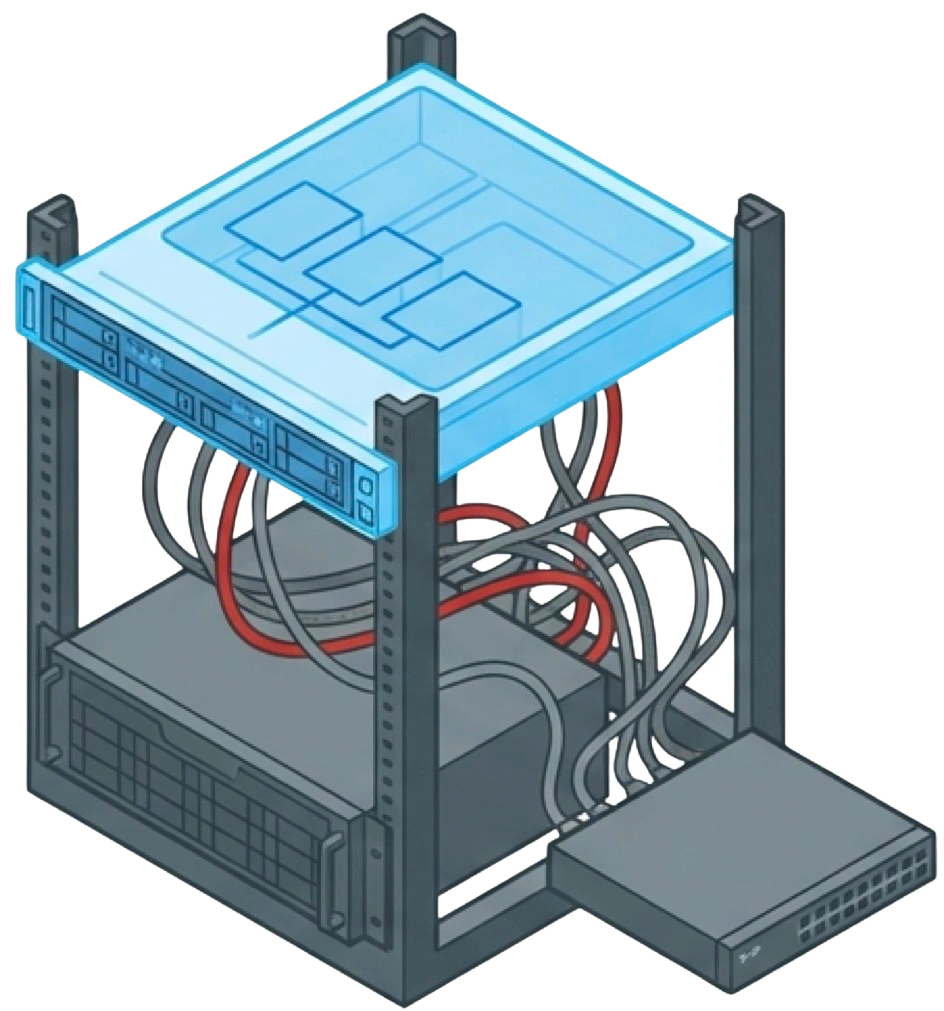
Virtualization abstracts one thing: servers. A hypervisor takes a physical server and carves it into multiple virtual machines. Each VM believes it has dedicated hardware. The hypervisor manages the illusion. This was transformative when VMware popularized it two decades ago, but it addressed only one layer of the data center.
Storage remained physical. Networking remained physical. Data protection requires separate products. Teams virtualized servers while everything else stayed the same. The result was a data center with one virtualized layer surrounded by traditional infrastructure.
Private cloud extends virtualization to the entire data center:
- Compute becomes virtualized.
- Storage becomes software-defined.
- Networking becomes a commodity.
- Data protection becomes infrastructure-aware.
- Hardware becomes abstracted.
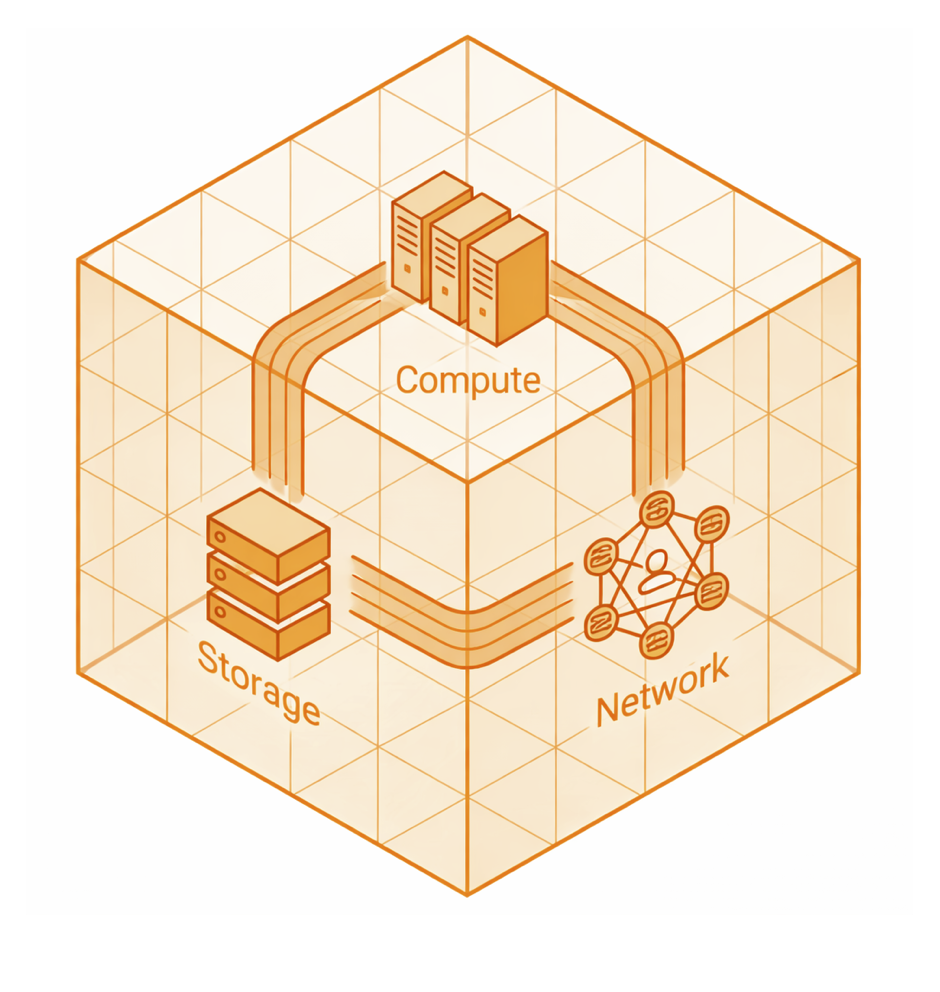
Everything operates as software-defined resources rather than physical devices. Some call this a Software Defined Data Center (SDDC). Others call it infrastructure abstraction. The principle is the same: treat the entire data center the way virtualization treats servers, and then present these resources as completely abstracted virtual data centers.
This distinction explains why VMware alone never delivered a private cloud. ESXi virtualized servers. vSAN attempted to virtualize storage. NSX attempted to virtualize networking. But these remained separate products with distinct lifecycles, management interfaces, failure domains, and licensing fees. Assembling them created something that looked like a private cloud but operated as three products bolted together.
A true private cloud virtualizes infrastructure holistically. The abstraction happens at the data center level, not the server level. Teams manage capacity and workloads, not products and devices.
The case for private cloud over server virtualization comes down to operational reality. Server virtualization requires teams to manage virtual machines, physical storage arrays, physical network switches, and separate backup products. Each domain has its own interface, upgrade cycle, and failure modes. Skills fragment across specialties. Troubleshooting crosses boundaries. Growth requires purchasing and integrating multiple products.
Private cloud consolidates these domains into one operational model. Provisioning a workload means allocating resources from a shared pool, not coordinating across products. Protecting data means configuring policies in one place, not managing separate backup infrastructure. Expanding capacity means adding hardware, not evaluating whether your storage array can handle additional load. The efficiency gains compound over time as teams operate on a single platform rather than five systems.
Why Hasn’t Private Cloud Taken Off?
If private cloud delivers operational simplicity and cost efficiency, why do most data centers still run server virtualization surrounded by traditional infrastructure?

Three forces held the private cloud back:
VMware’s dominance created inertia. For two decades, VMware defined how organizations thought about infrastructure. Teams built skills around VMware certifications. Vendors built ecosystems around VMware compatibility. The operational model of hypervisor plus storage array plus network switches became the default, not because it was optimal, but because VMware made it familiar. Organizations accepted complexity as normal because they had never experienced an alternative.
Incumbent vendors profit from fragmentation. Dell, HPE, NetApp, and Cisco built businesses selling separate compute, storage, and networking products. True private cloud threatens that model by collapsing multiple product sales into one platform purchase. These vendors responded by rebranding existing portfolios as “private cloud” through orchestration layers rather than building unified architectures. The result was marketing that promised a private cloud, all while still preserving the multi-product status quo.
Public cloud distracted the market. As private cloud architectures matured, AWS, Azure, and Google Cloud captured executive attention. The narrative shifted from “How do we build a better data center?” to “Why build a data center at all?” Investment in on-premises infrastructure slowed. Organizations that might have adopted private cloud platforms, instead migrated workloads to public cloud, assuming on-premises infrastructure would eventually disappear.
That assumption proved wrong for most enterprises. Data gravity, compliance requirements, latency constraints, and unpredictable cloud costs are bringing workloads back on-premises. Organizations now face a different question: what should the data center look like when public cloud is no longer the answer?
The answer is not a return to the old model. VMware’s acquisition by Broadcom disrupted the status quo. Licensing changes and pricing uncertainty forced organizations to evaluate alternatives they had long ignored. The same disruption that created pain also created an opening for private cloud architectures that deliver on the original promise of infrastructure simplicity.
Examining the Private Cloud Models
The Orchestration Model
Most private cloud platforms follow an orchestration model. They start with separate products and coordinate them through automation. Hypervisors come from one vendor. Storage comes from another vendor or product family. Networking from another. Each component retains its own lifecycle, management interface, and failure domain.
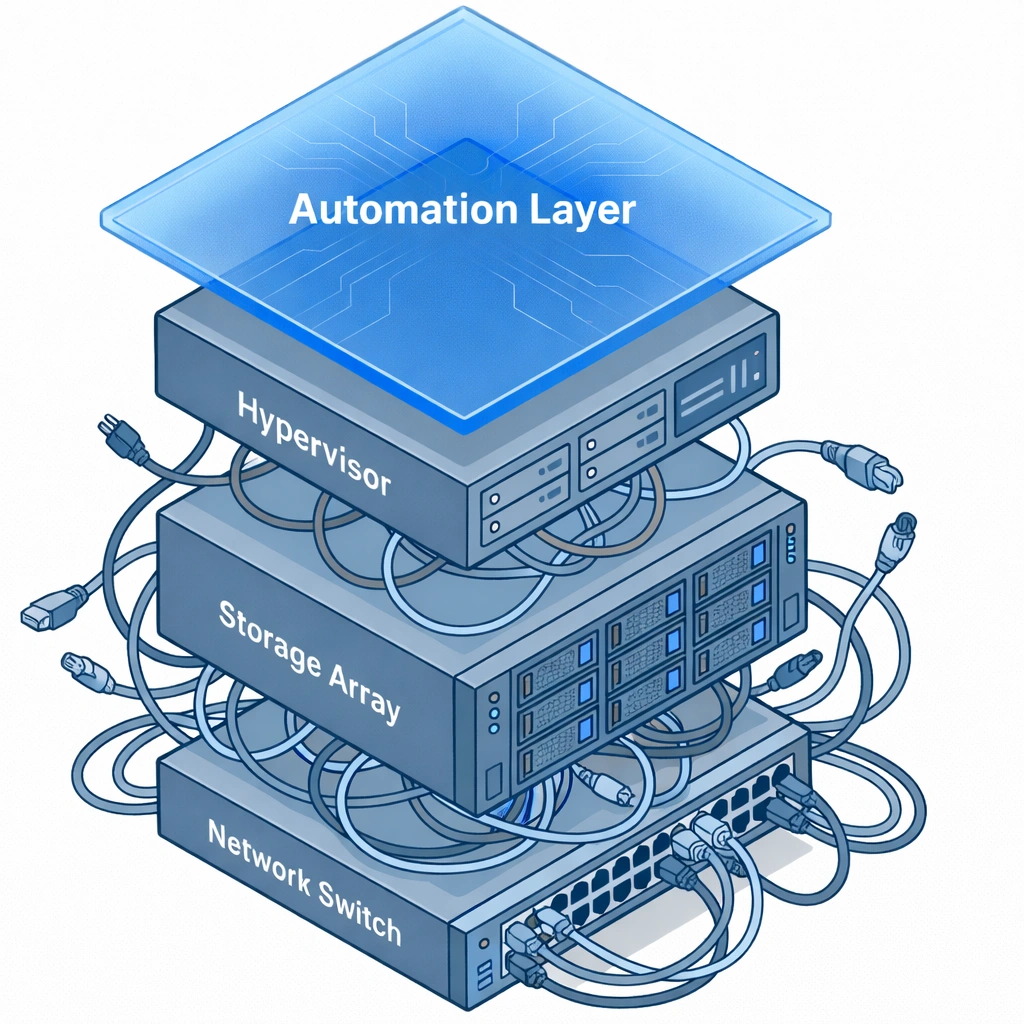
The “private cloud” in this model is the automation layer that sits above these components. It provides a unified interface for provisioning and monitoring. It coordinates firmware updates across products. It attempts to present a single experience, even though multiple systems operate beneath it.
Dell Private Cloud follows this approach. So do most VMware-based private cloud deployments. Nutanix began as a converged platform but still treats storage and compute as separable layers with distinct operational characteristics.
The orchestration model has advantages. It allows vendors to assemble private clouds from existing product portfolios. It gives customers the flexibility to swap components if a vendor relationship changes. It builds on established products with mature ecosystems.
The disadvantages become apparent in daily operations. When something fails, troubleshooting spans multiple products. When upgrades arrive, teams coordinate across lifecycles. As capacity grows, new hardware must meet each layer’s requirements independently. The automation hides complexity rather than eliminating it.
The Operating System Model
A Private Cloud OS takes a different approach. Instead of coordinating separate products, it treats all infrastructure functions as native capabilities of a single operating system. The fractured infrastructure of the orchestrated model makes automation harder to implement and less durable. The Private Cloud OS model enables automation to deliver on its promise of saving time.
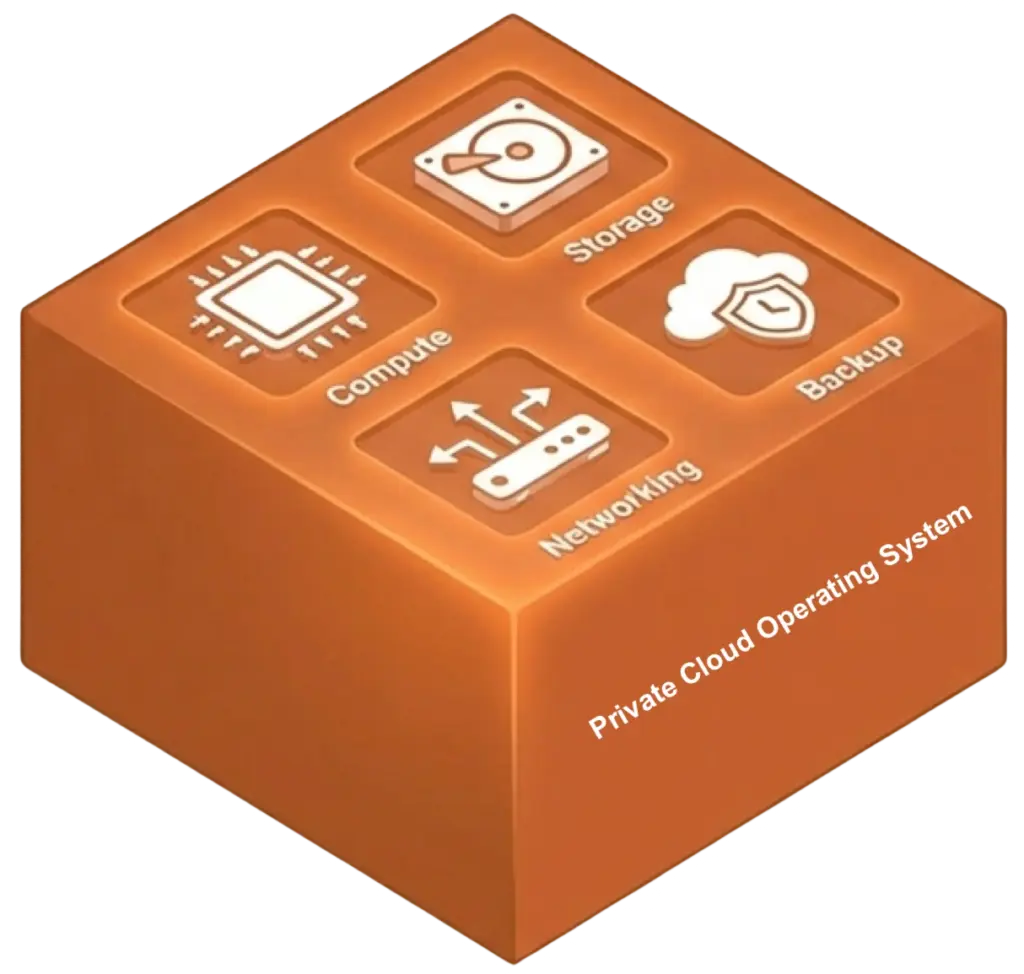
Compute virtualization runs as an OS function. Storage runs as an OS function. Networking runs as an OS function. Data protection runs as an OS function. No separate products exist. No integration layer exists. The OS manages hardware directly and presents infrastructure as abstracted resources.
VergeOS follows this model. Hardware becomes capacity. Servers contribute CPU cycles, memory, and storage media to a shared pool. The OS allocates those resources to workloads without requiring teams to manage separate storage arrays, configure SAN fabrics, or coordinate hypervisor lifecycles with storage lifecycles.
The operating system model changes what teams actually operate. Instead of managing five products that pretend to be one platform, teams manage one platform that delivers five capabilities. Upgrades roll through the environment as a single operation. Failures are isolated within a virtual data center rather than cascading across product boundaries. Growth means mixing in hardware resources, not decommissioning one set of products for another.
Why the Distinction Matters
The difference between orchestration and abstraction determines three operational realities.
Operational overhead changes significantly. Orchestrated platforms require teams to understand each underlying product. Storage behaves differently from compute. Networking has its own operational model. Troubleshooting requires knowledge of how products interact. A Private Cloud OS flattens this learning curve. Teams learn one system. Troubleshooting happens in one place. Operational knowledge compounds rather than fragments.
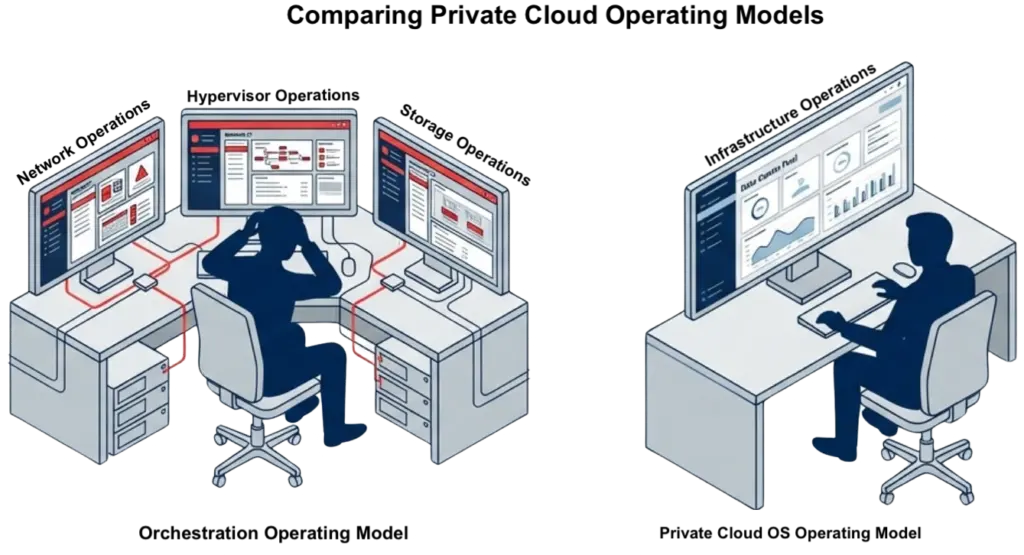
Failure domains behave differently. In an orchestrated environment, a storage array failure affects workloads differently than a hypervisor failure. Teams must understand failure modes across products and plan recovery accordingly. A Private Cloud OS unifies failure domains. The OS treats hardware failures as resource loss and automatically redistributes workloads without requiring teams to understand which product failed or why.
Hardware relationships invert. Orchestrated platforms often enforce hardware requirements. Storage arrays need specific drives. Hypervisors need certified servers. Networking only supports one vendor’s switches. Each product constrains hardware choice. A Private Cloud OS abstracts hardware entirely. It consumes whatever resources servers provide. Teams use hardware they already own, extend environments with hardware they choose, and avoid forced refresh cycles dictated by product certification matrices.
Testing for the Right Model
Three questions reveal whether a private cloud platform follows the orchestration model or the operating system model.
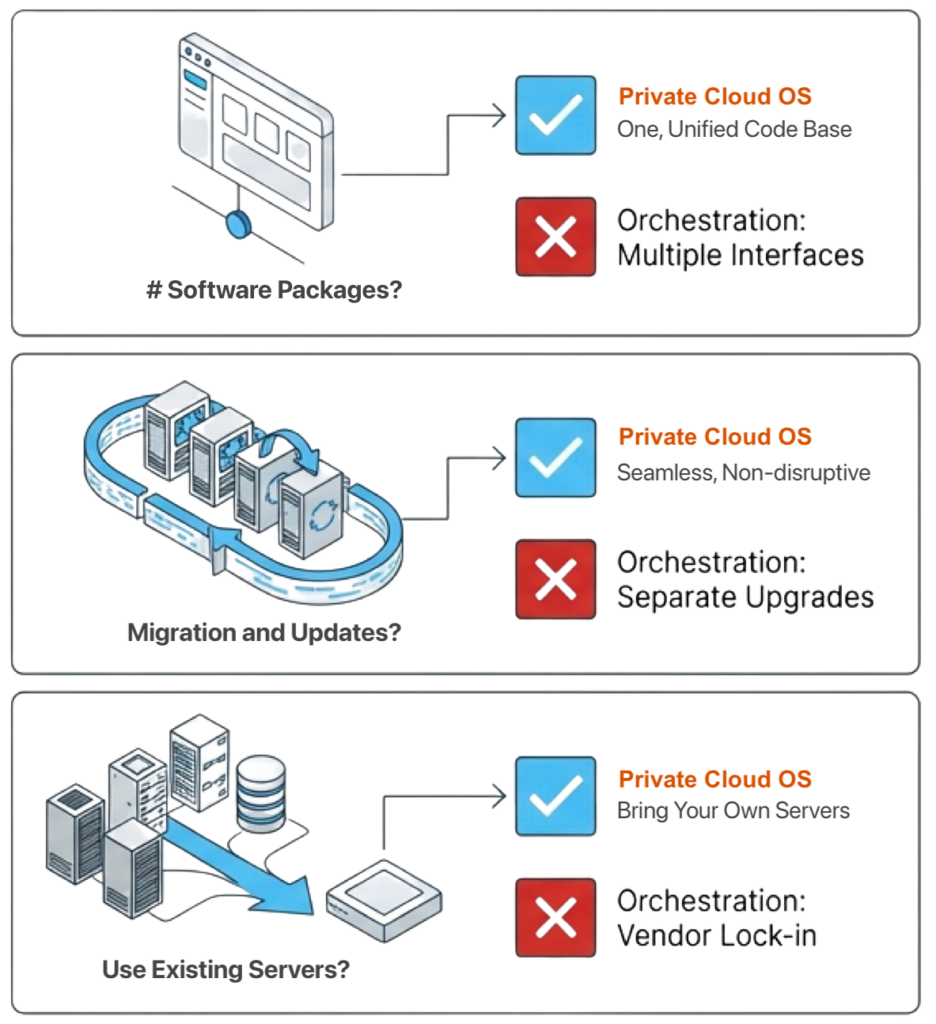
First, how many products are you actually operating? Count the management interfaces. Count the upgrade procedures. Count the support contracts. If the answer is greater than 1, you are operating in an orchestrated environment, regardless of how unified the marketing appears.
Second, what happens when you need to upgrade? Orchestrated platforms require coordination. Storage upgrades happen separately from hypervisor upgrades. Firmware updates cascade across products in a defined sequence. A Private Cloud OS upgrade is performed as a single non-disruptive, rolling operation.
Third, can you use hardware you already own? Orchestrated platforms impose constraints. Servers must meet certification requirements. Storage media must match array specifications. A Private Cloud OS consumes hardware as resources. If it has CPU, memory, and storage, it contributes to the pool.
VergeOS as a Private Cloud
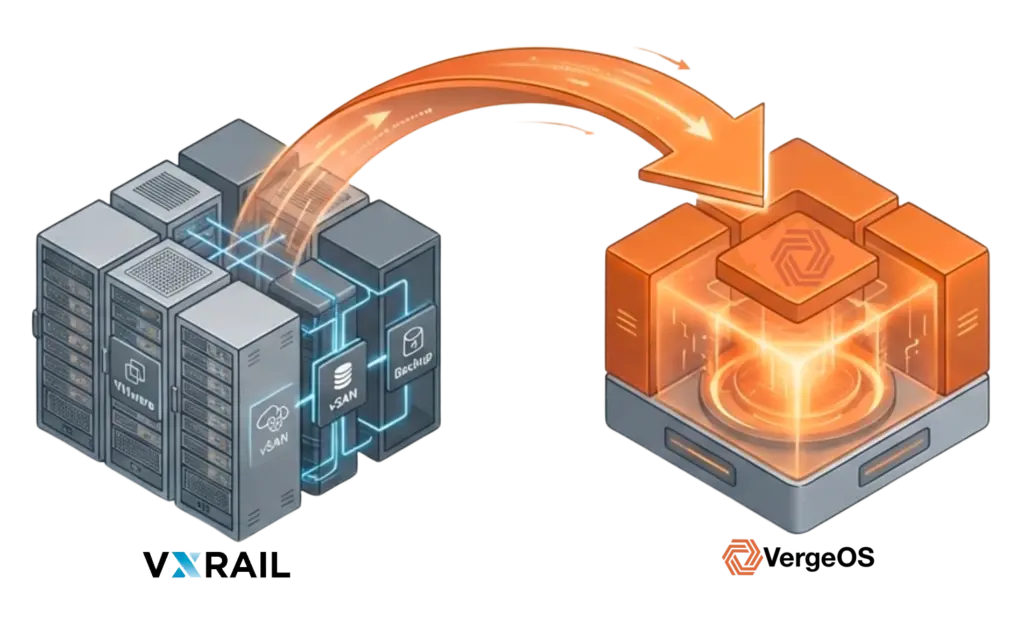
VergeOS represents the Private Cloud OS model in production. It delivers compute virtualization, software-defined storage, networking, and data protection as native functions of a single operating system. No external storage arrays. No separate networking products. No bolt-on backup solutions. The entire infrastructure stack runs as a single system with a single interface, a single upgrade path, and a single support relationship.
The architecture treats hardware as abstracted capacity. Servers contribute CPU, memory, and storage media to a shared resource pool. The OS distributes workloads across available resources and automatically handles hardware failures. Teams add capacity by adding servers—any servers—without evaluating compatibility matrices or coordinating across product lifecycles.
This design delivers measurable operational differences. Organizations running VergeOS report support response times measured in minutes rather than hours. Upgrades are complete and rolling, with no maintenance windows. Recovery scenarios that required coordination across multiple products now execute rapidly, from a single interface.
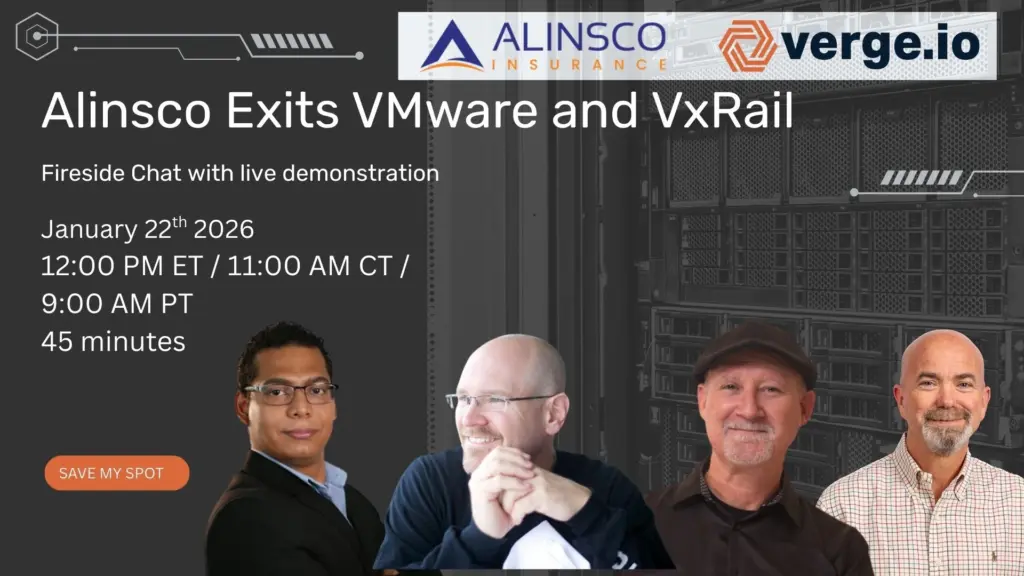
The VMware exit path illustrates the practical difference. Organizations like Alinsco Insurance, Topgolf, and Girtz Industries migrated from VMware on VxRail to VergeOS during business hours with zero downtime. They kept running on existing hardware. Performance improved on the same servers. The migration replaced VMware, vSAN, and their backup infrastructure in a single transition rather than requiring separate projects for each layer. They went from server virtualization to an on-premises private cloud OS.
VergeOS also changes the cost structure. Without external storage arrays, organizations avoid the AFA tax that inflates infrastructure spending. Without proprietary networking requirements, teams use commodity switches. Without separate backup products, licensing costs consolidate. The savings extend beyond VMware licensing to the entire infrastructure stack.
For organizations evaluating VMware alternatives, VergeOS reframes the decision. The question shifts from “which hypervisor replaces VMware?” to “does replacing the hypervisor alone solve the problem?” Most VMware alternatives only change the dashboard. If the answer involves keeping expensive storage arrays, proprietary networking, and fragmented operations, a hypervisor swap preserves the cost structure that created pressure in the first place. A Private Cloud OS like VergeOS eliminates it.
Frequently Asked Questions
What is the difference between a hypervisor and a Private Cloud OS?
A hypervisor virtualizes servers only. A Private Cloud OS virtualizes the entire data center—compute, storage, networking, and data protection—as native functions of a single operating system. The hypervisor addresses one layer; the Private Cloud OS addresses all layers.
Why doesn’t swapping hypervisors solve the VMware cost problem?
Hypervisor licensing represents a fraction of total infrastructure cost. External storage arrays, proprietary networking, separate backup products, and operational complexity cost 5X more than the hypervisor. Swapping hypervisors preserves these costs. A Private Cloud OS eliminates them.
Why didn’t VMware deliver a true private cloud?
VMware’s approach kept ESXi, vSAN, and NSX as separate products with distinct lifecycles, management interfaces, failure domains, and licensing fees. Assembling them created something that looked like private cloud but operated as three products bolted together rather than a unified system.
What is the orchestration model for private cloud?
The orchestration model starts with separate products—hypervisors, storage arrays, networking—and coordinates them through automation. The automation layer provides a unified interface but the underlying products retain separate lifecycles, failure domains, and operational requirements. Dell Private Cloud follows this approach.
How does a Private Cloud OS handle hardware differently?
A Private Cloud OS abstracts hardware entirely. Servers contribute CPU, memory, and storage to a shared pool. The OS allocates resources to workloads without requiring teams to manage separate arrays, evaluate compatibility matrices, or coordinate product lifecycles. Teams use hardware they already own.
Can I migrate from VMware to a Private Cloud OS without downtime?
Yes. Organizations like Alinsco Insurance, Topgolf, and Girtz Industries migrated from VMware to VergeOS during business hours with zero downtime. They continued running on existing hardware, and in many cases performance improved on the same servers.
How do I know if a platform is a true Private Cloud OS or an orchestrated product?
Apply three tests. First, count how many products you are actually operating—management interfaces, upgrade procedures, support contracts. Second, ask what happens when you upgrade. Third, ask whether you can use hardware you already own. If answers involve coordination, multiple lifecycles, or hardware constraints, you are evaluating an orchestrated platform.
What cost savings does a Private Cloud OS deliver beyond hypervisor licensing?
Without external storage arrays, organizations avoid the AFA tax. Without proprietary networking requirements, teams use commodity switches. Without separate backup products, licensing costs consolidate. Without forced hardware refresh cycles, capital expenditures decrease. The savings extend across the entire infrastructure stack.
A hypervisor virtualizes servers only. A Private Cloud OS virtualizes the entire data center—compute, storage, networking, and data protection—as native functions of a single operating system. The hypervisor addresses one layer; the Private Cloud OS addresses all layers.
Hypervisor licensing represents a fraction of total infrastructure cost. External storage arrays, proprietary networking, separate backup products, and operational complexity cost 5X more than the hypervisor. Swapping hypervisors preserves these costs. A Private Cloud OS eliminates them.
VMware’s approach kept ESXi, vSAN, and NSX as separate products with distinct lifecycles, management interfaces, failure domains, and licensing fees. Assembling them created something that looked like private cloud but operated as three products bolted together rather than a unified system.
The orchestration model starts with separate products—hypervisors, storage arrays, networking—and coordinates them through automation. The automation layer provides a unified interface but the underlying products retain separate lifecycles, failure domains, and operational requirements. Dell Private Cloud follows this approach.
A Private Cloud OS abstracts hardware entirely. Servers contribute CPU, memory, and storage to a shared pool. The OS allocates resources to workloads without requiring teams to manage separate arrays, evaluate compatibility matrices, or coordinate product lifecycles. Teams use hardware they already own.
Yes. Organizations like Alinsco Insurance, Topgolf, and Girtz Industries migrated from VMware to VergeOS during business hours with zero downtime. They continued running on existing hardware, and in many cases performance improved on the same servers.
Apply three tests. First, count how many products you are actually operating—management interfaces, upgrade procedures, support contracts. Second, ask what happens when you upgrade. Third, ask whether you can use hardware you already own. If answers involve coordination, multiple lifecycles, or hardware constraints, you are evaluating an orchestrated platform.
Without external storage arrays, organizations avoid the AFA tax. Without proprietary networking requirements, teams use commodity switches. Without separate backup products, licensing costs consolidate. Without forced hardware refresh cycles, capital expenditures decrease. The savings extend across the entire infrastructure stack.