Abstracted infrastructure saves automation by eliminating the variables that cause deployment failures across locations. When hardware differences become invisible to automation code, organizations gain the reliability that infrastructure-as-code promises.
Key Takeaways
Abstracted infrastructure saves automation by eliminating hardware variables that cause deployment failures. When the infrastructure operating system presents consistent interfaces regardless of underlying equipment, automation code works identically across production, DR, test, and edge environments without modification. Hardware refresh cycles no longer break automation pipelines.
Virtual data centers encapsulate complete environments as single objects. A VDC contains compute resources, storage volumes, network topologies, and protection policies in one logical construct. Terraform modules manipulate VDCs as units rather than coordinating separate infrastructure components. When a VDC replicates to a DR site, the entire environment arrives ready to activate.
VMware exits create natural migration windows for infrastructure simplification. Organizations can address architectural fragmentation during hypervisor transitions rather than maintaining three-tier complexity under a different vendor. Unified platforms eliminate expensive storage arrays in favor of affordable commodity SSDs while delivering both VMware replacement and automation reliability in one transition.
Traditional three-tier architecture exposes hardware details to automation tools:
- Packer must build multiple image variants for different storage backends
- Terraform modules must account for specific storage array APIs
- Ansible roles must handle different network switch configurations
- Monitoring integrations must adapt to vendor-specific metric formats
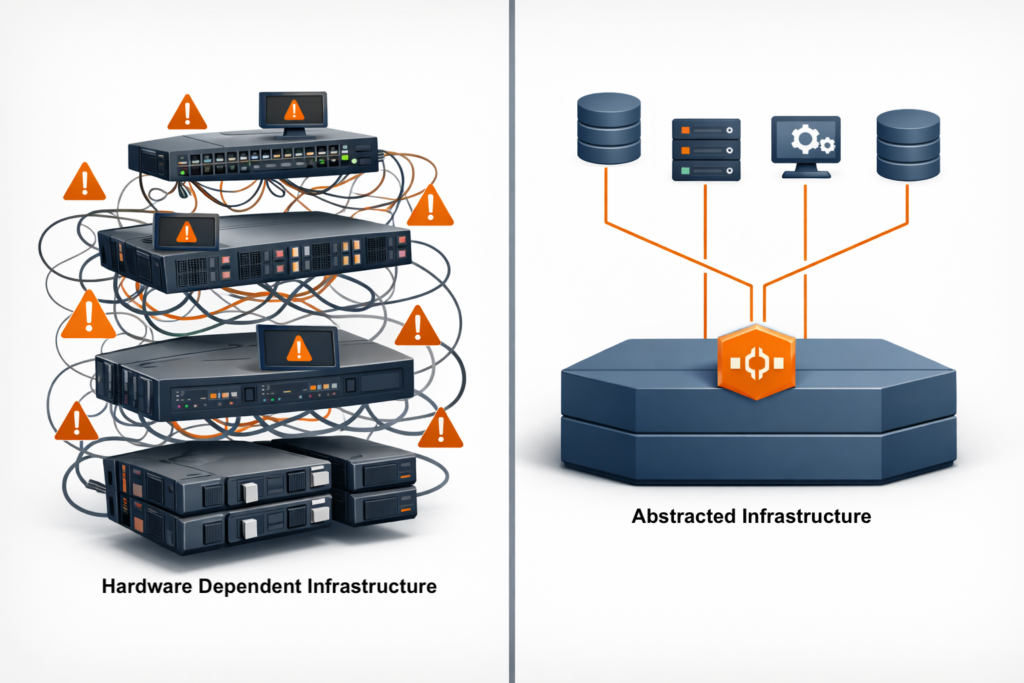
This hardware dependency creates brittleness. Code that works in one environment fails in another when underlying components differ. Abstracted infrastructure saves automation by providing consistent infrastructure services regardless of the underlying hardware.
Key Terms & Concepts
Infrastructure Abstraction: The practice of hiding hardware-specific details from automation tools by presenting consistent infrastructure services through a unified API, allowing automation code to remain stable across equipment changes and locations.
Virtual Data Center (VDC): A VergeOS construct that encapsulates an entire environment as a single object, including compute resources, storage volumes, network topologies, and protection policies, enabling automation tools to manipulate complete infrastructures as units.
Commodity Storage: Standard SATA and NVMe SSDs installed directly in servers rather than proprietary external storage arrays. VergeOS uses commodity drives to eliminate vendor-specific APIs and reduce infrastructure costs while maintaining enterprise capabilities.
Platform Abstraction Layer: The component of an infrastructure operating system that translates service-level definitions into hardware-specific configurations while presenting stable interfaces to automation tools and guest operating systems.
Service-Level Definition: Infrastructure specifications that describe capacity requirements, performance characteristics, and isolation policies without referencing specific hardware models or vendor features.
Where Abstracted Infrastructure Enables Success
A healthcare provider operates production infrastructure in their primary data center with DR capacity at a secondary facility. The production environment runs on servers that are one year old. The DR site runs on seven-year-old servers that were once in production. Both environments must support identical electronic health record systems with strict recovery time objectives.
The infrastructure team deploys VergeOS at both locations. The unified infrastructure operating system integrates storage, compute, and networking into a single platform with one API. VergeOS uses commodity SATA and NVMe SSDs installed directly in servers rather than external storage arrays, eliminating both array-specific APIs and the costs of proprietary hardware while entirely abstracting differences between production and DR hardware.
The team uses Packer to build golden images for their application servers. One template creates images that work at both sites without storage-backend-specific drivers or hardware-specific configurations. VergeOS provides consistent storage and network interfaces to guest operating systems regardless of underlying hardware, so boot behavior remains predictable, and device mappings stay constant across sites.
Terraform modules define virtual data centers (VDC) using these golden images. Each VDC encapsulates compute resources, storage volumes, network configurations, and protection policies into a single object, accessible through VergeOS APIs without requiring hardware-specific commands.
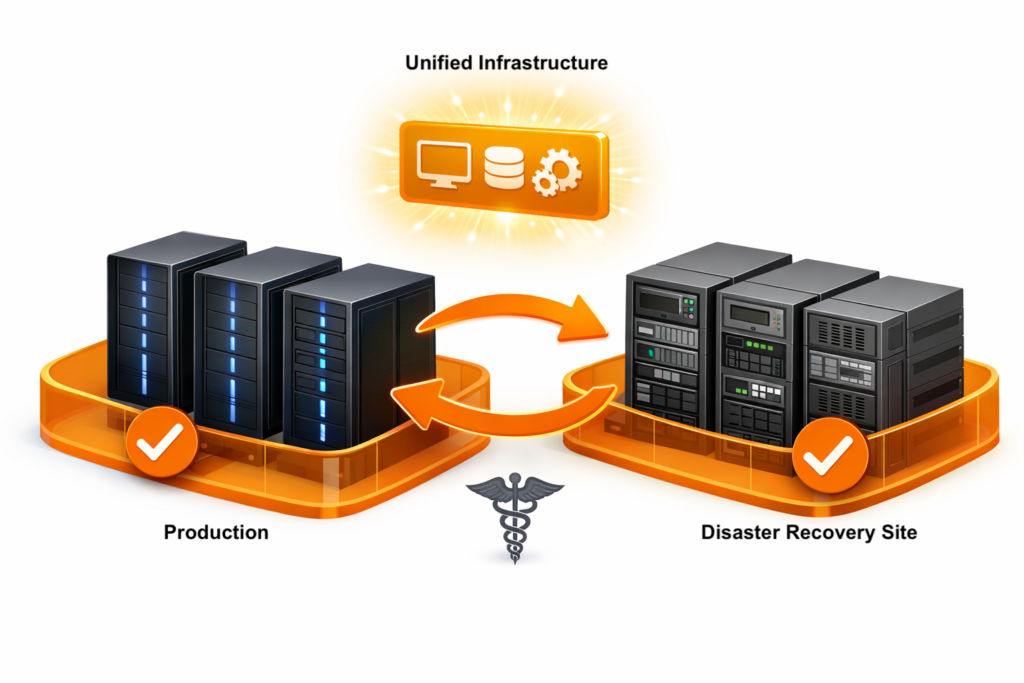
During quarterly DR testing, the automation pipeline executes identically at both sites. Packer images deploy without modification. Terraform provisioning succeeds despite different underlying hardware generations. Network configurations work correctly across switch types. Monitoring functions uniformly across equipment ages. The DR test completes in minutes, meeting the four-hour RTO requirement and building confidence that actual disaster scenarios will follow the same reliable pattern.
Abstracted infrastructure saves automation by making hardware differences irrelevant to deployment code.
Abstracted Infrastructure Saves Automation Pipelines
Traditional infrastructure exposes hardware details via separate management APIs, forcing Packer to account for storage-array variations during image creation. Different storage vendors require different guest tools, device drivers, and boot configurations. Teams maintain multiple image variants—one for each array vendor, including legacy systems that resist replacement.
Join VergeIO for a deep-dive session introducing the new automation capabilities coming to VergeOS, including support for Packer and Ansible. Register Now
This fragmentation extends through the entire automation chain. Storage arrays from different vendors require different Terraform providers. Network equipment from different generations needs different Ansible modules. Organizations attempt to solve this through conditional logic, where templates detect target platforms and branch accordingly, creating fragile code that breaks when hardware changes.
Hardware refresh cycles clearly demonstrate the problem. Production gets new storage arrays with different firmware, and Packer images that worked for years suddenly fail because arrays present storage differently. Device mappings change. Teams rebuild image variants for new hardware while Terraform modules update to reference new image IDs. Weeks pass as the pipeline is updated to accommodate vendor-specific changes, while DR sites drift further from production.
Abstracted infrastructure saves automation by eliminating this maintenance burden. VergeOS presents stable interfaces to both automation tools and guest operating systems while handling hardware variations internally. The platform uses affordable commodity SATA and NVMe SSDs instead of proprietary storage arrays, abstracting drive differences through the infrastructure OS. Packer builds one golden image that works everywhere. Terraform modules remain unchanged during equipment refreshes. The automation code stays focused on application requirements rather than storage vendor compatibility.
VergeOS Virtual Data Centers Provide Abstracted Infrastructure
VergeOS is an example of how abstracted infrastructure saves automation by implementing abstraction as a core design principle. The virtual data center architecture treats an entire environment as a single, encapsulated object, with compute resources, storage volumes, network topologies, and protection policies existing within a single logical construct.
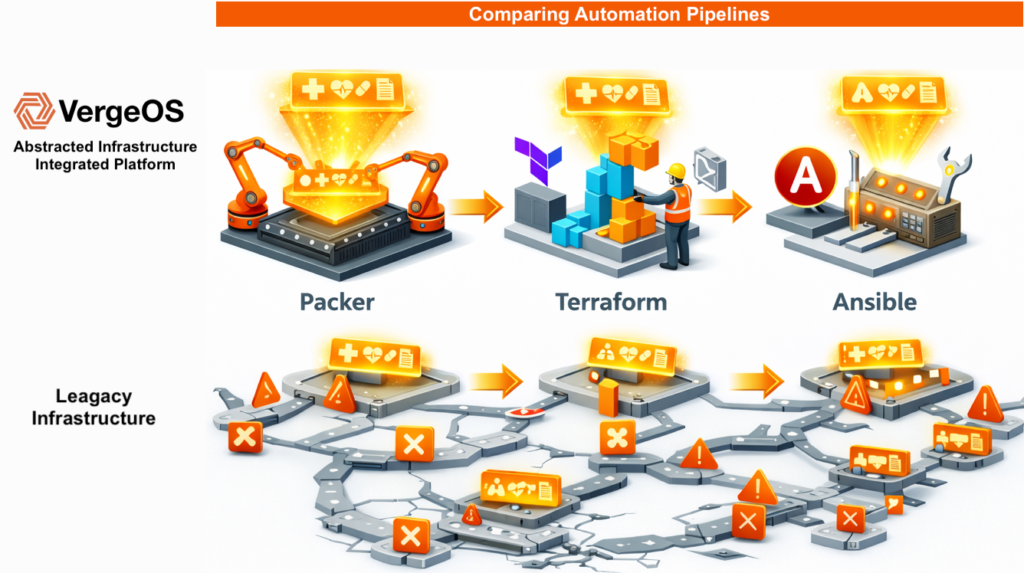
Packer templates build images by launching temporary VMs within a VDC, provisioning software through Ansible, and capturing the configuration. The golden images work across all VergeOS deployments because the platform maintains consistent guest interfaces, ensuring that boot behavior remains predictable, storage device names remain constant, and network adapter ordering does not shift between hardware generations.
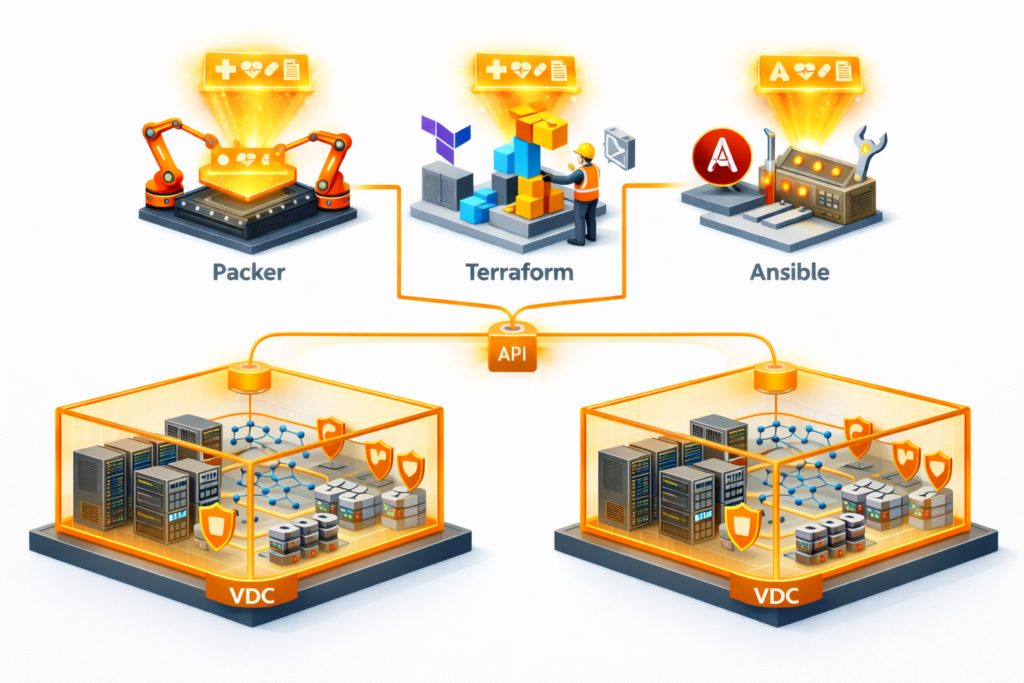
Terraform modules define VDCs through the VergeOS API with a single resource block that creates complete infrastructure. The module specifies capacity requirements, performance characteristics, and network isolation policies, and references Packer-built golden images. VergeOS translates these service-level definitions into hardware-specific configurations tailored to whatever equipment exists at that location.
Storage provisioning demonstrates the abstraction effectively. A Terraform module requests storage with specific IOPS and capacity targets without specifying drive types, data protection configurations, or vendor-specific features. VergeOS allocates storage from available commodity SSDs while meeting performance requirements. The same module works identically whether the site runs older SATA SSDs or newer NVMe drives, abstracting drive performance differences at the platform level.
This approach eliminates both the complexity and cost of traditional storage arrays. Organizations deploy affordable commodity drives instead of proprietary storage systems while gaining consistent automation behavior across all hardware generations. The infrastructure OS handles data protection, performance optimization, and capacity management internally.
Protection policies integrate at the VDC level. Snapshot schedules, replication targets, and retention policies attach to the virtual data center object. When the VDC replicates to a DR site, protection policies replicate along with golden images and infrastructure definitions. Teams do not rebuild backup configurations or re-create images at the remote location—the complete environment arrives ready to activate.
VMware Exit And Abstracted Infrastructure
Organizations evaluating VMware alternatives face a strategic decision point. Infrastructure automation should be part of your VMware exit strategy, not an afterthought. The disruption of migration creates a natural opportunity to address the architectural fragmentation that undermines automation reliability.
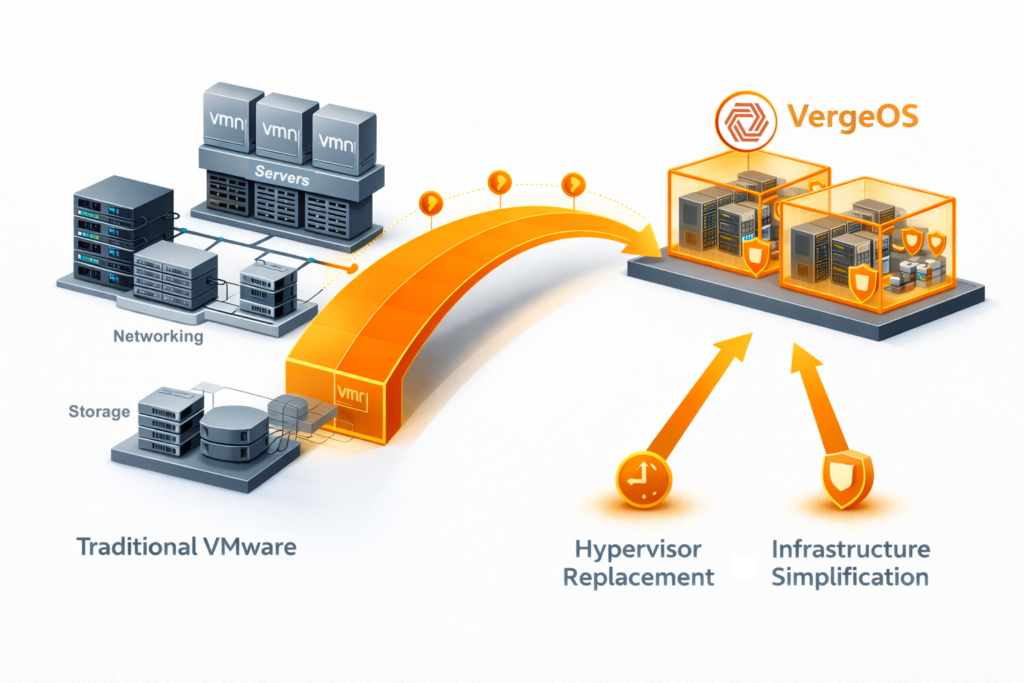
Traditional VMware exits maintain a three-tier architecture while swapping hypervisors. Teams update their automation to call different APIs but preserve the underlying fragmentation. External storage arrays remain with their vendor-specific interfaces. Network fabrics operate separately. The automation complexity persists under a different vendor name.
Unified infrastructure platforms eliminate this pattern by integrating storage, compute, and networking from the start. Organizations gain both a VMware replacement and infrastructure simplification in one transition. The approach also eliminates expensive storage arrays in favor of affordable commodity SSDs, reducing capital costs while improving automation reliability. The timing aligns naturally with storage refresh cycles, combining two disruptive projects into a single migration that delivers operational improvements and cost reduction alongside hypervisor alternatives.
The Abstracted Infrastructure Operational Advantage
Abstracted infrastructure saves automation by transforming the entire automation workflow. Packer images remain stable across infrastructure changes. Terraform deployments succeed predictably at any location. Ansible configurations apply consistently everywhere. The pipeline becomes reliable because the substrate supports it rather than resisting it.
DR testing evolves from a dreaded quarterly event into a routine validation. Tests execute reliably because automation behaves predictably. Teams validate business continuity plans rather than debugging infrastructure code differences, building confidence in actual disaster recovery through consistent test success.
Development and test environments gain production fidelity as teams create environments that mirror production characteristics without duplicating hardware. Packer images are built for production work in test environments. Developers test against infrastructure that behaves like production because the same platform manages both, reducing deployment surprises through consistent environments.
Abstracted infrastructure reduces automation overhead by eliminating hardware variables that cause deployment failures. Organizations gain reliable disaster recovery, predictable testing, portable infrastructure code, and lower storage costs. When the platform handles complexity internally using commodity hardware, automation tools deliver the consistency that makes infrastructure-as-code valuable.
Frequently Asked Questions
Why does hardware abstraction matter more for DR automation than production automation?
DR sites typically run on different hardware than production due to refresh cycles and budget constraints. Production might use newer equipment while DR runs on older servers. Without abstraction, this hardware difference forces separate automation code for each location, causing configuration drift and unreliable failover. Abstraction enables identical automation at both sites despite hardware age differences.
How does VergeOS eliminate the need for external storage arrays?
VergeOS uses commodity SATA and NVMe SSDs installed directly in servers rather than connecting to external storage arrays. The infrastructure operating system handles data protection, performance optimization, and capacity management internally. This eliminates vendor-specific storage APIs, reduces costs compared to proprietary arrays, and simplifies automation by removing an entire layer from the infrastructure stack.
Can existing Packer templates be migrated to VergeOS, or do they require complete rewrites?
Existing Packer templates typically require modification but not complete rewrites. The provisioning logic (installing software, configuring settings) remains the same. Changes focus on removing storage-array-specific drivers and hardware-dependent configurations that are no longer needed. Templates become simpler because VergeOS presents consistent storage and network interfaces that do not require conditional logic for different backends.
What happens to automation when hardware gets refreshed at one site but not others?
Nothing. The automation continues working unchanged. VergeOS abstracts hardware differences at the platform level, so new servers with different drive types or network adapters join clusters without requiring updates to Packer templates, Terraform modules, or Ansible playbooks. The infrastructure operating system handles the hardware variations internally while maintaining consistent interfaces to automation tools.
How does virtual data center replication differ from traditional storage replication?
Traditional storage replication copies data at the array level, requiring separate systems to rebuild infrastructure definitions and configurations at the DR site. VDC replication copies the entire environment as one object including compute definitions, network topologies, protection policies, and golden images. When the VDC arrives at the DR site, it is ready to activate without rebuilding configurations or coordinating across multiple systems.
Does abstraction mean vendor lock-in to VergeOS?
Abstraction trades infrastructure complexity for platform dependency. Traditional multi-vendor approaches avoid platform lock-in but create automation lock-in through hardware-specific code that becomes difficult to migrate. VergeOS creates platform dependency but eliminates automation complexity. The decision depends on whether infrastructure fragmentation or platform dependency poses greater long-term risk and cost to your organization.
Can development and test environments use older hardware than production?
Yes. This is one of the key benefits of abstraction. Development and test environments can run on repurposed hardware that production retired years ago. The same Packer images deploy successfully. The same Terraform modules provision infrastructure correctly. Applications behave identically because VergeOS maintains consistent interfaces regardless of underlying equipment age or performance characteristics.
How does this approach affect VMware migration timelines?
Organizations can combine VMware exit with infrastructure simplification in one project rather than sequential migrations. This reduces total disruption time and delivers both hypervisor replacement and automation improvements together. The unified approach also eliminates storage array refresh as a separate project because VergeOS uses commodity drives instead of external arrays.
What monitoring changes are required when moving to abstracted infrastructure?
Monitoring simplifies significantly. Organizations replace vendor-specific Prometheus exporters for storage arrays, backup software, and hypervisors with a single exporter that queries VergeOS APIs. Grafana dashboards consolidate because metrics follow consistent structures across all infrastructure components. Alert rules simplify because the platform exposes standardized telemetry regardless of underlying hardware variations.
How quickly can organizations see ROI from infrastructure abstraction?
Time savings appear immediately during the first DR test when automation works identically at both sites without debugging. Ongoing savings accumulate through reduced maintenance as hardware refreshes occur without automation updates. Cost savings from eliminating proprietary storage arrays and reducing administrative overhead typically deliver measurable ROI within the first year.
DR sites typically run on different hardware than production due to refresh cycles and budget constraints. Production might use newer equipment while DR runs on older servers. Without abstraction, this hardware difference forces separate automation code for each location, causing configuration drift and unreliable failover. Abstraction enables identical automation at both sites despite hardware age differences.
VergeOS uses commodity SATA and NVMe SSDs installed directly in servers rather than connecting to external storage arrays. The infrastructure operating system handles data protection, performance optimization, and capacity management internally. This eliminates vendor-specific storage APIs, reduces costs compared to proprietary arrays, and simplifies automation by removing an entire layer from the infrastructure stack.
Existing Packer templates typically require modification but not complete rewrites. The provisioning logic (installing software, configuring settings) remains the same. Changes focus on removing storage-array-specific drivers and hardware-dependent configurations that are no longer needed. Templates become simpler because VergeOS presents consistent storage and network interfaces that do not require conditional logic for different backends.
Nothing. The automation continues working unchanged. VergeOS abstracts hardware differences at the platform level, so new servers with different drive types or network adapters join clusters without requiring updates to Packer templates, Terraform modules, or Ansible playbooks. The infrastructure operating system handles the hardware variations internally while maintaining consistent interfaces to automation tools.
Traditional storage replication copies data at the array level, requiring separate systems to rebuild infrastructure definitions and configurations at the DR site. VDC replication copies the entire environment as one object including compute definitions, network topologies, protection policies, and golden images. When the VDC arrives at the DR site, it is ready to activate without rebuilding configurations or coordinating across multiple systems.
Yes. This is one of the key benefits of abstraction. Development and test environments can run on repurposed hardware that production retired years ago. The same Packer images deploy successfully. The same Terraform modules provision infrastructure correctly. Applications behave identically because VergeOS maintains consistent interfaces regardless of underlying equipment age or performance characteristics.
Organizations can combine VMware exit with infrastructure simplification in one project rather than sequential migrations. This reduces total disruption time and delivers both hypervisor replacement and automation improvements together. The unified approach also eliminates storage array refresh as a separate project because VergeOS uses commodity drives instead of external arrays.
Monitoring simplifies significantly. Organizations replace vendor-specific Prometheus exporters for storage arrays, backup software, and hypervisors with a single exporter that queries VergeOS APIs. Grafana dashboards consolidate because metrics follow consistent structures across all infrastructure components. Alert rules simplify because the platform exposes standardized telemetry regardless of underlying hardware variations.
Time savings appear immediately during the first DR test when automation works identically at both sites without debugging. Ongoing savings accumulate through reduced maintenance as hardware refreshes occur without automation updates. Cost savings from eliminating proprietary storage arrays and reducing administrative overhead typically deliver measurable ROI within the first year.